




Abstract
Aims:
Data from The Attitudes and Behaviors Survey (TABS) conducted in 2015 were used to investigate the prevalence of different forms of tobacco use and marijuana use among adults in Colorado.
Methods:
A secondary analysis of TABS on health data was conducted. A representative sample of 8616 adults 18 years and older participated in the survey, with sample weights used to adjust for oversampling.
Results:
Lifetime prevalence of cigarette-only use was 25.8%, compared with 10.6% for hookah use, 7.0% for both hookah and cigarettes, 12.6% for anything except cigarettes, and 43.0% for marijuana. The typical hookah user was a single/living alone (15.9%), English-speaking (11.6%), male (16.7%), age < 30 years (24.2%), with some college education (13.0%), and income less than 35 000 per year (14.3%). Hookah users, whether or not they also used cigarettes, were similar to those who used any other noncigarette tobacco products. The typical marijuana user was a single/living alone (50.2%), white (46.0%), English-speaking (46.7%), male (48.5%), age < 30 years (50.1%), with a graduate degree (40.8%) and salary of at least 50 000 per year (43.4%).
Implications:
In Colorado, in 2015, cigarette use was still highest among all forms of tobacco, but the use of other tobacco products such as vaping and hookah is on the rise, especially among young adults. Marijuana and hookah users were demographically similar to each other, and different from the typical cigarette user. These results indicate the need for further study of alternative tobacco product use, especially among young adults.
Introduction
Tobacco use remains the number one cause of mortality and morbidity among adults in the United States as well as globally. In the United States, tobacco use accounts for more than 480 000 deaths every year, or 1 in 5 deaths. 1 Despite all the efforts to reduce cigarette use, other forms of tobacco use such as vaping and waterpipe/hookah have been on the rise, especially among young adults.2-5
The current literature on alternative forms of tobacco use is limited. Waterpipe use is emerging as a global epidemic that needs immediate action and attention, 6 particularly among college students and young adults4,7 with prevalence ranging from 14.1% to 40% in the past 10 years.8-10 Moreover, there is concern that alternative forms of tobacco use may be a gateway drug to cigarette use.11,12 Despite the public’s misperception that hookah/waterpipe is safe, 2 the health effects of waterpipe/hookah are similar to those of cigarettes. Those effects include, but are not limited to, increased risk of different types of cancer, negative respiratory and cardiovascular outcomes, low birth weight, increased risk of infectious diseases such as tuberculosis from sharing the waterpipe hose among users, and smoking-associated risk from the combustion of the toxic chemicals of the flavored tobacco.13-15
Electronic nicotine delivery devices are known as electronic cigarettes and have been available in the United States since 2006. 16 As a result, the research on the health effects of such products is gradually growing and attracting more researchers in the field to investigate this topic. 17 The use of the electronic cigarettes is on the rise, especially among youths and young adults.18,19 In 2015, among adult e-cigarette users overall, 58.8% also were current regular cigarette smokers, 29.8% were former regular cigarette smokers, and 11.4% had never been regular cigarette smokers. 20 In 2016, 3.2% of US adults were current e-cigarette users, 20 with more than 2 million US middle and high school students having used e-cigarettes in the past 30 days, including 4.3% of middle school students and 11.3% of high school students. 1 Although the public might view electronic cigarettes as safe, the research shows that electronic cigarettes are not safe. Not only do they contain nicotine, which is highly addictive and has known health hazards, but they also contain other carcinogenic substances such as propylene glycol, formaldehyde, and nitrosamines.16,17,21
Marijuana use among US adults has been on the rise over the past decade. 22 Results from the National Institute on Alcohol Abuse and Alcoholism reveal that “past year” marijuana use doubled between 2001-2002 and 2012-2013, from 4.5% to 9.5% among the US adult population. According to the National Survey on Drug Use and Health (2011-2012), marijuana use was reported at 2.3% among individuals 18 years and older. The same survey showed that 5.2% of the adult population reported dual use of tobacco and marijuana. 23 According to the Colorado Department of Public Health and Environment (CDPHE), current use of marijuana among adults ⩾ 18 years was 13.6% in 2014 and 13.4% in 2015. 24
The purpose of this article is to present results from a large representative sample and assess the prevalence of different forms of tobacco use as well as marijuana use among adults living in Colorado. The characteristics of hookah users, users of other forms of tobacco including e-cigarettes, and marijuana users were compared with the characteristics of those who used cigarettes only.
Methods
Study design and participant selection
This study is based on secondary data analysis of The Attitudes and Behaviors Survey (TABS) on Health 2015, conducted by the Community Epidemiology and Program Evaluation Group as part of the CDPHE State Tobacco Education, Prevention Partnership in Colorado. It is a cross-sectional population survey conducted every 3 to 4 years since 2001 and supports Colorado public health program planning and policy implementation. Originally, TABS was based on the California Tobacco Survey and the tobacco-related questions on the Behavioral Risk Factor Surveillance Survey, conducted by the Centers for Disease Control and Prevention. 25 Since the first cycle in 2001, the survey has been modified to address the needs of individuals living in Colorado, and added information, including health outcomes questions related to high blood pressure and diabetes. 26
The survey was based on a dual-frame sampling design, which included a 2-stage stratified, list assisted, random digit (RDD) sample of adults with landline telephone, and a sample of cell phone users selected from RDD sample of cell phone users. Participants were invited to complete a computer-assisted telephone interview in their choice of English or Spanish. The frame allocation for the 2015 TABS totaled 59% cellphone and 41% landline. Oversampling methods were used in hard to reach populations, including African Americans, rural residents, and smokers, to provide better precision in estimates for these smaller populations. Each adult participant was analytically weighted to account for selection probability, nonresponse, and proportional representation of the Colorado adult population for age, sex, ethnicity, and education. 26
For TABS 2015, data collection occurred between October 27, 2015, and February 2, 2016. The 2015 TABS included lifetime tobacco use, cessation, e-cigarette use, marijuana use, perceptions of tobacco policies, secondhand smoke exposure, pediatric tobacco exposure, demographic and socioeconomic status information, and health outcomes such as high blood pressure and diabetes. 26 The survey questions for TABS can be found at http://www.ucdenver.edu/academics/colleges/PublicHealth/community/CEPEG/TABS/Surveys/Documents/COTABS_Adult%20Questionnaire_2015_FINAL_10_26bc.pdf.
Outcome variables
The main outcomes of interest were the following: lifetime use of cigarettes, ever using hookah, dual use (lifetime cigarettes and ever hookah users), and not using cigarettes but using any other tobacco product (termed “everything except cigarettes” or “anything else” users in the analyses below). We intended to examine e-cigarette users specifically, but almost all e-cigarette users also used other tobacco products; this group is therefore included in the “everything except cigarettes or anything else” category. The third and fourth outcomes were recoded into new variables based on combinations of existing variables in the TABS data set. Although marijuana use was not the primary focus of this article, the authors were also interested in evaluating the prevalence of marijuana use because its use is legal in the state of Colorado.
Information about tobacco-related outcomes of interest was obtained using the following questions:
Have you smoked at least 100 cigarettes in your lifetime?
Do you now smoke cigarettes every day, some days, or not at all?
Have you ever smoked a hookah pipe?
Have you ever used tobacco products other than cigarettes, such as chewing tobacco, snuff, snus, cigars, dissolvable strips, sticks, or orbs?
Have you ever used electronic cigarettes or other electronic vaping products, even just one time?
Have you ever used marijuana?
Data analysis
After construction of an adjusted data set in SAS that took into account complex survey design strata, clusters, and weights, SPSS version 21.0 was used was used for statistical analysis (SPSS Inc, 2010). Descriptive statistics were used to determine the prevalence of all the different forms of tobacco use among the sample. The phi correlation coefficient (Φ) was calculated to determine associations between tobacco use and sociodemographics. A P value of less than .05 was used to determine statistical significance in all analyses.
Ethical considerations
The study was approved by the Colorado Multiple Institutional Review Board prior to data collection.
Results
The results from TABS (2015) show that the sample included an almost equal proportion of men and women (44.7% vs 55.3%). About a third of the sample were adults between the ages of 18 and 44 years and 27.8% were 65 years and older. The majority of the sample (72.2%) were white, and the remainder of the sample were Hispanics, Asians, blacks, and Native Indians. More than half of the sample had “some college” education (57.1%), and about a third of the sample earned an income of $50 000 to $90 000 per year (40.6%), with (25.4%) earning equal or greater than $90 000 per year (Table 1).
Characteristics of survey participants (adults 18 years and older, N = 8616).
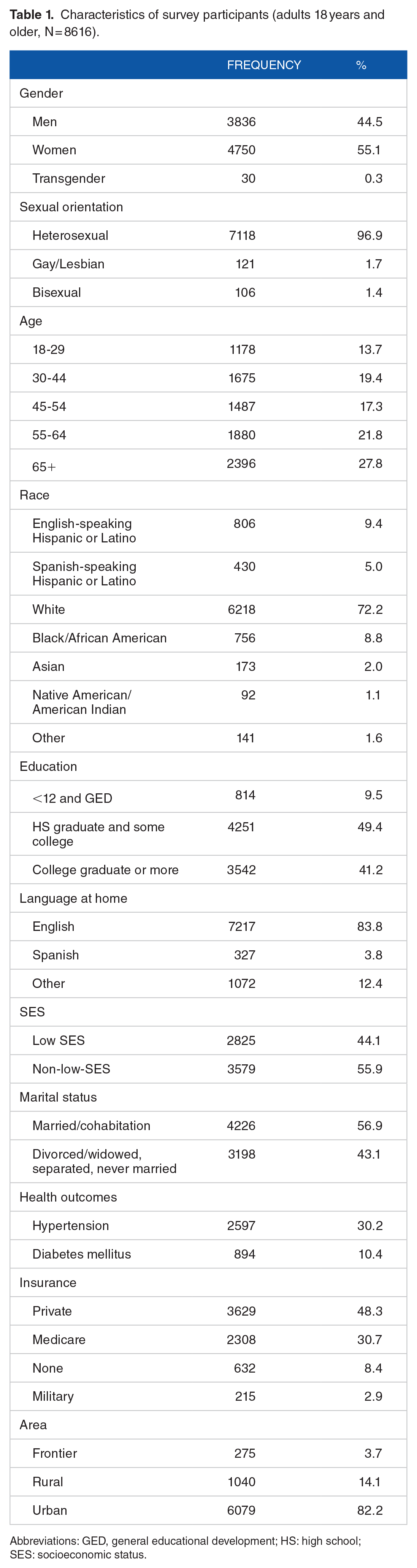
Abbreviations: GED, general educational development; HS: high school; SES: socioeconomic status.
Tobacco use
Table 2 shows the overall prevalence of different types of tobacco use. The lifetime prevalence of cigarette (only) smoking remains highest among the different forms of tobacco use at 25.8%, compared with 10.6% for “ever hookah use,” 7.0% for “dual users” (hookah and cigarettes), and 12.6% for “anything else” (or everything except cigarettes). In addition, 43.0% have ever used marijuana. More likely, cigarette smokers (only) were white (26.2%), divorced/single (26.1%), females (30.4%), 65 years or older (35.7%), had less than college education (30.5%), and had income of less than $35 000 per year (28.8%).
Overall use of multiple forms of tobacco products among adults 18 years and older.

Abbreviations: LCL, lower control limit; UCL, upper control limit.
Cigarette only: participants who only smoked cigarettes; ever hookah use: participants who have tried hookah at least once in their life; dual users: participants who smoked both traditional and electronic cigarettes; anything else: participants who smoke any tobacco products but not cigarettes.
The typical hookah user was a single/living alone (15.9%), English-speaking (11.6%), male (16.7%), age < 30 years (24.2%), with some college education (13.0%), and income less than $35 000 per year (14.3%). Hookah users, whether or not they also used cigarettes, were similar to those who used any other noncigarette tobacco products including e-cigarettes.
Marijuana use
The typical marijuana user was a single/living alone (50.2%), white (46.0%), English-speaking (46.7%), male (48.5%), age < 30 years (50.1%), with a graduate degree (40.8%) and a salary of at least $50 000 per year (43.4%) (Table 2).
Associations of tobacco use with demographics
Analysis of the percentages presented in Table 3 showed small negative associations between ever hookah use and older age (φ = –0.26). Everything except cigarette (anything else) use showed small negative associations with female sex (φ = –0.25) and single marital status (φ = –0.03). Results from the study showed negligible to very weak associations between the remaining tobacco use variables and sociodemographic variables. The results also revealed small positive associations between marijuana use and younger (18-24 years) age (φ = 0.17) (Table 3).
Frequency of tobacco use products among Colorado survey participants (N = 8616).
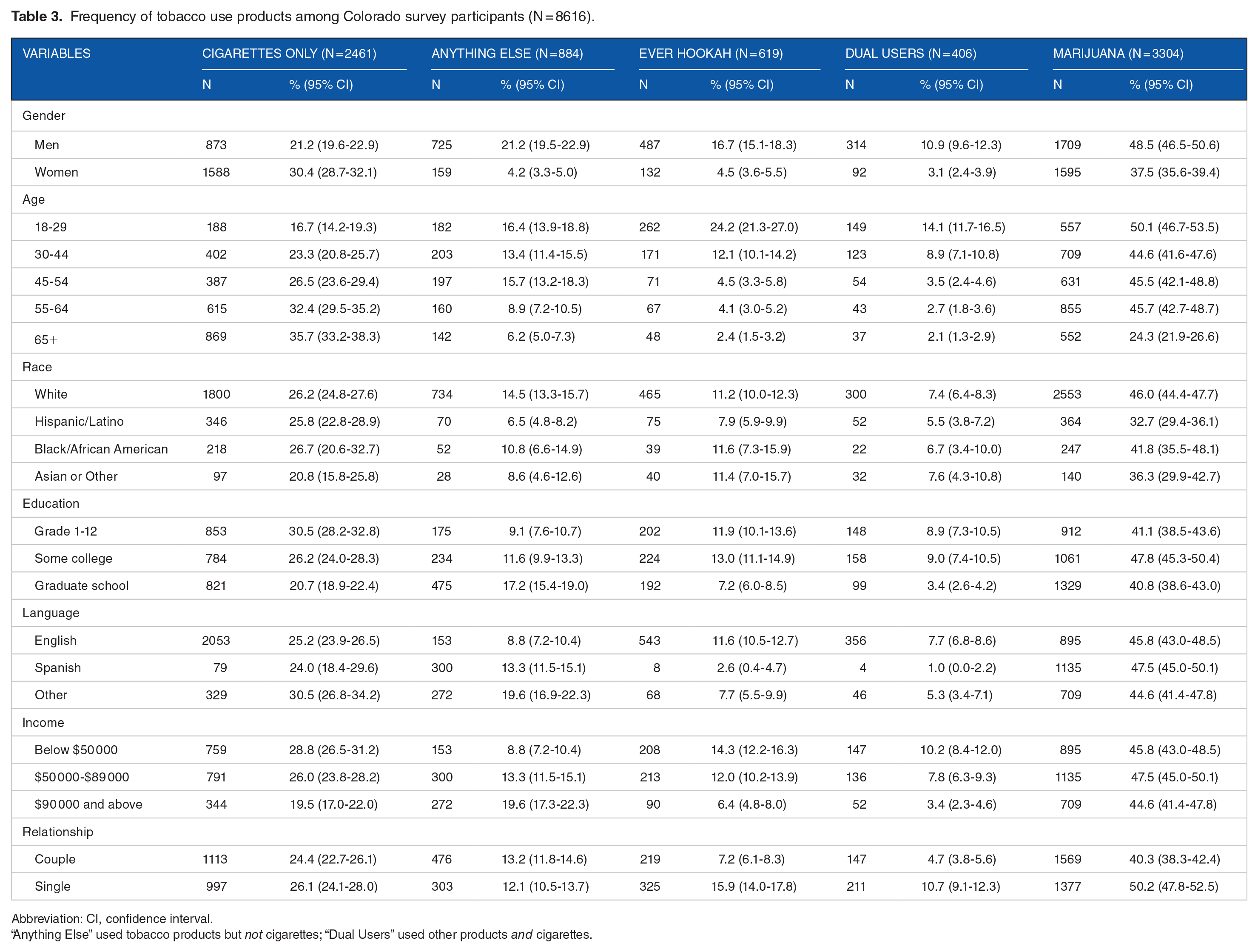
Abbreviation: CI, confidence interval.
“Anything Else” used tobacco products but not cigarettes; “Dual Users” used other products and cigarettes.
Discussion
This study described the prevalence of different forms of tobacco use as well as marijuana use among adults living in Colorado. This secondary data analysis of TABS 2015 showed that cigarettes remained the most commonly used tobacco products compared with other forms such vaping and waterpipe.
The most common cigarettes smokers were single/divorced women of 65 years and older and of lower socioeconomic status, compared with the typical ever hookah user who is a single/living alone young man of moderate socioeconomic status. The characteristics of marijuana users, dual users (hookah and cigarettes), and users of everything except cigarettes or anything else (including e-cigarettes) were similar to those of ever hookah users. These results are parallel to the literature that shows an increasing prevalence of waterpipe and electronic cigarette use among youths and young adults.16-19,27
Results from the North Carolina Tobacco Youth Survey showed that the prevalence of current hookah use increased from 3.6% (95% confidence interval [CI] = 2.8-4.5) in 2011 to 6.1% (95% CI = 4.9-7.5) in 2013. Reported lifetime hookah use also increased from 9.8% (95% CI = 8.0-12.0) in 2011 to 12.6% (95% CI = 11.0-14.4) in 2013. 28 Results from the New York Tobacco Use Survey showed an increase in the overall prevalence of ever hookah use among middle and high school students from 2008 through 2014 (8.9%-13.0%, P = .01). 29
The rise in the prevalence of alternative forms of tobacco products among adolescents is particularly concerning because nicotine has a negative impact on adolescent brain development. 21 The use of nicotine during adolescent years and young adulthood has been associated with lasting negative cognitive and behavioral effects, such as attention and memory. 30 The lack of regulation in purchasing alternative forms of tobacco such as vaping products and the aggressive glamorous advertising of such products have both contributed to the increase in the use of vaping products at alarming rates.11,12 Between 2011 and 2015, the US Surgeon General found e-cigarette use among high school students increased by 900%, with more teens now using e-cigarettes than cigarettes. Another concerning point is the public’s misconception that alternative forms of tobacco such as vaping and hookah are safe, 2 when the literature has shown that such products have health hazards similar to cigarettes.
In conclusion, tobacco use remains prevalent in Colorado despite its associated risks. Cigarette use is still the most prevalent, but alternate forms of tobacco use are particularly likely in a younger population. This may indicate increased risks due to noncigarette tobacco use that should be addressed in future research. In addition, this topic could be the focus of future targeted public health campaigns, strict tobacco regulatory policies, and comprehensive tobacco control programs.
Limitations of TABS (2015) include the use of a cross-sectional design that prevents determining causal relationships. Second, the survey used self-reported measures, which are subject to error and inaccuracy. A third limitation is a lack of detailed questions about alternative forms of tobacco use compared with questions about cigarette use. Future TABS cycles should investigate in more depth the use of alternative forms of tobacco products other than cigarettes.
Future directions
Future research should not only investigate the prevalence and specific health hazards of alternative forms of tobacco but also focus on the regulatory environment surrounding such products to limit and restrict the access to adolescents and teens who are the future of every population. Such products are not approved by the Food and Drug Administration to help in smoking cessation, despite some users’ perception that they can be used in this way; however, there is evidence that they might be gateway drugs to cigarette use. 11
Footnotes
Funding:
The author(s) disclosed receipt of the following financial support for the research, authorship, and/or publication of this article: The Attitudes and Behaviors Survey is funded by the State Tobacco Evaluation Program of the Colorado Department of Public Health and Environment (Interagency Agreement Routing No. 18 FHLA 101470 to Original Interagency Agreement Routing No. 16 FHLA 84703).
Declaration of conflicting interests:
The author(s) declared no potential conflicts of interest with respect to the research, authorship, and/or publication of this article.
Author Contributions
DEH contributed to the manuscript write up. The remaining authors contribute to data analysis section and professional editing of the manuscript.
