






Abstract
Drug abuse is a condition that impacts not only the individual drug user, but society as a whole. Although prevention of initial drug use is the most effective way to prevent addiction, avoiding relapse is a crucial component of drug addiction recovery. Recent studies suggest that there is a set of genes whose expression is robustly and stably altered following drug use and ensuing abstinence. Such stable changes in gene expression correlate with ultrastructural changes in brain as well as alterations in behavior. As persistent molecular changes, these genes may provide targets for the development of therapeutics. Developing a list of well-characterized candidate genes and examining the effect of manipulating these genes will contribute to the ultimate goal of developing effective treatments to prevent relapse to drug use.
Introduction
Relapse to drug use is a major barrier to overcoming addiction (Stewart, 2008; Leshner, 1996). Identifying changes in brain gene expression that underlie relapse liability will ultimately lead to a better understanding of what drives recovering addicts to relapse to drug use. Such an understanding will subsequently provide molecular targets on which pharmacological interventions to prevent relapse can be focused. Drug use alters the individual on multiple levels: behavior, neurochemistry, electrophysiology, and microanatomy, but underlying all these changes are gene and protein expression modifications (for review see Nestler, 2001 and Falcon and McClung, 2008). This review briefly describes several behavioral models of relapse, identifies a list of genes that are commonly found to be involved in relapse, and highlights epigenetic studies that are delving further into the role of genomic contributors to relapse. Studies that combine behavioral and molecular techniques to examine the relevance of certain genes to relapse are discussed, as are future directions of study to advance development of treatments for relapse.
Models of Relapse
Human relapse to drug use is an overarching problem addressed by studies of addictive drugs. For humans, relapse to drug use can occur even after substantial treatment for addiction and prolonged abstinence (DeJong, 1994; O'Brien, 2003). The difficulty in modeling relapse to drug use in animals has presented a challenge to researchers interested in the genomic underpinnings of addiction. Clearly, an effective model of relapse will replicate the human experience of drug use and relapse (Fig. 1A). Currently, a few behavioral relapse models exist, providing an effective way to study relapse in the controlled laboratory environment. Although these models differ slightly from one another, all adhere to the central experimental approach of drug self-administration followed by a period of abstinence (Fig. 1B).
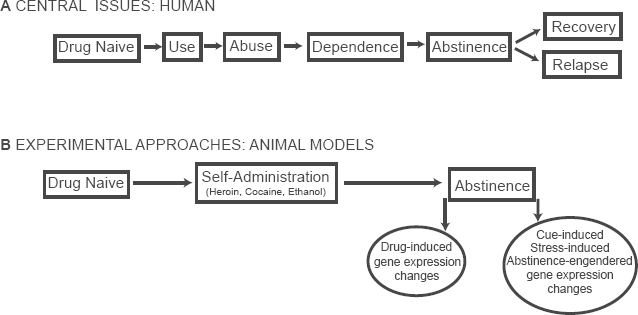
(A) Human drug use ends in either successful sustained abstinence or relapse. (B) Drug relapse is modeled in animals by cue-induced or stress-induced resumption of drug self-administration following an abstinent period. Categories of gene changes following drug use are depicted in ovals.
Incubation is the most recently recognized model of relapse. Occurring in response to both stimulants and opiates, incubation is described as a time-dependent increase in cue-induced operant responding after withdrawal from self-administration (Grimm et al. 2001; Lu et al. 2006). Incubation occurs following self-administration of cocaine (Freeman et al. 2008), methamphetamine (Shepard et al. 2004), and heroin (Shalev et al. 2001; Kuntz et al. 2008a); therefore, it may represent a generalizable phenomenon applicable across addictive drugs.
For both animals and humans, reinstatement of drug seeking behavior can be triggered by re-exposure to the previously self-administered drug, the context in which it was taken, or specific environmental cues.
In the animal model of extinction-reinstatement, drug seeking behavior is extinguished by multiple sessions during which no drug is received following responses on a previously drug-paired operant. In this paradigm, the drug reinforcer is disassociated from the behavior. Following extinction of the drug-seeking behavior, a stimulus such as an injection of the drug, re-exposure to the environment in which drug was received, or a stressful event can trigger resumption of the drug-seeking behavior. Extinction-reinstatement is known to occur for both cocaine-seeking behavior and heroin-seeking behavior (Crombag et al. 2008; Rogers et al. 2008). Extinction-reinstatement has been a widely used animal model for studying relapse, although the applicability of this model to human drug relapse has been debated (Katz and Higgins, 2003; Epstein et al. 2006). Extinction of drug-seeking is a crucial component of the extinction-reinstatement model in animals; however an analogous situation does not occur in humans. Therefore, the experience of animals that undergo the extinction-reinstatement procedure is quite different from that of human relapsing drug users.
Sensitization to a drug involves an increased drug response to the same amount of a drug following its repeated administration (Feldman et al. 1997; Kalivas et al. 1998a; Kalivas et al. 1998b; Smith et al. 2008). While not a faithful behavioral model of relapse, sensitization provides a highly visible demonstration of how responses to drugs remain altered following a period of abstinence from drug use (Vezina, 2007). Although sensitization occurs for a variety of drugs, it is best expressed following administration of psychomotor stimulants. In psychomotor sensitization, an animal receives injections of a psychomotor stimulant (e.g. cocaine) for a period of time and eventually becomes hyper-responsive to an injection of the stimulant. Both incubation and sensitization provide models of enduring behavioral changes that persist past cessation of drug administration.
Human studies of relapse can provide important insights but are confounded by numerous variables, such as polydrug use, different drug doses, and variations in lifestyle. Because of the confounding variables presented by human studies, animal relapse models provide the opportunity to study relapse in a controlled environment where animals can be manipulated by genetic, behavioral, and pharmacological methods.
Genes Implicated in Relapse
The animal models of relapse described above have been used to identify genes that are significantly altered following drug use and abstinence. The progression from initial drug use to dependence and addiction is characterized by multiple behavioral and physiological changes. Alterations in gene expression are believed to underlie these broader changes and have been demonstrated to alter behavior (Nestler et al. 2001; McClung and Nestler, 2003). Following drug use and abstinence, genomic changes can be divided into three broad categories (Fig. 2). Expression of particular genes can be increased or decreased during the period of drug-administration and arrive at a new steady-state of expression that is maintained throughout a period of drug abstinence. In this case, the physiologic condition produced by the new levels of gene expression can drive a former drug-user to relapse. In a second scenario, drug-administration again induces a change in gene transcript expression. However, as the time of abstinence from the drug increases, transcripts return to their pre-drug level of expression. These genes are less likely to be responsible for long-term relapse to drug use, but they may be necessary initial factors for more enduring secondary expression changes. A third group of genomic changes appear during the abstinent period following drug use. In animal studies, it is known that some of these changes result from re-exposure to a previously drug-paired context. In each of the described scenarios, drug use results in a homeostatic imbalance that is ultimately manifested in an individual's behavior. Given the multitude of genes present within a genome, when examining a particular behavior (such as relapse), it is useful to focus on a subset of genes believed to be involved in that behavior. The number of genes believed to be associated with drug use exceeds 100 (Worst et al. 2005; Kreek et al. 2005; Hemby, 2006; Yano and Steiner, 2007). However, the majority of these gene expression changes are present only during drug administration (Fig. 2, middle panel). Therefore, far fewer genes remain altered following a period of abstinence. A list of several genes that have been found to be altered in a variety of relapse models is provided in Table 1. Many of these genes are transcription factors, while others are involved in dopamine and G-protein signaling. The external factor of drug abuse is able to induce intranuclear changes that eventually affect entire cells, neighboring cells, and ultimately the physiology of an entire organism (Fig. 3). Genes identified in this article range from transcription factors that exist within the nucleus to genes encoding proteins that act intracellularly to those found within the plasma membrane to secreted factors.

Changes in gene expression can by classified into three broad groups.
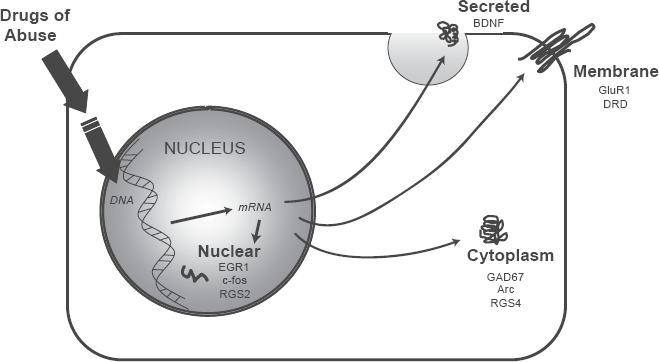
Drug abuse affects transcription of genes that ultimately have intranuclear, cytoplasmic, and plasma membrane actions.
Several genes have been identified to be changed in models of relapse.

One well-known addiction-related gene is early growth response 1 (EGR1, a.k.a., zif 268, NGFI-A, and krox 24). We have recently shown EGR1 gene expression to be increased in the medial prefrontal cortex (mPFC) of rats that exhibit incubation of heroin-seeking behavior following 14 days of abstinence from heroin self-administration (Kuntz et al. 2008b) and EGR1 has been repeatedly implicated in drug relapse by other laboratories (For recent examples, Schmidt et al. 2005; Lee et al. 2005; Covington et al. 2005, although a wealth of additional studies exist). In an illustration of how specific genes are affected in relapse models, either increased or decreased in expression depending on the specific drug previously used, expression of EGR1 is decreased in the mPFC of rats that have been abstinent from cocaine self-administration for either 1, 10, or 100 days (Freeman et al. 2008), while it is increased following abstinence from heroin (Kuntz et al. 2008b). The divergent directions of changes between the heroin and cocaine studies raises the question of whether these differences can be attributed to the depressive verses stimulant properties of heroin and cocaine, respectively, or variations in the psychodependence and physical dependence induced by different drugs. However, another study of relapse to cocaine seeking has reported mPFC EGR1 gene expression to be significantly increased rather than decreased following cocaine abstinence and contextual re-exposure. In this study, genes that were upregulated upon exposure to an environment in which cocaine was previously administered are not upregulated when rats are re-exposed to an environment in which cocaine was not previously available (Hearing et al. 2008a). Hearing's study included contextual re-exposure while the samples in Freeman's study were from rats that had not experienced contextual re-exposure. Re-exposure to a drug-related context is known to impact gene expression (Badiani et al. 1998; Ferguson et al. 2003; Badiani and Robinson, 2004) and offers a plausible explanation for the between-study differences. Variations in the cocaine dose (0.6 mg/kg verses 1.5 mg/kg), operant training method (discrete trial model versus fixed ratio), duration of training sessions (6 h verses 2 h), and RNA quantitation techniques are all possible reasons for the variations in results. Region-specific upregulation of EGR1 has also been observed in rats that experience an amphetamine sensitization challenge (Guitart-Masip et al. 2008). Subregions of the amygdala and striatum varyingly display increases or decreases in EGR1 gene expression, with the direction of change varying depending on the inbred characteristics of the strain and the specific brain region. For most of the subregions examined, EGR1 expression increased in rats that experienced an amphetamine challenge.
Brain-derived neurotrophic factor (BDNF) has been implicated in relapse to drug-seeking behavior. An upstream regulator of the immediate early genes Fos and Arc, BDNF promotes cocaine-taking and relapse behavior in rats (Graham et al. 2007). Interestingly, in the ventral tegmental area (VTA) BDNF protein levels have been found to be increased 10–15 days following withdrawal from cocaine injections, but not 1 day following withdrawal (Pu et al. 2006). Acute, but not chronic, cocaine administration increases striatal BDNF mRNA in rats (Liu et al. 2008). Thus, it is possible that an initial rise in BDNF mRNA levels is followed by subsequent increase in protein levels before the BDNF gene expression returns to a baseline. Because BDNF controls expression of other genes that are implicated in relapse, such as Fos and Arc, BDNF may be a crucial “switch” that activates numerous relapse-related intracellular cascades. Following cocaine withdrawal, levels of BDNF mRNA are reportedly increased in the hippocampus (Filip et al. 2006). Gene expression levels of trkB, the receptor for BDNF, were decreased in this study. Perhaps the decrease in receptors is indicative of a physiological response to counteract the increased levels of BDNF expression. Taken together, these findings suggest that changes in BDNF gene expression are both time and contingency-dependent. The suggested importance of BDNF to drug abuse has prompted studies investigating human polymorphisms of the BDNF gene; however, currently only modest associations between BDNF gene variants and substance abusers have been identified (Itoh et al. 2005; Liu et al. 2005). Levels of BDNF mRNA are increased following a single injection with cocaine (Le et al. 2005), as are levels of the dopamine D3 receptor (DRD3). BDNF is known to control DRD3 mRNA expression (Guillin et al. 2001), and this finding of concurrent increases in expression of these genes provides support for an interaction between these two genes. A reasonable hypothesis is that increased BDNF gene expression levels are responsible for increased DRD3 gene expression levels.
Increased dopamine signaling is an essential component of drug abuse (DiChiara and Bassareo, 2007). Five different subtypes of receptors exist for dopamine: D1, D2, D3, D4, and D5. Expression levels of the genes encoding these receptors have been examined in both human and animal studies of relapse, with expression of specific DRD alleles being prevalent in humans who exhibit addictions to smoking and gambling (Comings et al. 1997). The precise role of DRD and dopamine in addictive behaviors remains to be elucidated, but the generalization of DRD across a range of addictive behaviors suggests this gene may be relevant to addiction beyond the specific area of drug abuse. The mesolimbic dopaminergic system, often referred to as the reward pathway, is important for the appetitive drive to engage in a variety of goal-directed behaviors, regardless of whether they involve drugs (Alacro et al. 2007). Increasing DRD2 expression in the nucleus accumbens reduces ethanol consumption in rats (Thanos et al. 2004), while DRD2 knock-out mice that are treated with DRD2 vectors suggest that DRD2 levels play a complex role in regulating the amount of alcohol consumed (Thanos et al. 2005). Human heroin abusers possessing a polymorphism in the DRD4 or DRD2 genes report significantly higher levels of heroin craving than counterparts who do not possess either of these polymorphisms (Li et al. 2006; Shao et al. 2006). Polymorphisms in the DRD2 and DRD4 genes are believed to be predictive of how successful a person will be at smoking cessasion (David et al. 2007; David et al. 2008). Although these studies examine polymorphisms rather than changes in gene expression, the implication is the same as with expression studies: aberrances in dopamine receptor genes are suspected to be involved in drug use.
Regulators of G-protein signaling are intracellular proteins that terminate G-protein signaling by accelerating GTPase activity (Krumins et al. 2004; Xie and Palmer, 2005; Abramow-Newerly et al. 2006). Several genes exist in this protein family, and while the full extent of their involvement in intracellular functions remains to be elucidated, signaling by dopamine receptors and opioid receptors is known to involve RGS molecules. Messenger RNA for RGS2 and RGS4 is increased following opiate withdrawal (Gold et al. 2003). RGS4 mRNA in the prefrontal cortex and dorsolateral striatum is significantly decreased 21 days following either contingent or non-contingent cocaine administration. Interestingly, in both brain regions, re-exposure to the context in which cocaine was administered prior to the abstinence period restored RGS4 gene expression levels (Schwendt et al. 2007). Acute morphine increases RGS9 protein, while chronic exposure decreases the protein levels (Zachariou et al. 2003). RGS expression can be affected by dopamine signaling, and expression of RGS2, RGS4, and RGS9 are significantly decreased in dopamine D1 receptor knock-out mice (Stanwood et al. 2006). Cocaine induces an increase in RGS4 gene expression through D1 receptors (Zhang et al. 2005). Acute amphetamine decreases RGS4 mRNA expression in rat forebrain (Schwendt et al. 2006). Again, induction or reduction of mRNA expression is seen for RGS4 depending on whether the drug being studied is an opiate or a stimulant. Unfortunately, varibles in drug-taking schedules and abstinent periods necessitate the design of a specific study to assess whether the different directions of change in RGS4 gene expression are solely the result of the drugs studied.
AMPA receptors are composed of multiple glutamate receptor subunits, and expression of these glutamate receptor subunits is altered during withdrawal from cocaine (Lu et al. 2005) and heroin (Zhong et al. 2006; Bossert et al. 2006). Glutamic acid decarboxylase, isoform 67 (GAD67) is a GABA-synthesizing enzyme whose expression is known to be changed following drug use. After exposure to schedules of either morphine, amphetamine, or nicotine that induce behavioral sensitization, GAD67 mRNA expression is significantly increased in the central amygdala (Carta et al. 2008). This increase is evident following an initial drug treatment period and remains following sensitization, rather than a change specifically induced by the sensitization procedure. In hippocampal neurons, GAD67 gene expression is induced by EGR1 (Luo et al. 2008), suggesting a possible pathway through which some of the observed drug-induced changes in gene expression are coordinated (Fig. 4).

Genes discussed in this review can be placed into a hypothetical pathway of interaction. References depicted provide documentation of the intermolecular interactions. Clearly, the presence of all these relationships in a single cell is purely conjectural at this time.
Additional genes whose expression is reportedly increased following abstinence from heroin and decreased following abstinence from cocaine are Arc (activity-regulated cytoskeletal protein) and c-fos. Studies of relapse to cocaine-seeking report EGR1, Arc, and c-fos gene expression to be increased following cocaine abstinence and contextual re-exposure (Klebaur et al. 2002; Ostrander et al. 2003; Zavala et al. 2008; Hearing et al. 2008b). Changes in Arc and c-fos gene expression also exist in the amygdala following re-exposure to an environment paired with opiate withdrawal, although the direction and magnitude of change is variable between sub-nuclei regions (Lucas et al. 2008). Comparing the basolateral amygdala (BLA), intercalated cell masses (ITC), and central nucleus of the amygdala (CeA) following re-exposure to a drug-paired environment, both Arc and c-fos increased more in cells that were also positive for GAD67 when examined in the ITC and CeA. However, in the BLA, expression of both genes was higher in GAD67 negative neurons.
Contextual cues play a crucial role in neuronal gene expression changes that are associated with drug use. Several immediate early genes are reportedly upregulated when rats are reintroduced to an environment in which they previously self-administered cocaine, and neuronal regions including the nucleus accumbens (Fuchs et al. 2008), dorsal striatum (See et al. 2007), prefrontal cortex, amygdala, and hippocampus (Fuchs et al. 2005). Thus, the context of drug-taking affects gene expression.
Epigenetics
The field of epigenetics examines how intranuclear changes in the structure of DNA and chromatin can produce changes in gene transcription (Colvis et al. 2005). Changes in gene expression are the endpoint of complex interactions of histones and chromatin that determine which genes will be transcribed (Renthal and Nestler, 2008). Histone acetylation, histone methylation, histone phosphorylation, and DNA methylation combine to determine gene expression levels, and thus these are the mechanisms by which drugs actually elicit genomic effects. DNA is normally tightly wound around histones, forming the basis for chromatin structure. Transcription factors gain access to DNA that is not tightly wound around histones, and therefore epigenetic changes are central to determining which genes will be transcribed, and ultimately result in alterations in gene expression levels. In the nucleus accumbens, histone acetylation is induced by both acute and chronic cocaine administration (Kumar et al. 2005), although acute administration is associated with acetylation of H4 while chronic administration results in acetylation of H3. Acute administration results in deacetylation that promotes c-fos gene expression, while chronic administration accompanies histone deacetylation that promotes BDNF and cdk5 gene expression. In the mPFC, decreased levels of H3 aceytylation are seen both 1 and 100 days after cocaine self-administration (Freeman et al. 2008). In addition to the cocaine administration, cocaine-induced sensitization has also been associated with chromatin remodeling (Schroeder et al. 2008). In this case, changes in BDNF and D1 dopamine receptor gene expression were identified. Histone deacetylases remove acetyl groups from histones to change chromatin structure, and changes in expression of these enzymes could be responsible for drug-induced acetylation changes. Function of histone deacetylase 5 (HDAC5) is decreased in the NAc after chronic cocaine exposure (Renthal et al. 2007), and this decreased function alters the transcription pattern for several genes. Histone deacetylase 1 (HDAC1) affects c-fos gene expression following amphetamine exposure (Renthal et al. 2008). Expression of HDAC1 is normally chronically repressed by ΔfosB, but when it is expressed, HDAC1 allows chromatin remodeling that promotes c-fos gene expression.
Changes in mRNA levels that are correlated with changes in the chromatin modification of their respective genes have been documented. Thus, the role of chromatin structure in drug-induced changes in gene expression is a field which is rich in potential discoveries. Epigenetic studies are destined to provide a deeper understanding of the detailed mechanisms behind changes in gene expression.
Gene Intervention Behavioral Studies
Although many genes can be identified as being changed following drug use and relapse, the relevance of these genes to relapse must be assessed through behavioral studies. Fortunately, technologies such as siRNA, antisense oligonucleotides, and genetic knockouts allow the importance of specific genes, in specific neuronal areas, to be assessed. Infusion of EGR1 antisense RNA into the amygdala 90 min prior to a session of memory reactivation abolishes cue-induced reinstatement of cue-induced cocaine-seeking (Lee et al. 2005; Lee et al. 2006). Because drug-seeking behavior was reduced when EGR1 gene expression was reduced immediately prior to reconsolidation, the role of EGR1 in relapse appears to be closely tied to memory formation. This finding suggests EGR1 is an important gene for relapse, but because EGR1 functions as a transcription factor, the changes in expression of several genes transcribed by EGR1 is likely important to relapse. In fact, this is the authors' conclusion and points to the importance of further studies to gain a broad scope of genomic changes. Genetic manipulation, combined with behavioral relapse models, provides a powerful approach for investigating the relevance of particular genes to relapse. Intracranial infusions of antisense oligodeoxynucleotides (against EGR1) into rat amygdala prior to reactivation and reconsolidation of drug-seeking memory reduces seeking behavior for both cocaine and heroin (Hellemans et al. 2006; Lee et al. 2006). The gene-intervention studies discussed in this paper utilize antisense oligomers. However, oligos often have toxicity and it is necessary to confirm there is no damage to physiological functions or regions other than the one targeted. Therefore, models in which suppression of gene expression does not require introduction of a foreign agent are preferable for examining the role of specific genes.
Future Directions
Dynamic database
The studies discussed thus far provide a summary of what we currently know about genes whose expression levels are changed in models of relapse, but further steps must be taken to ensure a continuing increase in knowledge about relapse to drug abuse. An excellent start will be the development of a dynamic database to report genes that have been found to be implicated in relapse. A database similar to this was initially produced for cocaine-responsive genes (Freeman et al. 2002), but newer, web-based approaches, such as the Allen Brain Atlas (www.brain-map.org) could combine drug, behavioral, anatomical, and gene expression data. A central repository for relapse information will accelerate the progress that can be made in further experiments investigating relapse to drug use.
Temporally and Spatially-Selective Knock-outs
The relevance of specific genes to addiction can be studied using transgenic mice. Mice that are heterozygous or homozygous mutants for the EGR1 immediate early gene show behavioral differences from their wild type counterparts. Specifically, cocaine-induced locomotor sensitization is significantly lower in EGR1-/- and EGR1+/- mice than in EGR1+/+ mice (Valjent et al. 2006). To ensure that EGR1 was the only transcription factor affected by the knock-in, the researchers in this particular study examined pathways upstream from EGR1 and parallel signaling pathways. Because EGR1 is a transcription factor, a valid concern is the possibility that another (or several other) genes whose transcription is regulated by EGR1 are affected. An ideal experiment to examine the relevance of particular genes to relapse is to use mice in which gene knockouts are both temporally and spatially specific. Transgenic mice, such as CRE-LacZ reporter mice (Shaw-Lutchman et al. 2003), provide ideal models in which such studies can be conducted. Combining measurements of transcription with and without expression of a particular gene with drug exposure provides insight about whether a particular gene is affected by that drug (Green et al. 2006). This approach can be used in models of relapse to drug-seeking to establish the importance of particular genes to the relapse phenomenon. Of course, the difficulty in this approach is the paucity of relapse mouse models. Therefore, further developments in either murine models of relapse or rat genetic manipulation (such as viral delivery of shRNA) will be required before the power of this approach is fully harnessed. The importance of cAMP-response element (CRE) to opiate withdrawal behavior has been determined using a transgenic mouse model (Shaw-Lutchman et al. 2002; Han et al. 2006). Region-specific changes in CRE-mediated transcription occur during opiate withdrawal, and CRE activity increases opiate withdrawal while decreasing CRE activity decreases opiate withdrawal.
The importance of glutamate receptors to sensitization to cocaine is apparent through a study using viral-mediated gene transfer of wild-type or pore-dead Glutamate receptor 1 (GluR1) into rat NAc (Backtell et al. 2008). Infusions of wt-GluR1 viral vectors result in a decrease in cocaine sensitization. Cocaine-seeking during extinction and cocaine-induced reinstatement were also reduced in rats in which GluR1 was overexpressed. Further studies will be needed to elucidate how GluR1 overexpression prevents these relapse measures in animal models, but it is likely that many of the genes highlighted in this review are involved in the mechanism.
Drug discovery
An ultimate goal of drug abuse research is to design pharmaceutical treatments to prevent relapse. Identification of target genes is the first step in drug discovery, and a database of genes suspected to be related to relapse could be valuable to making the drug discovery process more efficient. Now that research has determined that intervention with EGR1 gene expression decreases relapse, the search for pharmaceutical agents that affect EGR1 gene expression and downstream targets of EGR1 in specific neuronal regions should begin. Future relapse prevention research should occur on multiple levels, ranging from molecular to behavioral, and combining different fields as often as possible.
Conclusion
Knowledge of the gene expression patterns that exist following prolonged drug use and abstinence is useful in understanding the neurobiological drive to relapse despite the ensuing adverse consequences. How does one progress from taking a drug because it elicits rewarding effects to engaging in drug use as a necessity? The answer to this question may lie in the intricate molecular changes occurring in neurons during drug use and abstinence. These molecular changes, however, will be intricately intertwined with learning and memory. Although the focus of this article has been on drug addiction, the contribution of some of these genes to relapse may be through their role in memory formation and retrieval. Multiple hypotheses exist to explain addiction (Robinson and Berridge, 2003; Thomas et al. 2008; Koob and Le Moal, 2008a; Koob and Le Moal, 2008b). Whether addiction and relapse stem from the avoidance of unpleasant physical states, motivational systems that drive compulsive behavior, or memories that refuse to be silenced, is a topic of debate, and components of each theory are likely necessary for a complete understanding of addiction. The genomic profile of former addicts who are highly susceptible to relapse represents a combination of memory and drug-induced changes, and knowledge of this pattern of gene expression will be critical for designing the most effective pharmacological treatments for relapse.
Disclosure
The authors report no conflicts of interest.