






Abstract
The treatment of breakthrough pain (BTP), a transitory exacerbation of pain that occurs on a background of otherwise-controlled, persistent pain, requires an opioid formulation and/or method of administration that can provide rapid and extensive systemic exposure. Fentanyl buccal tablet (FBT;
Introduction: Breakthrough Pain
Breakthrough pain (BTP) is a transitory exacerbation of pain that occurs on a background of chronic, persistent pain that is otherwise controlled by around-the-clock (ATC) opioids.1–3 Much of the medical literature surrounding BTP comes from studies of patients with cancer-related pain in which the BTP was characterized as rapidly escalating, often reaching peak intensity within minutes.1,2 In a landmark survey of 164 patients with controlled, persistent cancer-related pain, the median onset to peak BTP intensity was reported to be 3 minutes, with patients experiencing a median 6 episodes each day. 2 In a more recent survey that reported on the prevalence and characteristics of BTP in 228 opioid-treated patients with controlled, persistent noncancer pain, most patients (74%) had BTP, which reached maximum intensity in a median of 10 minutes; patients experienced a median of 2 episodes per day. 4 Over 700 patients were screened for this survey and the majority did not have controlled persistent pain, highlighting the need for better pain management.
A common practice in managing BTP in patients who are taking ATC opioids is to add supplemental short-acting opioids (e.g. immediate-release morphine, hydrocodone, oxycodone) to the chronic pain treatment regimen. These medications, however, typically require at least 30 minutes or more to begin to take effect,3,5 which is often not fast enough to alleviate BTP. In the study of BTP in association with chronic noncancer pain, in which most patients were taking short-acting opioids for BTP, 65% of patients reported that their BTP did not respond consistently to the interventions used.
4
Fentanyl buccal tablet (FBT;
Transmucosal Administration of Fentanyl for the Management of BTP
The toxicology, pharmacological effects, and mechanism of action of fentanyl, a potent µ-opioid receptor agonist, have been characterized extensively, and fentanyl has become one of the most widely prescribed opioids for chronic and perioperative pain management. 7 When given intravenously, the highly lipophilic fentanyl readily crosses the blood-brain barrier, quickly entering into the central nervous system.8,9 However, when given orally, fentanyl is absorbed through the gastrointestinal tract and undergoes extensive intestinal and hepatic first-pass metabolism, making it less bioavailable than fentanyl delivered intravenously.10,11 To relieve BTP effectively in an outpatient setting, delivery of fentanyl requires a formulation and/or method of administration that can provide rapid and extensive systemic exposure.
The oral mucosa is an attractive route for drug delivery because it is easily accessible, is more permeable than skin (because of its nonkeratinized epithelia), has a rich blood supply, and allows fentanyl to avoid first-pass metabolism.12,13 The lipophilicity of fentanyl allows it to pass readily through the buccal mucosa.
Oral transmucosal fentanyl citrate (OTFC®, Actiq®, Cephalon, Inc.) was the first rapid-onset opioid introduced for pain management. OTFC is indicated for the treatment of cancer-related BTP in patients who are already receiving and who are tolerant to opioid therapy for their underlying persistent cancer pain; OTFC is contraindicated in opioid non-tolerant patients and in the management of acute or postoperative pain including headache/migraine. 14 Formulated as a sweetened lozenge on a stick, OTFC is designed to dissolve slowly in the mouth; patients use the handle to move the lozenge from one side of the mouth to the other to “paint” the mucosa with the medication. Administered in this manner, OTFC was shown to increase the rate and extent of absorption of fentanyl compared with orally administered fentanyl. 11
Although the lipophilicity of fentanyl allows it to pass readily through the buccal mucosa, this same characteristic renders it less soluble in an aqueous solution, such as saliva. 15 As Durfee et al have observed, fentanyl is a weak base, and dissolution requires a relatively low pH, where the ionized, hydrophilic form of the drug predominates. In contrast, permeation and absorption of fentanyl through a cellular membrane, such as the buccal mucosa, requires a higher pH, where the nonionized, lipophilic form of the drug predominates. 15
FBT is a novel formulation of transmucosal fentanyl citrate. It uses OraVescent® technology to further increase the rate and extent of absorption of fentanyl provided by its predecessor compound, OTFC. 16 FBT is indicated for the treatment of cancer-related BTP in patients who are already receiving and who are tolerant to opioid therapy for their underlying persistent cancer pain; FBT is contraindicated in opioid non-tolerant patients and in the management of acute or postoperative pain including headache/migraine. 6 Aspects of the OraVescent delivery system are described in detail below.
OraVescent® Technology
OraVescent technology was developed to enhance drug delivery, using fentanyl as the test compound. It was hypothesized that the clinical efficacy of fentanyl might be enhanced if the delivery system could improve dissolution and passage of the drug into the circulation by selectively modifying the local pH and permeability at the mucosal wall. An initial decrease in pH would promote the soluble, ionized, hydrophilic form of fentanyl, and a subsequent, gradual increase in pH would promote the more absorbable, nonionized, lipophilic form. Also, the liberation of carbon dioxide (CO2) has been shown in animal tissue to increase the permeability of epithelial barriers by altering paracellular pathways, enhancing drug penetration. 17 These characteristics describe the broad mechanism of action of the OraVescent tablet. The approved FBT formulation contains sodium bicarbonate, sodium carbonate, and citric acid, which induce the required sequence of pH changes and an accompanying liberation of CO2. 15
A hypothesis explaining how the different reactions involved in the dissolution of tablets via the OraVescent system induce pH changes has been published elsewhere; the reactions are shown in Figure 1 15 and Table 1. 18 In brief, as the tablet begins to dissolve, the local environment becomes more acidic because of the dissolved citric acid and CO2. In this acidic environment, the available fentanyl becomes almost completely ionized and, therefore, its aqueous solubility is high. As the reactions progress, CO2 is released and the pH increases in the presence of a larger number of basic cations, rendering the dissolved fentanyl nonionized. Concurrently, the accompanying CO2 liberation is thought to improve membrane permeation of fentanyl. As the pH increases, a physiological “pump,” caused by the local concentration gradient of nonionized fentanyl, is created, which pushes the drug into and across the lipid barrier of the buccal mucosa.15,18
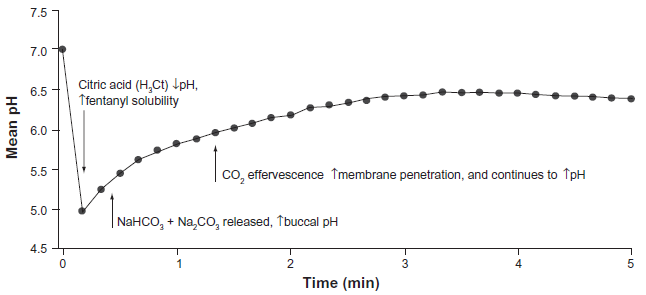
Changes in pH over the surface of the dissolving fentanyl buccal tablet during the initial 5-minute time interval.
Reactions occurring during OraVescent® tablet dissolution and absorption.
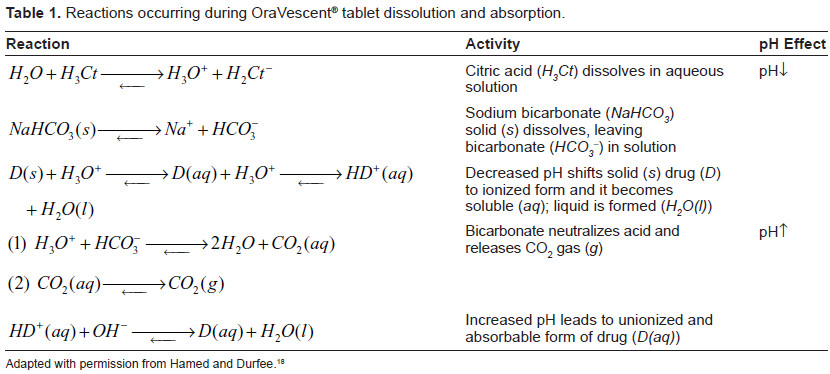
Adapted with permission from Hamed and Durfee. 18
A preliminary, open-label pharmacokinetic study that compared FBT with OTFC highlighted the potential of OraVescent technology. 19 In this study, 12 healthy men were randomized to receive one of three treatments: OraVescent FBT, non-OraVescent FBT (a tablet containing fentanyl and lactose in place of the OraVescent components), or OTFC. Subjects who received OraVescent FBT had an increased peak serum fentanyl concentration (Cmax), a shorter time to reach Cmax (tmax), and a larger area under the serum fentanyl concentration-vs.-time curve compared with those who received OTFC or non-OraVescent FBT (Table 2). Fentanyl was absorbed more rapidly and induced greater systemic exposure when coupled with OraVescent technology than with either of the other fentanyl formulations (Fig. 2). 19
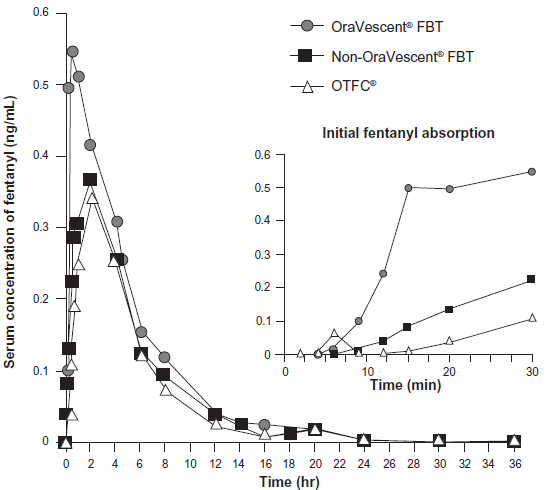
Serum concentration of fentanyl with OraVescent® fentanyl buccal tablet (FBT), non-OraVescent® FBT, and oral transmucosal fentanyl citrate (OTFC®) over time.
Early study of fentanyl pharmacokinetics following administration of OraVescent® FBT vs. Non-OraVescent® FBT and OTFC® in healthy volunteers.
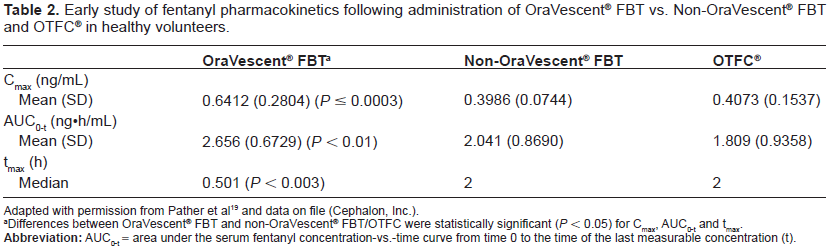
Adapted with permission from Pather et al 19 and data on file (Cephalon, Inc.).
Differences between OraVescent® FBT and non-OraVescent® FBT/OTFC were statistically significant (
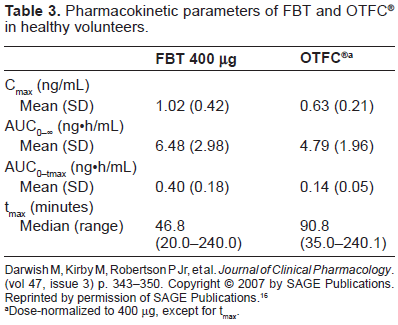
These preliminary findings were supported by an additional randomized, open-label, crossover study of healthy adults that assessed the bioavailability of fentanyl delivered using FBT and OTFC (Table 3). 16 The study showed that OraVescent technology more than doubled the portion of the fentanyl dose absorbed via the buccal mucosa (48% with FBT vs. 22% with OTFC). This resulted in greater absolute bioavailability of FBT than OTFC (65% vs. 47%) and more rapid absorption into the systemic circulation (tmax: 47 minutes for FBT vs. 91 minutes for OTFC). Because of the improvement in the extent and speed of absorption afforded by the OraVescent technology, the early systemic exposure (i.e. the area under the plasma drug concentration-vs.-time curve [AUC] from time 0 to tmax [AUC0-tmax]) to fentanyl exceeded that provided by OTFC (0.40 vs. 0.14 ng•h/mL) (Fig. 3, Table 3). 16
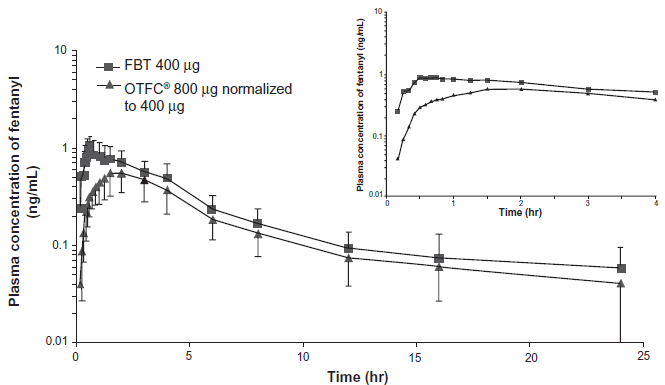
Plasma fentanyl concentration over time with fentanyl buccal tablet (FBT) 400 µg and oral transmucosal fentanyl citrate (OTFC®) 800 µg. Darwish M, Kirby M, Robertson P Jr, et al,
Pharmacokinetic parameters of FBT and OTFC® in healthy volunteers.
Darwish M, Kirby M, Robertson P Jr, et al.
Dose-normalized to 400 µg, except for tmax.
Because of these pharmacokinetic differences between the formulations, it should be noted that the clinical dose ratio of FBT to OTFC is not 1:1. Based on the study presented above, a dose of FBT up to 30% smaller than one of OTFC would be expected to result in comparable levels of systemic fentanyl exposure. 16
The Pharmacokinetics of FBT
A number of studies have been performed to describe the pharmacokinetic properties of FBT.20–23 These studies have shown that the AUC of fentanyl delivered by FBT is characterized by the rapid absorption of fentanyl into the systemic circulation (Fig. 2 and 3).16,19 This is followed by a triexponential decline from Cmax, which represents a rapid distribution of fentanyl from blood into highly perfused tissues (i.e. the brain, heart, and lungs); second, elimination and absorption of the swallowed portion of fentanyl in the intestinal tract; and, finally, the redistribution of fentanyl to the deep tissue compartments (i.e. muscle and adipose tissue) and subsequent elimination. 23 Plasma concentrations of FBT are generally maintained within 80% of Cmax from 20 minutes to 2 hours.20–23
The median tmax of fentanyl obtained with FBT has been shown to be approximately 50 minutes and has been consistent following single and multiple dosing studies.20–23 Early systemic exposure (AUC0-tmax of 100 µg [i.e. the reference dose] [AUC0-tmax’]) and overall systemic exposure (measured by Cmax and AUC from time zero extrapolated to infinity [AUC0-∞]) increased approximately linearly across the therapeutic dose range (100–800 µg). 21 This suggests that FBT can be reliably titrated within the therapeutic dose range (100–800 µg) for patients who require doses at the upper end of that range.20–22 More recently, FBT was shown to be dose proportional up to 1300 µg. 24
The time it takes for FBT to disappear completely once placed in the buccal cavity (i.e. the “dwell time”) varies among patients. Therefore, data from two open-label studies20,22 were analyzed to determine if dwell time affected the pharmacokinetic properties of FBT, specifically absorption. 25 Mean dwell times ranged from 14 to 25 minutes, with no apparent relationship to dose. 25 It is important to note that there was no evidence of an association between dwell time and dose-normalized Cmax (means 0.42–0.66 pg/mL/200 µg), dose-normalized AUC0-tmax’ (means 0.24–0.38 pg•h/mL/200 µg), or tmax (medians 45–60 minutes), suggesting that any remaining portion of the tablet contains little or no fentanyl and probably consists of the residue of excipients. 25
Sublingual placement of FBT has been explored as an alternative to buccal placement. A study among 90 healthy volunteers showed that median tmax (range) values were similar after buccal and sublingual administration: 0.75 hours (0.33–3.13 hours) and 0.78 hours (0.17–3.00 hours), respectively. 26 Drug concentration-vs-time plots were similar for the two administration sites, with comparisons of AUC0-∞ and Cmax meeting the criteria for bioequivalence. Oral inspection 15 and 30 minutes after FBT placement showed that fewer subjects had residue following sublingual compared with buccal placement. This may suggest that the larger volumes of saliva available sublingually may help to dissolve the tablet excipients. Indirectly, this also provides support for the premise that dwell time does not affect the absorption of fentanyl. Overall incidences of application site adverse events (AEs) were similar for the two placement options. Thus, sublingual FBT placement is an alternative to buccal placement in patients who prefer sublingual administration or require an alternative application site, for example, because of dentures, cancer-related mucositis, or the need for caregivers to place the tablet. 26
Clinical Outcomes with FBT
The analgesic effects of FBT have been evaluated in clinical studies of BTP in opioid-tolerant patients suffering from chronic persistent cancer and noncancer pain.27, 31 These studies provide evidence for the efficacy, safety, and tolerability profile of FBT in the management of BTP.
Initially, FBT was studied in patients with chronic cancer-related BTP. The evidence for the effectiveness of FBT in this indication is based primarily on two similarly designed, placebo-controlled studies of opioid-tolerant patients with chronic cancer pain experiencing one to four episodes of BTP per day28,31 The criterion used for opioid tolerance was a dose of ≥60 mg of oral morphine/day, or an equivalent (in analgesic effect) dose of another opioid for ≥7 days prior to enrollment. After FBT was titrated to an effective dose in each patient, patients were randomized to a blinded sequence of 10 treatments (seven FBT, three placebo) to be taken for 10 consecutive BTP episodes. Patients continued to receive their ATC opioid therapy and were allowed to take their prestudy supplemental drugs if they did not achieve satisfactory relief within 30 minutes of FBT administration. Patients rated their pain intensity (PI) before, and PI and pain relief (PR) after, each administration of the study drug for a BTP episode. The primary efficacy variable was the sum of PI differences (SPID) 30 and 60 minutes after treatment in Portenoy et al 28 and Slatkin et al, 31 respectively.
Similar results were seen in both studies: both showed consistent and clinically relevant improvements in PI and PR with FBT.28,31 The primary efficacy objective was achieved in both cases (study 1: SPID30, FBT vs. placebo, least squares mean [SEM]: 3.0 ± 0.12 vs. 1.8 ± 0.18; study 2: SPID60, FBT vs. placebo, mean [SE]: 9.7 ± 0.63 vs. 4.9 ± 0.50; both
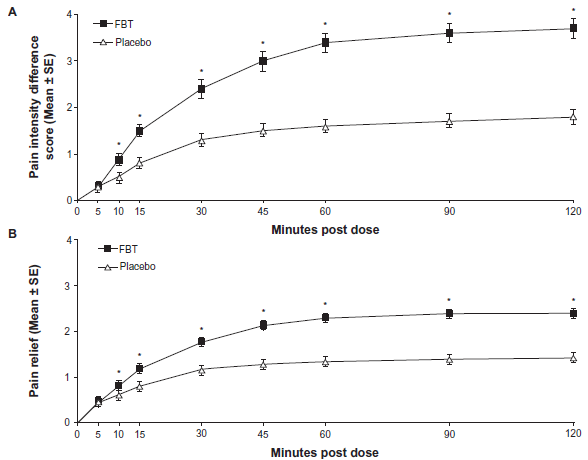
Effect of fentanyl buccal tablet (FBT) (black square) and placebo (white triangle) on pain scores in opioid-tolerant patients with breakthrough pain (BTP) associated with chronic cancer pain (n = 78):
To date, the clinical study program for FBT has also included three double-blind, placebo-controlled efficacy studies in opioid-tolerant patients with BTP in association with chronic noncancer-related pain. Two of the noncancer studies, which enrolled patients with chronic low back pain 29 and neuropathic pain, 30 were similar in design to the aforementioned cancer studies; the third enrolled patients with a range of chronic noncancer pain conditions and had a novel, 12-week design. 27
Consistent results were seen across the noncancer studies: the primary efficacy variable—SPID60—was significantly greater (
Overview of efficacy outcomes from clinical studies of FBT in opioid-tolerant patients with BTP in association with chronic cancer pain and chronic noncancer pain.27–31
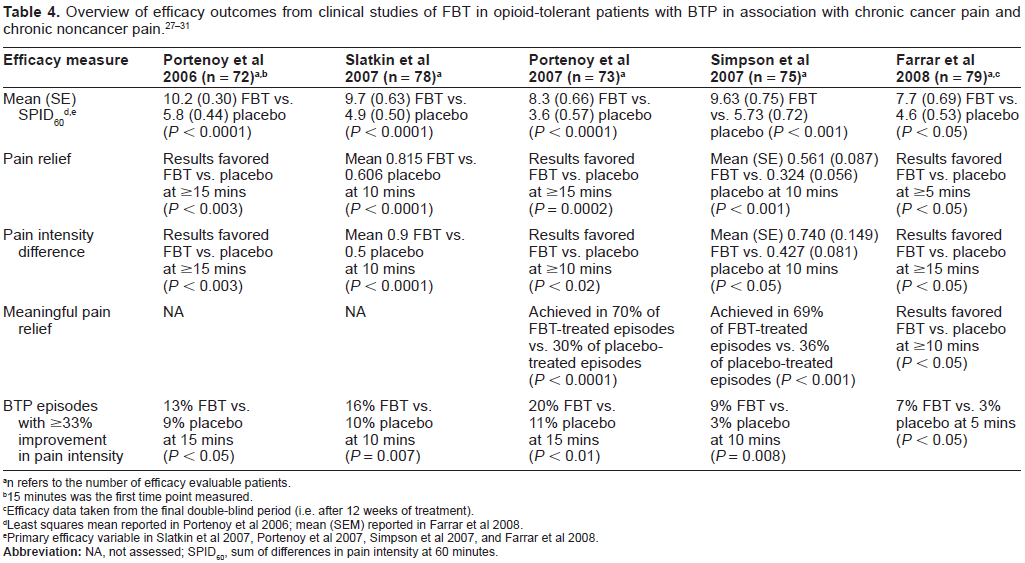
n refers to the number of efficacy evaluable patients.
15 minutes was the first time point measured.
Efficacy data taken from the final double-blind period (i.e. after 12 weeks of treatment).
Least squares mean reported in Portenoy et al 2006; mean (SEM) reported in Farrar et al 2008.
Primary efficacy variable in Slatkin et al 2007, Portenoy et al 2007, Simpson et al 2007, and Farrar et al 2008.
Safety and Tolerability Profile of FBT in Clinical Studies of BTP
Experience to date has suggested that the safety and tolerability profile of FBT is generally similar to that of other potent opioids.8,9,33 In the short-term studies with FBT, in both cancer and noncancer patient populations, the most frequent AEs included nausea, vomiting, headache, dizziness, and fatigue (Table 5).28–31 These AEs were generally mild to moderate in intensity. Application site AEs, related to the buccal placement of FBT, occurred in up to 10% of patients. The majority of these were mild and transient and did not lead to discontinuation of study drug. In the cancer studies, up to 11% of patients experienced a serious AE; none were considered by the investigator to be related to study medication.28,31 In the noncancer studies, three patients experienced a serious AE; one event (nonfatal overdose resulting in loss of consciousness) was considered by the investigator to be related to study medication.29,30
Adverse event profile of FBT during short-term clinical studies.28–31
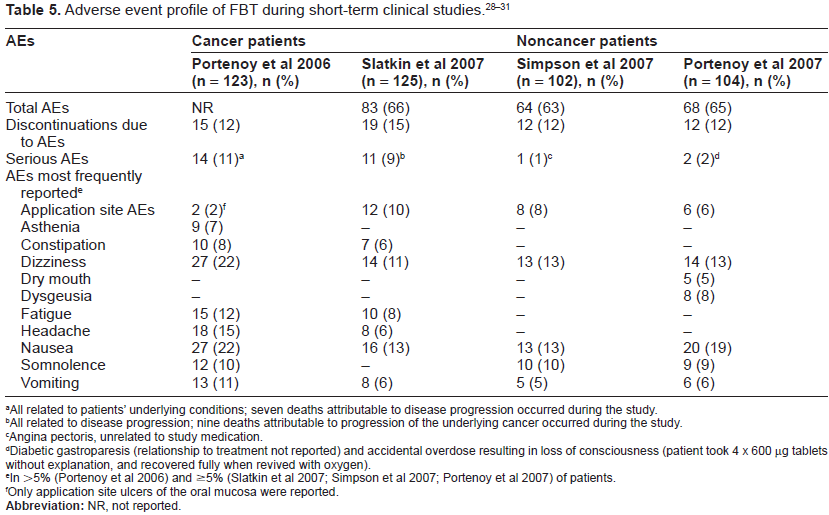
All related to patients’ underlying conditions; seven deaths attributable to disease progression occurred during the study.
All related to disease progression; nine deaths attributable to progression of the underlying cancer occurred during the study.
Angina pectoris, unrelated to study medication.
Diabetic gastroparesis (relationship to treatment not reported) and accidental overdose resulting in loss of consciousness (patient took 4 × 600 µg tablets without explanation, and recovered fully when revived with oxygen).
In >5% (Portenoy et al 2006) and ≥5% (Slatkin et al 2007; Simpson et al 2007; Portenoy et al 2007) of patients.
Only application site ulcers of the oral mucosa were reported.
The most commonly reported AEs in the 12-week study in patients with noncancer-related BTP included nausea (15%), dizziness (11%), somnolence (8%), vomiting (5%), and arthralgia (5%), which were similar to the AEs observed in the short-term studies. Application site AEs were reported in 7% of patients. Ten of 148 patients (7%) had one or more serious AEs during the study; most were considered not related to treatment. One patient developed pneumonia and had an accidental overdose of opioid medication; however, the relative contribution of study medication or other opioids to these events was unknown. One patient reportedly consumed all of her opioid medication (FBT, oxycodone, and oxycocet) over a short period of time and began suffering from withdrawal symptoms after finishing her medications. 27
The longer-term safety and tolerability profile of FBT has been investigated in an open-label extension study among patients with cancer-related chronic pain and BTP for treatment periods of 12 months or longer. 34 A total 197 opioid-tolerant patients were exposed to FBT for a median 122 days (range, 1–698). During the period when patients were maintained on their individual effective doses, 71 patients stopped treatment with FBT because of AEs. In general, these AEs were consistent with those observed in the short-term studies and included nausea, vomiting, and dizziness. All of the serious AEs were considered to be unrelated to study medication by the investigators, with one exception (drug withdrawal syndrome). 34
Data are also available for 728 opioid-tolerant patients with noncancer-related BTP treated for a median (range) 329 (1–638) days. 35 During long-term follow up (n = 646), the most common AEs were nausea (17% of patients), back pain (15%), vomiting (12%), and headache (11%). There were 118 patients (18%) with one or more serious AEs; the most common serious AEs were chest pain, pneumonia, and vomiting (five patients each). Six deaths occurred (three myocardial infarction, two cardiac arrest, one pneumonia); all were rated by investigators as not or unlikely to be related to FBT. There were two reports of accidental overdose; nine patients reported AEs associated with opioid overdose (ATC and/or FBT and/or other medications). Factors leading to these events included suicide attempt, altered mental status, and aberrant drug-related behaviors. There was also one case of study drug diversion. Drug withdrawal syndrome occurred in 23 patients following discontinuation of FBT alone/in combination with other opioids. Overall, 70 patients (11%) discontinued from long-term follow up because of AEs. 35
Conclusion
OraVescent technology enhances the oral dissolution and buccal absorption of fentanyl. This coupling of increased solubility and mucosal absorption facilitates rapid uptake of fentanyl into the bloodstream, reducing gastrointestinal absorption and successfully minimizing extensive first-pass metabolism. The resulting pharmacokinetic profile of FBT is characterized by greater bioavailability and a higher early systemic exposure compared with the earlier OTFC formulation. This technology could be used to enhance the delivery of other drugs that are pH-dependent for solubilization and absorption through a cellular membrane, such as the buccal mucosa.
In clinical studies of opioid-tolerant patients with cancer-related and noncancer-related BTP, FBT has provided consistent and clinically relevant improvements in PI and PR relative to placebo, with a safety and tolerability profile that is generally typical of that observed with other potent opioids.
Recently, other technologies have also utilized the buccal and sublingual mucosa for delivery of fentanyl for the treatment of BTP. For example, a sublingual orally disintegrating tablet has been formulated to distribute an ordered mixture of fentanyl combined with soluble carrier particles, 36 and a soluble film has been developed to deliver fentanyl by adhering to the buccal mucosa. 37
Effective management of BTP requires an efficient and rapid onset of analgesia. The pharmacokinetic properties of FBT allow for meaningful clinical efficacy, with an onset of action that closely matches the onset of BTP. As with any schedule II controlled substance, the risk of abuse, misuse, and diversion must be carefully monitored and managed.
Disclosures
This manuscript has been read and approved by all authors. This paper is unique and is not under consideration by any other publication and has not been published elsewhere. The authors are employees of Cephalon, Inc. (MD and JM) or CIMA Labs, Inc. (EH).
Footnotes
Acknowledgments
Writing support for an initial draft was provided by Ogilvy Healthworld, funded by Cephalon, Inc. The authors acknowledge the medical review by Arvind Narayana, MD, MBA, of Cephalon, Inc.