






Abstract
The objective of this study was to investigate whether the intake level of a staple food influences the nutritional status of water-soluble vitamins in pregnant Japanese women. Urinary excretion of water-soluble vitamins was used as a biomarker for nutritional assessment. Twenty-four-hour urine samples were collected and vitamin intake was surveyed using a validated self-administered comprehensive diet history questionnaire. Subjects were categorized into bottom, middle, and upper tertiles according to the percentage of total energy intake from wheat and wheat alternatives or rice and rice alternatives. The present study showed that the nutritional status of water-soluble vitamins did not differ with intake level of wheat and wheat alternatives or rice and rice alternatives as a staple food in pregnant Japanese women.
Introduction
The nutritional status of women during pregnancy influences the health of both the mother and the fetus. Many studies have reported on the dietary effects of pregnant women during various physiological events and diseases.1–21 Rice is a staple food in many Asian countries, including Japan. However, wheat and wheat alternatives are becoming increasingly prominent. Okubo et al 1 reported that inadequate nutrition was more prevalent in pregnant Japanese women with a dietary pattern of wheat products than of rice, fish, and vegetables. The nutrient intake examined in the study was calculated using the Standard Tables of Food Composition in Japan. However, this method is limited in its ability to evaluate nutrient intake.
We investigated whether intake levels of either wheat and wheat alternatives or rice and rice alternatives influenced the status of water-soluble vitamins in Japanese women in their third trimester of pregnancy using the urinary excretion of water-soluble vitamins as a biomarker.
Materials and Methods
The experiment was reviewed and approved by the ethics committee of the University of Shiga Prefecture. The purpose and protocol of this study was explained to all participants before they decided to join and written informed consent was obtained from each participant.
Subjects and experimental design
Subjects
Pregnant Japanese women (third trimester of pregnancy, after 28 weeks’ gestation) were recruited from a parenting circle at the University of Shiga Prefecture between April 2011 and February 2012. A total of 32 pregnant Japanese women with an average age of 31.7 ± 3.9 years voluntarily participated in the present experiment. They did not regularly use medications or dietary supplements or engage in habitual alcohol or cigarette consumption. Body weight, height, and body mass index (mean ± SD, n = 32) were 59.1 ± 7.8 kg, 160.2 ± 4.8 cm, and 23.1 ± 2.4 kg/m2, respectively. The exclusion criteria were: presence of cold or influenza and use of multivitamin supplements at least once during the previous month.
Diet history assessment
Dietary habits during the preceding month were assessed using a validated self-administered comprehensive diet history questionnaire (DHQ).23–25 The DHQ was a 16-page structured questionnaire that consisted of the following six sections: general dietary behavior; major cooking methods; consumption frequency and semi-quantitative portion size of 122 select food and nonalcoholic beverage items; intake of dietary supplements; consumption frequency and semi-quantitative portion size of 19 cereals usually consumed as staple foods (rice, bread, and noodles) and miso (fermented soybean paste) soup; and open-ended items for foods consumed regularly (more than once per week) but not appearing in the DHQ. Items and portion sizes were derived primarily from data in the National Nutrition Survey of Japan and several recipe books for Japanese dishes. All answered DHQs, including a lifestyle questionnaire, were checked at least twice for completeness. When necessary, forms were reviewed with the subject to ensure the clarity of answers.
The energy and nutrient contents of 150 food and beverage items were estimated using an
Collection of 24-h urine sample
A single 24-h urine sample was collected 1 day after completing the DHQ to measure the content of water-soluble vitamins and their metabolites. Subjects were instructed both in writing and orally on the methods of urine collection and the necessity of obtaining a complete 24-h urine collection. Subjects were requested to eat and drink normally during the collection and to follow their usual pattern of activity. They were then provided with a bag, three or four 1-L plastic bottles (containing no additives), and 10 400-mL cups. A recording sheet was also provided.
Subjects were asked to discard the first specimen in the morning and to record the time (usually 06:00-09:00) on the recording sheet (known as the start of the collection period). Subjects were then asked to collect all specimens before that time the following morning. If any specimens were missed, subjects were asked to record the estimated volume of missing urine and time. The last specimen was asked to be collected at the same time as the discarded specimen of the previous morning and the time recorded (known as the end of the collection period). The sheet was reviewed by staff at the time of collection to immediately obtain any missing information from subjects.
All urine from the 24-h collection period was combined and mixed thoroughly by vigorous stirring. The total urine volume of each subject was measured using a volumetric cylinder, and a urinary aliquot was taken and used to determine the presence of vitamins and their metabolites.
Chemicals
Thiamin hydrochloride, riboflavin, cyanocobalamin, calcium pantothenate, pteroylmonoglutamic acid (folic acid), D(+)-biotin, and L(+)-ascorbic acid were purchased from Wako Pure Chemical Industries (Osaka, Japan) and used as standards for vitamin B1, vitamin B2, vitamin B12, pantothenic acid, folate, biotin, and vitamin C, respectively. 4-Pyridoxic acid (4-PIC), a metabolite of vitamin B6, was manufactured by ICN Pharmaceuticals (Costa Mesa, CA, USA) and obtained through Wako Pure Chemical Industries.
Determination of vitamins and their metabolites in urine
To analyze vitamin B1, vitamin B2, 4-PIC, MNA, 2-Py, 4-Py, and biotin, 1 mL of 1 MHCl was added to 9 mL urine to stabilize the vitamins and their metabolites and stored at −80°C until analysis. Urinary contents were determined using the HPLC-post labeled fluorescence method (vitamin B1), 29 HPLC method (vitamin B2, 4-PIC, 2-Py, 4-Py, and MNA),28,30–32 and microbioassay method using Lactobacillus plantarum ATCC 8014 (biotin). 33
For vitamin B12, acetate buffer and potassium cyanide were added to urine, and any urinary vitamin B12 was converted to cyanocobalamin by autoclaving. 34 Urinary content of cyanocobalamin was then determined by the microbioassay method using Lactobacillus leichmanii ATCC 7830. 34
For pantothenic acid, part of the urine sample was stored at −80°C until analysis. Urine content of pantothenic acid was then determined using the HPLC method. 35
For folate, 1 mL of 1 M ascorbic acid was added to 9 mL urine to stabilize the folate and stored at −80°C until analysis. Urinary content of folate was determined by the microbioassay method using Lactobacillus rhamnosus ATCC 27773. 36
For ascorbic acid, 4 mL of 10% metaphosphate was added to 4 mL urine to stabilize the ascorbic acid and its catabolites and stored at −80°C until analysis. Urinary content of reduced and oxidized ascorbic acid and 2,3-diketogulonic acid was determined using the HPLC method. 37
Statistics
For analysis, subjects were categorized into bottom, middle, and upper tertiles according to the percentage of the total energy intake from wheat and wheat alternatives or rice and rice alternatives, as shown in Table 1. Data were expressed as the mean ± SD. Statistical significance between the bottom, middle, and upper tertiles was determined using one-way analysis of variance followed by Tukey's multiple comparison tests. Intake levels and urinary excretion of vitamins in the same tertile but between the wheat and wheat alternatives and rice and rice alternatives groups were compared using the Mann-Whitney U test. All statistical analyses were performed using GraphPad Prism version 5.0 (GraphPad Software, San Diego, CA, USA).
Division of tertiles according to the intake of wheat and wheat alternatives and rice and rice alternatives.

Results
Intake of water-soluble vitamins
Table 2 compares the intake of energy, major nutrients, and water-soluble vitamins between wheat and wheat alternative and rice and rice alternative diets in the three tertiles. Intake of wheat and wheat alternatives did not influence the total energy intake or % energy intake of protein, fat, and carbohydrate. Intake of rice and rice alternatives did not influence the total energy intake or % energy intake from protein, but it reduced the % energy intake of fat and increased the % energy intake of carbohydrate.
Intake of energy, major nutrients, and water-soluble vitamins of Japanese women in the third trimester of pregnancy.
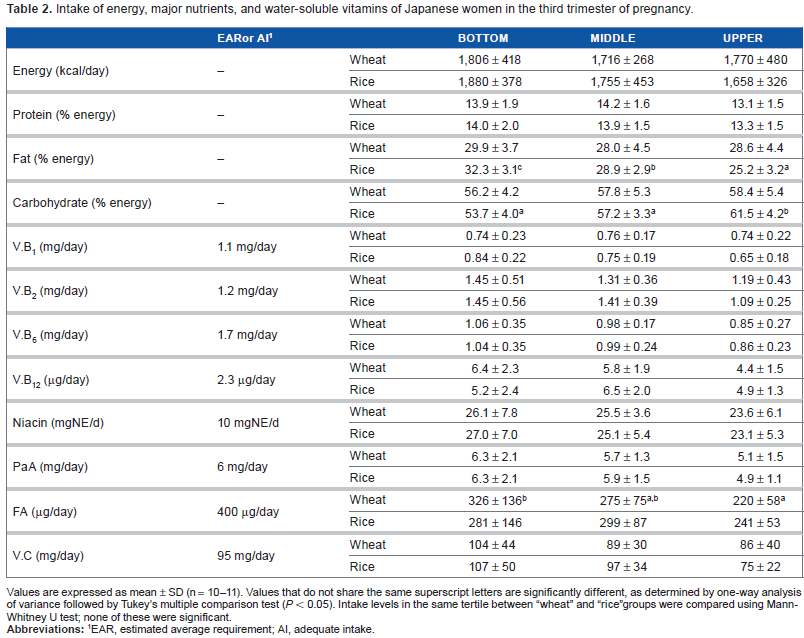
Values are expressed as mean ± SD (n = 10-11). Values that do not share the same superscript letters are significantly different, as determined by one-way analysis of variance followed by Tukey's multiple comparison test (
EAR, estimated average requirement; AI, adequate intake.
Increased intake of wheat and wheat alternatives reduced folate intake, while other vitamins were unaffected. Intake of vitamin B1, vitamin B6, and folate were below the respective estimated average for pregnant Japanese women, 38 regardless of the intake level of wheat and wheat alternatives.
Increased intake of rice and rice alternatives did not influence the intake of water-soluble vitamins. Intake of vitamin B1, vitamin B6, folate, pantothenic acid, and vitamin C in the upper tertile were below the respective estimated average intakes, 38 regardless of the intake level of rice and rice alternatives.
Vitamin intake between wheat and wheat alternatives and rice and rice alternatives in each of the tertiles was not significantly different.
Food category
To determine whether the pregnant women who consumed large amounts of wheat and wheat alternatives had preferences for different types of foods, Table 3 compares the intake of cereals, confectioneries, fats and oils, vegetables, fishes and shellfishes, meats, eggs, and milks between wheat and wheat alternative and rice and rice alternative diets in the three tertiles. The intake of wheat and wheat alternatives affected only vegetable intake, with the upper tertile consuming lower amounts of vegetable than the bottom and middle tertiles. Rice and rice alternative intake affected only cereal and confectionery intake. Cereal consumption increased with rice and rice alternative intake, while confectionery intake was lowest in the upper tertile.
Intakes of cereals, confectioneries, fats and oils, vegetables, fishes and shellfishes, meats, eggs, and milks of Japanese women in the third trimester of pregnancy.

Values are expressed as mean ± SD (n = 10-11). Values that do not share the same superscript letters are significantly different, as determined by one-way analysis of variance followed by Tukey's multiple comparison test (
No significant differences between wheat and wheat alternative and rice and rice alternative intake were observed in any of the food categories between the three tertiles.
Urinary excretion of water-soluble vitamin
Table 4 shows the effect of wheat and wheat alternative and rice and rice alternative intake on the urinary excretion of water-soluble vitamin for the three tertiles. Of the nine water-soluble vitamins, only niacin, which included the nicotinamide catabolites MNA, 2-Py, and 4-Py, was excreted less in the upper tertile of wheat and wheat alternatives than in the bottom and middle tertiles. For the rice and rice alternatives, none of the water-soluble vitamins were affected by tertile differences.
Urinary excretion of vitamin B1, vitamin B2, 4-PIC (a catabolite of vitamin B6), vitamin B12, niacin (sum of the nicotinamide catabolites), pantothenic acid, folate, biotin, and vitamin C of Japanese women in the third trimester of pregnancy.

These values are withdrawn from ref. 38
Values are expressed as mean ± SD (n = 10-11). Values that do not share the same superscript letters are significantly different, as determined by one-way analysis of variance followed by Tukey's multiple comparison test (
No significant differences were observed in the excretion of vitamins between wheat and rice consumption.
The proposed lower excretion limits for health maintenance are also shown in Table 4. 39 The value for vitamin B12 is not shown, as the main elimination pathway for this vitamin is not in the urine. All measured levels of excreted water-soluble vitamins were similar and/or higher than the respective lower limit. 39
Discussion
The dietary habits of pregnant Japanese women, particularly those in the third trimester of pregnancy, have a significant impact on the health of the developing fetus.8,11,18,19 Ohkubo et al 1 reported that the nutritional status of pregnant Japanese women with a high intake of wheat and wheat alternatives was worse than those who consumed rice and rice alternatives. This study sought to determine whether intake of a staple food influenced the status of water-soluble vitamins of Japanese women in the third trimester of pregnancy.
We recruited 32 pregnant Japanese women in the third trimester of pregnancy. No difference in energy intake was observed between those consuming wheat and wheat alternatives and those consuming rice and rice alternatives. The order of % energy of fat in rice and rice alternatives subgroup was upper tertile (32%) < middle tertile (29%) < bottom tertile (25%). Higher intake of rice and rice alternatives reduced % energy intake of fat. This was expected since the fat concentration of cooked rice is only 0.3%. 22 Fat intakes were different, but not significantly, so that % fat intakes by rice and rice alternatives did not affect the health of mother and their body mass index. We did not evaluate the embryo and newborn baby's health conditions. However, no adverse effects were reported.
We first analyzed how the intake of wheat and wheat alternatives influenced the intake of water-soluble vitamins. Only folate intake in women consuming wheat and wheat alternatives was lower in the upper tertile than in the bottom tertile. Vegetable intake, which is generally considered an excellent source of folate, was similarly lower in the upper tertile. Urinary folate excretion indicates that folate is available in the body, but no significant differences in urinary folate excretion were observed between the bottom, middle, and upper tertiles. Low intake of fish and shellfish was observed in the upper tertile of wheat and wheat alternatives. This may be advantageous as some fish and shellfish can inhibit conjugase, an enzyme required to breakdown dietary folate into mono- and di-glutamate forms before it can be successfully absorbed into the small intestinal cells. 40 Thus, the intake level of wheat and wheat alternatives for Japanese women in the third trimester of pregnancy did not influence the nutritional statuses of water-soluble vitamins.
Folate intake was calculated using the Standard Tables of Food Composition in Japan. 22 However, the Standard Tables of Food Composition for folate was limited by its two-enzyme determination method (protease and conjugase) compared to the recommended tri-enzyme method (amylase, protease, and conjugase). 42 Tamura43,44 suggested that all folate food tables should be reevaluated to determine more reliable values. He proposed using the tri-enzyme method, not the two-enzyme method, for extracting folate, as folate compounds in food exist in enzyme-bound polyglutamates that are surrounded by complex carbohydrates. 42 Folate compounds in urine, however, exist as free monoglutamates,45 and the test microorganism Lactobacillus rhamnosus ATCC 27773 alone can be directly used as the growth factor. Thus, the measurement of folate content in urine samples is more reliable than in food samples.
We subsequently analyzed how rice and rice alternatives influenced the intake of water-soluble vitamins. Neither the intake nor excretion of water-soluble vitamins was affected.
The present study was limited by the low number of subjects as well as the use of urinary excretion reference values 38 that were not set by authorized agencies such as the Expert Committee for Dietary Reference Intakes for Japanese. 37 Similar studies are needed in the future.
The urinary excretion of niacin in the upper tertile of wheat and wheat alternatives was lower in that in the middle tertile. In the present experiment, niacin nutrition was evaluated by measuring urine MNA, 2-Py, and 4-Py. These metabolites originated preformed niacin as well as L-tryptophan. Higher intake of wheat and wheat alternatives reduced the intake of vegetables. Some compounds in vegetable can be decreased through the conversion of L-tryptophan to niacin.
The use of biomarkers, such as vitamins excreted in urine, may be more reliable than the traditional method of assessing nutrient using food consumption tables. B-group vitamins exist in complex forms, eg, vitamin B1 exists as TDP-enzyme complex, vitamin B2 as FAD-enzyme complex, vitamin B6 as PLP-enzyme complex, vitamin as adenosyl (or methyl) cobalamine-enzyme complex, nicotinamide as NAD (P)-enzyme complex, pantothenic acid as CoA-enzyme complex, folate as polyglutamated tetrahydrofolate-enzyme complex, and biotin as biotin-enzyme complex. Furthermore, these coenzyme-enzyme complexes are surrounded by complex cellular materials. Determining B-group vitamins in food can be difficult. Instead, assessing urine is easier as B-group vitamins in urine are free forms, eg, thiamin, riboflavin, etc. We propose using urinary levels of water-soluble vitamins (B-group vitamins + vitamin C) as biomarkers of the nutritional status of vitamins.
In conclusion, the nutritional status of water-soluble vitamins did not differ according to the intake level of wheat and wheat alternatives and rice and rice alternatives as a staple food in pregnant Japanese women when the urinary excretion amounts of water-soluble vitamins were used as biomarkers of nutritional statuses of water-soluble vitamins. In addition, the nutritional statuses of all members of water-soluble vitamins were good in pregnant Japanese women.
Author Contributions
The study was designed by KS and TF. Data were analyzed and the manuscript drafted by KS. TF and SS reviewed the manuscript. All authors reviewed and approved the final manuscript.
Disclosures and Ethics
As required for publication, the authors have provided signed confirmation of their compliance with ethical and legal obligations, including, but not limited to, compliance with ICMJE authorship and competing interests guidelines, that the article is neither under consideration for publication nor published elsewhere, of their compliance with legal and ethical guidelines concerning human and animal research participants (if applicable), and that permission has been obtained for reproduction of any copyrighted material. This article was subject to blind, independent, expert peer review. The reviewers reported no competing interests.
Footnotes
Acknowledgements
The authors thank all the volunteers who participated in the present study and express their sincere appreciation to their students for measuring the urinary excretion of vitamins.