






Abstract
Biotin enzymes such as pyruvate carboxylase and acetyl-CoA carboxylase are involved with the most basic metabolism. Thus, it is very important to monitor the biotin nutritional status for maintaining good health. We examined urinary excretion and the intake of biotin in a Japanese sample population of 60 boys and 36 girls (10-12 y), 37 male and 135 female college students (18-27 y), and 35 female elderly persons (70-84 y) living freely. All food consumed, and the corresponding weighing, for 4 consecutive days were recorded. A 24-hour urine sample was collected on the fourth day, and the urine biotin was measured. The urine biotin at the fourth day was 57.8, 50.9, 81.0, 66.2, and 82.3 nmol/day in boys, girls, male students, female students, and elderly persons, respectively. The average intake of biotin for 4 consecutive days was 35, 31, 28, 26, and 32 μg/day in boys, girls, male students, female students, and elderly persons, respectively.
Introduction
Biotin plays crucial roles as coenzymes of 4 kinds of enzymes in mammals: pyruvate carboxylase (EC 6.4.1.1), acetyl-CoA carboxylase (EC 6.4.1.2), propionyl-CoA carboxylase (EC 6.4.1.3), and methylcrotonyl-CoA carboxylase (EC 6.4.1.4). Pyruvate carboxylase, which catalyzes the reaction [pyruvate + CO2 + ATP → oxaloacetate + ADP + H3PO4], is a key and initial enzyme of gluconeogenesis. Acetyl-CoA carboxylase, which catalyzes the reaction [acetyl-CoA + CO2 + ATP → malonyl-CoA + ADP + H3PO4] is a key and initial enzyme of fatty acid synthesis. Propionyl-CoA carboxylase, which catalyzes the reaction [propionyl-CoA + CO2 + ATP → D-methylmalonyl-CoA + ADP + H3PO4], is involved in the degradation pathway of isoleucine as well as odd-chain fatty acids. Methylcrotonyl-CoA carboxylase, which catalyzes the reaction [3-methylcrotonyl-CoA + CO2 + ATP → 3-methylglutaconyl-CoA + ADP + H3PO4], is involved in the leucine degradation pathway. In particular, pyruvate carboxylase and acetyl-CoA carboxylase are concerned with the most basic metabolism. Thus, it is very important to check the biotin nutritional status for maintaining good health.
In Japan, biotin in food contents had not been available as biotin contents were not described until the Standard Tables of Food Composition in Japan 2010 became available. 1 Hence, information on biotin intake is sparse. One report written in Japanese was published 2 after the publication of the Standard Tables of Food Composition in Japan 2010. 1 In this report, Kato et al 2 revealed that the intakes of biotin in Japanese males (40-89 y, n = 1,065) and females (40-89 y, n = 1,050) were 29 ± 13 μg/day (119 ± 53 nmol/day) and 25 ± 11 μg/day (100 ± 45 nmol/day), respectively. These values are much lower when compared to the adequate intake of biotin (50 μg/day = 205 nmol/day) for male and female provided by Japanese Dietary Reference Intakes 2010. 3 The value of adequate intake was set based on the studies of estimation of dietary intake of biotin done by total diet study.4–6 Part of the disagreement of biotin intake among the reports2,4–6 is attributable to the biotin measurements, while another is uncertainty using total diet samples. 5 The other is based on imperfection of description of the Standard Tables of Food Composition in Japan 2010 1 ; the values of biotin contents are not described in some kinds of foods. Preliminary survey of biotin intake in Japanese college women (n = 30) was about 30 μg/day (123 nmol/day), which is a similar value as that given by Kato et al. 2 Thus, the question arises whether the intake of ~30 μg/day of biotin can maintain good nutritional status of biotin or not.
We reported that the urinary excretion amounts of water-soluble vitamins closely reflect the intakes of water-soluble vitamins in rats7–21 and humans.22–33 The nutritional assessment using biomarkers is persuasive, and leads readily to the transformation of habitual dietary intakes. Recently, Shibata and Fukuwatri 34 proposed values for evaluating the nutritional status of water-soluble vitamins in humans administered a semi-chemically defined diet, according to Japanese Dietary Reference Intakes 3 ; the lower limit of excretion of biotin for maintaining health is 50 nmol/day.
In the present experiment, we examined the intake and 24 h urinary excretion of biotin in Japanese male and female elementary school children, male and female college students, and female elderly persons who were not restricted in their life or diet and can take food ad libitum.
Materials and Methods
Participants
This study was reviewed and approved by The Ethical Committee of The University of Shiga Prefecture.
Elementary school children
A total of 132 healthy Japanese male and female elementary school children aged 10-12 y who were not restricted in their life and are able to take food ad libitum, voluntarily participated in this study. The purpose and protocol of this study was explained to all participants as well as their parents before joining the study, and written informed consent was obtained from each parent, as all participants were less than 20 years old. We excluded participants diagnosed with cold or influenza, and those who had taken multi-vitamin supplement at least once during the previous month. In addition, we excluded participants whose 24 h urine collection or dietary records were considered incomplete, with a collection time outside the 22-26 hour range, urine volume less than 250 mL, creatinine excretion in relation to body weight (creatinine (mg) divided by body weight (kg)) outside the 10.8-25.2 mg/kg range,35,36 or extremely low or high energy intake (<2,092 or >16,736 kJ/d). 3 After these screenings, 96 school children (60 boys and 36 girls) were found to be eligible.
College students
A total of 216 healthy Japanese male and female dietetic university students aged 18-27 y who were not restricted in their life and are able take food ad libitum, voluntarily participated in this study. The purpose and protocol of this study was explained to all participants before joining the study, and written informed consent was obtained from each participant, and from the parents of participants aged less than 20 y. We excluded participants described as “elementary school children.” After these screenings, 175 participants (37 males and 138 females) were found to be eligible.
Elderly persons
A total of 64 healthy Japanese elderly females aged 70-84 y who were not restricted in their life and are able to take food ad libitum, voluntarily participated in this study. The purpose and protocol were explained to all participants before joining the study, and written informed consent was obtained from each participant. After these screenings, 35 elderly females were found to be eligible.
Dietary records
This was a 4 day dietary assessment in which the participants were not restricted in their life and were able to take food ad libitum. The first day (Monday) of the experiment period was defined as Day 1, the second day as Day 2, the third day as Day 3, and the fourth day as Day 4. All food consumed during the 4-day period was recorded using a weighed food record method. 37 A digital cooking scale (1 g unit; Tanita Inc. Japan), a set of dietary record forms, a dietary record manual, and a disposable camera were distributed to the participants in advance. Upon entry of the dietary record, the status of food at oral intake was identified as “raw,” “boiled,” “cooked,” “the presence of skin,” “a part of cooking ingredients,” or “with or without seasoning,” and coded according to the Standard Tables of Food Composition in Japan 2010. 1 The participants took photos of the dishes before and after eating with their disposable camera. Several experienced dietitians used the photos to complete the data, and asked participants to resolve any discrepancies or to obtain further information when needed. The food that remained after eating was measured by a digital scale and was deducted from the dietary record. Food, nutrient, and energy intakes were calculated using SAS statistical software, version 6.12 (SAS Institute, Cary, NC, USA), based on the Standard Table of Food Composition in Japan 2010. 1
24 hour urine sample
A single 24 h urine sample was collected on the fourth day to measure urinary biotin. In the morning, participants were asked to discard the first specimen and to record the time on the sheet. The next morning, participants were asked to collect the last specimen at the same time as that of the discarded specimen from the previous morning, and to record the time on the sheet. After the urine sample was collected, the volume of the sample was measured and then stored at −20°C until analysis.
Chemicals
D(+)-Biotin (C10H16N2O3S = 244.31) was purchased from Wako Pure Chemicals (Osaka, Japan). All other chemicals used were of the highest purity available from commercial sources.
Analytical methods
The catabolites of biotin in human urine are known. Mock et al
38
reported that biotin is catabolized to bisnorbiotin and biotin sulfoxide in humans, and that the bioassay organism grows equally well on the biotin as well as the biotin metabolites present in urine. The standard catabolites are not purchased from commercial sources but, in the present study,
Urinary excretion percentage of biotin
The urinary excretion of percentage of biotin over average intake of biotin during Day 1 through Day 4 was calculated as follows: (24-hour urinary excretion of biotin at day 4, nmol/day)/(average biotin intake of day 1~day 4, nmol/day) × 100.
Statistical methods
The significance of the differences in the mean among groups was treated with one-way ANOVA and followed by Tukey's post hoc analysis used to compare among the groups. Pearson correlation coefficients were calculated to determine the association between urine and intake of biotin. The differences
Results
Basic characteristics
The basic characteristics of the participants are presented in Table 1. Each value was similar to those reported for children aged 10-11 y, adolescents aged 18-29 y, and elderly females older than 70 y in the Dietary Reference Intakes for Japanese 2010. 40 Thus, the participants were considered as typical parsons in respective ages of Japan. Table 1 also shows energy intakes and the energy percentages from protein, fat, and carbohydrate.
Basic characteristics of participants.
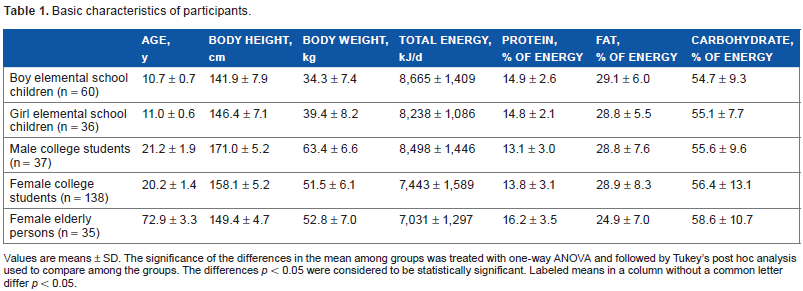
Values are means ± SD. The significance of the differences in the mean among groups was treated with one-way ANOVA and followed by Tukey's post hoc analysis used to compare among the groups. The differences
Urine biotin
Figure 1A shows the urinary excretion of biotin in boys aged 10-12 y. The mean ± SD was 57.8 ± 23.2 nmol/day. The maximum, median, and minimum values were 135.4, 54.3, and 21.4 nmol/day, respectively.

Urinary excretion of biotin in boys (
Figure 1B shows the urinary excretion of biotin in girls aged 10-12 y. The mean ± SD was 50.9 ± 22.3 nmol/day. The maximum, median, and minimum values were 109.6, 43.9, and 13.1 nmol/day, respectively.
Figure 1C shows the urinary excretion of biotin in male college students aged 18-27 y. The mean ± SD was 81.0 ± 30.4 nmol/day. The maximum, median, and minimum values were 169.6, 73.4, and 31.5 nmol/day, respectively.
Figure 1D shows the urinary excretion of biotin in female college students aged 18-27 y. The mean ± SD was 66.2 ± 32.7 nmol/day. The maximum, median, and minimum values were 253.5, 61.3, and 18.5 nmol/day, respectively.
Figure 1E shows the urinary excretion of biotin in female elderly persons aged 70-84 y. The mean ± SD was 82.3 ± 39.9 nmol/day. The maximum, median, and minimum values were 238.6, 75.3, and 23.6 nmol/day, respectively.
As described by Shibata and Fukuwatri, 34 proposed values for evaluating the nutritional status of water-soluble vitamins in humans administered a semi-chemically defined diet, according to Japanese Dietary Reference Intakes 3 ; the lower limit of biotin excretion for maintaining health is 50 nmol/day. The dotted lines in Figure 1 show 50 nmol/day. The ratios of below the value were 0.43 (26/60), 0.67 (24/36), 0.11 (4/37), 0.36 (50/138), and 0.17 (6/35), in boys, girls, male students, female students, and female elderly persons, respectively.
Intake of biotin
Figures 2A through 2E show the daily 4 days consecutive intakes of biotin in boys, girls, male students, female students, and female elderly persons, respectively. The 4 day consecutive mean biotin intakes were not significantly different among days in the populations.

Intakes of biotin in boys (
Figure 3A shows the average intakes of biotin during Day 1 through Day 4 in boys aged from 10-12 y. The mean ± SD was 142 ± 38 nmol/day (35 ± 9 μg/day). The maximum, median, and minimum values were 266 (65 μg/day), 133 (32 μg/day), and 84 nmol/day (20 μg/day), respectively.

Average intakes of biotin in boys (
Figure 3B shows the average intakes of biotin during Day 1 through Day 4 in girls aged from 10-12 y. The mean ± SD was 127 ± 25 nmol/day (31 ± 6 μg/day). The maximum, median, and minimum values were 176 (43 μg/day), 129 (31 μg/day), and 81 nmol/day (20 μg/day), respectively.
Figure 3C shows the average intakes of biotin during Day 1 through Day 4 in male college students aged 18-27 years. The mean ± SD was 114 ± 37 nmol/day (28 ± 9 μg/day). The maximum, median, and minimum values were 193 (47 μg/day), 112 (27 μg/day), and 45 nmol/day (11 μg/day), respectively.
Figure 3D shows the average intakes of biotin during Day 1 through Day 4 in female college students aged 18-27 y. The mean ± SD was 108 ± 48 nmol/day (26 ± 12 μg/day). The maximum, median, and minimum values were 382 (93 μg/day), 99 (24 μg/day), and 34 nmol/day (8 μg/day), respectively.
Figure 3E shows the urinary excretion of biotin in female elderly persons aged 70-84 y. The mean ± SD was 133 ± 42 nmol/day (32 ± 10 μg/day). The maximum, median, and minimum values were 249 (61 μg/day), 129 (31 μg/day), and 51 nmol/day (12 μg/day), respectively.
Urinary excretion percentage of biotin
Figure 4 shows the urinary excretion percentages of biotin, which was calculated by comparison of 24 hour urinary excretion of biotin and average biotin intake of Day 1 through Day 4.

Urinary excretion percentage of biotin in boys (
Figure 4A shows the urinary excretion percentages of biotin in boys aged 10-12 y. The mean ± SD was 42.7 ± 19.7%. The maximum, median, and minimum values were 117.7%, 39.6%, and 16.9%, respectively.
Figure 4B shows the urinary excretion percentages of biotin in girls aged 10-12 y. The mean ± SD was 40.1 ± 15.8%. The maximum, median, and minimum values were 87.1%, 35.0%, and 11.0%, respectively.
Figure 4C shows the urinary excretion percentages of biotin in male college students aged 18-27 y. The mean ± SD was 77.2 ± 34.0%. The maximum, median, and minimum values were 160.1%, 71.8%, and 27.0%, respectively.
Figure 4D shows the urinary excretion percentages of biotin in female college students aged 18-27 y. The mean ± SD was 64.6 ± 26.4%. The maximum, median, and minimum values were 138.0%, 62.3%, and 18.8%, respectively.
Figure 4E shows the urinary excretion percentages of biotin in female elderly persons aged 70-84 y. The mean ± SD was 60.9 ± 21.9%. The maximum, median, and minimum values were 138.0%, 57.0%, and 30.9%, respectively.
Correlation between 24 hour urinary excretion of biotin and daily biotin intake
Table 2 shows the correlation between 24 hour urinary excretion of biotin and daily biotin intakes. The urinary levels of biotin was correlated positively with mean intake over the recent 4 days in girls and female students, while, its relationship was not observed in boys, male students, and female elderly persons.
Correlation between 24-h urinary excretion of biotin and daily biotin intakes. 1

Pearson correlation coefficients were calculated to determine the association between urinary excretion of biotin and daily biotin intake.
Discussion
The Committee of Japanese Dietary Reference Intakes has determined that the adequate intake of biotin in adults in male and female is 50 μg/day, based on the data on biotin measurement of total diet samples. 3 However, there are uncertainties in this method. 5 Recent publication on the intake of biotin in Japanese showed that biotin intake in males (40-89 y, n = 1,065) and females (40-89 y, n = 1,050) were 29 ± 13 μg/day (119 ± 53 nmol/day) and 25 ± 11 μg/day (100 ± 45 nmol/day), respectively. 2 Thus, the present experiment was immediately arranged. In addition, the urinary excretion of biotin was measured as a biological surrogate index of biotin nutritional status. 34 We proposed that the urinary excretion of biotin over 50 nmol/day is needed for maintaining good health in adults. When the urinary excretion of biotin 50 nmol/day is met, the saturation of body stores of biotin is assumed. Over half of the participants exceeded the value of 50 nmol/day in adults with an intake of about 30 μg/day; it therefore could be plausible that the biotin nutritional status in the present participants were good. If so, 30 μg/day of biotin intake in Japanese adults could be considered to be a new estimated average requirement. The urinary excretion percentage of biotin in adults was over 50%, which may also support that this consideration.
Conversely, the urinary excretion of biotin in children aged 10-12 y was lower than that of adults aged 18-84 y, although the intakes of biotin were almost the same between the two populations. The urinary excretion percentage of biotin in children was about 40%, lower than the value of adults. This data implies that a requirement of biotin is higher in childhood than in adulthood. However, further studies are needed to determine a requirement of biotin of childhood.
Various studies have investigated the urinary excretion of biotin as an index of biotin nutritional status.41–46 Mock et al
46
reported that biotin is catabolized to bisnorbiotin and biotin sulfoxide in humans and that the bioassay organism grows equally well on the biotin and biotin metabolites present in urine. In the present experiment,
Author Contributions
Designed the study: KS, TF, TT. Drafted the manuscript: KS. Analysis of the dietary protocols: TT. Reviewed the manuscript: TF and TT. All authors reviewed and approved the final manuscript.
Disclosures and Ethics
As a requirement of publication, the authors have provided signed confirmation of their compliance with ethical and legal obligations including but not limited to compliance with ICMJE authorship and competing interests guidelines, that the article is neither under consideration for publication nor published elsewhere, of their compliance with legal and ethical guidelines concerning human and animal research participants (if applicable), and that permission has been obtained for reproduction of any copyrighted material. This article was subject to blind, independent, expert peer review. The reviewers reported no competing interests.
Footnotes
Acknowledgements
The authors express their sincere appreciation to our students for measuring the urinary excretion of biotin.