






Abstract
Various herbal teas including German chamomile, Chrysanthemum Vascuflow herb tea, hop, jasmine and orange flowers, sweet marjoram, spearmint and thyme leaves, and papaya-mint tea as well as coffee substitutes (Bambu instant Swiss, Teeccino chocolate-mint, and Teeccino Mediterranean Espresso) were analyzed for fungal contamination and the presence of aerobic mesophilic bacteria (APC). The results of this investigation showed that fungal counts reached levels as high as 5.8 × 10⁵ colony forming units (cfu) per gram. German chamomile harbored the highest fungal contamination. The most common fungi found in herbal teas were Aspergillus niger, Penicillium spp., Eurotium rubrum, E. chevalieri, A. flavus, Fusarium spp., Alternaria alternata, and yeasts. Among the coffee substitutes, only the chocolate-mint coffee was contaminated with low numbers (<1.0 × 10³ cfu g-1) of E. rubrum, Ulocladium spp. and Phoma spp., and with yeasts (< 100–6.8 × 10³ cfu g-1). Aerobic mesophilic bacteria were recovered from 100% of the herbal tea, chocolate-mint and Mediterranean Espresso, and from 50% of the Bambu instant Swiss coffee samples. The highest APC counts of 1.2 × 10⁷ cfu g-1 were observed in spearmint leaves.
Introduction
Hot water infusions of botanicals have been used as drinks for thousands of years in the Far East and Mediterranean countries for their taste and flavors. Many of them are believed to have medicinal properties and they are used to treat minor illnesses and disturbances. German chamomile (Matricaria chamomilla), for instance, has been used since ancient times in the region around the Mediterranean Sea as a stomach-soothing agent, mild sedative and as a diuretic. Recent reports by Gyllenhaal and his co-workers (2000) described some sedative attributes of German chamomile, while research by Macchioni et al. (2004) demonstrated a significant acaricidal activity of extracts from chamomile flowers. Chrysanthemum tea has been used in Chinese medicine as a detoxifier, to maintain healthy cholesterol levels and to improve blood flow. This herb contains health-promoting compounds such as choline, vitamins A, B1 and ascorbic acid, adenine, amino acids, flavonoids, glycosides and volatile oil (Gins et al. 2000), possesses anti-tumor properties (Ukiya et al. 2002), and has inhibitory effects against several bacteria and against the yeasts Saccharomyces cerevisiae, Candida spp. and Hansenula anomala (Shunying et al. 2005).
Infusions of spearmint (Mentha spicata), marjoram (Origanum marjorana), thyme (Thymus vulgaris) and papaya-mint tea are primarily consumed to treat digestive ailments, to reduce fever and for their anti-inflammatory, anti-oxidant and antimicrobial properties (Abe et al. 2004; Dorman et al. 2003; Mahady et al. 2005; Triantaphyllou et al. 2001; Dorman et al. 2004; Morton, 1987; Bagamboula et al. 2001). Marjoram, mint and other members of the Lamiaceae family contain phenolic compounds and flavonoids to which they probably owe their antioxidant attributes.
Hops (Humulus lupulus) and orange (Citrus sinensis) flowers are mainly used to relieve nervous tension (Gyllenhaal et al. 2000; Morton, 1987). Jasmine (Jasminum grandiflorum) flowers are used as an ingredient to add aroma and flavor to Chrysanthemum Vascuflow, green and other teas. This herb is also used as an alternative treatment for cancers and for viral and bacterial infections. Research by Kolanjiappan and Manoharan (2005) demonstrated a strong chemoprevention against experimental mammary carcinogenesis in rats.
Herbal coffee substitutes have the advantage over coffee that they do not contain caffeine and, depending on their ingredients, could contain various concentrations of health-promoting phytochemicals while they imitate coffee flavors. Therefore, an increasing number of health-conscious individuals are substituting coffee with these formulations. Several such products including chocolate-mint, Mediterranean Espresso and instant Swiss coffee are readily available in the U.S. market, mostly found in health stores and dietary supplement companies.
Although many herbal tea remedies are known and utilized for centuries, there is an increase of their consumption in recent years due to a trend to use natural therapies. Therefore, it is essential that these products are microbiologically safe. A few reports demonstrating microbial contamination of medicinal herbs from various parts of the world exist in the literature. Rizzo et al. (2004) indicated that medicinal plants in Argentina harbored toxigenic fungi such as A. flavus, A. parasiticus and several members of the Genus Fusarium; Efuntoye (1996) showed that dried medicinal plants from Nigerian herb markets contained A. flavus, A. parasiticus and A. ochraceus. The same investigator (1999) reported that the above fungal isolates were capable of elaborating mycotoxins when grown on semi-synthetic media. Martins et al. (2001), after evaluating several medicinal herbs obtained from Portugese markets, reported that these commodities were infested with a variety of moulds such as Aspergillus and Fusarium spp., whereas Halt (1998) isolated a wide spectrum of fungi (including Aspergillus, Penicillium, Alternaria, Cladosporium, Rhizopus and Mucor species) from Croatian herbal teas and medicinal plants. Czech et al. (2001) reported bacterial and fungal contamination of medicinal herbs in Austria, while Skorska et al. (2005) showed that the air in chamomile and peppermint processing farms in Poland contained high levels of Pantoea agglomerans and other gram negative bacteria. Such reports indicate the existence of a ubiquitous problem. Consequently, this research was designed to determine if various medicinal herbal teas and coffee substitutes available in the U.S. market are contaminated with toxigenic fungi and if they contain high levels of aerobic mesophilic bacteria.
Materials and Methods
Materials
A total of 69 herbal tea and coffee substitute samples comprised of German chamomile, Chrysanthemum Vascuflow tea, hop, jasmine and orange flowers, papaya-mint tea, sweet marjoram, spearmint and thyme leaves, and Bambu instant Swiss, Teecccino chocolate-mint and Mediterranean Espresso coffee substitutes were tested during the course of this experiment. Fifty-gram samples of spearmint, thyme, jasmine and hop flowers were obtained from bulk jars in local supermarkets; German chamomile, sweet marjoram, orange flowers and papaya-mint tea were purchased from commercial sources in their original, individual 4.0-oz (113 g) packages; Chrysanthemum Vascuflow tea was obtained from the same companies in intact boxes containing 20 tea bags; the coffee substitutes (Bambu instant Swiss, Teecccino chocolate-mint and Mediterranean Espresso) were also purchased from commercial sources in their individual, intact containers {8.5-oz (241 g) Teeccino chocolate-mint, 3.5-oz (99 g) Bambu instant Swiss and 0.85-oz (24 g) Teeccino Mediterranean Espresso}. Samples were purchased and maintained at room temperature until analysis; analysis was conducted within 1–4 days from the day of purchase.
Mycological analysis
All supplements were tested as follows: Ten grams of each sample were aseptically removed and transferred to sterile blender jars. Subsequently, each sample was blended in 90 ml of 0.1% peptone (Tournas et al. 2001) for 45 sec. Serial dilutions of the homogenate (in 0.1% peptone) were surface plated in duplicate potato dextrose agar (PDA) (DIFCO, Detroit, MI, U.S.A.) containing 0.01% chloramphenicol (0.1 ml/plate) and plates were incubated for 5 days at 25 °C. Then, colonies were counted and counts were expressed as colony forming units per gram (cfu g-1); mould isolates were purified on PDA and further sub-cultured on malt extract agar (MEA), czapek yeast extract (CYA), 25% glycerol nitrate (G25N) and czapek yeast extract 20% sucrose (CY20S) agar for microscopic examination and identification. Identification was performed according to the methods and keys described by Pitt and Hocking (1997) and Nelson et al. (1983). The compositions of CYA, MEA, G25N and CY20S media are described in “Fungi and Food Spoilage” (Pitt and Hocking, 1997).
Aerobic plate count determination
The aerobic plate counts were determined as follows: Ten-gram sample portions were aseptically transferred into sterile blender jars and treated as stated above except that Butterfield's phosphate buffer (Maturin and Peeler, 2001) was used as diluent instead of 0.1% peptone water. Serial dilutions were surface plated in duplicate plate count agar (PCA) plates. Plates were incubated at 35 °C for 48 hrs. Plate reading and colony counts determination were done according to the method described by Maturin and Peeler (2001).
Results and Discussion
Herbal teas
Mould and yeast (MY) counts in various herbal teas and coffee substitutes.
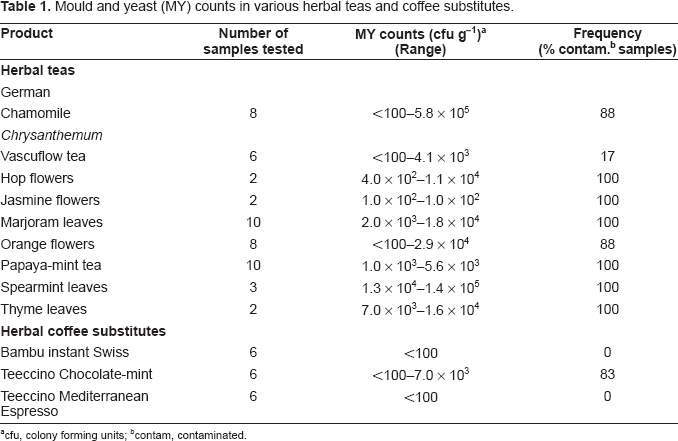
cfu, colony forming units;
contam, contaminated.
Fungal species and APCs a found in herbal teas and coffee substitutes.
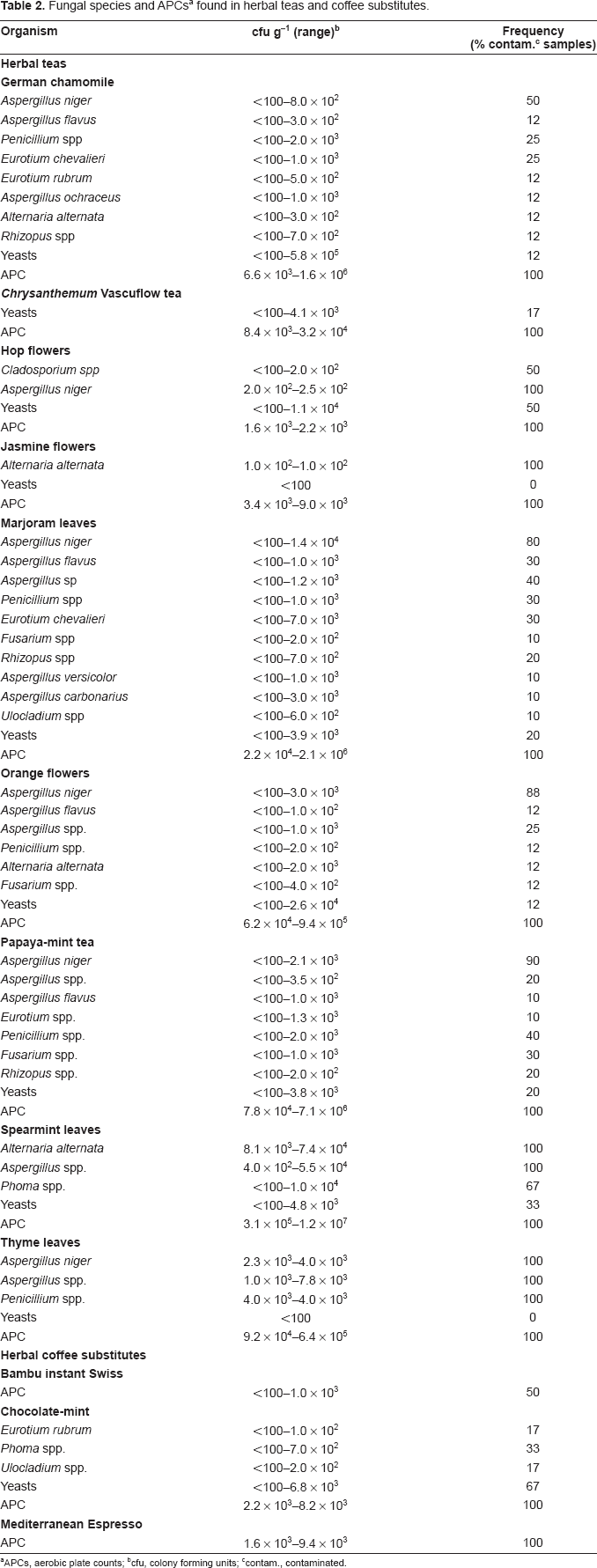
APCs, aerobic plate counts;
cfu, colony forming units;
ccontam., contaminated.
Seventeen per cent of the Chrysanthemum Vascuflow tea samples were contaminated with yeasts. No live moulds were found in this commodity (Table 2). Mould spores originally present in the herb were probably killed during processing. The isolated yeasts possibly originated from the personnel handling the materials after processing. Low numbers of A. niger were present in both hop flower samples, whereas one of the samples also contained Cladosporium spp. at levels not exceeding 2.0 × 10 2 cfu g-1 and yeasts (1.1 × 10 4 cfu g-1) (Table 2). Such low numbers of moulds are probably random air contaminants found in herb processing plants (Dutkiewicz et al. 2001). The higher incidence of yeasts could be due to contamination during handling after drying. Low incidence of A. alternata in jasmine flowers (1.0 × 10 2 cfu g-1) seems insignificant and it could be attributed to random contamination from the air in the processing area (Dutkiewicz et al. 2001). No other fungi were isolated from this product.
All marjoram samples tested contained live fungi. MY levels ranged between 2.0 × 10 3 and 1.8 × 10 4 cfu g-1 (Table 1). The most frequently isolated fungus was A. niger found in 80% of the samples at levels reaching as high as 1.4 × 10 4 cfu g-1. One third of the samples contained A. flavus, E. chevalieri and Penicillium spp. at numbers reaching or exceeding 1.0 × 10 3 cfu g-1. Aspergillus spp. other than A. niger and A. flavus were isolated from 40% of the tested samples; one sample contained A. carbonarius (3.0 × 10 3 cfu g-1) and another was contaminated with A. versicolor (1.0 × 10 3 cfu g-1) (Table 2). The isolation of various aspergilli, especially A. flavus and A. carbonarius, is of the highest concern because these organisms are known to produce aflatoxins and ochratoxin, respectively (Pitt and Hocking, 1997; Riba et al. 2008). E. chevalieri, A. niger, A. versicolor and Penicillium spp. also have the potential for toxigenesis (El-Kady et al. 1994; Perone et al. 2006). El-Kady et al. (1995) reported the presence of aflatoxin (9 ppb) and sterigmatocystin (17 ppb) in marjoram. Yeasts were found in 20% of the samples; their counts ranged between <100 and 3.9 × 10 3 cfu g-1 (Table 2).
The main fungal contaminants found in orange flowers were A. niger, Aspergillus spp., A alternata and yeasts. A. niger was the most frequently encountered fungus isolated from 88% of the samples, whereas yeasts were found at the highest levels reaching up to 2.6 × 10 4 cfu g-1. A. alternata and yeasts were isolated from 12% while Aspergillus spp. other than A. niger were recovered from 25% of the tested samples (Table 2). Several Aspergillus species including A. niger were also isolated from orange tree leaves by Martins et al. (2001a).
Ninety per cent of the papaya-mint tea samples contained A. niger, 10% had A. flavus and Eurotium spp., 40% had Penicillium spp., 30% were contaminated with Fusarium spp. and 20% contained yeasts. The levels of these contaminants were below 4.0 × 10 3 cfu g-1 (Table 2). Morton (1987) also reported the isolation of F. solani from papaya plants. This organism is a plant pathogen attacking papaya plants in the field. Spores of Fusarium could survive drying conditions and remain dormant for several months possibly years on the dried herb. During that time, if the moisture of the product would increase to levels allowing spore germination, significant mould growth and possibly mycotoxin production could occur. Fusarium could also grow on mint herb and produce toxins. The presence of fumonisin B1 (160 ppb) in mint was reported by Omurtag and Yazicioglu (2004). Other organisms found in this product could be originating from its mint component.
All spearmint samples contained Aspergillus spp. and A alternata at levels reaching 5.5 × 10 4 and 7.4 × 10 4 cfu g-1, respectively. Sixty seven per cent of the analyzed samples were contaminated with Phoma spp. (up to 1.0 × 10 4 cfu g-1) and 33% had live yeasts reaching levels as high as 4.8 × 10 3 cfu g-1 (Table 2). Alternaria and Phoma are plant pathogens occasionally causing disease in mint plants in the field (PMSP 2002). Infection and colonization of the mint plants by these organisms could have started from the field and spoilage could become rapid and extensive after harvest, when the plant defenses are weakened or eliminated. Alternatively, a few spores carried on healthy mint leaves from the field could also spoil the product after harvest during transport and storage if the moisture level were sufficient for fungal growth. Both, Alternaria and Phoma, have the ability to produce mycotoxins (Canafoglia et al. 2007; Lugauskas et al. 2006). Therefore, their presence in this herb should be kept as low as possible and the moisture of the product should be maintained at levels that do not allow fungal growth.
Both thyme leaf samples tested contained live Aspergillus spp., A. niger and Penicillium spp. at levels of 1.0 × 10 3 cfu g-1 or higher. No yeasts were isolated from this product (Table 2). Some thyme oil constituents such as thymol have fungicidal properties, and they could be detrimental to yeast cells. Inhibition of the yeast Candida albicans by thyme oil was demonstrated in research conducted by Azaz et al. (2004).
The aerobic plate counts from herbal teas are shown in Table 2. One hundred per cent of the analyzed samples were contaminated with aerobic mesophilic bacteria. The highest APCs (1.2 × 10 7 cfu g-1) were recovered from spearmint leaves and the lowest (1.6 × 10 3 cfu g-1) were found in hop flowers. Higher numbers of bacteria could be explained by the fact that some of these organisms (e.g. Bacillus and Clostridium spp.) produce spores which are resistant to harsh processing, elevated heat and dry conditions. Therefore, they can survive for a long time on the product in a dormant state. B. cereus and C. perfrigens were isolated from chamomile and other herbs by Martins (2001a). Also, part of the bacterial bioburden may have originated from the personnel handling the tea materials after processing, especially if strict GMPs and hygienic conditions were not followed, and from the processing plants’ environment. The air and settled dust in herb processing plants are often highly contaminated with bacteria, which could add to the microbial burden already present in the commodities brought in from the field. Dutkiewicz and his coworkers (2001) reported the presence of B. cereus, B. subtilis, Alcaligenes faecalis, Pseudomonas fluorescens, P. agglomerancs, Staphylococcus epidermidis, various fungi, and actinomycetes from herb (mint, marjoram, sage, etc) processing plants. Some of these organisms are capable of causing human infections, allergies and/or producing endotoxins, which makes them health risks (Dohmae et al. 2008; Obi et al. 1995). Therefore, care should be taken to reduce such contaminants, mainly by following strict GMPs at all stages of processing.
Herbal coffee substitutes
Mould and yeast contamination of herbal coffee substitutes are summarized in Table 1. Fungi were isolated only from 83% of the chocolate-mint coffee samples. MY counts ranged from <100 to 7.0 × 10 3 cfu g-1. The vast majority of the isolated organisms were yeasts contaminating 67% of the analyzed samples; moulds only comprised a small percentage of the total fungal population. E. rubrum, Phoma and Ulocladium spp. were recovered from this commodity in numbers not exceeding a few hundred cfu g-1 (Table 2). Generally, such low numbers indicate random contamination from the environment. However, in this case, the mould contamination could be originating from the mint component of the product. Mint, as shown in previous pages, supports good growth of a variety of microfungi. Higher yeast populations could be the result of non-strict GMP and hygienic conditions during preparation and packing of the product. Bambu instant Swiss and Mediterranean Espresso coffee substitutes showed no fungal growth. These products possibly undergo harsher processing which inactivates any fungal entities present in the raw ingredients.
One hundred per cent of the chocolate-mint and Mediterranean Espresso and 50% of the Bambu instant Swiss coffee substitute samples contained aerobic mesophilic bacteria. APCs ranged from <100 to 9.4 × 10 3 cfu g-1 (Table 2). Bacteria isolated from samples that had no live fungi could indicate that these organisms belong to processing-resistant species probably spore-formers such as Bacillus and Clostridium spp. Some of these species (e.g. B. cereus and C. perfrigens) are known to cause human illness. Although hot water is added to the product during preparation of the coffee drink and before consumption, Bacillus spores are not killed by immersion in boiled water. Consumption of live spores could cause illness especially in individuals with compromised immune system. Therefore, care should be taken to rid these products of such bacteria.
Conclusions
Potentially toxigenic moulds including A. flavus, A. niger, A. carbonarius, A. versicolor, A. ochraceus, A. alternata, Eurotium, Fusarium and Penicillium spp. were isolated from herbal teas at levels sometimes exceeding 1.0 × 10 4 cfu g-1. Such levels indicate that these organisms could grow in the commodities. A. niger was the most frequently encountered mould. Yeasts were isolated from the majority of the samples and comprised a high percentage of the total fungal bioburden. Part of the yeast populations could be originating from the personnel handling the products after drying or other forms of processing. Therefore, strict GMPs and hygienic practices should be followed in order to minimize added contamination. Aerobic mesophilic bacteria were recovered from all herbal tea samples tested at numbers sometimes reaching or exceeding 1.0 × 10 6 cfu g-1. Such high bacterial contamination could constitute a health hazard if the bacteria present are pathogenic or capable of producing toxin.
The herbal coffee substitutes analyzed were of better mycological quality than the herbal teas. Only the chocolate-mint coffee substitute contained live fungi. These fungi probably originated from the mint component of the formulation. Aerobic mesophilic bacteria (≥1.0 × 10 3 cfu g-1) were isolated from 83% of the herbal coffee substitute samples tested. More extensive surveys are needed in order to establish fungal profiles and APC levels in herbal teas and coffee substitutes. Additionally, these commodities should be tested for the presence of pathogenic bacteria.
Footnotes
Acknowledgments
This research was solely supported by the Food and Drug Administration.
The authors report no conflicts of interest.