






Abstract
During this work we detected 5 species of pathogenic fungi that damage seedlings and saplings of the Tiang—Shang spruce fir, which cause a perceptible damage to the coniferous nurseries of Northern Kyrgyzstan and require activities to protect the woods.
The biological activity of Streptomyces metabolites for raising the resistance of seedlings to phytopathogenic fungi was tested in laboratory and field conditions during three seasons.
In order to evaluate the biological activity of Streptomyces preparations as biological agents, we have soaked the seeds in the suspension of Streptomyces metabolites with the concentrations of 50, 100, 500 mg per liter. In other variant, the seeds were at first processed in the culture of pathogenic fungi as infectious drowning of sprouts (Fusarium, Alternaria), crown rot of sprouts (Sclerotinia graminearum Elen.) and grey dew of needles (Hypodermella sulsigena Tub.), then they were treated in the suspension of Streptomyces. Also we have used a spraying treatment with the suspension of Streptomyces metabolites of the one-year-old seedlings of Tiang—Shang spruce fir already staggered and dying from infectious drowning.
The best results against the Alternaria culture were demonstrated by the use of preparation S. griseogromogenes 24-8 at the concentration of 500 mgs per liter, which provided the safety of sprouts to 80.2%. Preparations of S. rubrogriseus TK2-5, S. wistariopsis CI73-13 and S. griseogromogenes 24-8 were effective in protection of sprouts from Fusarium sp. cultures. They provided safety of sprouts to 80% on average.
Introduction
The spruce fir of Tiang—Shang or spruce fir of Schrenkiana Picea Schrenkiana is the main forest-forming breed of winter green forests of Kyrgyzstan.
In the mountain countryside forestry serves as the main supplier of the biomass used as fuel. Approximately 60% of the cut down wood is used as fuel without regular renewal.
A significant need in wood has led to intensive felling, especially in readily available places, which have resulted in sharp reduction of forest biomass stocks and the occurrence of negative natural phenomena. Due to intense anthropogenic influence, the area of fir-trees has considerably reduced since 1930, and in 25 years, i.e. by 1955, it reduced to 50%, and their area made up 109.5 thousand hectares. By 1978 the area of Tiang—Shang fir-trees constituted 86.3 thousand hectares, by 1983—it increased up to 90.7 thousand hectares and only in 1993 the area of fir forests was restored and reached 107.0 thousand hectares, i.e. the level of 1956 [6].
Due to unsatisfactory natural renewal it was necessary to arrange artificial plantings of the spruce fir of Tiang—Shang and further care about them.
However, the spruce fir of Tiang—Shang, in comparison with other conifer trees, has the lowest earth germination and the safety of sprouts by the end of the first vegetative period [6].
The major factors limiting the germination and safety of sprouts of the spruce fir—tree in the mountain climatic conditions are fungus diseases caused by phytopatogenic fungi.
Protective measures against pests and diseases, which are being conducted at present, include mechanical methods as well as the application of chemical preparations—insecticides, fungicides and acaricides. However, chemical preparations harm not only for phytoparasites but also caused a lot undesirable effects on the plants and soil micro flora. Thus, use of antibiotic substances to fight against plants’ diseases, which has some advantages compared to chemicals, has attracted the researchers’ attention lately [11]. A group of antibiotic compounds derived from Streptomyces species is of great importance in phytopathology, especially in protection of coniferous breeds. It is explained by the fact that coniferous plants are more sensitive to fungicides than the majority of other agricultural and woody-shrubby breeds [12].
The purpose of the present work was to increase ground germination, safety and growth stimulation of spruce fir sprouts using active metabolites of Streptomyces bacteria as an alternative means to chemical fungicides.
Materials and Methods
Detection of the spread of fungous diseases and their degree of disutility was carried out by phytopathologic inspections [16] of spruce fir seedlings in the nurseries and forest cultures of Northern Kyrgyzstan. Registration platforms (on average from 4 up to 10 registration platforms) were organized at the size of 1 × 1 m on the diagonal of a site with an interval of 5–15 meters, and registration of all plants with a subdivision to the lost, sick and healthy ones was realized on these platforms. The reasons for the disease were determined by a mycological analysis of 50–100 samples taken from each site.
When phytopathogenic fungi were detected the samples (needles, sprouts of plants) were preliminary disinfected in 96% solution of ethanol, then washed out in distilled water and kept in a damp chamber. Petri dishes were placed in an incubator and cultivated at the temperature of 25–26 °C. In 4–5 day, the occurrence of a fungi spot was marked, which then was replanted on a hard nutrient medium. To isolate pure cultures of fungus we used: Capek's medium, a starch—ammonium agar and a potato agar.
Morphological and cultural properties of fungi were studied by a light microscopy of preparations prepared from grown colonies as soon as mycelium and spore-forming of fungus ripen. The determinants [2, 3, 5, 9, 10, 17, 18] were used to determine the taxonomic classification of molds.
This research used laboratorial samples of biological products of Streptomyces as microbiological agents for protection of the Tiang—Shang spruce fir seedlings.
The biological activity of Streptomyces metabolites for raising the resistance of seedlings to phytopathogenic fungi was investigated. Fir-tree seeds were processed in water suspension of Streptomyces, then they were dried up to friability, afterwards, immersed in water suspension of phytopathogenic fungi. The pickled seeds, after preliminary drying up to friability, were sowed in boxes with ground. The number of repetitions was three. The control seeds were processed in a solution of 0, 03% KMnO4. The processing of the seeds by this solution disinfects the seeds’ surface from the presence of a natural epiflora and phytopathogenic microflorae. It creates a pure background for artificial infection of the seeds by the culture of phytopathogenic fungi and facilitates the evaluation of the efficiency of actynomyces preparation.
The soil was placed on terrace-like sites with the size of 1 × 2 meters. During the experiments we sowed 8–10 grams of I–II class fir seeds per 1 meter.
The experiment scheme looks as follows:
Seeds soaked in the suspension of Streptomyces metabolites with the concentrations of 50, 100, 500 mg;
Seeds soaked in the suspension of Streptomyces + infected with the agents of investigated diseases: infectious drowning of sprouts (Fusarium, Alternaria), crown rot of sprouts (Sclerotinia graminearum Elen.), grey dew of needles (Hypodermella sulsigena Tub).,
Spraying with the suspension of Streptomyces metabolites the one-year-old seedlings of Tiang—Shang spruce fir already staggered and dying of infectious drowning;
The seeds were processed in a solution of 0, 03% KMnO4 as a control.
The first accounts were accomplished with the beginning of the growth of sprouts; the subsequent ones—every 3 days, and 1.5–2 months later—every 10 days. The final account of the sprouts safety in laboratory conditions was carried out when 2.5–3 months passed after the beginning of the experiments in the boxes, and field experiments was done at the end of August and during the first half of September. Besides, 25–30 pieces of healthy seedlings were dug out each time and the length of the over-the-ground parts (stalk, needles), the length of main rootlets, and the diameter of root neck were measured and the seedlings’ organic weight was determined. An estimation of the efficiency of Streptomyces strains was accomplished in comparison with the control. The most active strains were selected to be tested in field conditions. Experiments have been carried out in laboratory and field conditions during three seasons (2002–2005). The obtained data were exposed to the dispersive analysis [13, 14].
Results and Discussions
During this work we detected 5 species of pathogenic fungi that damage seedlings and saplings of the Tiang—Shang spruce fir, which cause a perceptible damage to the coniferous nurseries of Northern Kyrgyzstan and require activities to protect the woods.
Drowning of sprouts and seedlings
Drowning of sprouts and seedlings is one of the most widespread and dangerous diseases in the coniferous branches of the nurseries and is characterized by the fact that young seedlings turn yellow and wither at first, then lie down on the ground (Fig. 1). Affection of fir-tree sprouts in the nurseries of East Issuk-Kul region is from 25 up to 56%, and in the nurseries of “Chon-Kemin” National Natural Park it reached 86%. Our researches identified that drowning of seedlings in the above-mentioned forest areas is caused by fungi of genus Fusarium and Alternaria.
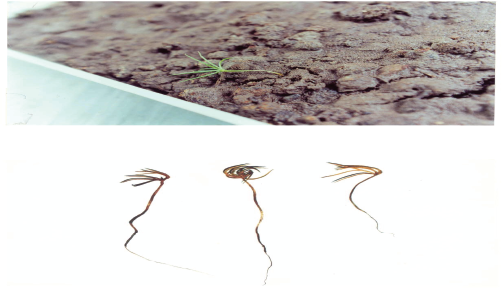
Young seedlings of Tian-Shang fir-trees affected by fungi Fusarium spp. (The author is Doolotkeldieva T.).
Grey dew of needles
The infecting agent is a fungus belonging to a group of Dyscomycetes orders Hypodermella sulsigena Tub; a conidial stage—Hendersonia acicola Munch. Et Tub. The pure culture of fungi Hypodermella sulsigena on a nutrient medium forms white air mycelium. We were the first in Kyrgyzstan to reveal this disease. The disease was found mainly in 15–20-year-old cultures of Tian Shan fir-trees in the gorges “Karakol” of Issyk-Kul province.
It was detected that this disease affects the needles of separate branches, some bunches turn yellow and redden to the 1/2–1/3 of the length of needles (Fig. 2). Next spring the affected tips of the needles turn grey, so that the plant looks as though it was covered with ash. According to the literary data, an economic harm caused by this pathogen to the trees is not significant [15], but our experiment detected that fungi strongly reduce seeds’ germination, which was 31.4% after the inoculation of spruce fir-tree seeds with a pure culture of Hypodermella sulsigena, whereas germination in the control was 69.2%. A Hypodermella sulsigena fungus is likely to reduce seeds’ germination of spruce fir-trees in nature.
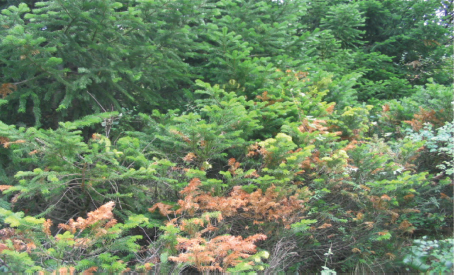
The disease—Grey Dew of Needles affects the needles of separate branches; some bunches turn yellow and redden to the 1/2–1/3 of the length of needles. (The author is Doolotkeldieva T.).
Crown rot of sprouts
The infecting agent is fungi of Sclerotinia graminearum Elen that belongs to a group of Dyscomycetes orders.
The development of the disease in winter periods is stipulated by warm winter with thick snow cover and continuous spring with slow melting of snow. Affected seedlings die, though rarely, their growth is staggered and become incapable to be planted. The first symptoms of the disease are observed right after melting of snow. During this period a grey-white pellicle of mycelium is seen on the staggered seeds, which quickly collapses and disappears. The mycelium of Sclerotinia graminearum, which grows on an artificial nutritious medium, in the beginning has a grey-brown color, and then gets a black color. The staggered needles die off and get a red—brown color.
Red rust of spruce fir trees (pathogen—Chrysomyxa deformans)
It was proved that “red rust” damages not only adult Tian-Shang fir-trees, but also their seedlings of all ages, except for sprouts [5]. Affected needles remain tightly close due to imperceptible lengthening of internodes. Sick sprouts die off, and the growth of branches continues at the cost of the neighboring unaffected sprouts and buds (Fig. 3).
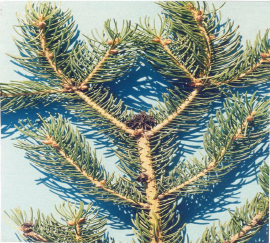
Red Rust of Spruce Fir Trees (pathogen—Chrysomyxa deformans). (The author is Doolotkeldieva T.).
Antifungal activity of streptomyces strains to fungous diseases of spruce fir-trees
The biological activity of Streptomyces metabolites for raising the resistance of seedlings to fungous diseases was investigated.
The experiment's results show (Table 1) that preliminary soaking of seeds in the suspensions of Streptomyces preparation raises resistance of sprouts to drowning. On the sites where the seeds had been processed by the suspension of actynomyces preparations an affection and destruction of sprouts from infectious drowning was 3–9 times less than in the control variant. The safety of sprouts reached 55.6% on average. The best results against the Alternaria culture were demonstrated by the use of preparation S. griseogromogenes 24-8 at the concentration of 500 mgs per liter, which provided the safety of sprouts to 80.2%, accordingly their destruction reached 19.8%.
Influence of laboratory samples of biological products on resistance of Fir-Tree seeds and seedlings to infectious drowning.
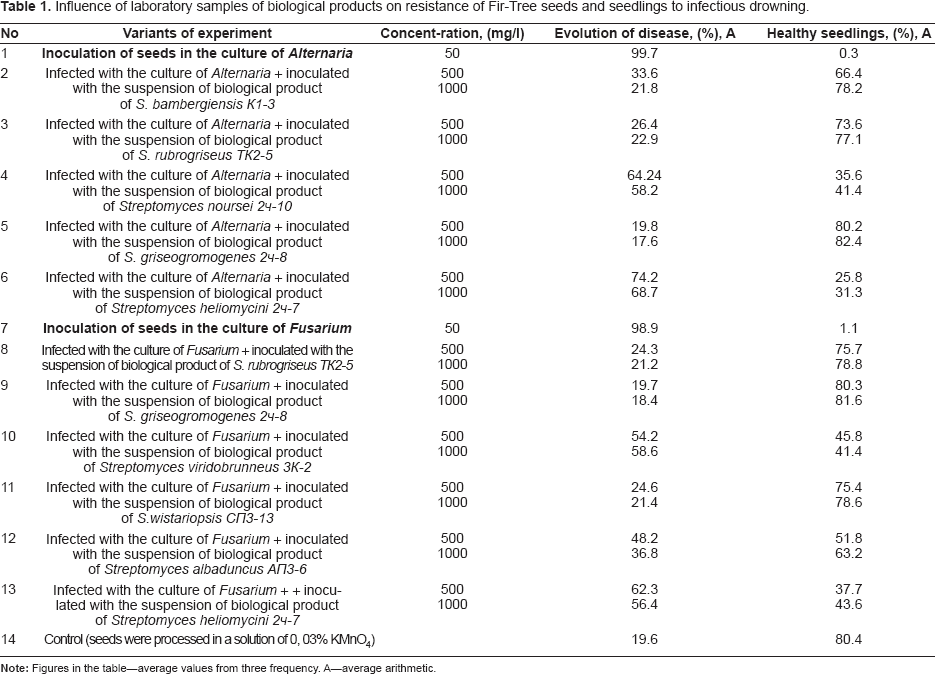
A relatively high safety of sprouts, 75.4% was provided by the suspension of S. rubrogriseus preparation TK2-5. Sprouts destruction made up 24.6%. The biological preparations on the basis of S. bambergiensis K1-3 and S. wistariopsis CI73-13 were also efficient. These preparations at the concentration of 500–1000 mgs per liter provided the safety of sprouts up to 72.3% on average, whereas the destruction of seedlings reached 27.7%.
Preparations of S. rubrogriseus TK2-5, S. wistariopsis CI73-13 and S. griseogromogenes 24-8 turned out to be the most effective preparations in protection of sprouts from Fusarium sp. cultures. They provided safety of sprouts to 80% on average (S. rubrogriseus TK2-5—to 77%, S. griseogromogenes 24-8 at the concentration of 500 mgs per liter to 80.3%, S wistariopsis CI73-13—to 77%).
In order to identify an effective period of soaking of seeds in the suspensions of Streptomyces at the concentration of 50 mgs per liter, we carried out 6, 12, 24, 48-hour expositions of seeds (Table 2). The results indicate that when exposed for 6 hours, soaking of seeds in the suspension of S. wistariopsis CI73-13 strain provided the highest earth germination (105% as compared to the control), and on the contrary, soaking of seeds in the suspensions of S. rubrogriseus TK2-5 and S. griseogromogenes 24-8 for more than 12 hours demonstrated a converse effect and inhibited the earth germination of seeds (62.5% in comparison with the control). However, when exposed for 6 hours, these strains provided the highest safety of sprouts. Soaking of seeds in Streptomyces suspensions reduced the destruction of seeds from drowning to 2.8 times on average (in the control variants the destruction of sprouts from drowning made up 43.2% from the appeared sprouts).
Influence of duration of seeds exposition on safety of sprouts.
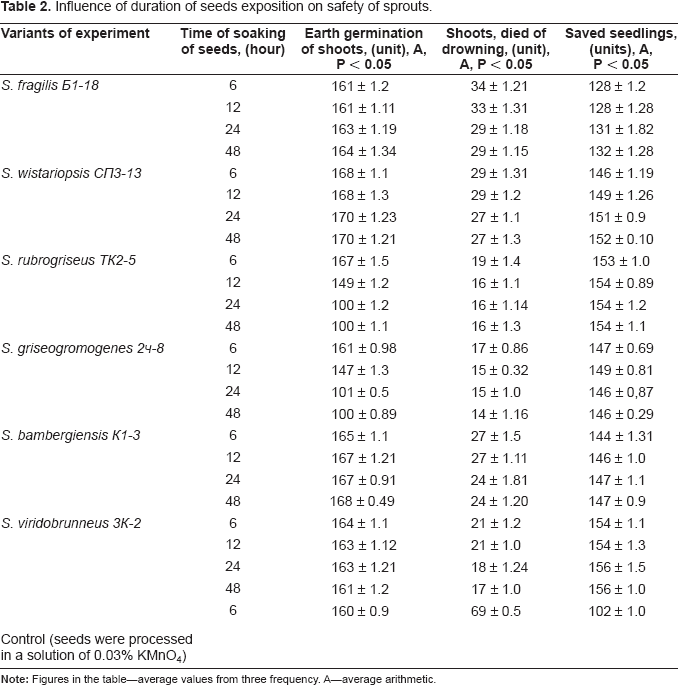
Soaking of seeds for 12 hours positively influenced the safety of sprouts and the reduction, though insignificantly, of seeds destruction from drowning, therefore, soaking of seeds for 6 hours turns out to be the most optimal and effective.
Thus, the results of experiments showed that the development of the disease is effectively suppressed if seeds are processed in the suspension of biological products before sowing. This fact is essential when methods of struggle against diseases of coniferous breeds are to be developed. Many scientists stated that the degree of disease development depends on the duration of the period seeds stay in the ground. Therefore, any measures stipulating the acceleration of seeds germination are measures of protection in a certain degree.
According to literary sources, in order conidia of a Fusarium fungus to germinate, a minimal temperature equal to 6 °C is required, and for the growth and development of mycelium—10 °C, at the same time higher temperature equal to 16–20 °C is necessary for the normal germination of seeds of coniferous breeds. It is this circumstance that results in the fact that by the time of sowing seeds there already is quite advanced mycelium of fungi which then penetrate into the weakened seeds and young sprouts and damage them before they grow out onto the ground surface [1]. As it has been mentioned above, application of fungicides to coniferous breeds is undesirable because of their sensitivity to them [12]. All these factors give a ground to believe that biological products based on S. rubrogriseus TK2-5, S. wistariopsis CI73-13, S. bambergiensis K1-3 strains can be successfully used to protect seedlings from infectious drowning.
Efficiency of biological preparations of streptomyces on pathogen agent of crown rot of fir-tree sprouts
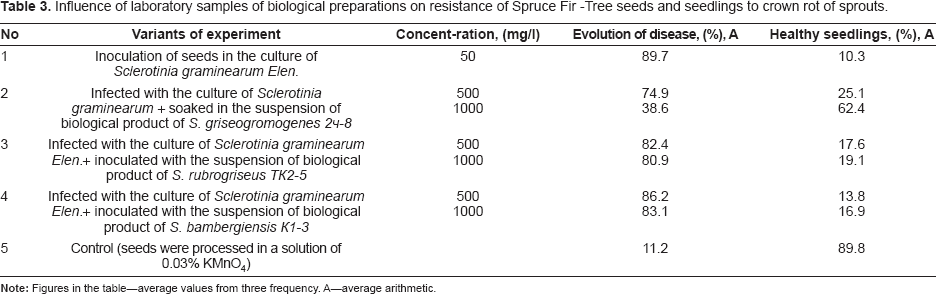
Among all tested biological preparations based on Streptomyces good results in protection of seeds and sprouts from the pathogen agent of Crown rot of sprouts—Sclerotinina graminearum were provided by using the biological product of S. griseogromogenes 24-8 for processing seeds before sowing. Pre-sowing treatment of seeds by a biological product based on the above-mentioned strain provided the safety of sprouts at the concentration of 1000 mg per liter up to 62.4%, whereas their destruction made up 38.6% accordingly. Other strains provided the safety of sprouts only to 18.0%, on average and the destruction made up 82.0% accordingly (Table. 3). The undertaken researches proved that the best safety of sprouts from Crown rot of sprouts was provided by soaking in the suspension of S. griseogromogenes 24-8 at a 6-hour exposition where safety of sprouts reached 87.5% in comparison with the control where safety made up 74.0%. When seeds were exposed for 24, 48 hours, we observed the inhibition of earth germination of seeds to 73% in comparison with the control (Table. 4).
Influence of laboratory samples of biological preparations on resistance of Spruce Fir -Tree seeds and seedlings to crown rot of sprouts.
Influence of duration of seeds exposition on safety of sprouts.
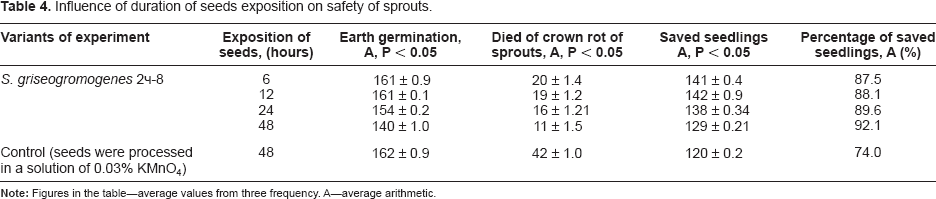
Thus, to work out protective measures to fight against the agent of Crown rot of sprouts, we selected only one biological preparation based on S. griseogromogenes 24-8 at the concentration of 1000 mgs per liter and 6–12-hour exposition of seeds.
Efficiency of biological preparations of streptomyces on infecting agent of grey dew of fir-tree needles
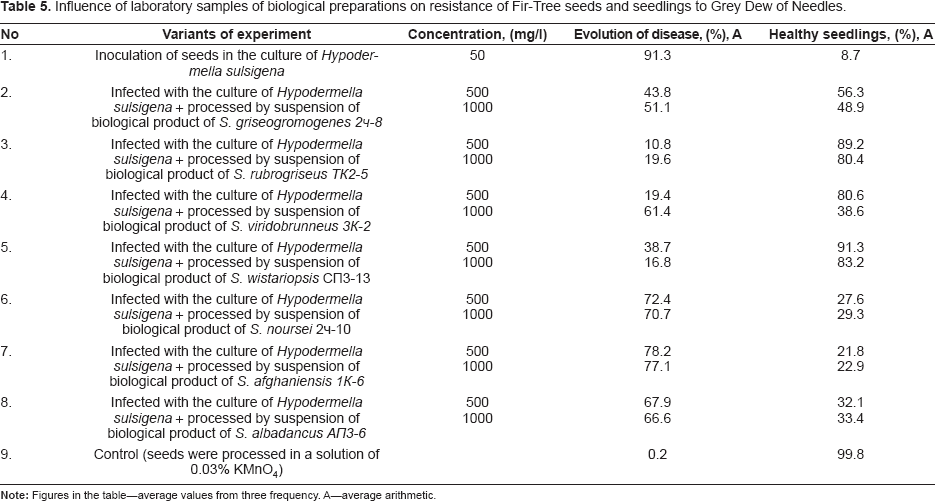
Our researches showed that the infecting agent of grey dew of needles Hypodermella sulsigena reduces earth germination of Tian Shan fir-tree seeds up to 91.3% when fir—tree seeds are inoculated in the suspension of agent's pure culture. Here we could observe an affection of the root system of sprouts. Grey dew of needles is likely to reduce germination of fir—tree seeds in nature, which can negatively affect the natural renewal and cause an appreciable damage to the forestry though the literary sources show that grey dew of needles does not cause a tangible damage to the forestry. However, these data can be characterized just as visual observation.
The undertaken researches proved that soaking of seeds in the suspensions of actynomyces preparations increases earth germination to 1.2–1.5 times. When Tian Shan fir-tree seeds were inoculated in the pure culture of Hypodermella sulsigena fungus, we noted an affection of the root system of sprouts. The best results were achieved when the seeds were soaked in the suspension of S. wistariopsis CI73-13. At the concentration of 100 mgs per liter germination of healthy seedlings made up 91.3%, and the percentage of the disease evolution was 8.7% accordingly. When S. rubrogriseus TK2-5 was used at the concentration of 100 mg per liter, germination of healthy seedlings reached 89.2%, development of the disease—10.8% accordingly, while the use of S. viridobrunneus 3K-2 at the concentration of 100 mgs per liter provided 80.6% germination of healthy seedlings, percentage of development of the disease accordingly—19.4% (Table 5).
Influence of laboratory samples of biological preparations on resistance of Fir-Tree seeds and seedlings to Grey Dew of Needles.
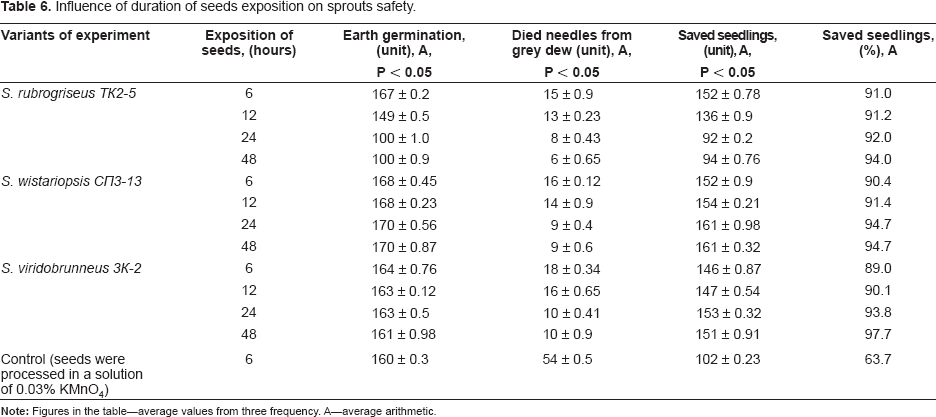
The study of influence of various expositions on the safety of sprouts showed that soaking of seeds in the suspensions of strains provided the safety of sprouts to 147% as compared to the control where the safety of sprouts was 51%. However, soaking of seeds in the suspension of S. rubrogriseus TK2-5 for more than 12 hours inhibited earth germination of seeds to 62.5% in comparison with the control. In all variants of experiment mortality from grey dew of needles turned out to be 3.3 times less than the control where mortality was 34% from the germinated sprouts (Table 6). Thus, soaking of seeds in biological products of S. rubrogriseus TK2-5, S. wistariopsis CI73-13 and S. viridobrunneus 3K-2 at the concentration of 100 mgs per liter and exposition of them for 6–12 hours protected fir—tree seeds from a damage by the infect agent of grey dew of needles-Hypodermella sulsigena and at the same time stimulates their growth.
Influence of duration of seeds exposition on sprouts safety.
Besides this, the results showed that preliminary processing of seeds in the suspensions of biological products on the basis of Streptomyces not only suppresses the development and distribution of infectious drowning of seedlings but also stimulates the growth of seedlings. Moreover, the difference is felt not only in the capacity of seedlings’ development but also in its construction of stem and root part. So, growth stimulation of the root system resulted in substantial increase of the number of the root branching, which is an essential factor in increasing resistance to diseases and consuming nutrients from the ground for the growth.
Processing of seedlings by spraying
Processing of seedlings by spraying with the suspension of biological products of Streptomyces at the concentration 500–1000 mgs per liter was conducted two times with an interval of 14 days. 26–27 days later after the first processing the inspection of the nursery showed that the safety of seedlings processed with the biological products on the basis of Streptomyces rubrogriseus reached 86%, S. wistariopsis—79% out of the total number of the processed seedlings. In the control variant mortality of seedlings from infectious drowning continued and was 18%.
The achieved results proved that (Table 7) processing by spraying considerably improved their look and significantly influenced on the development of the seedlings’ root system. As a whole, a positive influence was felt in the general physiological development of seedlings both before their transplantation in wood cultures and after it. Thus, as the researchers’ data show [15]), acclimatization of seedlings with a powerful root system is much higher than that of seedlings with a less powerful root system.
Growth parameters of Spruce Fir—Tree seedlings when sprayed with suspension of biological preparations of Streptomyces.
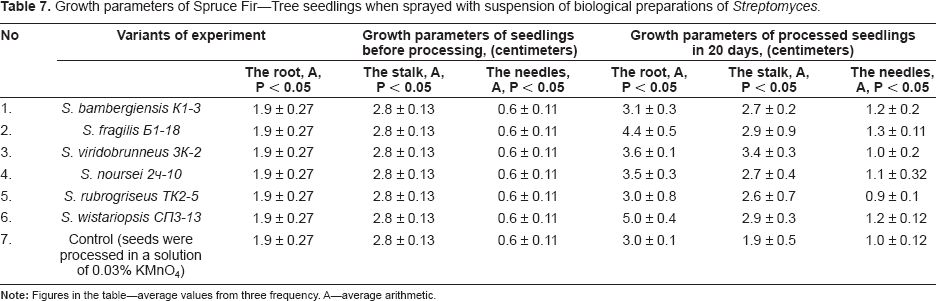
As the data in Table 7 how, the biological products of S. wistariopsis and S. fragilis demonstrated the best results in growth stimulation of seedlings. Thus, when processed with S. wistariopsis, the length of the root increased 1.7 times, when processed with S. fragilis it increased 1.4 times as compared to the control variant. The stalk of processed seedlings in both cases was 1.5 times longer than that of the control variant. Stimulation of needles’ length in all variants was insignificant and reached 0.1 centimeters on average. However, the needles of processed seedlings had a more satiated color, which proves a normal course of physiological processes.
Thus, our results allowed us to select the most efficient Streptomyces strains which will be applied as the basis to develop the biostimulators and bio-fungicides preparations. They will protect the seeds from fungi diseases and increase their germination energy and growth. Also these results have confirmed the data existing in the practical science on the use of Streptomyces preparations in crop protection as biological agents.
Actynomyces proved to show an antagonistic action to the most different microorganisms. They can suppress the growth of phytopathogenic bacteria [16, 9] and fungi [10, 6, 8, 27]. Streptomyces ssp. strains are widely used as a producer of biological preparation for protection of plants from root rots. A new biological product “Alirin” was developed on a basis of Streptomyces felleus [13]. This preparation is designed to protect various agricultural crops from fungi and bacterial diseases. Recently, Streptomyces avermitilis has got a special scientific attention in many countries as a producer of antibiotic compounds as avermectin, abamectin, ivermectin and others. It has a high insecticide, fungicide and nematocide activity [19]. On the basis of abamectin and ivermectin, the “Merck” Company develops a line of preparations both for veterinary purpose and for plant protection [3].
In plant growing the antibiotic of Streptomyces, as phytobacteriomysin has been successfully tested against the drowning of seedling of coniferous breeds and has been widely applied. It is established that a preseeding processing of coniferous breed's seeds by phytobacteriomysin reduces in 3 to 9 times the destruction of shoots from a drowning and increases the seedling safety to 54%–59%. Furthermore, phytobacteriomysin increases the energy of shoots germination in 1, 3 to 1, 5 times [1].
Footnotes
Acknowledgements
This work was supported by the Kyrgyz Science Foundation “Biotechnology”.
The authors report no conflicts of interest.