






Abstract
We aimed to investigate the relationship between dietary saturated fat on fasting triglyceride (TG) and cholesterol levels, and any mediation of this relationship by dietary carbohydrate intake. Men and women in the NHLBI Genetics of Lipid-Lowering Drugs and Diet Network (GOLDN) study (
Introduction
Cardiovascular disease (CVD) is associated with a dyslipidemic profile that includes increased LDL-C and decreased HDL-C and may include high TGs. 1 Early animal models showed that a high saturated fat intake can lead to increased serum cholesterol and the development of atherosclerotic plaques. 2 These were initially substantiated by epidemiological3–10 and clinical intervention11–14 studies in humans and reducing dietary fat, especially saturated fat, remains the mainstay of dietary advice aimed at reducing CVD risk.
However, more recent studies have started to challenge the idea that saturated fat intake is, in itself, a risk factor for dyslipidemia. Low carbohydrate diets, where a portion of energy from carbohydrates is exchanged for energy from saturated fat, are associated with a decrease in a number of CVD risk factors, including decreased blood pressure, increased HDL-C and TG, 15 just as the exchange of fat, particularly saturated fat, for carbohydrate is associated with an increase in TG, VLDL-C and LDL-C in lipid profiles in hypercholesterolemic and hyperlipidemic (raised LDL-C and TG) patients. 16 Given that there were differences between the hypercholesterolemic and hyperlipidemic groups, it is important to replicate this in healthy groups before the results can be generalized to the general population. The reasons underlying the beneficial effects of low carbohydrate diets are not clear, but may arise through de novo VLDL-TG lipogensis (shown mostly from the ingestion of simple sugars), 17 or through reduced plasma VLDL-TG clearance, shown with both diets high in simple sugar, and high in solid-food high-fiber carbohydrate sources, but low in simple sugars. 18 Without the increased secretion of VLDL-TG and hepatic uptake of free fatty acids, 19 dietary fat intake may not increase dyslipidemia. Understanding the relationship between carbohydrate and saturated fat intake together, and their effects on serum lipids, is thus crucial for the dietary management of CVD risk.
This study examined the relationship between dietary fat, dietary carbohydrate and lipidemia (TG, VLDL-C, LDL-C and HDL-C) using data from a large cross-sectional study. In addition we examined whether any relationship between saturated fat intake and lipids was mediated by carbohydrate intake. We used linear mixed models to test whether, based on habitual dietary intake, there is an association between saturated fat intake and fasting plasma TG and cholesterol levels when controlling for other dietary covariates. We further ran mixed linear models that included an interaction term between carbohydrate and fat intake to examine whether the association between dietary fat on serum lipids varies across levels of dietary carbohydrate intake.
Results
Participant characteristics
Table 1 shows characteristics of men and women who participated in the Genetics of Lipid Lowering Drugs network (GOLDN) study. There were significant differences (
Sample characteristic means (standard deviations in brackets) for men and women.
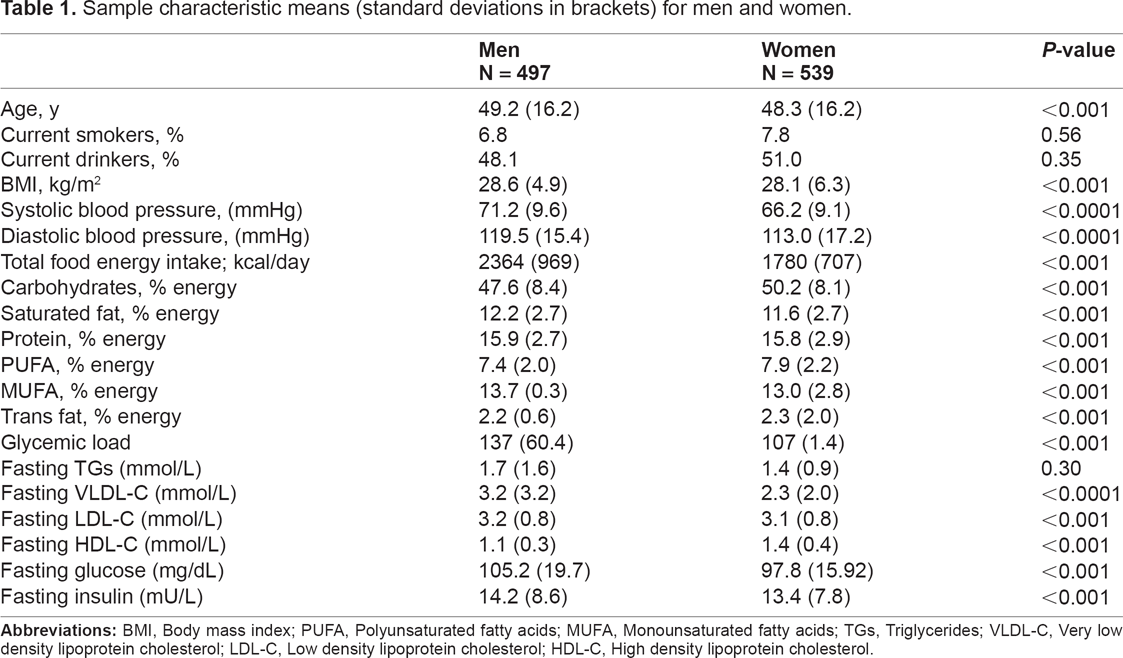
Table 2 shows the distribution of potential confounders by tertiles of energy from carbohydrate. Individuals with lower proportion of energy from carbohydrate were significantly more likely to be male, current or past smokers and current drinkers; therefore models looking at the moderation of the association between saturated fat and TGs by carbohydrate intake controlled for these factors.
Participant characteristic by tertiles of percent energy from carbohydrate intake.

Main effects of saturated fat on lipids
Mixed models were fitted which looked for an association between saturated fat and lipids. From the fully adjusted model, saturated fat intake did not show a significant association with fasting TG (
Main effects of saturated fat on fasting lipids when controlling for carbohydrate Intake
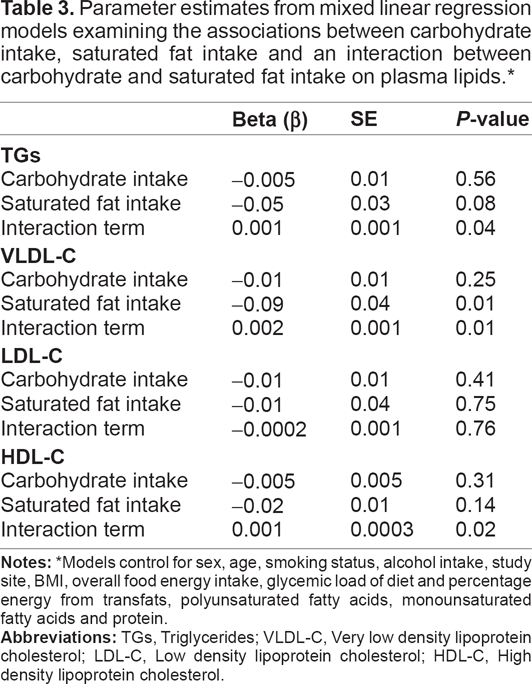
In fully adjusted models that included a saturated fat -carbohydrate interaction term, carbohydrate intake showed no main effect on TG (
Parameter estimates from mixed linear regression models examining the associations between carbohydrate intake, saturated fat intake and an interaction between carbohydrate and saturated fat intake on plasma lipids.*
Interactions between carbohydrate and saturated fat on fasting lipids
Although continuous dietary variables were used in the mixed models, graphs are presented using tertiles of carbohydrate intake (as above) and saturated fat divided into ‘high’ and ‘low’ categories. Saturated fat was divided into these categories by splitting the ordered distribution of fat intake into two equal-sized categories. This is done for easy interpretation.
Fully adjusted models revealed a significant interaction was observed between carbohydrate intake and saturated fat intake on fasting TG concentrations (
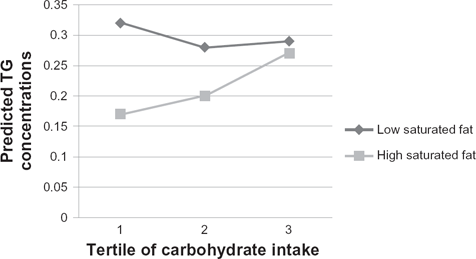
Triglyceride (TG) concentrations by carbohydrate intake tertiles, split into high and low saturated fat intake.
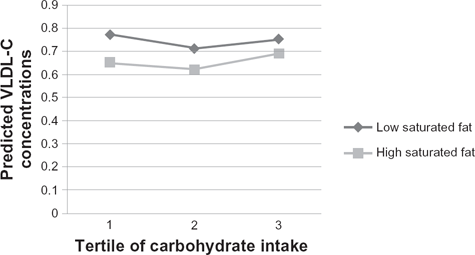
Very low density cholesterol (VLDL-C) concentrations by carbohydrate intake tertiles, split into high and low saturated fat intake.
In addition, there was a significant interaction (
We did not observe significant interactions between carbohydrate and saturated fat intake on LDL-C (
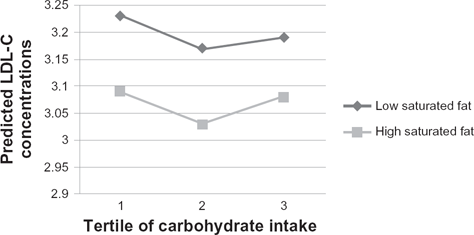
Low density cholesterol (LDL-C) concentrations by carbohydrate intake tertiles, split into high and low saturated fat intake.
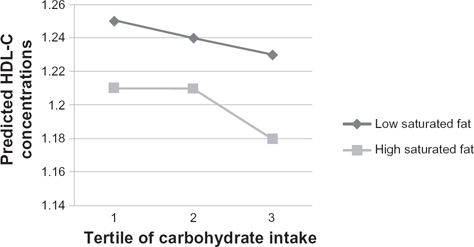
High density cholesterol (HDL-C) concentrations by carbohydrate intake tertiles, split into high and low saturated fat intake.
Discussion
We aimed to investigate the relationship between dietary saturated fat intake, dietary carbohydrate intake and fasting lipids. When not controlling for carbohydrate intake, there was no association between saturated fat intake and TG or any fraction of cholesterol. However, when models accounted for the mediation of saturated fat on lipids by carbohydrate intake, we then found a significant association between higher saturated fat intake and
Despite early epidemiological studies reporting increased saturated fat to be associated with increased TG and VLDL-C concentrations,3–10 data are emerging showing no association between saturated fat and CVD risk,20–24 with a recent meta-analysis on prospective data concluding there was no association between saturated fat intake and CVD risk across studies.
25
Indeed a recent study on Japanese men showed that saturated fat was associated with a lowering of LDL-C, although this did not reach statistical significance.
26
However, the issue of whether saturated fat intake is associated with dyslipidemia remains controversial; individual differences such as age or gender have been shown to affect the relationship between saturated fat and coronary heart disease
7
and the nature and direction of the relationship was debated in a recent issue of the
It is frequently observed that diets where fat is substituted for carbohydrate, increase fasting TGs and their precursors.29,30 As this is not always the finding from studies 28 the need to continue to investigate this relationship is emphasized. Our results support data that show higher dietary saturated fat to be associated with lower fasting VLDL-C and TG. However, we additionally show that this association is not seen at a high carbohydrate intake. This confirms in a large, epidemiological “free-living” design, the inference of results from exchange studies where exchanging fat for carbohydrate increases TG and VLDL-C, and exchanging carbohydrate for fat has the reverse effects.16,27,29–31 To our knowledge, no study has yet examined whether carbohydrates mediate the effects of saturated fat on fasting lipids using an epidemiological design, and we suggest that failing to account for an interaction between the two macronutrients may have mask the link between lower VLDL-C and TG and saturated fat.
A diet high in carbohydrates may interact with saturated fat through two possible pathways: (1) post prandial clearance mechanisms that arise from high fructose corn syrup (HFCS). HFCS is the most commonly used sweetener in the United States and may therefore account for a considerable amount of dietary carbohydrates. It has been shown that fructose, and HFCS leads to higher postprandial TG concentrations.
32
This raise in postprandial TG is believed to occur enhanced de novo lipogensis via the activation of sterol regulatory element binding protein 1-c (SREBP-1c) and carbohydrate response element binding protein (ChREB), a nuclear transcription factor that has been suggested to mediate the effects of fructose.
33
Alternatively, (2) decreased clearance of VLDL-TG. This occurs through the ingestion of carbohydrate,
18
and may additionally be mediated through increased insulin resistance which arises from a higher carbohydrate intake.
34
This hypothesis is supported by research on the effect of the glycemic load (GL) of the diet. Lower GL diets result in a slower, steadier release of insulin, with a lower overall peak. New research suggests that the effects of increasing carbohydrate intake in TG and VLDL-C levels may based on the type of carbohydrate that is increased; replacement of saturated fat with low GL carbohydrates may not show this effect,
35
indicating that the effects of carbohydrates on lipoproteins may be insulin mediated. Given the potential role of insulin resistance in mediating the effects of saturated fat on lipoproteins, it would be of interest to repeat the current analysis in diabetic, or pre-diabetic patients, which is not possible in the current sample due to a lack of power. Although a fuller assessment of the role of insulin resistance in mediating the metabolism of carbohydrate and saturated fat is beyond the scope of the current analysis, we do report that homeostatic model assessment of insulin resistance (HOMA-IR) was significantly predicted by saturated fat intake (
Our results do entirely concur with previous data; some data have shown that that high carbohydrate intake is associated with higher TG and VLDL-C, 16 which we do not see in our data. The reasons for this are not clear, but could reflect either the healthy study population, the effects of longer term dietary patterns, or the overall high carbohydrate intake of the participants (with the lowest tertile of carbohydrate intake averaging 40% of energy intake from carbohydrate), when compared to controlled exchange studies that can be more restrictive. In addition the average age of our participants was 49 years, and the relationship between saturated fat and lipids may be age dependent warranting replication in a younger cohort. 7
Thus, the results from this study need to be viewed in light of a number of limitations. First, we used existing data from a cross-sectional study, so were unable to establish any causal association. Secondly, dietary intakes were assessed once with a food-frequency questionnaire which has some inherent errors. Although this instrument has been validated in other US populations, it has not been validated specifically for our study population. Finally, we did not have data on potential dietary mediators, nor did we analyze other health outcomes in relation to saturated fat intake, making us unable to make general public health recommendations. A potential dietary mediator of interest would be the type of carbohydrate intake (although overall GL of the diet was included as a covariate in the regression models). This would be a useful avenue for future research, given that whole grains may confer protective effects on TG and VLDL-C concentrations36,37 while simple sugars and highly refined grains confer more detrimental effects. 38 The exchange of high GL carbohydrate sources, such as simple sugars, for lower GL sources, such as whole grains, confers lipid profile benefits in addition to lower fasting insulin levels 39 and reduced insulin resistance, 40 emphasizing the need to investigate the role of insulin in the interaction between carbohydrate and saturated fat intake that we report here. In terms of health outcomes other than lipid profile, although we controlled for BMI, we were unable to examine other correlates of saturated fat intake, such as liver function, which would be another important avenue for future research, However, the GOLDN study provided an opportunity to study the relation between macronutrients and lipids across a broad spectrum of weight and clinical characteristics, and focus on habitual dietary intake in a non controlled way.
We also note that it not clear whether carbohydrate induced TG and VLDL-C levels confer the same atherogenic risk as other elevations in TG,29,30,41–43 and this requires further investigation.
There is importance in understanding the pathways through which macronutrient intakes affect dyslipidemia and CVD. We recommend future studies replicate these findings and examine the differential roles of different types of carbohydrate in mediating saturated fat intake on dyslipidemia. Overall, our data suggest that the role of saturated fat in dyslipidemia is mediated through carbohydrate intake, which if validated of which has important implications for dietary advice.
Methods
Participants
1328 men and women were recruited and screened for the in the GOLDN study population. All participants were white men and women recruited from Minneapolis, Minnesota and Salt Lake City, Utah. The details of the GOLDN study have been published elsewhere. 44 Subsequent to recruitment, we excluded data from participants who were unwilling to stop lipid lowering pharmacological interventions, those with a self-reported history of kidney or Grave's disease and those in the top and lowest one percentile of total energy intake. In addition, those with missing data on potential confounders were excluded leaving a final sample for analysis of 1036 individuals across 187 families, consisting of 497 men and 539 women (mean ± SD = 48.8 ± 16.2 years of age). The primary aim of the GOLDN study was to characterize the role of genetic and dietary factors on an individual's response to a high fat diet and fenofibrate. The protocol for this study was approved by the Institutional Review Boards at the University of Minnesota, University of Utah, Tufts University/New England Medical Center and the University of Alabama at Birmingham. Written informed consent was obtained from all participants in accordance with the ethical standards of both data collection sites.
Data collection
Clinical characteristics, including anthropometric and blood-pressure measurements, were taken at the study clinics where a fasting blood sample was also drawn as described previously. 44 Questionnaires were administered to collect demographic data and information on lifestyle attributes and medical history.
Dietary intake
We used the Diet History Questionnaire (DHQ) developed by the National Cancer Institute to assess habitual dietary intake. This instrument is a Food Frequency Questionnaire that measures habitual dietary intake over the preceding six months. The DHQ was validated against four 24-hr dietary recalls for ability to assess dietary intake and showed an average correlation of 0.62. 45
Biochemical measurements
All plasma samples were analyzed together at the end of the study. Measurements of plasma TG, VLDL-C, LDL-C and HDL-C were determined using enzymatic assays as previously described. 46
Statistical analysis
Statistical analyses were carried out using SAS for Windows, version 9.2 (SAS Institute, Cary, NC).
Before running multivariate linear mixed models to examine main effects and potential interactions between carbohydrate and saturated fat intake on fasting lipids, levels of potential confounders across carbohydrate intake levels were examined. For this initial, exploratory analysis, carbohydrate intake was divided; the ordered distribution (ordered by percentage of the dietary intake as carbohydrate) of the study population was divided into tertiles. The significance of differences in the distribution of continuous variables, by carbohydrate tertile, was examined using linear mixed models that adjusted for correlations within pedigrees. The significance of categorical variables was tested using a 2-
To maximize power, carbohydrate and saturated fat intake were used in multilevel mixed models as continuous variables. Unlike HDL-C and LDL-C which were normally distributed, TG and VLDL-C had skewed distribution and were log-transformed. The association between saturated fat and plasma lipids and the interaction between carbohydrate and saturated fat on lipids, both expressed as percent of total energy intake, were tested using a mixed model implemented in the Mixed Procedure in SAS (SAS institute, Cary, NC).
Potential confounders were adjusted for in a step-wise fashion. The following separate models were run sequentially. The outcome variable was the lipid (or TG), and predictor variables were:
Saturated fat.
Saturated fat, age and sex. Both are expected to confound with lipids 47 and show significant differences across potential confounders in the current study (Table 1) and across tertiles of carbohydrate intake (Table 2);
Saturated fat, age, sex and smoking, alcohol and BMI. Alcohol and BMI showed significant differences across tertiles of carbohydrate intake (
Saturated fat, age, sex, smoking, alcohol, BMI and fat intake broken into trans-, PUFA and MUFA fat intake differed across tertiles of carbohydrate intake (
Saturated fat, age and sex, smoking, alcohol and BMI, fat intake and type of carbohydrate intake as measured by GL. GL may confer differential effects on fasting lipids across the distribution;39,40
Saturated fat, age, sex, smoking, alcohol and BMI, fat intake, type of carbohydrate intake and percentage of the diet as protein. Protein was added given recent findings on the thermogenic effect of protein; 48
Saturated fat, age, sex, smoking, alcohol and BMI, fat intake, type of carbohydrate intake, percentage of the diet as protein and systolic and diastolic blood pressure, taken at the time of the blood draw,
After looking for a main effect of saturated fat on lipids, the models were rerun including carbohydrate as a predictor variable and an interaction term between carbohydrate and saturated fat. The direction and significance (with an alpha of
Footnotes
Acknowledgements
We are grateful to the staff of the GOLDN study for the assistance in data collection and management. This study was funded by NHLBI grant number U01HL072524-04.
Author Contribution
ACW conceived the hypothesis, designed the analysis, conducted the analysis and wrote the manuscript. EKK designed the analysis and was involved in critical review of the manuscript. IBB, HKT, JMO were involved in critical review of the manuscript. DKA was involved in critical review of the manuscript and collected the data.
Disclosures
Author(s) have provided signed confirmations to the publisher of their compliance with all applicable legal and ethical obligations in respect to declaration of conflicts of interest, funding, authorship and contributorship, and compliance with ethical requirements in respect to treatment of human and animal test subjects. If this article contains identifiable human subject(s) author(s) were required to supply signed patient consent prior to publication. Author(s) have confirmed that the published article is unique and not under consideration nor published by any other publication and that they have consent to reproduce any copyrighted material. The peer reviewers declared no conflicts of interest.