






Abstract
Since 1998, the Short-Term Training Program (STTP) at the David Geffen School of Medicine at the University of California, Los Angeles has nearly tripled (from 30 to 89) in the number of first-year undergraduate medical students participants. STTP supports mentored research projects in the areas of basic sciences, clinical sciences, medical education, and public health (local and international). Although projects can be very specific in scope, the overall experience in STTP exposes students to some, if not all, of the Accreditation Council for Graduate Medical Education (ACGME) six core competencies–-Patient Care, Medical Knowledge, Practice-based Learning and Improvement, Interpersonal and Communication Skills, Professionalism, and Systems-based Practice. Thus, STTP has been an important aspect of medical education to prepare our students for residency programs. We describe and analyze the STTP as a model system to introduce the ACGME core competencies at an early point in undergraduate medical education. We conclude with a call to provide more mentored anatomical sciences basic and clinically applied research opportunities.
Introduction
In 1999, the Accreditation Council for Graduate Medical Education (ACGME) established six core competencies to unify graduate medical education–-patient care, medical knowledge, practice-based learning and improvement, interpersonal and communication skills, professionalism, and systems-based practice. These competencies help serve as public assurances that resident and attending physicians will be compassionate in their service, knowledgeable of and continually learning best scientific and clinical practices, diligent in communicating information with other physicians and with patients, professional, ethical, and resourceful. Undergraduate medical students begin learning these competencies in pre-clinical and clinical settings.
The Liaison Committee on Medical Education recognizes the importance of vertical and lateral learning opportunities for undergraduate medical students based on accreditation standards for the Academic Environment. 1
Since 1998, the Short-Term Training Program (STTP) has provided scientific learning opportunities through mentored research at the David Geffen School of Medicine (DGSOM) at the University of California, Los Angeles (UCLA) that expose each student to many, if not all, of the six ACGME core competencies in the span of a 7–1/2 week period during the summer intercession between the first and second pre-clinical years. STTP has nearly tripled (from 30 to 89) in the number of participants from 1998 to 2013 and has been an important aspect of medical education for preparing students for residency programs. We describe the program here and demonstrate educational themes that relate to the ACGME core competencies.
Description
Ucla Sttp
Although research is an optional activity, approximately 94% of DGSOM at UCLA students were involved in a summer research activity in 2013; of these students, 79% were involved in STTP. Originally funded by the National Institutes of Health, the Dean's Office now completely supports the 7–1/2 week elective summer STTP. Students engage in mentored research in areas of their choice from the basic sciences, clinical sciences, medical education, and public health (local and international). Students must find a UCLA faculty principal investigator (PI) sponsor who directs and supports the research. The PI must be a faculty member with a permanent position at UCLA or one of its affiliate sites. Typically, students choose established research projects, as the time frame is too short for novel pursuits. However, some students are able, with the guidance of their mentor, to initiate, develop, and execute new projects. Students learn to be resourceful and professional by searching for and contacting PI's whose research fits their interests. Almost all students have reported engaging in an employment process of submitting a curriculum vitae with cover letter to 10–20 PI's, interviewing with several PI's and receiving even fewer offers.
Upon acceptance, a student and PI work together to craft a 1–3 page proposal that describes the specific aims of the proposed research, hypothesis being tested in general terms, the methods used, and how the data will be analyzed. The student and PI describe the techniques that will be learned, and potential difficulties that may be encountered in the acquisition and analysis of data. If an Institutional Review Board (IRB) or any type of training is required, the student must take the initiative to complete the necessary application and training to meet compliance. Mentors agree to spend the necessary time to provide guidance, instruction, and laboratory support. At the end of the summer, the student is required to submit a first author abstract and present a poster at the DGSOM Josiah Brown Poster Fair. The mentor is invited to this fair to support his/her STTP student and other students presenting. It is not uncommon for a student to also present his/her work at conferences for a society to which the PI belongs. Both student and mentor sign a contract agreeing to these terms of the program.
Medical students are supported in their research endeavors through stipends, funding for conference travel, and administrative support of research fellowships and grants. The funding for these research activities come from a variety of sources. STTP is a line item in the Dean's Office budget. In contrast, other School of Medicine programs are funded by grants, endowments, the UCLA Hospital System, and other philanthropic sources. Finally, national research fellowships are funded through the national awarding agency.
Student satisfaction with the STTP experience
In 2012, Thakur et al 2 reported results from a survey ascertaining satisfaction with their STTP experience to the same population of students included in this study. We re-analyzed the qualitative data from that study and report representative positive and negative student responses pertaining specifically to the six ACGME core competencies (Table 1).
Representative student responses regarding their STTP experience within the context of the six ACGME core competencies–- Patient Care, Medical Knowledge, Practice-based Learning and improvement, Interpersonal and Communication Skills, Professionalism, Systems-based Practice.

Themes of STTP research
We performed a two-step qualitative analysis of student exposure to basic science and clinical science research, and educational scholarship. We first performed a word frequency analysis of the titles and abstracts that students submit as their capstone presentation, followed by a thematic analysis.
We created tag clouds (http://www.wordle.net) to visually represent our analysis of presentations from 2011 to 2012. Words used with greater frequency are represented in a larger font size relative to less-frequent words represented in smaller font sizes. Common English language articles, prepositions and conjunctions, and abstract section headings (and derivatives) were excluded from display in the tag clouds. In our analysis, we included ancillary programs that sponsor STTP work, but are funded independently. The artistic representation of word frequencies led to the qualitative thematic analysis.
During these two summers, 229 students participated in summer research, of which 181 completed projects were funded by STTP (79%). Research encompassed many disciplines related to basic sciences, clinical sciences, medical education, and public health (local and international). We categorized the projects into these disciplines using the following operational definitions, and then used the titles and abstracts text to create categorical tag clouds.
Basic sciences projects included those involving non-human and animal studies, or studies that examine methodologies or mechanisms.
Clinical sciences projects included human studies directly related to patient care.
Medical education projects included studies that examined the improvement of patient education or self-efficacy and of physician training.
Public health projects included studies that examined clinical treatment to specific medical and/or ethnic populations in a community.
Overall projects
Figure 1 (top) depicts word frequencies from titles of 181 presented abstracts (total word count = 2,341). The most frequent word, patients, appears 37 times. Words that appear approximately 25–50% as frequent as patients include development, effects, treatment, health, cancer, cell, evaluation, and surgery.

Word frequencies in titles and abstracts of all 2011 and 2012 STTP presentations. There were 181 projects in total.
Figure 1 (bottom) depicts word frequencies from abstract texts (total word count = 56,589). The most frequent word, patients, appears 487 times. Words that appear approximately 25–50% as frequent as patients include study, treatment, compared, health, and data.
Basic science projects
Figure 2 (top) depicts word frequencies from titles of 48 presented abstracts (total word count = 574). The most frequent word, cells, appears 19 times. Words that appear approximately 25–50% as frequent as cells include effects, stem, cancer, model, human, mechanical, inflammatory, signaling, carcinoma, evaluation, and formation.
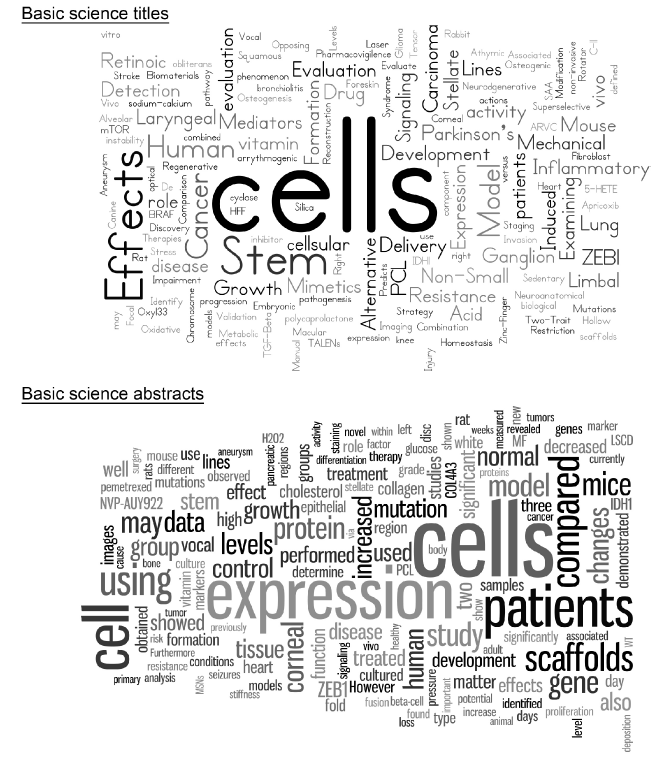
Word frequencies in titles and abstracts of basic sciences of 2011 and 2012 STTP presentations. Basic sciences projects included those involving non-human and animal studies, or studies that examine methodologies or mechanisms. There were 48 basic sciences projects.
Figure 2 (bottom) depicts word frequencies from abstract texts (total word count = 15,656). The most frequent word, cells, appears 102 times. Words that appear approximately 25–50% as frequent as cells include expression, patients, compared, scaffolds, mice, mutation, protein, levels, control, and gene.
Clinical science projects
Figure 3 (top) depicts word frequencies from titles of 104 presented abstracts (total word count = 1,318). The most frequent word, patients, appears 27 times. Words that appear approximately 25–50% as frequent as patients include treatment, surgery, development, cancer, outcomes, novel, effects, and health.
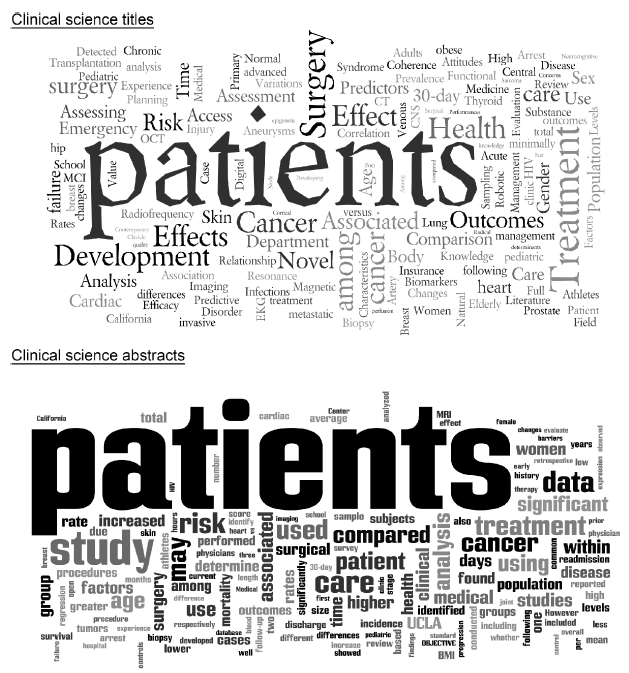
Word frequencies in titles and abstracts of clinical sciences of 2011 and 2012 STTP presentations. Clinical sciences projects included human studies directly related to patient care. there were 104 clinical sciences projects.
Figure 3 (bottom) depicts word frequencies from abstract texts (total word count = 31,941). The most frequent word, patients, appears 485 times. Words that appear approximately 25–50% as frequent as patients include study, compared, data, cancer, treatment, care, used, risk, and analysis.
Medical education projects
Figure 4 (top) depicts word frequencies from titles of four presented abstracts (total word count = 57). The most frequent word, quality, appears two times. Words that appear approximately 25–50% as frequent as quality include all other words in the titles.

Word frequencies in titles and abstracts of medical education of 2011 and 2012 STTP presentations. Medical education projects included studies that examined the improvement of patient education or self-efficacy and of physician training. There were four medical education projects.
Figure 4 (bottom) depicts word frequencies from abstract texts (total word count = 1,028). The most frequent word, residents, appears 11 times. Words that appear almost as frequent as residents include patient, students, quality, and care. Words that appear approximately 25–50% as frequent as residents include safety, medical, skills, arthroscopy, training, and themes.
Public health projects
Figure 5 (top) depicts word frequencies from titles of 25 presented abstracts (total word count = 392). The most frequent word, Ghana, appears seven times. Words that appear approximately 25–50% as frequent as Ghana include health, rural, prevalence, services, Western, survey, and rural.

Word frequencies in titles and abstracts of public health (local and international) of 2011 and 2012 STTP presentations. public health projects included studies that examined clinical treatment to specific medical and/or ethnic populations in a community. There were 25 public health projects.
Figure 5 (bottom) depicts word frequencies from abstract texts (total word count = 7,964). The most frequent word, health, appears 79 times. The word patients appears 60 times. The word children appears 44 times. Words that appear approximately 25–50% as frequent as health include population, treatment, care, HIV, diarrhea, and services.
Thematic analysis
Across basic science, clinical science, medical education, and public health research, students were focused on some aspect of patient care, regardless of the arena or research topic. This may not come as a surprise when considering the focus of clinical science, medical education, or public health research, but it is noteworthy that students engaging in basic science research would make direct connections to patient care, especially since the vast majority of projects dealt with cells.
Interested in the basic science–patient care connection, we followed-up our study with a cursory analysis of students who we were able to mentor in the basic science field of anatomy. In particular, we wanted to know if anatomy research exposed students to something seemingly unrelated–-the ACGME core competencies. Additional analysis needs to be done for students who participated in cell biology research.
STTP experience specific to anatomical sciences research
From 2006 to 2012, four students participated in STTP through research projects in the anatomical sciences. As a pilot study, we contacted these students and asked them to complete an IRB-approved survey through SurveyMonkey (www.surveymonkey.com) ascertaining their experience in the program and what exposure they had to the six ACGME core competencies. Three students participated in STTP in 2008 and are now residents. One student participated in 2010 and is currently a 4th year medical student. Three of the four students returned the survey: one medical student and two residents.
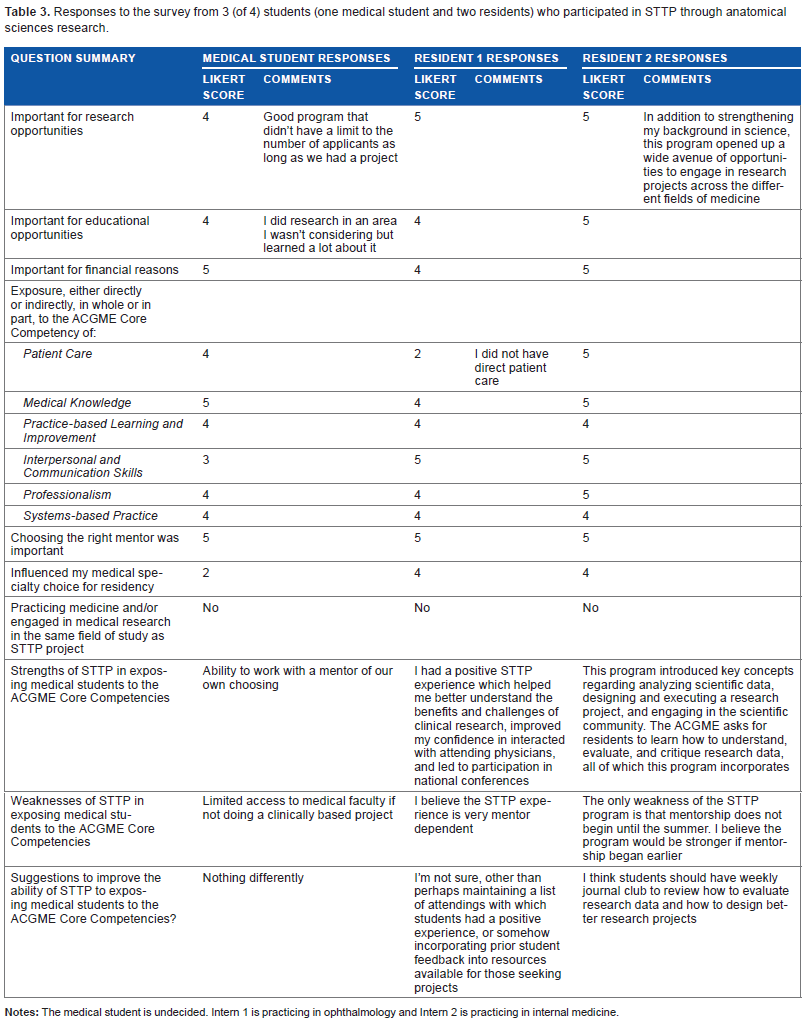
The survey asked the following questions and, where appropriate, required a 5-point Likert response followed by an optional free-response section for elaboration. Questions are listed in detail in Table 2, and in summary, with answers in Table 3. We recognize that our pilot study is limited to the responses of these three individuals and plan to validate and use this instrument for future studies of STTP participants.
Survey questions given to medical students who completed STTP research in the anatomical sciences.

Responses to the survey from 3 (of 4) students (one medical student and two residents) who participated in STTP through anatomical sciences research.
Discussion
STTP themes related to ACGME core competencies
The tag clouds demonstrate the breadth of exposure students have on aspects of all six ACGME core competencies. Altogether, the scientific aspects of STTP exposed students to Patient Care, Medical Knowledge, and Practice-based Learning and Improvement. However, based on formal and informal surveys, it is clear that the experience of working in a research team, and with a mentor, exposed students to Interpersonal and Communication Skills, Professionalism, and Systems-based Practice.
STTP research breadth
By using operational definitions to classify the different projects into categories of basic sciences, clinical sciences, medical education, and public health, we were able to ascertain the main areas of research in which students are engaged. Basic sciences projects focused on cellular biology. Clinical sciences projects focused on patient care with regard to treatments and outcomes. Of these, many projects focused on cancer. Medical education projects interestingly focused on residents, patients, and quality care. Although there were relatively much fewer medical education studies than other types of studies, this category in particular highlights the bridge between graduate and undergraduate medical education. Public health projects focused on international and rural care with regard to HIV, children, and African populations. This reflects the strong international global health program at the DGSOM. Across all topics, and interestingly including basic sciences research, students related their work back to patient care.
STTP research in the anatomical sciences
Although the number of anatomical sciences projects in the STTP is a mere fraction of the total number of projects, it is interesting to note that based on the data from our informal survey, the three students who responded felt their research experience in a traditional basic science discipline exposed them to the six Core Competencies with an overall Likert score average of 4.27. Clearly, we need to–-and we plan to–-use this survey instrument with more students from other basic sciences fields. However, if this trend holds true, it would speak very highly of the value of basic anatomical sciences research in medical education.
Students who participated in STTP presented their findings at the annual UCLA-sponsored summer research fair, 42% of the students who participated in STTP went on to present their research findings at the Western Student Medical Research Forum in their second year of medical school. The group interviewed published two papers on the clinical application of mapping the cervical sympathetic chain ganglia for improved targeted transient sympathectomies:3,4 one award-winning conference paper on the anatomical etiology of Eagle's Syndrome 5 and several conference papers on the anatomical validity of Diffusion Tensor Imaging.6,7 Although anatomy is typically considered a basic sciences discipline, our work shows that when applied to clinical problems, anatomy research may transcend stereotypical bench research. The basic sciences abstracts tag cloud from Figure 2 exhibits cells as the most frequent word and the clinical sciences abstracts tag cloud from Figure 3 exhibits patients as the most frequent word. We assert that clinical anatomy research can be a bridge between basic science and clinical care. This needs to be studied in more depth, but will require more programs across the country to encourage students to participate in clinical anatomy research.
Future directions for improvement in aligning with ACGME core competencies
We, and other investigators,2,8,9 have shown that mentorship plays a key role in motivating students to pursue a career in research. Therefore, strong emphasis needs to be placed on the role of the mentor in STTP and coaching the PI to become a better research mentor. This was clear in student and responses to surveys. The mentor is key to the success of a student's experience, but standardizing mentors may be difficult.
Instead, intermittent workshops throughout the course of STTP to help students address common problems with research, such as working with a mentor, IRB issues, research progress, statistical analyses, may be a better option for improving student experiences. Likewise, student training on professionalism in research, including ethics of research, manuscript preparation, would be very helpful in providing more exposure to ACGME core competencies. We can also be more explicit in program goals and assessments that point directly to learning the Core Competencies through post-STTP evaluation surveys, and perhaps adding in a component of focus groups to determine how STTP is helping students to pursue research beyond the summer.
Future research could also review the medical student research titles for greater stratification of the research types, further aligning the research themes with ACGME core competencies. The purpose of this preliminary analysis was to get a sense of the general research themes; future analyses would delve into the students' chosen research subject and how many of the core ACGME core competencies they address.
Author Contributions
Conceived and designed the experiments: JJW, ST and MES. Analyzed the data: JJW, ST and MES. Wrote the first draft of the manuscript: JJW. Contributed to the writing of the manuscript: JJW, ST and MES. Agree with manuscript results and conclusions: JJW, ST, and MES. Jointly developed the structure and arguments for the paper: JJW, ST, and MES. Made critical revisions and approved final version: JJW, ST, and MES. All authors reviewed and approved of the final manuscript.
Footnotes
Acknowledgments
The authors would like to thank Linda Baum, M.D., Ph.D. for her insightful advice on the manuscript and for her tireless efforts to help ensure the annual success of STTP as its Scientific Director. They would also like to thank the STTP alumni interviewed for this study for their time and enthusiasm in helping us improve the program. Finally, they thank the DGSOM Dean's Office for their financial support of STTP.