



Abstract
Background
Investing in developing the research skills of medical students is crucial for improving the healthcare systems. This study assesses the knowledge, attitudes, experiences, and barriers to research as perceived by undergraduate clinical year medical students at Addis Ababa University, Ethiopia.
Methodology
A cross-sectional study design was used to assess the knowledge, attitudes, experiences, and barriers to research among clinical year undergraduate medical students at Addis Ababa University, Ethiopia. The study population included clinical-year medical students at Addis Ababa University, College of Health Sciences, from April 1, 2023, to August 1, 2023. The final sample size was calculated to be 244. Stratified random sampling was used to select study participants. On the basis of the strata, 99, 70 and 75 responses were expected from 4th year, 5th year and 6th year medical students, respectively. The selected participants were requested to fill out the Google forms. ANOVA and t tests were used to study the associations between knowledge score and age, sex, and year of study.
Results
The average knowledge score ± SD of the participants was 43.1% ± 17.07%. There was no significant association between knowledge score and age (P-value .129), sex (P-value .774), or year of study (P-value .150). A total of 72.5% reported medical school as their primary source of education/training in research. In terms of the roles taken in the research, only 38 (15.6%) had participated as primary investigators. A total of 134 (54.9%) participants participated as data collectors, 59 (24.2%) participated in data analysis, and 25 (10.2%) participated in writing. Among the major barriers mentioned, lack of opportunity in research (56.1%) took the lead, followed by lack of time (54.1%), lack of guidance and supervision (48.8%), and lack of resources (28.3%). Data analysis and logistics and finances were reported as challenging factors for conducting research.
Conclusion
Overall, in this study, knowledge of clinical year medical students on research was inadequate. While research was noted as crucial by majority of the students in this study, lack of opportunity, time, resources, guidance, and supervision were the major barriers faced by the participants. This calls for collective action by the college administration to work on investing more resources and providing research opportunities to medical students.
Introduction
In this day and age, evidence-based medicine has become the cornerstone for ensuring high-quality clinical care. 1 Research significantly increases the delivery of quality healthcare. 2 In the sub-Saharan African region, which faces the world's largest disease and mortality burden, 3 evidence-based medicine contributes to cost-effective and efficient health services. 4 One of the strategies that can be used to tackle Africa's health needs is promoting health research conducted and published by Africans. 5 Most global health guidelines are derived from high-income countries, which have different disease burdens and more advanced healthcare systems. 3 A key step in increasing evidence-based medicine practices is to foster the increased engagement of clinicians in research. 1 Initiating the research engagement early in medical schools can increase professional development and the academic output of clinicians. 6
Physicians are expected to integrate their clinical impressions with available research evidence to provide the best-suited medical practice. The quality of health care can be ensured through the implementation of evidence-based medicine. 7 Although most medical schools have incorporated research training into their undergraduate research activities, studies show that it is still inadequate, uncoordinated and faced with many challenges. 7 Late and inadequate exposure to research during undergraduate years can be associated with poor engagement and knowledge of research. 1 Early involvement of students in research not only improves their scientific skills but also enhances the quality of published articles and professional satisfaction. 8
Engaging students in research provides increased academic output for universities and creates local evidence that can be used to guide health policy. 3 Furthermore, early participation in research improves students’ judgment, critical thinking, and literature appraisal. 9 Research at the undergraduate level involves self-motivated work with guidance or tutors. 10 Numerous studies recommend engaging in research from the start of the medical career journey. Students who publish articles at the undergraduate level are 3 times more likely to publish more than those who do not publish as undergraduates. 7 Although most medical schools around the world and sub-Saharan Africa have incorporated research into their curriculum, the persistent low output and engagement necessitate an examination of the attitudes and knowledge of medical students toward research. A lack of funding and mentorship are perceived barriers despite the positive attitude toward research, as concluded from a study in Uganda. 3
Ethiopia is a low-income country located in sub-Saharan Africa, and Addis Ababa University, the College of Health Sciences, is one of the largest public academic institutions in the country. The university currently provides 4 courses on measurements and determinants of health and disease, research and methodology, health promotion and disease prevention, and rural community health practice, which includes one research project in 2nd, 3rd, 4th and 5th year of medical school, respectively.
To improve healthcare services in sub-Saharan Africa, investing in future health professionals through undergraduate research is vital. 4 Assessment of medical students’ attitudes and perceived barriers is also crucial. 2 Although few studies have been conducted in resource-limited settings such as Ethiopia, to our knowledge, no studies from Ethiopia have been published on this topic. This research aims to fill this information gap. This would provide baseline information for focused interventions to invest in future medical professionals for better-quality healthcare practice and delivery.
Materials and Methods
Study design
A cross-sectional study design was used to assess the knowledge, attitudes, experiences, and perceived barriers to research among clinical undergraduate medical students at Addis Ababa University, Ethiopia.
Study setting
The source population is clinical-year medical students at Addis Ababa University, College of Health Sciences. Addis Ababa University's College of Health Sciences is based in Addis Ababa, Ethiopia. As the College's teaching hospital, Tikur Anbessa Specialized Hospital (TASH) is the largest specialized hospital in Ethiopia.
Study population
The study population included clinical-year medical students at Addis Ababa University, College of Health Sciences, from April 1, 2023, to August 1, 2023.
Inclusion and exclusion criteria
Inclusion criteria
Students from the clinical year enrolled in their academic studies.
Exclusion criteria
All students who have not entered their clinical years
Participants who have graduated
Students who are no longer enrolled in their academic studies.
Study sampling
According to the literature, the average score of students is 49.0% on the knowledge scale.
11


At the time this study was conducted, in the Academic year of 2023/24, there were a total of 670 undergraduate clinical-year medical students at Addis Ababa University, College of Health Science, School of Medicine. Based on an initial calculated sample size of 384 and a total population of 670 during the year of study, application of the finite population correction factor yielded an adjusted sample size of 244.





Variables
Dependent: Knowledge score, attitude toward research, research experience
Independent: Age, sex, academic year
Contextual: Barriers, institutional support, access to resources
Data sources
The questionnaire was pretested on 5% of the intended sample size. Feedback from participants was systematically collected, reviewed, and incorporated to refine the final version. The selected participants were requested to voluntarily fill out the Google forms through their classmates and class representatives which greatly helped in successful completion of data collection. Anonymity was ensured to reduce social desirability bias.
The data was collected via the collector's device after informed consent was obtained. Completion of the form was confirmed by the data collector after the participant returned the device.
The data collection tool was adapted from previous research by Khan et al. 12 The tool was originally validated by Vodopivec et al. 13 To ensure contextual relevance, content validity was further reviewed by experts from the university. All data were checked for completeness prior to analysis, and the study achieved a 100% response rate. No imputation of missing data was necessary. Sensitivity checks were conducted to ensure that the results were not dependent on specific assumptions or subsets of data, and the main conclusions remained unchanged.
The reporting of this study conforms to the Strengthening the Reporting of Observational Studies in Epidemiology (STROBE) statement for cross-sectional studies 14 [Supplemental File S2: STROBE Checklist].
Operational definitions
Clinical Year Medical Students—medical students who have completed 2 years of basic science and who have started clinical rotations in hospitals which includes 4th-, 5th-, and 6th-year medical students.
Ethical considerations
The study was conducted under the Ethical Principles for Medical Research of the Helsinki Declaration. Ethical approval was sought from Addis Ababa University, College of Health Sciences, Department of Surgery ethical review committee under the Reference REC/155/2025/2017. Informed written consent was obtained from all the responders prior to their participation in the study. Confidentiality was maintained, and the data were collected anonymously.
Statistical analysis
The collected data were analyzed via SPSS version 28. A descriptive analysis was performed to calculate the frequencies and proportions of the responses. Descriptive analysis was used to determine the mean score on the knowledge scale. Responses to the ten knowledge questions were scored based on correctness, and the total score for each participant was converted to a percentage (out of 100%). Inferential statistics were used to examine associations between knowledge scores and demographic variables. Independent t-tests were applied to compare mean knowledge scores between 2 groups (eg, male vs female, age categories), while ANOVA was used for comparisons across more than 2 groups (eg, academic years). A P-value < .05 was considered statistically significant.
Results
Knowledge
With 100% response rate, a total of 244 students participated in our study. The majority (77.5%) of our study participants were in the age range of 21 to 24. A total of 63.3% (152) of the participants were male. According to the strata, 40.6% (99) were 4th-year students, 28.7% (70) were 5th-year medical students, and 30.7% (75) were 6th-year medical students as shown in Figure 1.

Academic year of study participants.
The average knowledge score ± SD of the participants was 43.1% ± 17.07%. The most frequent result was 50%. The results ranged from 0% to 80%. The correct responses to the individual questions are shown in Table 1.
Magnitude of Correct Responses to Knowledge Questions.

ANOVA and t tests were used to test associations between age, sex, year of study and knowledge. There was no significant association between knowledge score and age (P-value .129), sex (P-value .774), or year of study (P-value .150). The mean knowledge score for participants aged 21 to 24 years was 43.4% ± 17.0%, while for participants aged 25 and above was 41.0% ± 16.5%. The mean knowledge score for male students was 43.3% ± 17.1%, while that for female students was 42.8% ± 16.9%. The mean knowledge scores were 41.6% ± 18.5% for 4th-year students, 46.4% ± 14.8% for 5th-year students and Internship = 41.9% ± 16.9% for 6th-year students.
Attitude
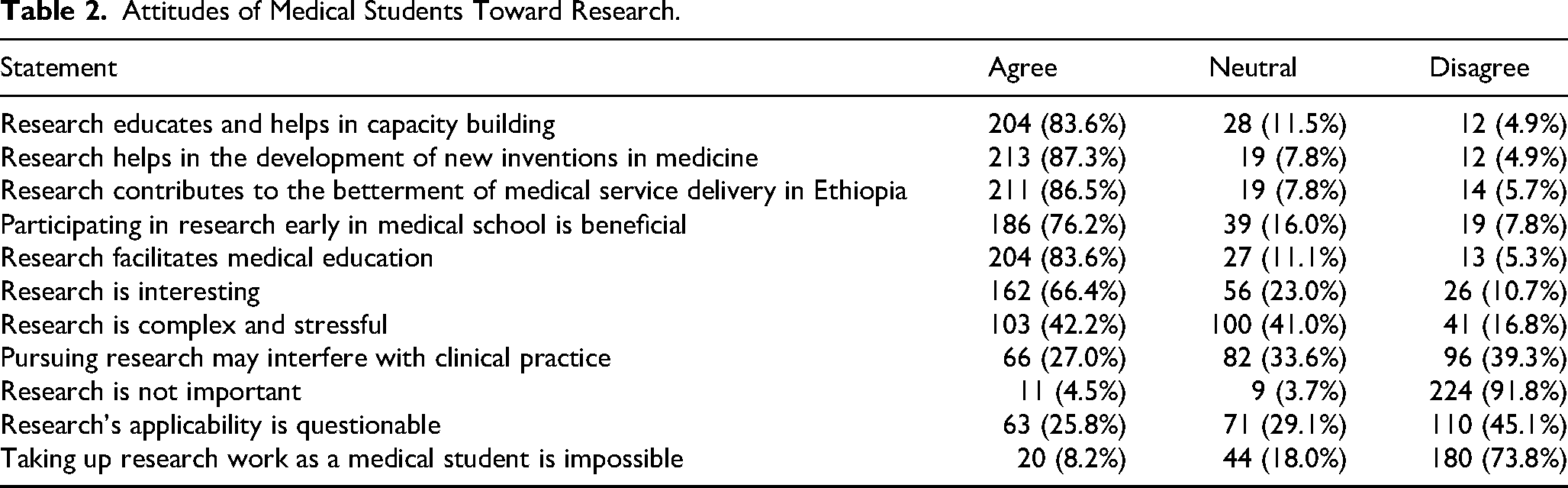
From the study participants, 204 (83.6%) participants agreed that research educates and helps in capacity building. Among the 244 participants, 213 (87.3%) agreed that research helps in the development of new inventions in medicine. A total of 86.5% of the participants agreed that research contributed to better medical service delivery in Ethiopia. A total of 76.2% agreed that participating in research early in medical school is beneficial, and 83.6% agreed that it facilitates medical education. A total of 23.0% were neutral when asked if the research was interesting, and 10.7% disagreed. A total of 103 (42.2%) agreed that the research was complex and stressful. Sixty-three (25.8%) believed that research applicability was questionable. A total of 180 (73.8%) did not agree that undertaking research work as a medical student is impossible, as shown in Table 2.
Attitudes of Medical Students Toward Research.
Experiences
Among the study participants, 46.3% reported that they had one source of education/training about research. A total of 19.7% used 2 different categories of sources, whereas 18% reported that they had 3 different categories of resources. A total of 10.2% reported that they had more than 3 categories of sources for research, education, and training. The majority, 72.5%, considered medical school their source of education/training in research. A total of 39.3% had the opportunity to obtain education about research through books and journals. A total of 45.1% also used online sources. 23.8% of the study participants were able to learn from their peers. A total of 6.1% reported that they had no resources. A total of 168 (68.9%) reported that they were motivated and interested in doing research. Seventy-nine (32.4%) had not participated in any research. Sixteen (6.6%) reported that they had been involved in more than 3 research projects.
Roles undertaken during research participation were assessed. Thirty-eight (15.6%) patients participated as primary investigators. A total of 134 (54.9%) participants were data collectors. Fifty-nine (24.2) participated in the data analysis. Twenty-five (10.2%) participants participated in the write-up. Two (0.8%) had experience with laboratory-based research. A total of 135 (55.3%) had experience with questionnaire-based research. Twenty-four (9.8%) were part of case–control studies, whereas 10 (4.1%) had experiences with cohort studies. Fourteen (5.7%) studies were randomized control trials, as shown in Table 3.
Research Experiences of Medical Students.

Barriers
Lack of time (54.1%), lack of resources (28.3%), lack of guidance and supervision (48.8%), and lack of opportunity in research (56.1%) were the major barriers reported.
Data analysis and logistics and finances were considered parts that would be difficult to perform while conducting research as shown in Table 4.
Anticipated Areas of Difficulty Reported by Medical Students.

Two hundred eleven (86.5%) of the study participants did not believe that there was enough support from their school or university to encourage students to carry out research. A total of 223 (91.4%) did not believe that research education and training at their school was adequate. A total of 125 (51.2%) did not believe that journals and research articles are accessible to them.
Discussion
In this study, the average knowledge score was 43.1%, with the most frequent result being 50%. There was also no significant association between knowledge score and age, sex, or year of study. This result was relatively lower than the mean percentage score of 49.0% reported among a group of Pakistani medical students in a cross-sectional pilot study conducted in 2006. Although age and sex were not factors associated with knowledge, year of study was linked with knowledge level among Pakistani medical students, with a year increase in year of study yielding an increase in knowledge score of 4.1%. 11 On the contrary, a study done among undergraduate health profession students in Uganda highlighted that age, sex, and year of study were significantly associated with research involvement. 3 A study done among final year Sudanese medical students also showed comparable findings where there was no association between perceptions toward research with sex. 15 Another study conducted among 193 students at Zagreb University School of Medicine reported that their knowledge of scientific research was poor, with a knowledge score of 2.2 ± 1.2 out of 8 questions, even though there was a positive attitude toward science. Undergraduate and postgraduate students from 3 medical, dentistry, and pharmacy schools in Shiraz, Iran, were selected to be part of a cross-sectional descriptive study to assess knowledge, attitudes, and barriers toward research. Seventy-five percent of the participants had an inadequate level of knowledge, with no significant associations between knowledge and participants’ age, sex, or type of knowledge. 16 A study by Memarpour et al revealed that, compared with other participants, participants who were previously taught about research methodology had a positive association with research knowledge. 16 This highlights the overall prevalence of inadequate knowledge about research in medical schools. In addition, different contexts and education systems could also lead to varying research culture in undergraduate studies of health professionals.
According to our study, 76.2% believed that participating in research early in medical school was beneficial. Similarly, a study done among students at the College of Medicine and Health Sciences of University of Rwanda also showed similar findings where 60% of study participants fully agreed that research is important. 6 This result is also comparable to the research performed at Easternmost Medical College of India from November to December 2015, with 87.3% of the students agreeing that it is important for medical students to know about research methodologies and 75.9% of them believing that students should be part of more research. 17 Another comparative study from Germany also revealed that medical students had positive attitudes toward research and that more than half had already started involvement in research before their dissertation. 18 In the same study, 63.2% of the participants noted that undertaking research increases the burden on students, which is a higher percentage than in our study, with 42.2% believing that research was complex and stressful. A total of 86.5% of the participants in our study believed that research contributed to better medical service delivery in our country. Similarly, 83.9% of the participants from the above study concluded that research is useful for improving patient outcomes.
A prospective study of medical students from 3 medical schools (Queens University, University of Ottawa, and University of Western Ontario) in Ontario reported that 83% of the respondents agreed that some participation in research was valuable in their medical education. 19 This result is similar to that of our study, with 83.6% of the participants agreeing that research facilitates medical education. In a study conducted at a New Zealand medical school to determine attitudes toward research and research careers among students, only 25% of the students had participated in some form of research activity during medical school, 20 which is low compared with the 67.6% of students who participated in at least one research activity reported in our study.
Several challenges to conducting research were reported by the participants. In terms of difficulty, data analysis, logistics, and finances were considered challenging parts of the research. A similar cross-sectional descriptive study performed to assess the knowledge and attitudes of medical students across 3 Arab universities (King Faisal University (Saudi Arabia), Arab Gulf University (Bahrain) and Kuwait University (Kuwait)) reported that a lack of time, a rewarding and motivational system in their colleges, appropriate knowledge and necessary skills, and proper mentoring to encourage and guide students in the field of scientific research were the main barriers listed by respondents. 21 A total of 86.5% of our participants did not believe that there is support from their university to carry out research, whereas 91.4% did not believe that research education and training at their school is adequate. In a study performed among medical student members of the American Medical Association's Medical Student Section and the American Medical Student Association, a lack of faculty mentors and a lack of a research office/coordinator were the main barriers mentioned by responders. 22
Strengths of This Study
The study achieved a 100% response rate, minimizing nonresponse bias and enhancing the representativeness of the findings. In addition, it provided a comprehensive assessment of medical students’ research knowledge, attitudes, experiences, and perceived barriers, offering a holistic understanding of research readiness. Knowledge was measured using pretested, multiple-choice questions with objective scoring, reducing information bias. The inclusion of students across multiple academic years allowed for meaningful comparisons and insights into potential determinants of research knowledge.
Limitations
Despite its strengths, this study is not without limitations. This study consisted of study participants from one institution which has a potential to introduce bias. Response bias could have been introduced as the participants were approached by their classmates and class representatives. Moreover, while associations with demographic variables were explored, the cross-sectional design precludes causal inferences. Recall bias can lead to some aspects of research experience and barriers being underreported or overreported as well.
Conclusion
In conclusion, our research reported an average knowledge score of 43.1%, with no associations with age, sex, or year of study. Knowledge of clinical year medical students on research was found to be inadequate; however, it was also found that the majority of the students in this study considered research as important. This result implies that more work needs to be done on identified barriers, such as a lack of time, resources, guidance, and opportunities. We call for interventions by medical schools and relevant stakeholders to further incorporate research into the curriculum and provide more resources and guidance to medical students.
Supplemental Material
sj-sav-1-mde-10.1177_23821205261420885 - Supplemental material for Knowledge, Attitudes, Experiences, and Perceived Barriers to Health Research Among Clinical-Year Medical Students at Addis Ababa University, College of Health Sciences: A Cross-Sectional Study
Supplemental material, sj-sav-1-mde-10.1177_23821205261420885 for Knowledge, Attitudes, Experiences, and Perceived Barriers to Health Research Among Clinical-Year Medical Students at Addis Ababa University, College of Health Sciences: A Cross-Sectional Study by Abigael Abiy Mesfin, Kidist Nega Aragaw, Laltu Megerssa Negasa and Meskerem Dessie Demessa, Feruz Ismael Jemal, Dagim Fisseha Tamirat in Journal of Medical Education and Curricular Development
Supplemental Material
sj-docx-2-mde-10.1177_23821205261420885 - Supplemental material for Knowledge, Attitudes, Experiences, and Perceived Barriers to Health Research Among Clinical-Year Medical Students at Addis Ababa University, College of Health Sciences: A Cross-Sectional Study
Supplemental material, sj-docx-2-mde-10.1177_23821205261420885 for Knowledge, Attitudes, Experiences, and Perceived Barriers to Health Research Among Clinical-Year Medical Students at Addis Ababa University, College of Health Sciences: A Cross-Sectional Study by Abigael Abiy Mesfin, Kidist Nega Aragaw, Laltu Megerssa Negasa and Meskerem Dessie Demessa, Feruz Ismael Jemal, Dagim Fisseha Tamirat in Journal of Medical Education and Curricular Development
Supplemental Material
sj-docx-3-mde-10.1177_23821205261420885 - Supplemental material for Knowledge, Attitudes, Experiences, and Perceived Barriers to Health Research Among Clinical-Year Medical Students at Addis Ababa University, College of Health Sciences: A Cross-Sectional Study
Supplemental material, sj-docx-3-mde-10.1177_23821205261420885 for Knowledge, Attitudes, Experiences, and Perceived Barriers to Health Research Among Clinical-Year Medical Students at Addis Ababa University, College of Health Sciences: A Cross-Sectional Study by Abigael Abiy Mesfin, Kidist Nega Aragaw, Laltu Megerssa Negasa and Meskerem Dessie Demessa, Feruz Ismael Jemal, Dagim Fisseha Tamirat in Journal of Medical Education and Curricular Development
Footnotes
Abbreviations
Acknowledgments
We would like to acknowledge our data collectors Kidist Solomon, Dr Bethelhem Workneh, Dr Temesgen Habtu, Kalkidan Desalegn, Kalkidan Yilma, and Dr Saba Habtu

Ethical Considerations
The study was conducted under the Ethical Principles for Medical Research of the Helsinki Declaration. Ethical approval was sought from Addis Ababa University, College of Health Sciences, Department of Surgery ethical review committee under the Reference REC/155/2025/2017. Confidentiality was maintained, and the data were collected anonymously.
Consent to Participate
Informed written consent was obtained from all the responders prior to their participation in the study.
Author Contributions
AM, FJ, and KA wrote the proposal; MD supervised the data collection and cleaning; AM analyzed the data; LN and DT wrote the final manuscript; MD and AM reviewed and gave directions during the write-up process.
Funding
The authors received no financial support for the research, authorship, and/or publication of this article.
Declaration of Conflicting Interests
The authors declared no potential conflicts of interest with respect to the research, authorship, and/or publication of this article.
Declaration of Generative AI and AI-Assisted Technologies in the Writing Process
During the preparation of this work, the author used Curie to improve language. After using this tool/service, the author reviewed and edited the content as needed and takes full responsibility for the content of the published article.
Data Availability
The data used in this study is submitted with the manuscript as supplemental material.
Supplemental Material
Supplemental material for this article is available online.
References
Supplementary Material
Please find the following supplemental material available below.
For Open Access articles published under a Creative Commons License, all supplemental material carries the same license as the article it is associated with.
For non-Open Access articles published, all supplemental material carries a non-exclusive license, and permission requests for re-use of supplemental material or any part of supplemental material shall be sent directly to the copyright owner as specified in the copyright notice associated with the article.
