






Abstract
When two tones are presented in a short interval of time, the presentation of the preceding tone (masker) suppresses the response evoked by the subsequent tone (signal). To address the processing in forward suppression, we applied 2- and 4-kHz maskers, followed by a 1-kHz signal at varying signal delays (0 to 320 ms) and measured the signal-evoked N1m. A two-way analysis of variance revealed a statistically significant effect for signal delay in both masker presentation conditions. The N1m peak amplitude at the signal delay of 320 ms was significantly larger than those of 10, 20, 40, and 80 ms (p < 0.05). No significant enhancement for the very short signal delay was observed. The results suggest that the enhancement of N1m peak amplitude for short signal delay conditions is maximized when the frequency of the masker is identical to that of the signal.
Introduction
N1 and N1m are, respectively, the auditory-evoked potentials and fields generally investigated in numerous studies. Their amplitude and latency are affected by various factors, and extremely sensitive to the interval between two repeated stimuli. It is believed that shorter inter-stimulus intervals attenuate the N1. However, the N1 peak amplitude does not progressively become diminished as the inter-stimulus interval decreases. When the inter-stimulus interval is randomly changed, the N1 peak amplitude paradoxically enhances for short interval conditions.1,2 Although a decreased contribution of inhibitory postsynaptic potentials and a latent inhibition may be associated with the mechanism underlying this enhancement, 2 4 the details have not yet been revealed.
When the two tones are presented in turn, the presentation of the preceding tone (masker) suppresses the response evoked by the subsequent tone (signal). 5 7 This phenomenon is known as forward suppression. Various factors, such as the interval between the masker and signal (signal delay) and their frequency, affect the forward suppression.6,8 As the signal delay decreases, the interaction between the two tones increases, and the response evoked by the signal is expected to decrease. With regard to their frequencies, it is expected that the forward suppression is greater in the equal frequency condition than in the different. In the psychoacoustic experiment, the threshold of the signal is elevated in the presence of the masker, which is referred to as forward masking. According to previous studies on forward masking, the threshold of the signal increased as the differences in the signal delay and frequency decreased.9,10 In contrast, in forward suppression, the effect of the frequency on the suppression of subsequent response agreed with the expectation based on the psychoacoustic experiment. 5 However, when the signal delay was randomly changed, the N1m peak amplitude showed the minimum value at a signal delay of 40 ms, and paradoxically increased as the signal delay decreased below 40 ms. 8 This paradoxical enhancement resembles the results of previous studies on the effect of inter-stimulus interval on N1 and N1m amplitudes.
Forward suppression is an important process in the central nervous system. Some processing in the auditory cortex probably contributes to the results of the previous study on signal delay. 8 The knowledge of forward suppression in this processing contributes to the understanding of brain function. We evaluated the effect of signal delay on the signal–evoked N1m in the condition in which the masker frequency differed from the signal frequency.
Materials and Methods
Eight volunteers (4 females and 4 males aged 26–32 years) took part in the present study. All the subjects had normal hearing and were right–handed. This study was approved by the Ethical Committees of National Institute of Advanced Industrial Science and Technology (AIST). The participants provided written consent after receiving information regarding the experimental procedure and purpose of these studies. Except for the masker frequency, the conditions used in the present study were the same as described previously. 8 The previous study used 1-kHz tones for both the masker and the signal. While the signal frequency was also set at 1 kHz in this study, 2- and 4-kHz tones were used as the maskers. The intensity of signal and masker was set at 85 dB HL. The duration of the masker and signal were set at 160 and 50 ms, including rise and fall ramps of 5 ms, respectively. The signal delay was set at 0, 10, 20, 40, 80, 160, and 320 ms. Nine stimulus trains, including the signal without masker and the masker without signal, were randomly presented. The interval of inter–stimulus–train was randomly set at 2.0 ± 0.1 s. A functional generator (WF1974; NF Electronic Instruments, Yokohama, Japan) generated the stimuli. An earphone (E–A–R TONE 3A, Cabot Safety, Indianapolis, IN) calibrated with an Ear Simulator (Type 4157; Brüel and Kjær, Nærum, Denmark) emitted the stimuli. They were delivered to the left ear through a plastic tube. During the measurement, the subject watched a self–chosen silent movie and was instructed to pay no attention to the stimuli.
Responses were measured using a whole–head Neuro-magnetometer (Neuromag–122; Neuromag Ltd, Helsinki, Finland) in a shielded room. The data were sampled at 0.4 kHz after band-pass filtering (0.03 and 100 Hz). Magnetic signals exceeding 3000 fT/cm were rejected. The analysis time was 1.0 s from 0.2 s prior to the masker onset, and the preceding 0.2-s period was employed as the baseline. The responses were averaged more than 100 times. The averaged responses were digitally band-pass filtered (0.1 and 30 Hz).
As in the previous studies, the N1m peak amplitudes and latencies were compared at the channel where the largest N1m amplitude evoked by the signal without masker were observed in the right hemisphere.8,11 The two pick-up coils of the neuromagnetometer measured the two tangential derivatives (δ
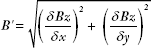
In order to compare the forward suppression among the subjects, the N1m peak amplitudes were normalized to the amplitude evoked by the signal without masker. In addition, the N1m peak amplitudes were also analyzed after removing the overlap of the responses to the maskers. These values were calculated by subtracting the response to the masker without signal, and the N1m peak amplitudes and latencies were measured in the calculated responses. The obtained values were normalized to the N1m peak amplitude evoked by the signal without masker in the right hemisphere.
Te data of the amplitude and latency were analyzed using a two-way analysis of variance (ANOVA), with frequency and signal delay as within-subject factors. The Ryan method was used for post-hoc comparisons. The data after subtracting the masker response were also compared in the same manner as those before the subtracting.
Results
Figure 1 shows the amplitudes of brain magnetic fields for a subject in the 2- and 4-kHz masker presentation conditions. N1m deflections were observed for all stimuli sets.

Waveforms of brain magnetic fields (B’) at each signal delay in the presence of a 2-kHz masker (
Figure 2A shows the mean N1m peak amplitudes before subtracting the response to the masker. A two-way ANOVA revealed a statistically significant effect for signal delay (F[6,42] = 4.27, p < 0.01), but not for frequency (F[1,7] = 0.18, p = 0.68). The interaction between them was not recognized (F[6,42] = 1.03, p = 0.42). In multiple comparisons, the N1m peak amplitude at the signal delay of 320 ms was significantly larger than those of 10, 20, 40, and 80 ms (p < 0.05), which is independent of the frequency.
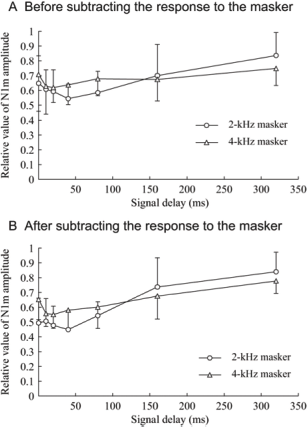
Mean normalized N1m amplitudes as a function of signal delay in the presence of the 2-kHz masker (
Figure 2B shows the mean N1m peak amplitudes after subtracting the response to the masker. A two-way ANOVA revealed a statistically significant effect for signal delay (F[6,42] = 15.19, p < 0.01), but not for frequency (F[1,7] = 0.74, p = 0.42). The interaction between them was recognized (F[6,42] = 3.16, p < 0.05). In multiple comparisons, for the frequency of 2 kHz, the N1m peak amplitudes at the signal delay of 160 and 320 ms were significantly larger than those of 0, 10, 20, 40, and 80 ms (p < 0.05). For the frequency of 4 kHz, the N1m peak amplitudes at the signal delay of 320 ms were significantly larger than those of 10, 20, 40, and 80 ms (p < 0.05). At the signal delay of 0 ms, the N1m peak amplitude for the frequency of 2 kHz was significantly smaller than that of 4 kHz (p < 0.05).
Figure 3A shows the mean N1m peak latencies before subtracting the response to the masker. No statistically significant effect (signal delay (F[6,42] = 1.01, p = 0.43) and frequency (F[1,7] = 3.09, p = 0.12)) and interaction (F[6,42] = 1.73, p = 0.14) were recognized.

Mean N1m latencies as a function of signal delay before (
Figure 3B shows the mean N1m peak latencies after subtracting the response to the masker. No statistically significant effect (signal delay (F F[6,42] = 0.76, p = 0.60) and frequency (F[1,7] = 0.18, p = 0.69)) and interaction (F[6,42] = 0.92, p = 0.49) were recognized.
Discussion
In this study, we employed 2- and 4-kHz maskers and 1-kHz signal. At the peripheral level, auditory filter is an important factor for forward masking.9,10 The difference in frequency for the current condition was too large to elevate the signal threshold owing to forward masking. We confirmed that the threshold of the 1-kHz signal was not evaluated in the presence of the current 2– and 4-kHz maskers (Fig. 4).

When the two stimuli are presented in a short interval, the respective responses to the masker and signal overlap with each other. The N1m amplitude evoked by the signal may be affected by this overlap. One of the methods to eliminate the influence of the overlap is to subtract the response evoked by the masker without signal from that evoked by the signal with masker.8,11 With regard to the merit of this analysis, there is the following risk: the responses evoked by the signal with masker are not always identical to the combination of the two responses obtained solely in the presence of the masker or signal. The evoked response in the presence of two stimuli may involve the interaction between the responses to two stimuli, and the subtraction data does not reflect the interaction. In this study, we analyzed both results obtained before and after the subtraction of the masker response. Comparing both results, significance was more frequently observed in the data of the N1m peak amplitudes after the subtraction. Furthermore, significance was more frequently observed in the presence of the 2-kHz masker. The removal of the masker response might emphasize the differences. However, no remarkable difference in the tendency of the effect of the signal delay was observed between them. With regard to the N1m peak latency, no significant effects of the signal delay and frequency were observed before or after the subtraction. Thus, the merits of the subtraction method were not obviously recognized in this study. From the current results, it is not possible to conclude whether the subtraction of the masker response is advantageous to the data analysis. No correlation between the N1m peak amplitude and latency was observed in the current results. Although no significant effect on the N1m peak latency was observed, a significant effect of the signal delay on the N1m peak amplitude was observed. The N1m peak amplitude decreased for short signal delay conditions. On the other hand, with regard to the frequency factor, no statistically significant effect was observed. The 1-kHz signal used a different auditory filter from the 2- and 4-kHz maskers, which might be responsible for the current results. Despite the difference in the auditory filter between the 2- and 4-kHz masker, this difference was not reflected in the current forward suppression. To address the effect of the masker frequency factor on forward suppression, the measurement has to be performed in other conditions; for instance, where the auditory filters of the masker and signal overlap each other, and where the frequency of the masker is lower than that of the signal.
At signal delays above 40 ms, these findings agreed with the previous study for forward suppression employing the 1-kHz masker and signal. 8 However, in the previous study, the N1m peak amplitude evoked by the signal enhanced as the signal delay decreased below 40 ms. While the minimum amplitudes for 2- and 4-kHz masker presentation were observed at the signal delay of 40 and 10 ms, respectively, no significant enhancement was observed in the current results. The results suggest that the enhancement of N1m peak amplitude for short signal delay conditions is observed when the frequency of the masker is identical to that of the signal. When the masker frequency is different from the signal, forward suppression is attenuated. 6 Owing to the attenuation of forward suppression, the gap between the N1m amplitude at the signal delay of 0 ms and the minimum was probably reduced. Thus, the difference might not statistically be recognized in the current results. Unfortunately, the current results cannot conclude the mechanism underlying the enhancement of N1m peak amplitude for short signal delay conditions. The current results indicated the necessity of considering the frequency factor (auditory filter) in the investigation of forward suppression. Further study is needed to reveal the mechanism.
Author Contributions
Conceived and designed the experiments: TN, SN. Analyzed the data: YU, TO, TY. Wrote the first draft of the manuscript: YU. Contributed to the writing of the manuscript: YU, TN. Agree with manuscript results and conclusions: YU, TN, SN, TO, TY, HH. Jointly developed the structure and arguments for the paper: YU, TN, SN, TY, HH. Made critical revisions and approved final version: YU, TN. All authors reviewed and approved of the final manuscript.
Disclosures and Ethics
As a requirement of publication the authors have provided signed confirmation of their compliance with ethical and legal obligations including but not limited to compliance with ICMJE authorship and competing interests guidelines, that the article is neither under consideration for publication nor published elsewhere, of their compliance with legal and ethical guidelines concerning human and animal research participants (if applicable), and that permission has been obtained for reproduction of any copyrighted material. This article was subject to blind, independent, expert peer review. The reviewers reported no competing interests.