






Abstract
The pathogenesis of morphea and other cutaneous sclerosing disorders remain poorly understood. Although they are considered to be autoimmune disorders, abnormal tryptophan metabolism may be involved. Current therapy is directed to supressing the autoimmune response. Demonstration of a therapeutic response to manipulation of the kynurenine pathway would both support a role for abnormal tryptophan metabolism and offer additional targets for therapy. Tranilast is a 3-hydroxyanthranilic acid derivative known to target the kynurenine pathway. The aim of this study was to see if tranilast lowered the urinary excretion of the kynurenine metabolites kynurenic and quinolinic acid under condition of L tryptophan loading in a volunteer. Mean baseline value for kynurenic acid and quinolinic acid were 1.1 and 2.1 mmol/mol creatinine, respectively. This rose to 5.6 and 3.8 mmol/mol creatinine respectively under conditions of L tryptophan loading 2 grams daily. Adding 1 g of tranilast daily lowered the values to 2.0 and 2.9 mmol/mol creatinine, respectively. These data suggest that tranilast acts as a competitive inhibitor of either indoleamine 2, 3-dioxygenase (IDO), tryptophan 2, 3 di-oxygenase (TDO) or both. As it involved only 1 subject, the results may not be representative of the larger population and must be considered preliminary.
Introduction
Morphea is a localized variant of scleroderma. Its variants include plaque, bullous, linear, frontoparietal, subcutaneous, generalized and pan-sclerotic morphea of childhood. Eosinophilic fasciitis was recently included in the disease spectrum. 1 It is considered to be an auto-immune disease possibly related to microchimerism of fetal cells. 2 Abnormal tryptophan metabolism has been reported in other sclerosing cutaneous diseases. 3 L-tryptophan supplementation was responsible for an outbreak of eosinophilia myalgia syndrome, which resulted in cutaneous sclerosis resembling eosinophilic fasciitis. 4 Although initially reported in association with contaminated L-tryptophan, later reports linked the condition to L-tryptophan from other suppliers. 5
Abnormalities in L-tryptophan metabolism were also reported in the toxic oil syndrome reported in Spain from contaminated rapeseed (canola) oil. 6 This resulted in cutaneous sclerosis similar to eosinophilic fasciitis.
The kynurenine pathway is shown in Figure 1. Several drugs known to act on the kynurenine pathway have been reported to produce cutaneous sclerosis as side-effects. These are listed in Table 1.
The kynurenine pathway. Agents known to be active in the kynurenine pathway which have been reported to produce scleroderma like syndromes. Based on sites of action all would appear to increase kynurenine levels.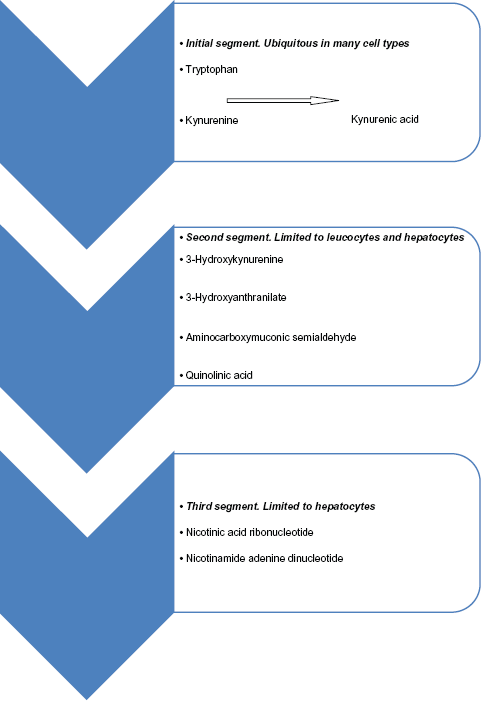

L-Tryptophan is an inducer of tryptophan2, 3 di-oxygenase, 7 the first enzyme in the hepatic kynurenine pathway. Benserazide is a potent inhibitor of the enzyme kynurenase 8 and a component of levodopa containing preparations used to treat Parkinsonism. Several cases of scleroderma-like illnesses have been reported during treatment of Parkinsonism with L-5-hydroxytryptophan and levodopa/benserazide combinations. 9 Aromatic hydocarbons have also has been reported to precipitate scleroderma-like illnesses, 10 and these are ligands for the aryl hydrocarbon receptor. Kynurenine is a natural ligand for the aryl hydrocarbon receptor. 11
Manipulation of this pathway may provide additional therapeutic options to supplement the traditional immunosuppressive modalities known to have efficacy in this disorder (corticosteroids, methotrexate, mycophenylate mofetil and phototherapy). 12 An ideal candidate agent would have known safety, approval for use in human subjects and anecdotal reports of efficacy in this group of disorders.
Tranilast is an agent approved in Japan and Korea for the management of allergic disorders. It is known to inhibit the release of mast cell mediators. 13 More recently, it was demonstrated to inhibit the release of transforming growth factor beta 1 14 and it is now approved for the management of keloids and hypertrophic scars. There have been anecdotal reports of beneficial use in morphea. 15 It is a derivative of 3-hydroxyanthralinic acid, which is a known stimulator of TGF beta production, 16 suggesting that it is acting as an antagonist.
The aim of this study was to evaluate whether tranilast had a direct effect on the kynurenine pathway under conditions of tryptophan loading.
Methods and Materials
L tryptophan was obtained from Bioeva Australia (BIOVEA, Hurstville NSW 2220 Australia). Tranilast was obtained from eBiochem (Pudong, Shanghai, China), weighed and capsulated. Early morning urine specimens were obtained, frozen and transported in laboratory-supplied kits. Organic acid profiles were performed at the Great Plains Laboratory (Lenaxa Ks) via gas chromatography/mass spectrometry. A healthy 56-year-old male with no significant co-morbidities acted as the subject. Ethical approval for this research was obtained, and the subject gave his written, informed consent to participate.
Results
Urinary organic acid profile for kynurenic and quinolinic acid. All results are expressed in mmol/mol creatinine. A two tail, two sample equal variance


Graph of mean urinary kynurenic and quinolinic acids under baseline conditions (1), L-tryptophan 2 g/day loading (2) and L-tryptophan 2 grams per day with tranilast 1 gram per day (3). Values on the Y axis are expressed in mmol/mol creatinine.
To improve reliability, specimens were collected over a several-week period at variable time intervals. Tryptophan loading was commenced 10 days prior to the collection of the initial specimen and continued throughout the trial period. The timeline for data collection is included.
Mean baseline value for kynurenic acid and quinolinic acid were 1.1 and 2.1 mmol/mol creatinine, respectively. This rose to 5.6 and 3.8 mmol/mol creatinine, respectively, under conditions of L tryptophan loading 2 grams daily. Adding 1 gram of tranilast daily lowered the values to 2.0 and 2.9 mmol/mol creatinine, respectively. A 2 tail, 2 sample equal variance
The main limitation of this study was the involvement of a single individual only. Although reaching statistical significance in this individual, the results may not automatically be applicable to a larger population.
Discussion
A number of agents have been reported to exhibit activity on the kynurenine pathway. As drugs known to promote cutaneous sclerosis as an adverse reaction would be anticipated to increase kynurenine levels, any potential therapeutic agent needs to be shown to produce statistically significant lowering of both kynurenine and quinolinic acid, presumably by acting at the level TDO/IDO. The data does not allow us to determine which enzyme or both is being acted on. From a therapeutic perspective, the aim is to lower levels of kynurenine as the evidence suggests this is the most relevant metabolite.
The agent initially used to demonstrate the role of the kynurenine pathway in the maintenance of immunological tolerance during pregnancy, 1-methyl-D-tryptophan, 17 is undergoing trials in patients with advanced malignancy. 18 Until these are available, there remains little data on its use in human subjects.
Indoleamine 2, 3-dioxygenase is involved in immune regulation. Expression varies at the body site, being maximal in interface areas 19 including the gastrointestinal tract, lung and skin where exposure to foreign antigens occurs, in the spleen and thymus where it presumably plays a role in the regulation of self-antigens, and in the epididymis and prostate where it presumably has a protective role against intracellular infectious organisms.
Tranilast is a 3-hydroxyanthranilic acid derivative. As it inhibits TGF beta activity, which is normally enhanced by 3 hydroxyanthranilic acid, it would appear to be acting as an antagonist to 3 hydroxyanthranilic acid. These data suggest that tranilast may act as a competitive inhibitor at the level of tryptophan 2, 3 di-oxygenase/indoleamine 2, 3-dioxygenase. However as the trial involved only single individual, results must be considered preliminary.
Author Contributions
Conceived and designed the experiments: RRN. Analyzed the data: RRN. Wrote the first draft of the manuscript: RRN. Contributed to the writing of the manuscript: RRN. Agree with manuscript results and conclusions: RRN. Jointly developed the structure and arguments for the paper: RRN. Made critical revisions and approved final version: RRN. The author reviewed and approved of the final manuscript.
Funding
Author(s) disclose no funding sources.
Competing Interests
Author(s) disclose no potential conflicts of interest.
Disclosures and Eethics
As a requirement of publication the author has provided signed confirmation of compliance with ethical and legal obligations including but not limited to compliance with ICMJE authorship and competing interests guidelines, that the article is neither under consideration for publication nor published elsewhere, of their compliance with legal and ethical guidelines concerning human and animal research participants (if applicable), and that permission has been obtained for reproduction of any copyrighted material. This article was subject to blind, independent, expert peer review. The reviewers reported no competing interests.