






Abstract
This study describes the aquatic habitats, species composition, and the insecticide resistance level of the mosquito Culex pipiens pallens in Shandong Province, China. A cross-sectional survey of mosquito larval habitats was conducted from May to November 2014 to determine the species composition and larval abundance. Larvae were collected using the standard dipping technique, and a total of four habitat types were sampled. The fourth instar larvae of Cx. pipiens pallens collected in each habitat type were tested for resistance to five insecticides according to a WHO bioassay. A total of 7,281 mosquito larvae were collected, of which 399 (5.48%) were categorized as Anopheles mosquito larvae (An. sinensis), 6636 (91.14%) as culicine larvae (Cx. pipiens pallens, Cx. tritaeniorhynchus, Cx. halifaxii, and Cx. bitaeniorhynchus), 213 (2.93%) as Armigeres larvae, and 33 (0.45%) as Aedes larvae (Aedes albopictus). In addition, a total of 1,149 mosquito pupae were collected. Culex larvae were distributed in all habitats investigated. Tukeys HSD analysis showed that roadside drainages were the most productive habitat type for Culex larvae. Armigeres species were found only in drains, Aedes only in water tanks, and Anopheles in water that was comparatively clear and rich in emergent plants. Bioassay showed that the maximum resistance level of Cx. pipiens pallens was to deltamethrin, while it was lowest to plifenate. The productivity of various mosquitoes in different habitat types is very heterogeneous. It is particularly important to modify human activity and the environment to achieve effective mosquito vector control. For effective larval control, the type of habitat should be considered, and the most productive habitat type should be given priority in mosquito abatement programs.
Keywords
Introduction
As the most medically serious disease vector, the mosquito has abundant species and wide distribution. 1 Mosquitoes not only bite and harass humans but also spread various parasitic and viral diseases such as malaria, filariasis, 2 viral encephalitis, and dengue. In 2010, China reported 7,855 malaria cases with an incidence rate of 0.06/10,000. In addition, it reported 34,082 suspected cases and 19 deaths. For instance, Shandong Province reported 117 malaria cases in 2010, down 2.5% compared to the previous year, and among them 70% were imported cases. Furthermore, mosquito-borne viral diseases like epidemic encephalitis B happened occasionally. 3 Culex pipiens pallens is also a potential vector of West Nile virus (WNV) in China. 4 The control of mosquito populations is based on chemical insecticides, but, unfortunately, the rapid development of insecticide resistance undermines the effectiveness of control. Especially in Cx. pipiens pallens, long-term intensive and widespread use of pyrethroids has led to moderate or high resistance for DDVP, propoxur, acetofenate, cypermethrin, and deltamethrin, making the use of this class of insecticides ineffective and limiting the available options for mosquito control.5–7 Therefore, it is of great significance for planning control measures to counteract various mosquito-borne diseases, to study the composition and distribution of the mosquito population, as well as their breeding places and disease vector control interventions.
The rapid development of tourism has increased sewage levels, thus making the lake environment more conducive for the growth of mosquitoes. The population of Shandong Province has reached about 95.79 million, and domestic sewage pools and above-ground pools of human excreta are widespread in urban areas, where they have become the main breeding ground of Cx. pipiens pallens.
We categorized four main mosquito breeding habitats in Shandong Province: irrigation ditches, roadside drainages, freshwater lake fringes, and water tanks. Then, we investigated the larvae according to their different ecological types to obtain a systematic understanding of the species and distribution of mosquitoes in Shandong Province, the relationship between the habits of the mosquitoes and the natural environment, and the insecticide resistance levels of Cx pipiens pallens. A new mosquito database was established based on this investigation, which provided a scientific basis for both appropriate control measures targeting mosquito-borne diseases and efforts to prevent or slow down the development and spread of insecticide resistance in the mosquito population.
Materials and Methods
Study Area
Shandong Province lies in the coastal area of east China, 34°22'52”–38°15'02”N and 114°19'53”–122°43'E, covering an area of 157,100 km2. The land is generally flat, with very few sections of undulating ground, with wheat, rice, and corn as the predominant crops. It has a temperate continental monsoon climate with concentrated rainfall during the hot, rainy summer season. The average annual rainfall for this region is approximately 550–950 mm (based on data of 1958–2008), 8 with 60%–70% concentrated inthe months of June, July, and August and an average temperature of 21.5°C–27°C, thus appropriate for the growth and reproduction of mosquitoes.
Mapping of Study Areas
Larvae were collected in larvae form from three separate districts in Jinan (36°38'N, 116°56'E), Qingdao (35°41'N, 119°44'E), and Jining (35°18'N, 116°29'E) in Shandong Province (Fig. 1). Coordinate readings (latitude and longitude) and altitude of major roads, freshwater lakes, aquatic habitats, and houses were taken once using a geographic positioning system (GPS) unit, and records were kept in order to repeat samplings.
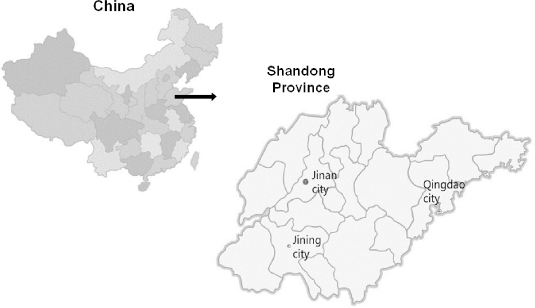
Map of China demonstrating the distribution of mosquito sampling sites. Jinan (36°38'N, 116°56'E), Qingdao (35°41'N, 119°44'E), and Jining (35°18'N, 116°29'E).
Selection of Aquatic Habitats
All selected aquatic habitats were mapped in Shandong Province from May to November in 2014. These were sampled twice per month to determine the presence or absence of larvae. Habitats were grouped by the types of irrigation ditches, roadside drainages, freshwater lake fringes, and water tanks. These habitat types were described as follows: 1) irrigation ditches were those used to irrigate rice, wheat, corn, and other produces; 2) drains on roadsides were collections of rainwater and effluents from factories and houses; 3) lake fringes were edges of a freshwater lakes with reeds (Phragmites australis), lotus (Nelumbo nucifera), and common duckweed (Lemna minor); and 4) water tanks were containers in which people collect rainwater.
The dissolved oxygen, pH, and NH4 + N of all standing waters in habitats greater than 100 mm depth was evaluated using a YSI Professional multiparameter meter. When any breeding site was dry, an attempt was made to survey the vicinity.
Larval Sampling
A larva dipper was used to collect mosquito larvae from various habitats, and the collected larvae were put in specimen boxes and taken to the laboratory for morphological identification.9,10 Every potential breeding site was surveyed for mosquito larvae and pupae using a standard dipper (∼350 mL) and performing five dips per site (1750 mL). The specimen boxes (length = 25 cm, width = 15 cm, height = 20 cm) were made of plastic.
Mosquito larvae densities were calculated as the mean number of larvae per dip sample. Larvae with similar morphology were fed with pork liver powder and yeast powder until they reached adult stage. Care was taken to retain the fourth instar larvae of Cx. pipiens pallens for subsequent bioassay.
Bioassay
The susceptibility of fourth stage larvae of Cx. pipiens pallens collected was tested on site to five insecticides, namely cypermethrin, propoxur, deltamethrin, plifenate, and DDVP, and testing was done according to WHO bioassay procedure. 11 The fourth instar larvae (20–24 numbers) were exposed in plastic vials with 50 mL tap water, and the test concentrations were as follows: cypermethrin, 2–32 μg/L, propoxur, 0.28–1.35 mg/L, deltamethrin, 2.5–40 μg/L, plifenate, 2.5–40 μg/L, and DDVP, 0.25–4 mg/L. Susceptible mosquitoes were exposed in the plastic cup with tap water as control. After 24 hours, the number of dead mosquitoes was recorded. Sensitive strains (protected from contact with insecticides for 20 years), routinely reared in our laboratory, were used as the control. The test was repeated thrice.
Statistical Analysis
Statistical analyses were carried out using the SPSS software (Version 19 for Windows, SPSS Inc.). Logistic regression analysis 12 was used to test associations of the environmental variables with the occurrence of different mosquito larvae. Presence of larvae was categorized as 1, while the absence of larvae was categorized as zero. One-way analysis of variance (ANOVA) was used to compare the differences in the number of mosquito larvae in different habitats.
Results
Habitat Characterization, Larval Species, and Their Abundance
The habitat types sampled in Shandong Province during this survey, from May to November 2014, included irrigation ditches (n = 3), roadside drains (n = 6), freshwater lake fringes (n = 4), and water tanks (n = 5). Larvae were differentiated macroscopically according to whether they hung down from the water surface (culicines), floated parallel to the surface (Anophelines), 13 or had a distinguishing thin and bifurcated hair V 14 or S-shaped movement in the water (Aedes).15,16 A total of 7,281 mosquito larvae were collected, of which 399 (5.48%) were categorized as Anopheles, 6636 (91.14%) as Culex, 213 (2.93%) as Armigeres, and 33 (0.45%) as Aedes larvae. In addition, a total of 1,149 mosquito pupae were collected (Table 1). In the investigation, culicine late instars were found in 34.29% (2,497) of all samples, and Anopheles late instars were found in 3.91% (285). Culicine early instars were found in 4,139 samples (56.85%), whereas Anopheles early instars were found in 114 samples (1.57%). The density of early instars was 1.66-fold higher than late instars for culicines, while for Anopheles the late instars were 2.50-fold higher than early instars. Furthermore, late instar larvae are frequently used to assess the dynamics of larval populations in habitats of different types and characteristics.17,18 Further identification based on morphology showed that the most abundant was Cx. pipiens pallens (88.94%, n = 6,476), which was observed in all habitats investigated. An. sinensis (5.42%, n = 399), the second most abundant mosquito, was found in irrigation ditches and margins of a freshwater lake with reeds, lotus, and common duckweed. The third most important mosquito was Aedes albopictus (0.48%, n = 33), which was only found in water tanks. In addition, Cx. Tritaeniorhynchus (0.81%, n = 59), Cx. halifaxii (0.16%, n = 12), Ar. subalbatus (2.93%, n = 213), and Cx. bitaeniorhynchus (1.22%, n = 89) were identified based on their morphology. Ar. subalbatus and Cx. halifaxii, which were sampled from roadside drains (collections of rainwater and effluent from factories or houses), had more niche overlap with Cx. pipiens pallens and were a predator of it. Cx. tritaeniorhynchus and Cx. bitaeniorhynchus were sampled from the margins of a freshwater lake.
Mosquito larval abundance in the different habitat types in Shandong Province.
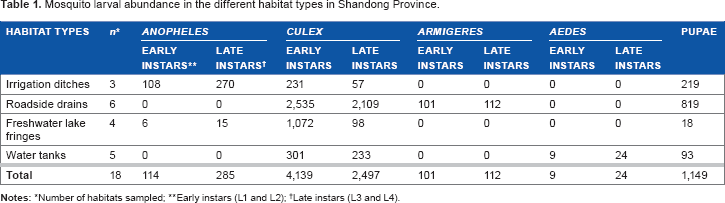
Number of habitats sampled;
Early instars (L1 and L2);
Late instars (L3 and L4).
Water samples from all these habitats were detected by a handheld multiparameter meter (Table 2). It is noteworthy that drains on the roadsides were the most turbid habitat type, as observed with the naked eye, and the most productive habitat type for culex mosquitoes. Irrigation ditches and the margins of freshwater lakes were the most suitable habitat types for Cx. pipiens pallens and other clean-water mosquitoes such as An. sinensis. Water tanks found near homesteads, mostly used to harvest rainwater and containing fallen leaves, were the ideal habitat for Ae. albopictus. Obviously, productivity was not homogeneous for every habitat type. The highest density of larvae was 182.1 per dipper in roadside drainages, and the lowest was 26.4 per dipper in water tanks. The densities of larvae in irrigation ditches and freshwater lake fringes were 59 and 60.45 per dipper, respectively.
Characteristics of larval habitats.
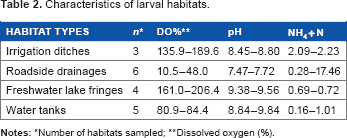
Number of habitats sampled;
Dissolved oxygen (%).
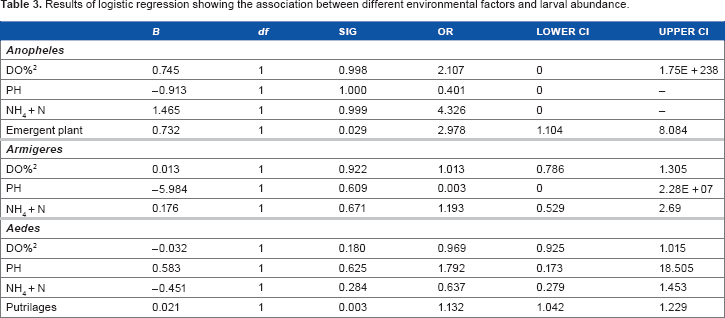
Culex was distributed in all habitats investigated in this study, but there was a significant difference in Culex production from the different larval habitat types (F(3,14) = 217.236, P < 0.001). Tukeys HSD analysis further showed that roadside drainages were the most productive habitat type for Culex larvae. By contrast, Armigeres were found only in roadside drains, and Aedes were found only in water tanks (Table 1). Logistic regression showed that emergent plants (P = 0.029) were the best predictors of Anopheles larval abundance in the aquatic habitats, and putrilages (P = 0.003) were positively associated with Aedes larval abundance (Table 3).
Results of logistic regression showing the association between different environmental factors and larval abundance.
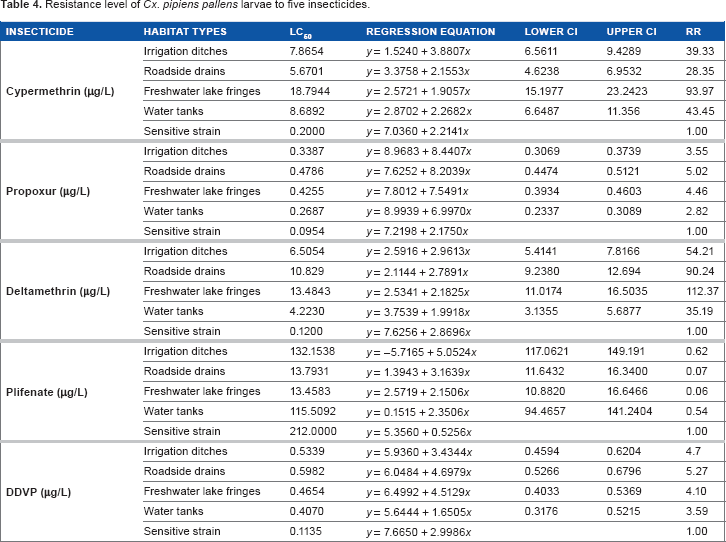
Bioassay showed that the highest resistance levels were to deltamethrin and the highest resistance ratio was 112.37-fold in Cx. pipiens pallens collected in freshwater lake fringes, while the plifenate resistance level was the lowest in larvae from all of the habitat types (Table 4).
Resistance level of Cx. pipiens pallens larvae to five insecticides.
Discussion
This study was conducted to understand the ecologies of mosquito larvae and mosquito species composition in this area. A total of 7,281 mosquito larvae were collected in Jinan, Qingdao, and Jining, of which 5.48% were categorized as Anopheles mosquito larvae (An. sinensis), 91.14% as culicine larvae (Cx. pipiens pallens, Cx. tritaeniorhynchus, Cx. halifaxii, and Cx. bitaeniorhynchus), 2.93% as Armigeres larvae, and 33 (0.45%) as Aedes larvae (Aedes albopictus). To that end, the spatial distribution of the dominant populations and the resistance level in these populations were analyzed. The habitats sampled in the study included irrigation ditches, roadside drainages, freshwater lake fringes, and water tanks. The mosquito larvae species found in these samples belong to four genera Culex (four species), Anopheles (An. sinensis), Armigeres (Ar. subalbatus), and Aedes (Ae. albopictus). Cx. pipiens pallens, An. Sinensis, and Ae. albopictus are medically important vectors of bancroftian filariasis, malaria, and yellow fever.
Culicine larvae were distributed in all habitats investigated, and roadside drains were their most productive habitat type. Culex mosquitoes are the predominant bloodsucking mosquitoes in the north of China and the main carrier of bancroftian filariasis: Cx. tritaeriorhynchus (n = 59, 0.81%), Cx. halifaxii (n = 12, 0.16%), and Cx. bitaeniorhynchus (n = 89, 1.22%). In this study, Cx. pipiens pallens was very common in polluted, stinking waters and was the most abundant overall. The result indicated that the species composition and quantity were the same as earlier results. 19 As Cx. pipiens pallens is the main mosquito in Shandong, its insecticide resistance levels are particularly important. The resistance levels of Cx. pipiens pallens to cypermethrin and deltamethrin were viewed as middle and high, which were similar to the national levels. In 1997, the resistance ratios of Guangzhou, Shenzhen, Shantou, Shaoguan, Maoming, Foshan and Jiangmen City, and Guangdong Province were 222.0, 146.5, 149.0, 91.0, 26.9, 26.9, and 48.1, respectively. 20 Monitoring in the above-mentioned cities 12 years later has found that the resistance ratio had varied by as much as two-fold. 21 Since pyrethroid insecticides had been widely applied in preventing and controlling disease vectors, the problem of resistance was very important. 22 Plifenate (resistance ratio 0.06–0.62) is currently the only organochlorine insecticide allowed for production in China. 23 Currently, the mosquitoes are susceptible to it.
The second most abundant mosquito was An. sinensis (n = 399, 5.42%), which was found in water comparatively clear and rich in emergent plants. An. sinensis is the predominant malaria vector. There were 1,130 reported malaria cases in Shandong Province during 1989–2007, among which 456 cases (40.4%) were infected locally within the province, indicating that there were still indigenous cases. An earlier study indicated that a potentially important malaria vector control strategy was to target the immature stages of An. sinensis. 24 Therefore, realization and modification of larval habitats have been important aspects for malaria control. An. sinensis larvae were collected in temporary pools located in irrigation ditches on farms and freshwater lake fringes. It appears that conditions in these habitats may be very heterogeneous. Irrigation ditches are small, shallow habitats, while freshwater lake fringes were wide and deep, but they were both comparatively clear and rich in emergent plants. The presence of emergent plants in aquatic habitats has been, in different studies, positively, negatively, or not associated with that of Anopheles mosquitoes.25,26 That might be because Anopheles mosquitoes are known to oviposit in habitats with a certain degree of shade and light. Bryson considered that the presence of emergent plants in habitats may be describing a wide variety of plants at varying coverage levels, and the conflicting results may be due to this. 26 Lastly, Ae. albopictus, as the major vector of yellow fever, was found only in water tanks that had putrilages.
Conclusion
In conclusion, the productivity of different habitat types for various mosquitoes was found to be heterogeneous. However, it is of particular importance to modify human activity and the environment to enhance the effects of mosquito vector control. For achieving this target, the type of habitat should be considered and the most productive habitat type 27 should be given priority in the mosquito abatement program.
Author Contributions
Conceived and designed the experiments: HML, MQG. Analyzed the data: PPY, PC, HFW, HWW. Wrote the first draft of the manuscript: HML. Contributed to the writing of the manuscript: XH, CXZ, LJL. Agree with manuscript results and conclusions: MQG. Jointly developed the structure and arguments for the paper: YQZ. Made critical revisions and approved final version: MQG. All authors reviewed and approved of the final manuscript.