






Abstract
Cultured cells of Pavlova sp. glycosylated bisphenol A to its mono-glucoside, 2-(4-β-D-glucopyranosyloxyphenyl)-2-hydroxyphenylpropane (9%). Use of immobilized Pavlova cells in sodium alginate gel improved yield of the product (17%). On the other hand, Pavlova cell cultures converted benzophenone into diphenylmethanol (49%) and diphenylmethyl β-D-glucopyranoside (6%). Incubation of benzophenone with immobilized Pavlova cells gave products in higher yields; the yields of diphenylmethanol and diphenylmethyl β-D-glucopyranoside were 85 and 15%, respectively.
Keywords
Introduction
Bisphenol A 1 and benzophenone1,2 have been listed among “chemicals suspected of having endocrine disrupting effects” by the World Wildlife Fund, the National Institute of Environmental Health Sciences in the USA and the Japanese Environment Agency. These biphenyl compounds exhibited estrogenic activity in bioassays.1,2 These compounds are widely used to manufacture polyacrylates, ether resins, phenol resins, insecticides, agricultural chemicals, pharmaceuticals, and coatings, and their residues are released as pollutants into rivers and seas. 3 In the case of bisphenol A, worldwide production capacity was estimated about 1,100 million pounds. 4 From the viewpoint of seawater pollution control, metabolism of bisphenol A and benzophenone by marine microalgae is of importance. There have been several reports on the biodegradation of these biphenyl endocrine disrupters by bacteria so far. They are broken down by oxidative cleavage catalyzed by specific peroxidases in bacteria.5–10 Recently, it has been reported that freshwater microalgae converted bisphenol A into its mono-glucoside. 11 However, little attention has been paid to the metabolism of bisphenol A and benzophenone by marine microalgae. Because Pavlova is a marine microalga generally found in a coastal lagoon, its use for bioremediation of environmental pollution is of interest.
We report here the reduction and glycosylation of bisphenol A and benzophenone by marine microalga Pavlova sp. Use of immobilized Pavlova cells improved the conversion yield of the products.
Results and Discussion
Biotransformation of bisphenol A
The biotransformation products were isolated from Pavlova cell cultures, which had been incubated with bisphenol A (

Glycosylation of bisphenol A (1) by free suspended and immobilized Pavlova cells.
In our recent study, it was found that the endocrine disrupting activity of glycosyl derivative of bisphenol A decreased 80% in comparison with that of bisphenol A. 12 The present glycosylation system using Pavlova cells is useful for chemical modification of the biphenyl endocrine disrupter, bisphenol A.
Next, bisphenol A (
A time-course experiment was carried out to examine the ability of free suspended or immobilized Pavlova cells to glycosylate bisphenol A (

Time courses of the biotransformation of bisphenol A (1) by A) free suspended or B) immobilized Pavlova cells. Yields of 1 (•) and 2 (•) are plotted.
Biotransformation of benzophenone
The conversion of benzophenone (

Reduction and glycosylation of benzophenone (3) by free suspended and immobilized Pavlova cells.
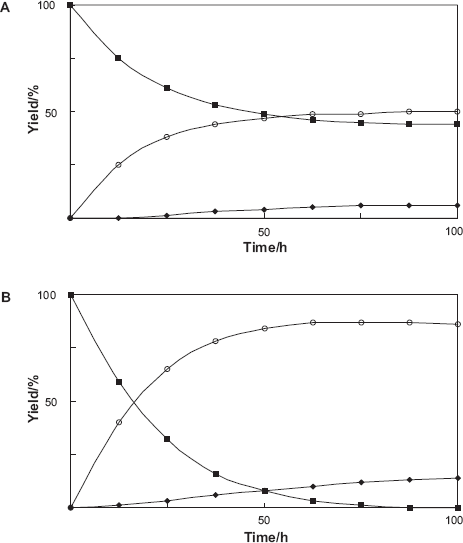
Time courses of the biotransformation of benzophenone (3) by A) free suspended or B) immobilized Pavlova cells. Yields of 3 (•), 4 (•), and 5 (•) are plotted.
Use of immobilized Pavlova cells improved the yield of products; the yields of diphenylmethanol (
Materials and methods
Bisphenol A (
Biotransformation of biphenyl compounds by cultured Pavlova cells
Cultured Pavlova cells were harvested by centrifugation at 3000 rpm for 15 min and washed twice by adding 100 ml of synthetic seawater followed by centrifugation (3000 rpm for 15 min). To the 500 ml flask containing 9 g of cultured Pavlova cells and 300 ml of a synthetic seawater was added 0.2 mmol of substrate. The cultures were incubated at 20 °C with aerobic shaking for five days under illumination (1000 lx). After the incubation period, the cells and synthetic seawater were separated by centrifugation at 1000 g for 15 min. The synthetic seawater was extracted with ethylacetate. The cells were extracted (three times) by homogenization with methanol, and the methanol fraction was concentrated and partitioned between water and ethylacetate. The ethylacetate fractions were analyzed by HPLC, combined, and concentrated. The water fraction was applied to a Diaion HP-20 column and the column was washed with water followed by elution with methanol. The methanol eluate was subjected to preparative HPLC to give glycosylation products. The yield of the products was determined on the basis of the peak area from HPLC and expressed as a relative percentage to the total amount of the whole reaction products extracted. The control free suspended cells, which had not been treated with substrates, were subjected to the same extraction procedures and HPLC analyses as normal biotransformation experiments, and no products and substrates have been detected in the cells and in the medium despite careful HPLC analyses.
Biotransformation of biphenyl compounds by immobilized Pavlova cells
Sodium alginate (2%) was suspended in water (50 ml), which was autoclaved at 120 °C for 30 min. Cultured Pavlova cells (9 g) were added to this solution and the mixture was stirred for 2 h until it became homogeneous. The suspension was added dropwise from a dropping funnel with a glass tube into a 5% CaCl2 solution (1 l) with stirring to form pieces of spherical sodium alginate gel with 5 mm diameter immediately. After washing with a synthetic seawater, immobilized Pavlova cells were used for biotransformation experiments.
To the immobilized Pavlova cells which included 9 g of Pavlova cells with 250 ml of the synthetic seawater in a 500 ml flask was added 0.2 mmol of substrate. The flask was incubated at 20 °C with aerobic shaking for five days under illumination (1000 lx). Isolation of products was carried out by the similar procedures to normal biotransformation experiment described above.
Time-course experiments using cultured or immobilized Pavlova cells
Time-course experiments were performed by a procedure similar to normal transformation experiments.13–15 Substrate (0.2 mmol) was administered to each of eight 500 ml flasks containing 9 g of cells or immobilized Pavlova including 9 g cells. At a regular time interval (12.5 h), one of the flasks was tested to evaluate the yields of the products. The yield of the products was determined on the basis of the peak area from HPLC and expressed as a relative percentage to the total amount of the whole reaction products extracted.
Conclusions
In this work, we have reported the reduction and glycosylation of bisphenol A and benzophenone by free suspended and immobilized Pavlova cells. The free suspended Pavlova cells converted bisphenol A into its glucoside product, and benzophenone into the reduction and glucosylation products. Use of the immobilized Pavlova cells effectively enhanced the yield of the products. The present biotransformation system including immobilized Pavlova cells is useful for chemical modification of these biphenyl endocrine disrupters.
Disclosures
The authors report no conflicts of interest.