






Abstract
Benzophenone and bisphenol A are environmental pollutions, which have been listed among “chemicals suspected of having endocrine disrupting effects” by the World Wildlife Fund, the National Institute of Environmental Health Sciences in the USA and the Japanese Environment Agency. The cultured cells of
Introduction
Use of plant cell culture is a new approach to biotransformation research. Furthermore, biological potential of plant cell culture to biotransform exogenously added toxic compounds has attracted much attention in pollution control.1–5 The biotransformation reactions catalyzed by cultured plant cells include oxidation, reduction, hydroxylation, esterification, hydrolysis, methylation, glycosylation, and isomerization. Hydroxylation and glycosylation are particularly efficient procedures for the phytoremediation of environmental pollution.6,7
Benzophenone and bisphenol A are widely used as the starting material for the production of polyacrylates, ether resins, phenol resins, insecticides, agricultural chemicals, pharmaceuticals, and coatings, and are released as pollutants and toxic compounds into the environment.
8
Recently, it has been reported that benzophenone and bisphenol A exhibited estrogenic activity in bioassays.
9
They have been listed among “chemicals suspected of having endocrine disrupting effects” by the World Wildlife Fund, the National Institute of Environmental Health Sciences in the U.S.A. and the Japanese Environment Agency. Up to now little attention has been paid to the biotransformation of such endocrine-disrupting chemicals with cultured plant cells. We now report the biotransformation of benzophenone and bisphenol A to the corresponding glycosides, which are accumulated in the cells to lower the concentration of the substrates in the medium, by immobilized cells of
Material and Methods
General
Benzophenone and bisphenol A were purchased from Aldrich Chemical Co. The
1
H and 13C NMR, H-H COSY, C-H COSY, and HMBC spectra were recorded using a Varian XL-400 spectrometer in CD3OD solution. The chemical shifts were expressed in
Biotransformation of benzophenone and bisphenol a by the cultured cells of N. tabacum
To the 500 ml flask containing the suspension cultured cells of
Spectral data of products: 4-
Preparation of immobilized cells of N. tabacum in sodium alginate gel
Sodium alginate (2%) was suspended in water (500 ml), which was autoclaved at 120 °C for 30 min. Cultured cells of
Biotransformation of benzophenone and bisphenol a by immobilized cells of N. tabacum in sodium alginate gel
To 150 ml of the immobilized
Results
Biotransformation products were isolated from the MeOH extracts of the cultured cells of
In order to examine the ability of cultured

Time course of the biotransformation of benzophenone (1) (A) by cultured cells and (B) by immobilized cells of
Next, the conversion of benzophenone (
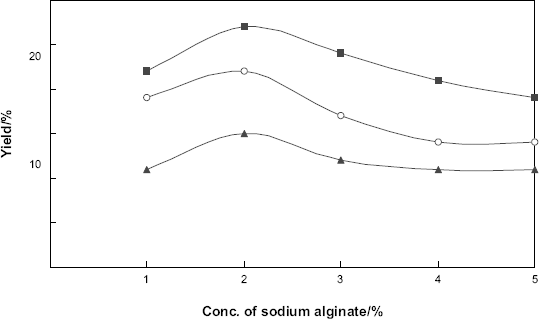
Effects of sodium alginate concentration on the glycosylation activity of the immobilized cells of
On the other hand, bisphenol 2,2-bis(4-β-D-glucopyranosyloxyphenyl) propane (

Time course of the biotransformation of bisphenol A (5) (A) by cultured cells and (B) by immobilized cells of

Biotransformation pathway of benzophenone (1) by cultured and immobilized plant cells of
Discussion
This study demonstrated that the cultured plant cells of

Biotransformation pathway of bisphenol A (5) by cultured and immobilized plant cells of
The results of this experiment revealed that plant cells of
Disclosure
The authors report no conflicts of interest.