






Abstract
Doxycycline has remained one of the most commonly used and inexpensive of the broad-spectrum antibiotic drugs currently in use. It has a variety of applications to common respiratory and genitourinary tract infections, but also amongst atypical infections, such as malaria, rickettsial infections, leptospirosis, brucellosis and some of the bioterrorist agents, including anthrax. It is known that the tetracycline class of antibiotics does have a range of side-effects, such as photosensitivity and gastrointestinal side effects, and noteworthy contraindications, especially amongst pregnant women and young children.
Introduction
Globally, doxycycline has remained one of the most commonly used and inexpensive of the broad-spectrum antibiotic drugs currently in use. 1 In Australia, over the period 2002-2005, there were still well over 800,000 prescriptions of doxycycline 100 mg annually. 2 The development of doxycycline in 1967 followed the development of tetracycline class of compounds and their clinical application in 1953. 3 It has also been observed that it has been prescribed up to three times as often as minocycline, another commonly used drug in the tetracycline class. 3 Doxycycline has a variety of applications, but it is known that the tetracycline class of antibiotics does have a range of side-effects and noteworthy contraindications. 1
Applications
Doxycycline has a significant application in the treatment of common chronic conditions, such as acne and rosacea; however its use in a range of more unusual infectious diseases, including what Holmes et al describe as “atypical bacteria”, has given doxycycline some fame as a “wonder drug” (p 473) or the “secret weapon of the infectious disease physician” (p 479). 1 Besides its treatment of common causes of respiratory and genitourinary tract infections, some of its broader applications are again diseases such as rickettsial infections,4,5 leptospirosis, 6 malaria, 7 brucellosis, 8 and a number of sexually transmitted infections 1 should not be underestimated. It also has a variety of dental applications. 9
There was also a 30% increase in the number of prescriptions following the anthrax bioterrorism scares in 2000-2001. 10 In addition to anthrax, doxycycline could have application in the event of other bioterrorist agents being used, such as tularaemia and the plague. 1 Future applications may also involve the treatment of some parasitic infections, such as lymphatic filariasis, where it appears to have action against the endosymbiotic bacteria of certain filariae. 11
Use in Malaria Prophylaxis
Doxycycline has probably been the most widely used antimalarial in Australia over the past 15 years.2,12,13 Although its application as a malaria chemoprophylaxis varies from country to country, 2 it was likely to be the most common antimalarial used in New Zealand 14 and South Africa, 15 although in each case it is hard to quantify as doxycycline has indications other than malaria prophylaxis. It is useful as it provides effective antimalarial prophylaxis in areas with high levels of transmission of mefloquine-resistant or multidrug-resistant malaria due to Plasmodium falciparum, 7 although there are concerns that it may not be adequate prophylaxis for P. vivax. 7 In more recent trials using the currently recommended dosage (100 mg/day as the adult dose), doxycycline has shown protective efficacy ranging from 92%-100% in non-immune and semi-immune adults living in endemic areas. 7 In areas of chloroquine-resistant malaria, it was equivalent to mefloquine and atovaquone/proguanil and superior to chloroquine/proguanil. 16 Resistance has not been reported among Plasmodium spp, although bacterial resistance occurs, 17 as will be discussed under efficacy.
Mechanism of Action, Pharmacology, Metabolism and Main Drug Interactions
Doxycycline is a bacteriostatic drug, inhibiting protein synthesis, as described by Holmes et al. 1 It can be given orally (usually 200 mg as a starting dose and then 100-200 mg daily depending on the severity of infection) or parenterally for treatment. 1 The drug is almost completely absorbed from the gastrointestinal tract and is highly bound by plasma proteins (93%). It is excreted by the kidneys and has a half-life of 18 hours, allowing for once-daily dosing. 17 Antacids containing aluminum, calcium, or magnesium and iron-containing preparations may impair absorption of doxycycline. Doxycycline may render oral contraceptives less effective and that barrier contraception should be utilized. 1 In addition, since anticonvulsants such as phenytoin, barbiturates, and carbamazepine induce hepatic microsomal enzyme activity, doxycycline levels and half-life may be reduced. A dosage adjustment of the latter may be required.17,18
Safety
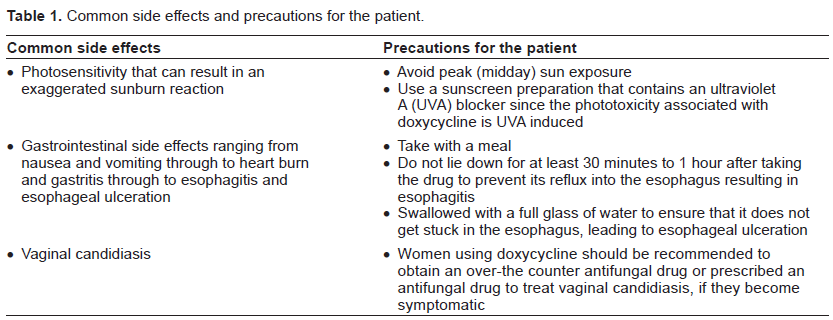
Holmes et al report that doxycycline is well-tolerated, 1 noting the contraindications outlined in the next section. Although the most common adverse events described for doxycycline include the oesophageal erosion and photosensitivity (reported as a 10% risk), there were only 130 described between 1966 and 2003 and the denominator is unknown, 3 but it is likely that the number of prescriptions for doxycycline during this period was probably 100's of millions. There are, however, a wider range of side-effects, which may present with the use of doxycycline, many of which may be reduced by some common sense measures (see Table 1). It should be noted that side-effects are not limited to medical practice and may be seen in dental practice as well. 19 Some of the more unusual side effects include photo-onycholysis, various skin eruptions, Stevens-Johnson syndrome, Jarisch-Herxheimer reaction, and benign intracranial hypertension, as well as a potential risk of hepatotoxicity, which is thought to be low compared to other tetracyclines. 1
Common side effects and precautions for the patient.
Contraindications
Doxycycline should not be used by pregnant or lactating women or by children younger than 8 years because of its deleterious effects on bone and tooth development. 1 Also, it should not be used by persons with known allergy or sensitivity to the drug.3,17
Efficacy
Although an increasing prevalence of resistance is reported by various infectious agents in various geographic locations, this is mainly limited to the Enterobacteriaceae, Staphylococcus aureus, Streptococcus pneumoniae, Bacteroides and Gonococcus. 1 Most of the other infectious and parasitic agents discussed remain sensitive to doxycycline. 1
Conclusion
Doxycycline is a relatively well-tolerated drug in the tetracycline class. It is widely used in clinical practice as a broad spectrum antibiotic. It also remains one of the major “weapons” for the treatment of a variety of atypical infections. It also has an important application as a malaria chemoprophylaxis in a number of countries. There are a variety of strategies that can be used to reduce the incidence of some of the common side-effects, although it is contraindicated in several groups, including those with allergy/sensitivity to the drug, pregnant and lactating women and young children.
Disclosure
The author reports no conflicts of interest.