






Abstract
A survey of sleep schedules, sleep health, and the impact on school performance was conducted in 585 adolescents in a high school in China. A high level of early and circadian-disadvantaged sleep/wake schedules during weekdays was observed. Significantly shorter sleep duration on weekdays was reported (P < 0.0001). Older teenagers slept significantly less than the younger teenagers (P < 0.0001). Complaints of inadequate sleep and sleepiness during weekdays were prevalent. Night awakenings were reported in 32.2% of students. Students with a sleep length of less than 7 hours, complaint of inadequate sleep, or excessive daytime sleepiness during weekdays were more likely to report an adverse effect of poor sleep on performance. The present observations are qualitatively similar to those reported in our study in American adolescents, particularly with respect to Chinese adolescents exhibiting a similar sleep deficiency on weekdays. We concluded that sleep deficiency and sleep health problems were prevalent in the participating adolescents in China, and were perceived to adversely affect school performance.
Introduction
Sleep problems among adolescents have gained greater recognition over time. Adolescents often go to sleep later and wake up later than younger children. However, high school schedules do not accommodate this demand and, as a consequence, a sleep inadequacy during school days in adolescents has been reported.1–6 Our previous study confirmed such a sleep deficiency in high school students in New Jersey. 7 In that study, a forward shift of sleep schedule and a shortened sleep length during weekdays as compared to weekends was observed. The students slept later and longer during weekends, suggesting they were at least partially making up for the lack of sleep during the week. In addition, students with multiple sleep health problems tended to report poorer academic performance.
The aim of this current study was to repeat our previous study 7 in a Chinese adolescent population. The first objective was to evaluate the sleep patterns of students to identify sleep habits. The second objective was to determine if sleep deficiencies and sleep health problems are also present in Chinese adolescents. The third objective was to assess whether sleep deficiency is perceived to affect academic performance.
Method
Questionnaire
An anonymous questionnaire was distributed to students in the Wen Zhou Science Academy High School, in Wen Zhou (an urban city), of the Zhejiang Province, the People's Republic of China. The classes started at 7:30 AM and ended at 5 PM. The questions were in the native language of Chinese, and as such, were comprehensible to these students. The questions varied from multiple choices to fill in the blank. The students were queried about matters regarding sleeping schedules and habits, perceived sleep health problems such as night time awakening and school morning start times, as well as whether his or her sleep schedules affected academic performance. Questions were based on the student's typical daily schedule and included such things as sleep duration in hours, perception of sleep adequacy, daytime sleepiness, prolonged sleep onset, night awakenings, and naps after school. The students were asked to distinguish their schedules and habits on weekdays and weekends.
Subjects
A total of 614 questionnaires were distributed and 596 were returned. Students ranged in age from 13 years old to 18 years old. The distribution of the student age and gender is shown in Table 1. The students were grouped by age, rather than school year, as there was up to a 3 year age range within the same grade in this high school. The school start time was 7:30 AM for all subjects and thus was not used as a parameter for comparison.
Demographics of the participants.

Data analysis
Of the 596 questionnaires collected, six questionnaires were excluded due to a large number of unanswered questions (more than six individual questions). Five questionnaires were excluded due to the students’ age being greater than 18 years. The total number of questionnaires included for data analysis was 585. The results of each question were coded and imported into an Excel spreadsheet. Quantitative results such as “duration of sleep” were separated into groups such as “less than 5 hours”, “5–6.5 hours”, etc. Blank answers were treated as missing data for each question. Some questions were answered by all 585 participants, while other questions had as many as 17 participants leaving the questions blank. The frequency of variables of each question was tallied. SAS version 8.0 was used for statistical analysis. A Wilcoxon rank test was used for comparison of sleep durations on weekdays vs. weekends. Both a Chi square test and Fisher's exact test were performed to determine the statistical significance of association. Odds ratios were calculated when the P values were less than 0.05. Pearson's correlation test was used to assess the correlation between the prevalence of more than one problematic sleep schedule/habit, or risk factors, and the perception of whether sleep schedule/habit affects school performance.
While the survey procedure of this study was modeled after our US study, 7 three questions were modified. Age of the participants was used instead of grades, due to the disparity in ages within the same grade in the Chinese cohort. We believed, upon consultation with the teachers of the Chinese school, that grouping students by age was more accurate than by grade. Another difference was that this sleep study was conducted in a single school in China with a uniform school start time. As such, we could not analyze the impact of school start times on sleep/wake cycles and the other sleep parameters. Finally, we modified the question of the impact of sleep schedules/habits on school performance. Within the Chinese school, there were distinct advanced classes and average/mainstream classes. The academic grades were not adjusted or weighted. We therefore used self reported impact of sleep schedules on school performance. The questions on sleep/wake schedules, sleep quantity and quality, and sleep health problems were the same in both studies, thus the results are comparable.
This study was approved by the Institutional Review Board of The University of Medicine and Dentistry of New Jersey—New Jersey Medical School. The informed consent process was waived due to the anonymous nature of this study. Permission was obtained from the principal of the Chinese school to conduct this survey.
Results
Participants
Of the 585 participants, 291 (49.7%) were male and 277 (47.4%) were female; 17 (2.9%) students did not report their genders. The age distribution of the students was 50 thirteen year olds, 59 fourteen year olds, 94 fifteen year olds, 140 sixteen year olds, 220 seventeen year olds, and 16 eighteen year olds. Eleven students did not report their ages. Students of 13 to 15 years old were grouped as early teens, while students of 16 to 18 years old were grouped as late teens.
Sleep schedules
The sleep and wake schedules of the participants as a whole showed different patterns during weekdays and weekends, especially the morning rise times. 72% of the students went to bed before 11:30 PM on weekdays, while 58% of the students went to bed before this time period on weekends. The rise times on weekends showed a more significant shift towards later hours than those of weekdays (Fig. 1A and B). Almost 73% of the students arose prior to 6:30 AM on weekdays, while 100% the students slept in after 6:30 AM on weekends; a majority (62%) of the students slept until after 8 AM on weekends. The results suggest that the majority of students “sleep in” on weekends.
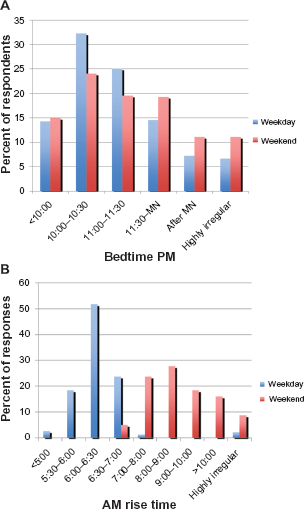
Sleep schedules on weekdays and weekends.
Sleep durations
The sleep durations of the students during weekdays and weekends were different (Fig. 2). The vast majority of the students (over 93%) slept less than 8 hours during week nights, with over 42% sleeping less than 6.5 hours. Defining less than 8.5 hours nightly sleep in adolescents as sleep deficiency, the majority of the students suffered sleep deficiency during weeknights. On the other hand, 70% of the students slept more than 8.5 hours, with 46% sleeping more than 10 hours on weekends, thus at least partially compensating for their weekday sleep deprivation by sleeping longer hours on the weekend. The median sleep duration on weekdays (7.0 hours) was significantly different than that of weekends (9.0 hours) (Wilcoxon signed rank test, **P < 0.0001).

Sleep duration on weekdays and weekends of Chinese adolescents.
The sleep duration among the early teens (13–15 years old) vs. the late teens (16–18 years old) was compared. The median sleep duration on weekdays and weekends for early teens were 7.5 and 10 hours respectively. The median sleep duration on weekdays and weekends for late teens were 6.5 and 9 hours respectively. Late teens slept a significantly shorter duration than early teens both on weekdays (P < 0.0001, Mann Whitney test) and weekends (P < 0.05, Mann Whitney test). See Figure 3.
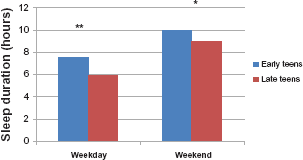
Median sleep durations on weekdays and weekends in early vs. late teens.
Sleep health problems
Sleep health problems such as inadequate sleep duration or quality, daytime sleepiness, difficulty falling asleep and night awakenings were reported in this cohort of adolescents (Table 2). The majority of the students reported inadequate sleep on weekdays but adequate sleep on weekends. This sleep inadequacy during weekdays was further perceived by the students to adversely affect academic performance.
Sleep health problems and perceived impediment on performance.

Association with school performance (using a cutoff of “barely or lesser” vs. “some or huge impact”). Odds ratios were calculated when P values were significant.
Similarly, daytime sleepiness on weekdays was reported by almost three quarters of the students, and this sleep health problem was associated with reports of poor school performance (P < 0.0001, Odds ratio 6.5). Conversely, daytime sleepiness on weekends was reported in less than one quarter of the students and had no reported association with academic performance.
Sleep duration of less than 7 hours on weekdays was associated with reports of poor academic performance (P < 0.001, Odds ratio 1.98). However the number of students that reported a sleep duration of less than 7 hours on weekends, and both weekdays and weekends was small (<5%). There was no impact on academic performance reported.
Despite the unsatisfied sleep duration and daytime sleepiness, only 17% of the students took a nap after school. Most students reported no difficulty in sleep onset. However, 32% of the students reported night awakening.
In summary, students that reported inadequate sleep, daytime sleepiness, and sleep durations of less than 7 hours during weekdays also reported that their sleep schedules/habits adversely affected their school performance.
Comparisons of American and Chinese adolescents
Median sleep durations of American adolescents from our previous study 7 were used to compare the sleep durations of Chinese adolescents of the current study (Fig. 4). The disparity in median sleep durations between weekdays and weekends is similar among the two cohorts of adolescents. Both populations of adolescents reported longer sleep durations on weekends and the median sleep durations on weekdays in both populations were shorter than the required 8.5 hours sleep for this age.
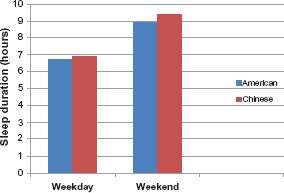
Sleep durations of American and Chinese adolescents.
Discussion
This study shows the following important trends among the Chinese adolescents: (1) a forward shift of sleep/wake cycles towards much earlier rising times during weekdays, while bedtimes remain relatively similar during weekdays and weekends; (2) significantly reduced sleep quantity on weekdays, and a tendency to make-up sleep on weekends were prevalent, suggesting a sleep deficiency; (3) sleep health problems such as inadequate sleep, daytime sleepiness, sleep duration less than 8 hours during weekdays were perceived to adversely affect on school performance.
This study, conducted in adolescents in a single junior high/high school in China, modeled our previous study conducted in high school students in New Jersey. 7 Both studies revealed a forward shift of sleep/wake cycles towards circadian disadvantaged cycles during weekdays. Both studies showed that the majority of adolescents’ sleep durations on weekdays were shorter than the required optimal sleep duration of 8.5 hours for these age groups, and the majority had a tendency to make-up sleep during weekends. Similarly, sleep health problems were prevalent in both cohorts of adolescents. The majority of the students (Chinese or American) perceived their sleep during weekdays was inadequate and they experienced daytime sleepiness. In both adolescent populations, over 32% of participants reported night awakening, a sign of sleep disturbance. Participating American adolescents reported higher prevalence of prolonged sleep onset and napping after school than those of the Chinese adolescents. Furthermore, the disparity in bedtimes between weekdays and weekends was less in degree in Chinese adolescents, a finding shared by another Chinese cohort reported by Ouyang et al 8 Chinese students may be more disciplined in keeping the bedtime on weekdays and weekends consistent, but their sleep needs dictated their weekend rise time to be later, thereby making up the sleep debt.
The timing of bedtime among different adolescent populations in China were variable. The bedtime during weekdays and weekends in our study is similar to those reported by Ouyang et al, 8 but different from those reported by Chung et al 9 and Liu et al. 10 The modern Chinese school systems are diverse in curriculum and schedules, especially among different regions of China, rural and urban school districts, and the degree of industrialization and commercialization of the school districts. These differences may inadvertently affect the school schedules and the corresponding sleep and wake schedules of their adolescent students, contributing in part to the different sleep/wake schedules reported among the studies.
Our results of shorter than the required 9 hours sleep duration and excessive daytime sleepiness being prevalent among our study cohort are in agreement with those of the worldwide studies in the recent meta-analysis. 11 Likewise, the increase in sleep time observed on weekends found in this study has been consistently reported by a majority of studies. 11 Insomnia was found in 6.6% of this cohort, albeit a slightly lower prevalence than the reported insomnia rate of 7.1%-36.2% of the adolescents noted in 15 of the 41 studies analyzed by Gradisar et al. 11
The school schedule placed a disadvantageous circadian demand on these adolescents. The early school start time misaligns the sleep wake schedule with the natural delay phase circadian rhythm of adolescents especially in older teens. 12 The requirement of being awake for longer periods during weekdays in adolescents results in high sleep homeostatic pressure. This homeostatic pressure dissipates when sleep time increases on weekends but is again followed by a rebuilding of the homeostatic pressure during weekdays. The results of both of our studies and others suggest that adolescents worldwide are under the chronic stress of circadian misalignment, high sleep homeostatic pressure and sleep debt during school days. This chronic stress may contribute to sleep health problems such as excessive daytime sleepiness, or insomnia.
In conclusion, sleep deficiency has been defined as “Insufficient quantity or inadequate quality to meet the need for optimal health, performance and well being”. 13 As such, we conclude that the adolescents who participated in both of our studies suffered sleep deficiency.
Disclosures
Author(s) have provided signed confirmations to the publisher of their compliance with all applicable legal and ethical obligations in respect to declaration of conflicts of interest, funding, authorship and contributorship, and compliance with ethical requirements in respect to treatment of human and animal test subjects. If this article contains identifiable human subject(s) author(s) were required to supply signed patient consent prior to publication. Author(s) have confirmed that the published article is unique and not under consideration nor published by any other publication and that they have consent to reproduce any copyrighted material. The peer reviewers declared no conflicts of interest.
Footnotes
Acknowledgement
The authors wish to acknowledge all the participating students, Principal Wang, teachers and staff of the Wen Zhou Science Academy High School.