






Abstract
In this paper, we review multiscale modeling for cancer treatment with the incorporation of drug effects from an applied system's pharmacology perspective. Both the classical pharmacology and systems biology are inherently quantitative; however, systems biology focuses more on networks and multifactorial controls over biological processes rather than on drugs and targets in isolation, whereas systems pharmacology has a strong focus on studying drugs with regard to the pharmacokinetic (PK) and pharmacodynamic (PD) relations accompanying drug interactions with multiscale physiology as well as the prediction of dosage-exposure responses and economic potentials of drugs. Thus, it requires multiscale methods to address the need for integrating models from the molecular levels to the cellular, tissue, and organism levels. It is a common belief that tumorigenesis and tumor growth can be best understood and tackled by employing and integrating a multifaceted approach that includes
Introduction
Although there have been extensive studies on multiscale modeling of cancer from molecular level to tumor level in the past decade, drug effect modeling has mostly remained at the pharmacokinetic/pharmacodynamic (PK/PD) characterization in modern pharmacotherapy without any multiscale consideration and integration with existing multiscale tumor studies. Thus, there is a need to develop multiscale computational models which cover the divide between organism-level PK/PD model and cell-level biochemical models.
Multiscale modeling deals with integrating information at multiple temporal and spatial scales and at various levels of biochemical complexities as summarized in Figure 1. It involves linking data resulting from the studies of molecules, cell, tissue, organ, organism, and population. 1 Multi-scale modeling has been widely touted as being exceedingly challenging with few successes but many failures. 2 However, successes typically have a great impact as depicted by the application of multiscale modeling of the human heart to patient care, 3 clinically driven design of multiscale modeling of cancers (eg, nephroblastoma, lung cancer, and glioblastoma multiforme),4,5 multiscale modeling of the progression of breast cancer, 6 multiscale modeling of the development of cancer in epithelial tissues, 7 and so on.

Hierarchical abstractions or components of multiscale models.
It is possible that the
This review of multiscale models is from the system's pharmacology perspective. System pharmacology is a vast area of study that deals with the applying knowledge of systems biology 8 in combination with large-scale experiments and model-based computational analysis in the studies of drug effects, targets, and activities9–11 as well as the dynamics of drug interactions with biological systems.12–14 More concisely, multiscale modeling with drug effects integrates PK/PD drug models with phenomena at two or multiple temporal and spatial scales such as signaling networks, drug interactions, physiological processes operating at the tissue and organ level as well as animal models or clinical information. In other words, it is aimed at understanding the dynamics and evolution of a true multiscale model with PK/PD or integrative pharmacological perturbations through experimentations and mathematical or computational analysis.15–18
Currently, drug efficacy improvement is a critical research need, and this implies the identification of a new or better therapeutic targets. In recent years, there has been an increasing usage of molecularly targeted agents (MTAs)19–23 for cancer treatment. MTA design enables the interruption of vital components of crucial pathways in the system. MTAs are used to enhance the selectivity and efficacy by interfering with specific-targeted molecules needed for carcinogenesis and tumor growth. Although the lack of precision of the traditional cytotoxic drug allowed a rather direct approach in preclinical and clinical study, developing a paradigm that will better evaluate MTA efficacy is substantially more complicated. Moreover, complex diseases, such as cancer, involve the interaction of more complicated and dynamical biological systems. Thus, it is important to quantify drug effectiveness regarding different dosing regimens, optimal target(s), and combinational therapy at multiple scales of biochemical complexities.
The rationale of integrating multiscale modeling with drug effects is to link PK and PD information with experimental design (at cell population level and tumor level) in order to establish and evaluate dose–concentration–response relationships and subsequently describe and predict the effect-time courses resulting from a drug dose, while taking into account the underlying biological regulatory networks (at the molecular level).24–26 There are several challenges in this regard, namely:
Selecting a model with manageable complexity, while not losing critical information.
Accurate model parameter identification.
Experimental validation of the proposed model.
The approach to tackle these challenges is as follows: (1) at the cell population level, study the response of a population of cells to various drugs and quantify the drug efficacy from experimental data; (2) use stochastic hybrid systems (SHSs) theory to link the drug efficacy obtained at the cell population level to pathways of interest at the molecular level; (3) extend the model to integrate the drug administration at the tumor level; and (4) improve the experimental design and drug intervention optimization iteratively while refining the multiscale drug effect model. Further discussions are given in the “Computational multiscale models incorporating PK/PD drug effect” section.
The need for a paradigm shift to the integration of multi-scale models with drug development in relation to PK/PD or integrative pharmacological information is evident,9,11,13,14,27,28 as partly corroborated by various National Institute of General Medical Sciences workshops tagged as
The remainder of this paper is outlined as follows: the “Fundamental multiscale models” section presents a review of the fundamental multiscale models, while the “Multiscale models incorporating drug effects” section focuses on multiscale models incorporating drug effects. An example of a multiscale model using SHSs with PK/PD and the evaluation of drug effects is reviewed in the “Computational multiscale models incorporating PK/PD drug effect” section. Finally, this paper is concluded in the “Conclusions” section.
Fundamental Multiscale Models
We present example studies on general multiscale modeling for cancer and then later move on to multiscale modeling works incorporating drug effects. This review aims to complement excellent reviews such as Refs 1,19,30–38 in the literatures but from a slightly different perspective. This is due to the common belief that cancer and tumor growth are complex biological phenomena. The complexity can be best understood and tackled by employing a multifaceted approach that may involve
A review of important and recent works on multiscale cancer models that span two or more spatiotemporal biological scales and those that have successfully studied tumor angiogenesis, invasion, progressions, and metastasis from a truly multiscale perspective can be found in the study by Deisboeck et al.
30
The work considered four major biological scales in space and time and the various modeling approaches in terms of continuum, discrete, and hybrid modeling techniques.39–45 There are diverse classifications of biological scales
46
because of the diverse nature of the systems to be modeled. The central theme of the classifications is that a multiscale model should consider different scales in time and space that reasonably, predictively, and realistically capture the behavior of the biological system across the different scales from lower to higher scales or vice versa.47,48 The research community has tackled this challenging problem with different modeling and analytical or computational approaches. For instance, Marias et al and Stamatakos et al.5,49 have performed a promising study on computational multiscale cancer models and
Sample multiscale modeling researches (with and without system pharmacology considerations) based on application areas and methodology used.

Researchers have extensively studied the simulation of cancer growth with multiscale agent-based modeling.33,50,51 Genetic mutations have long been understood to be the primary cause of uncontrolled growth of cells, and this has prompted researchers to investigate the genes that are responsible for the growth of cells and the associated processes affected and regulated in tumorigenesis 52 as well as their influence on the microenvironments and metastasis of tumors. 53 Usually, different approaches such as wet-lab experiments and mathematical and computational models are employed to tackle the complexity and multifacetedness of abnormal cell growth. 54 The mathematical cancer models can be discrete, continuous, or hybrid.55–57 Wang et al. 33 reviewed the most current multiscale agent-based modeling (ABM) of tumors that has elucidated the concept of tumor growth and invasions from a multiscale perspective. The study discusses the various hypotheses resulting from these modeling approaches as well as the challenges associated with these cancer ABMs. ABMs have successfully incorporated and investigated several aspects of the morphology of cancer cells, including angiogenesis, phenotype-altering mutation, extracellular matrix influences, responses to chemotherapy or surgery, availability of nutrients and effects of oxygen, adaptations to the microenvironment, metastasis, and invasions of normal tissues.55–57
One example application of the potential of multiscale models of cancer is the study by Chakrabarti et al. 6 , in which the authors present a multiscale model of breast cancer progression. They study multiscale modeling of breast cancer with the specific focus on integrating models based on intracellular signal transductions with procarcinogenic mechanical and chemical micro environmental indications. The authors study the initiation, proliferation, and the basic biomolecular angiogenesis of breast cancer. They investigate modeling methods for different types of cancers as well as models specific to breast cancer with the long-term aim of identifying and validating potential therapeutic targets. For the identification and validation of multiscale simulations, the authors succinctly describe the integration of microfluidic and three-dimensional tissue engineering platform development that could be geared toward such an endeavor. Multiscale modeling has further been applied as a spatiotemporal computational model which integrates genetic evolution with spatial growth in predicting that migration and cell turnover limits heterogeneity within a tumor. 58 The model is based on stochastic replication of cells having rates that are proportional to the values of the neighboring empty sites, thus suggesting that the growth rates of a tumor can be markedly affected by attacking the short-range dispersal activities of the tumor cells. 58
Multiscale Models Incorporating Drug Effects
Wang et al have carried out a number of research studies on how multiscale models can be used in the identification of drug targets and combination therapy.59–61 The approach is based on quantifying the relations among intracellular Epidermal growth factor receptor (EGFR) signaling dynamics, extracellular Epidermal growth factor (EGF) stimuli, and multicellular growth in lung cancer. Multiscale modeling of tumors incorporated with system pharmacology will aid progress toward the development of practical smart drugs. It will result in an integrated system-level method of determining the dynamics of actions of existing and new drugs in preclinical trials, model organisms, and individual patients. In addition, the experimental, mathematical, and computational studies of biological networks in diseases and health will provide a better way to understand the multiple factors that influence the drug effects and thus will help in revealing better ways to therapeutically intervene in the pathophysiology of disease and also reduce toxicity to the minimum.29,62 The group has also been studying multiscale modeling for investigating huge malignant brain cancer as biosystems that are self-organizing and dynamically complex,63–66 which furthers the argument for using multiscale modeling for interdisciplinary cancer research.
Researchers are currently working on multiple modeling approaches that promise to be integrative while linking different levels of biological complexities and biochemical details. For instance, differential equation models and extensive stochastic simulations have helped to clarify the origin of noise in the biological systems, 67 the temporal and spatial dynamics of complicated signaling pathways, 68 and the origin of variabilities in cellular response to drugs. 69 Regression analytical models are used to explain more complex pathway models and to compare drug responses in diseased and normal cells.70,71 At another direction, bioinformatics and data mining techniques have been used to study the diversity in patient drug response. 72 In a practical context, PK/PD models have remained as the foundation upon which drug discovery is based. Li et al have carried out several studies in an attempt to link pathway and PK/PD modeling via hybrid systems modeling and the characterization of drug effects by PK/PD.24–26
Of particular interest to this review is the study by Li et al. 24 involving a multiscale integrative preclinical model that combines mathematical analysis and experimentations in studying the pathway dynamics crucial to cancer cells when perturbed with drugs, thereby assessing the therapeutic effects of such drugs. The multiscale model bridges cell-level biochemical models and organism-level PK/PD models.
The imperative research needed today is the improvement of drug efficacy, which implies the identification of better or new targets and/or combinations of targets. This is predicated on better predictions, which depend on better computational models and measurements. Examples of multiscale models that incorporate molecular and cellular information with PK/PD models and studies of a tumor's drug absorptions, distributions, and engagements of targets are given in Refs 18, 25, 26, 28.
The work by Li et al. 24 has the potential to help in administering the appropriate dose and dosage regimens as well as the identification of patients who will respond well to new therapeutic drugs and/or drug combinations. The approach is to combine multiscale mathematical modeling of signaling and regulatory pathways with single-cell and multifaceted experimental data in order to grasp the exact biochemistry, functionality, and dynamics of the networks controlling regular cell physiology and implicated in disease. The work provides a detailed mathematical and computational approach to study and describe the dynamics and mechanisms of drug actions on tumor growth and diseased cells. 18 It also provides a systematic way of determining the best effective dose. 5 An extension of the work will arm researchers with mathematical and systematic ways of understanding the mechanisms of drug action and adverse responses in a computational multi-scale context, thereby improving the probability of success in new drug discovery. 38
The ContraCancrum project paradigm74–82 has been focused on clinically driven design of multiscale cancer models. The project has been seeking to develop a multiscale cancer models that contribute to the clinical adaptations of predictive
Furthermore, the ContraCancrum project team has developed the technological integrative oncosimulator, which combines multiscale cancer models with information technology within the
Multiscale modeling has been used to explain the discovery of molecular targets in cancer.38,59 Wang et al extensively studied the identification of molecular therapeutic targets of high value via multiscale modeling in combination with cross-scale agent-based analytical techniques and its associated challenges in terms of data heterogeneity, verification of model parameters, validation of model outputs, and computational complexity of more complicated models. They provided an
The design of multiscale PK/PD models that is cell type specific for personalized patient care has been examined by Ballesta et al. 86 and specifically applied to Temozolomide chemotherapy against brain tumor. The study provided a quantitative characterizations of Temozolomide brain dispositions in the patient using a physiological-based mechanistic modeling approach at the molecular level to determine the PKs of Temozolomide; the law of mass action was used to model the chemical reactions, and the law of diffusion was used to model the passive drug transportation. The overall modeling approach defined intracellular standard brains and brain tumors compartment, where Temozolomide pH-dependent conversions to the DNA-alkylating species resulted in forming DNA adducts that served as the entry point for the PD model. The study will help in personalizing Temozolomide chemotherapy and the development of optimal dosage schedules as well as the optimal combination of drugs for personalized medical care. 86
Computational Multiscale Models Incorporating Pk/pd Drug Effect
The modeling and characterization of drug effects at different scales and across scales have been reported by Li et al.24–26 Specifically, in a study by Li et al. 24 , the authors’ goal is to investigate the responses of cancer cell population to a variety of drugs that target the proliferations and survival pathways by proposing a multiscale model that combines dynamics of genetic regulation and cell population responses to drugs using SHS approach. For the validation of the model, they used the example of a colon cancer cell line HCT-116 with the application of the Lapatinib drug.24,87 At the time of the Translational Genomics Research Institute (TGen) experiments on HCT-116 cell line, the measure to determine whether the proliferation pathway at the cell population level is repressed is the percentage change in nonproliferating cells. For the linkage of this measure to the drug effects on the molecular level, an integrative pathway and cell population model were proposed based on SHS theory and the setup of the experiments at TGen.
The behavior of cancer can be modeled using discrete, continuous, or hybrid mathematical approaches. Discrete modeling can provide a spatiotemporal representation of individual cells and cell–cell interactions. The major disadvantage of this modeling approach is that the computation required increases as the number of cells being modeled grows and this limitation confines the model to a very small number of cells. Continuous modeling is a good candidate for describing large-scale systems. It can capture large-scale dynamics of tumor growth and development at a lower computation cost but sacrifices the resolutions of individual cells, especially when the properties of the cell vary over little spatiotemporal scales.
Hybrid modeling combines the advantages of both discrete and continuous modeling methods, and is appealing for modeling genetic networks under drug perturbations because biological systems are naturally nonlinear, have highly varied regulatory requirements, and possess a wide range of control strategies for meeting their needs. In the case of pathway dynamics, we adopted the well-recognized model of the proliferation and the survival pathways using Ordinary Differential Equations (ODE). 24
Another modeling approach is the S-system modeling rubric.88–91 The S-systems are described as systems of power-law-oriented, finite-difference differential equations cast in a canonical producer–consumer form, and their representations are mathematically equivalent to the generalized Lotka–Volterra schema. Any system of ordinary differential equations can be recast (although not uniquely) as an S-system. S-systems have many attractive mathematical properties that permit one to freely merge varying levels of abstraction with the assumption that flux conservations are respected. Specifically an S-system modeling method could be employed in unifying the representations of gene regulations, 91 molecular mass action-oriented kinetics, and population dynamics.
The approach adopted by Li et al follows an SHS modeling framework92–95 with the dynamics as shown in Table 2. Specifically, they considered the case where the drug effect coefficients are stochastic with the switching mechanisms following a Markov chain as shown in Figure 2.

Schematics of the multiscale model used by Li et al.
24
Notations and pathway dynamics (
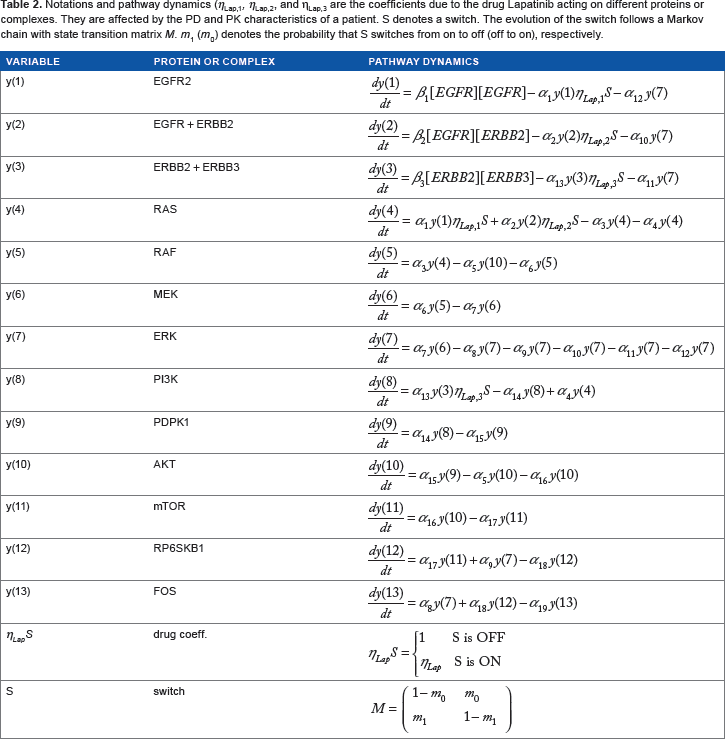
The proliferation and the survival pathway, which biologists presently understand, for instance, the Kegg collection of pathways (http://www.genome.jp/kegg/pathway.html) and NIH BioCarta pathways collections http://cgap.nci.nih.gov/Pathways/BioCarta_Pathways, are given in Table 2 together with input from the drug Lapatinib. The drug effects are introduced to the switch by affecting 

A baseline run of the proliferation and the survival pathway with HCT-116 cancer cell line and input of Lapatinib.
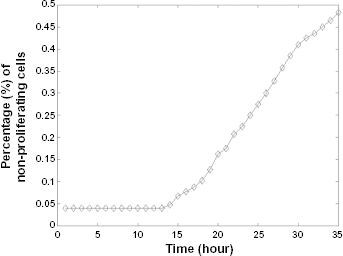
The result of the simulations of the percentage change in nonproliferating cells versus the time for which Lapatinib was applied to the HCT-116 cancer cell line.
An immediate extension of the work is the identification of the model parameters and the validation of the model across various drugs and cancer cell lines, but the model has to be carefully examined so as not to under- or overfit the parameters of interest. These phenomena are mostly relevant to multiscale integrated models in which there is a risk of propagating errors across scales and between models. The other challenge with this is that the model is more closely related to linear systems with markov jumps, and our understanding of such systems is not as thorough as those of linear systems, bilinear systems, or SHSs.
Conclusions
In this paper, we review multiscale modeling for cancer treatment with the incorporation of drug effects from a quantitative system's pharmacology perspective. We believe that tumorigenesis and tumor growth can be best understood and tackled by employing and integrating a multifaceted approach. This includes
Author Contributions
XL, WO, LQ performed the literature review, developed and implemented the algorithm, conducted all simulations and data processing and wrote the initial draft of the paper. ED advised XL on algorithm development. All authors revised the paper. All authors read and approved the final manuscript.