






Abstract
The present study intents to find a possible protective role of a Mediterranean type meal on mammary carcinogenesis. Several factors have been associated with breast cancer risk, genetics and environment are the most pointed out in epidemiologic and experimental studies. Diet is an environmental factor that can promote or prevent disease, being responsible for almost 35% of total cancer cases. A total of 72 female rats 50 days old were randomly divided in three groups of 24 rats and housed 4 in each plastic cage in a holding room under constant conditions of 22 ± 2 °C, 55 ± 10% humidity and a 12 h light/dark cycle. All the animals were submitted to the administration of 20 mg of 7, 12 dimethylbenzanthracene (DMBA) in olive oil, by gavages, except group A. The same defined standard food was provided for all the animals in group A and B, supplemented with a Mediterranean meal in group C. All the animals were sacrificed by the end of 150 days. Total carcinoma number did not differ significantly between Groups B and C and there were not found any neoplastic lesions in Group A. Most tumors showed a mixed architectural pattern, with cribriform and papillary areas, comedocarcinoma and necrosis was only seen in Group B. Histopathologic analysis showed that Group C tumors had lower mitotic activity and Pattern Grades, but higher Nuclear Grades. Mediterranean diet type meal showed lower Pattern Grades and lower Mitotic count in spite of that a higher nuclear pleomorphism was also found. Even so, tumors from Group C were better differentiated which can indicate lower malignancy.
Introduction
The influence of diet and nutrition in chronic diseases risk and prevention has been subject of several studies for years. Cancer is one of the most concerning subjects in research, knowing that nutrition is an important environmental factor, several epidemiologic and other population or even laboratory studies have been made to identify foods and nutrients related with increased and decreased disease risk. 1 In 1981, Doll and Peto 2 published an extensive revision concluding that diet and nutrition are responsible for 35% of total cancer causes.
Mediterranean diet is a general term to identify several dietary and lifestyle habits characteristic of Mediterranean countries people. During several years, Keys observed that immigrant colonies from this countries who maintain their cultural and food habits had a lower incidence of cardiovascular and oncologic diseases even when living in other side of the ocean. 3 The Mediterranean diet is considered a good example of healthy nutrition and it consists in diet particularly rich in fresh fruits and vegetables as well as whole grains, nuts, seeds and pulses. This type of diet also implies some other healthy practices such as a moderate food intake in frequent small meals, low consumption of red meat and sugar but high fish intake (rich in omega 3 fatty acids) and moderate ingestion of red wine. 4 The main dietary fat used is olive oil that is a healthy fat, if consumed in adequate amounts, due to its richness in the monounsaturated oleic fatty acid, vitamin E and several other antioxidant compounds inversely associated with cardiovascular diseases and apparently with anti-carcinogenic effects.5–10
The role of diet and nutrition in health promotion and disease prevention can be exerted by several factors such as the type of foods, their nutrients and other compounds (eg, polyphenols, phytosterols), quantity and quality, food and lifestyle habits, cooking methods that can even be influenced by religious, cultural or tradition and economic agents. These elements don't have an isolated action rather a synergy of possible outcomes in health and disease.
It is theoretically clear that this kind of food/nutritional habits may confer some protection against several diseases. However it is not always possible to verify the mechanism by which they exercise their influence. Epidemiologic data can give some information on possible correlated nutrients but the complex structure of human nutrition and food habits invalidate definite conclusions. 11
Data from experimental studies has been an important add-on to reinforce this possible relationship. Small rodents like the rat are the most used animal models, their susceptibility of mammary gland to develop neoplasms is very high and these neoplasms closely mimic human breast disease. Study conditions are fully established and the effect of chemical agents like 7, 12 dimethylbenzanthracene (DMBA) had been previously validated several times.12–15 Furthermore, it is easy and possible to control diet and foods added as supplements in order to evaluate the possible effect in all the carcinogenesis process phases.
There are plenty associations between some food consumption and higher or lower risk of breast cancer. However, in human nutrition, it is impossible to look at isolated foods or even their compounds one by one. It is important to study the global effect of nutrition habits as part of a lifestyle.
Materials and Methods
Animal care
The experimental procedure was approved by the Veterinary Advice Commission published in the Portuguese legislation (DL 129/92) and it was conducted in strict adherence to animal care guidelines in compliance with the Guide for the Care and Use of Laboratory Animals.
Seventy-two female Sprague-Dawley rats (Charles River Laboratories, Barcelona) 42 days old were randomly assigned to three groups, housed in plastic cages maintained at 22 ± 2 °C, 55% ± 10% humidity and with a 12 h light/dark cycle. The animals were all kept in quarantine during one week before the application of the following procedures.
Experimental diets
All the animals received a standard food formula ISO9002 certified (Standard Panlab A04) add libitum and had free access to tap water. Group C food was supplemented with a Portuguese Mediterranean meal called “Sardinhada à Portuguesa”. This supplement was carefully prepared with the following procedures:
Potatoes were pealed and boiled, then mashed;
Sardines were broiled, and the head, entrails, spines and the skin were totally removed;
The red and green peppers were grilled, washed, it was peeled and all seeds removed;
Onions were peeled and cut in small pieces;
Tomatoes were washed and cut.
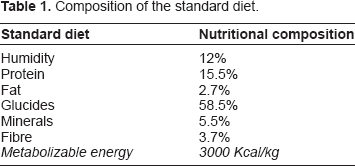
It was all mixed after the lyophilisation process and the final mixture had the following proportions: 32 g/kg sardine, 3.5 g/kg pepper, 4.3 g/kg tomato, 22 g/kg potato, 0.196 g/kg onion. The nutritional composition of Standard Panlab Diet is presented in Table 1.
Composition of the standard diet.
Protocol for chemical tumor induction
Animals from groups B and C received 20 mg DMBA (Sigma-Aldrich, Lisbon, Portugal) solved in 1 ml olive oil by gavages after one week of quarantine, 50 days old.
Other procedures
Animal's body weight was recorded every two weeks. The weight homogeneity index (HW) was calculated at the beginning of the study, according to the formula HW = Ws/[(Ws + Wg)/2,being Ws is the lowest weight and Wg is the highest weight found in this group of rats. The body weight gain (WG) was monitored for a stipulated period of time, two weeks, considering the weight recorded in the beginning (Win) and the end (Wfin) of the considered period, according to the following formula WG = [(Wfin – Win)/Win] * 100.
Necropsy
All the surviving animals were humanly sacrificed after 150 days through inhalation of carbon dioxide and they were all submitted to necropsy process. All the neoplasic lesions, mammary or extra-mammary found were measured and prepared for histologic studies.
Collection and evaluation of tissue
The rate of neoplastic lesions in this experimental model was described through the ratio between the number of rats that revealed neoplasms and the number of rats still alive at the end of experiment.
For each group the occurrence (Oc) of mammary lesions was determined according to the different types of volume using the formula Oc (%) = No tumors nx/No of total mammary tumors found in each group at the end of the experiment, where x = tumors volume. The number of neoplastic lesions in each animal was divided into four classes, categorized as 0, 1–2, 3–5, 6–8, >9 tumors/rat.
Tumor size was evaluated according to their volume (V = 4/3 πr 3 ) where r is the average radius of several tumors in the same group) and then classified in the following categories: categorized as type A (volume ≤ 0.033 cm3); type B (0.033 cm3 < volume ≤ 0.267 cm3); type C (0.267 cm3 < volume ≤ 0.904 cm3); type D (0.904 cm3 < volume ≤ 2.143 cm3); or type E (volume > 2.143 cm3).
Histopathologic study
The tumors were dissected and the fragments collected for histology were fixed in neutral buffered formaldehyde, processed and embedded in paraffin, cut in microtome and stained with hematoxylin and eosin.
Data from the present study refers exclusively to mammary neoplastic lesions. The histological classification done considered the following elements: type of lesion (benign or malignant, invasive or in situ), architectural pattern, cribriform areas and histological grade based on three parameters: tubular formation or Pattern Grade, nuclear pleomorphism or Nuclear Grade and Mitotic count.12–15
Statistical analysis
All statistical tests were two-tailed and conducted at 95% confidence level. Significance tests for all pair wise comparisons were adjusted for multiple comparisons by multiplying the actual P value by number of comparisons made for the evaluation of statistical significance. The software package used was SPSS 17 (SPSS Inc., Chicago, Ill).
The purpose of the analysis was to test whether the null hypothesis of distribution was equal in all groups. In addition to overall test of significance, pair wise comparisons between groups were also made through Mann-Whitney tests. The overall weight gain of the animals of all groups was compared by use of single classification variance analysis ANOVA with repeated measures. The interest of this test was to verify the difference between weight gain over time among the groups.
Results
All the animals grew at a similar rate and gained weight during the experiment (Fig. 1), Group C showed the higher weight gain (P < 0.05) when compared with the other groups. The weight homogeneity index was also higher in Group C without significant difference between groups (P > 0.05). Some deaths occur during quarantine period, which was not related to experimental procedure and those animals were not considered for the subsequent study.
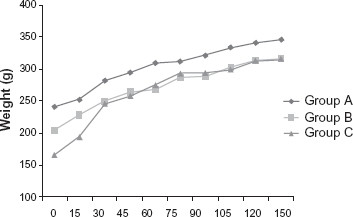
Animals weight evolution after DMBA administration.
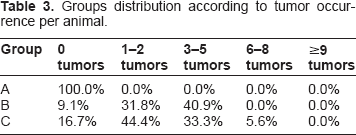
There were not found any neoplastic lesions in Group A animals, the tumor occurrence was higher in group B however without significant difference when compared with group C (P > 0.05) as seen in Table 2. The total of mammary carcinomas found in two groups did not differ significantly (P > 0.05). Almost half of the animals from Group C had 1–2 tumors (44.4%) while 40.9% from Group B had 3–5 tumors (Table 3). Few animals in Group C had more than 5 tumors (5.65%) and none in Group B. In what concerns to tumor volume, as seen in Table 4 both groups showed a majority of type E tumors without significant statistical difference (P > 0.05).
Animal and tumor count from the experimental study.
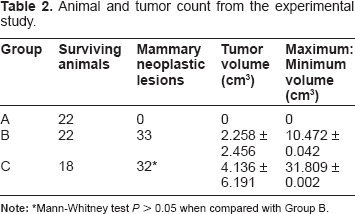
Mann-Whitney test P > 0.05 when compared with Group B.
Groups distribution according to tumor occurrence per animal.
Group distribution according to tumor size categories.
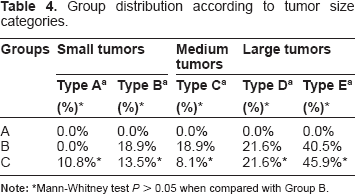
Mann-Whitney test P > 0.05 when compared with Group B.
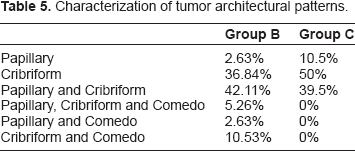
In both groups, only malignant and invasive carcinomas were found. Most tumors showed a mixed structural pattern with papillary and cribriform patterns (Figs. 2, 3 and 4), with significant differences between groups in cribriform areas proportion and on the different structural patterns frequency as shown in Table 5 (P < 0.05). It is specially noted the absence of comedocarcinoma pattern in Group VII as well as necrosis, comparing with Group B where 28.9% of the tumors showed focal necrotic areas and some comedocarcinomas were found (Fig. 5)
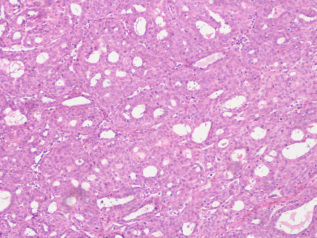
Carcinoma of the rat mammary gland showing a cribriform pattern with extensive solid areas, neoplastic lesion fragment from Group B animal. (Hematoxilin & Eosin, ×100).
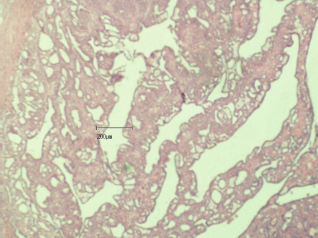
Carcinoma of the rat mammary gland showing a papillary pattern with papillary projections sustained by thin connective tissue cores, neoplastic lesion fragment from Group C animal. (Hematoxilin & Eosin, ×100).
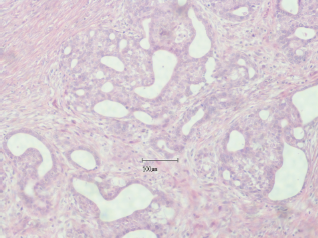
Carcinoma of the rat mammary gland showing a cribriform pattern, neoplastic lesion fragment from Group C animal. (Hematoxilin & Eosin, ×200).
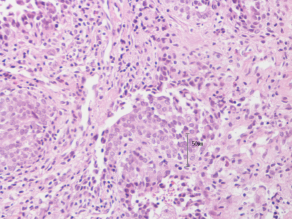
Comedocarcinoma in the rat mammary gland, neoplastic lesion fragment from Group B animal. (Hematoxilin & Eosin, ×100).
Characterization of tumor architectural patterns.
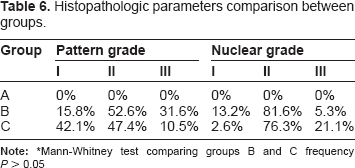
The histopathologic study revealed some controversial results. Pattern and Nuclear Grade differ significantly between groups (P < 0.05). As showed by Table 6, in Group C most have Pattern Grade I (42.1%) or II (47.4%). Surprisingly nuclear pleomorphism was higher in Group C, 76.3% were classified as Nuclear Grade III while in Group B only 21.1% scored that level.
Histopathologic parameters comparison between groups.
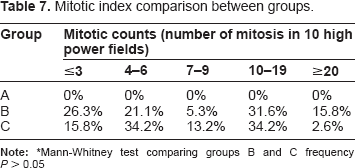
Data from mitotic activity (Table 7) was clearer, only 2.6% of Group C tumors have 20 or more mitosis in 10 HPF (Fig. 6), and in Group B 15.8% of the tumors were in this category (Fig. 7).
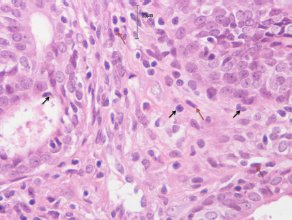
Nuclear pleomorphism and little mitosis in a Group C rat mammary carcinoma, pleomorphic nucleus are pointed with black arrow and mitosis with red arrows. (Hematoxilin & Eosin, ×400).
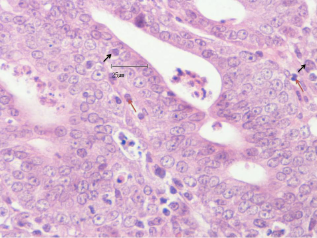
Nuclear pleomorphism and some mitosis in a Group B rat mammary carcinoma, pleomorphic nucleus are pointed with black arrow and mitosis with red arrows. (Hematoxilin & Eosin, ×400).
Mitotic index comparison between groups.
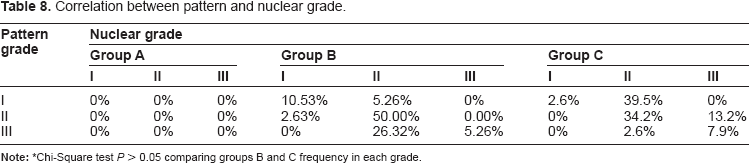
When correlating histopathologic data (Table 8), it is possible to see that lower Pattern Grades are associated with lower Nuclear Grades in both groups. The higher category (Pattern Grade III and Nuclear Grade III) was shown less than 10% of the tumors from both groups, in Group C, 39.5% had Pattern Grade I and Nuclear Grade II while in Group B half was classified as Pattern and Nuclear Grade II with no significant statistical difference between both groups (P > 0.05).
Correlation between pattern and nuclear grade.
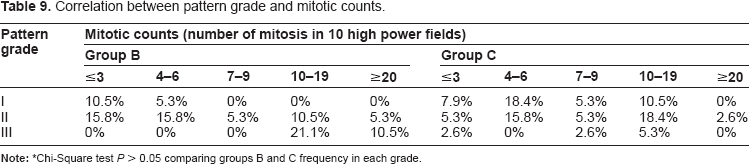
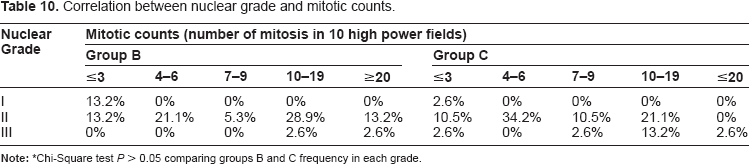
Mitotic activity was higher when Pattern Grade was higher but only in Group B. From Group B 21.1% were Pattern Grade III and had 10–19 mitoses in 10 high power fields, in Group C in Pattern Grade III 5.3% had 10–19 mitoses/10 high power fields. Higher Nuclear Grades (Table 10) were also not related with higher Mitotic counts. Only 2.6% are Nuclear Grade III and had 20 or more mitoses in Group B, as well as in Group C where 13.2% had 10 to 19 mitoses (Table 9). The vast majority showed intermediate levels of nuclear pleomorphism and less than 10 mitosis/10 high power fields, without significant difference between Groups (P > 0.05).
Correlation between pattern grade and mitotic counts.
Correlation between nuclear grade and mitotic counts.
Discussion
The use of animal models like Sprague-Dawley rats had been very useful to study several mechanisms related to carcinogenesis processes. In this laboratory animal species the chemical induction is particularly efficient and breast tissues are especially susceptible to neoplastic lesions. The induction process was done accordingly with previously validated studies.12,14
Mediterranean diet type has been associated with health promotion and disease prevention due to the several protective nutrients included. It is particularly rich in fresh fruits and vegetables, as well as fatty fish and the main dietary fat used is olive oil, foods that are inversely associated with breast cancer risk. However previous studies only consider the effect of separate foods and/or nutrients in breast cancer and human nutrition cannot be summarized in isolated factors considering that they can suffer synergic or antagonistic interactions after ingestion. Taking this into account this, the present study evaluated the effect of a whole meal characteristic of Mediterranean diet on the carcinogenesis process.
The present study revealed some of these possible protective effects. The neopleastic lesions found in the Mediterranean diet group had a lower Pattern Grade and Mitotic count when compared to neoplastic lesions found in Group B (P < 0.05), these parameters can indicate better differentiated and consequently less malignant lesions as proposed by Elston and Ellis. 13 However, their nuclear pleomorphism was higher and tumors were larger (P > 0.05) which could contradicts a possible benefit from the supplement.
It is important to point out that Group C animals gained significantly more weight (P < 0.05) which can explain some controversial results due to the effects of weight-gain and obesity in breast cancer risk shown in humans.16–18
This Mediterranean diet type meal could exert some protective effects due to its richness in antioxidant vitamins and some phytochemicals present in vegetable salad and because of the omega-3 fatty acids from fatty fish. Fatty fish is an important source of polyunsaturated fat, especially omega-3 fatty acids like eicosapentanoic acid and docosahexanoic acid. Larsson proposed several mechanisms that can explain the positive influence of the fatty acids on breast cancer prevention like their effects on cell growth and differentiation as well as angiogenesis and metastasis. 19 Vegetable consumption has been strongly associated with several chronic diseases prevention, including cancer, due to their richness in vitamins, minerals and phytochemical compounds with antioxidant, anticarcinogenic and antimutagenic actions. 20
Nevertheless, in this meal it is important to consider the variations in nutrient composition and bioavailability within vegetables and possible changes due to culinary confection. Raw salad vegetables have been strongly associated with lower breast cancer risk when compared to cooked vegetables possibly because of structural and nutritional changes in flavonoids, polyphenols and vitamin C due to heating.21,22
It is also important to remember that the chosen meal included boiled potatoes, a complex carbohydrate source with moderate to high glycemic index, 23 which can also influence carcinogenesis according to epidemiologic data.24,25
Taking these results in consideration this Mediterranean diet type meal had shown some beneficial effects on rat mammary carcinogenesis however not as significant as expected. Further studies are needed to evaluate the possible protective effect of other meals characteristic in this diet type in breast carcinogenesis. Although Mediterranean diet cannot be resumed in one single meal because it also includes other practices like food variety, frugality and an active lifestyle 26 this studies could simulate better human food habits and their relationship with breast cancer.
Disclosures
This manuscript has been read and approved by all authors. This paper is unique and not under consideration by any other publication and has not been published elsewhere. The authors and peer reviewers report no conflicts of interest. The authors confirm that they have permission to reproduce any copyrighted material.
Footnotes
Acknowledgements
We thank Coimbra University Hospitals and Faculty of Medicine from Coimbra University, to Egas Moniz, Cooperativa de Ensino Superior, CRL all sources of funding and support. We thank Lurdes Silva, Dr. Graça Osório, Margarida Menezes and Elisa Patrício for their precious contributions in anatomic pathological study.