The interesting article reported in Bone and Tissue Regeneration Insights by Wu and Xiao entitled “Evaluation of the in vitro bioactivity of bioceramics” contrasts two methods (Simulated body fluid (SBF) and cell culture experiments) which have been commonly used to evaluate the in vitro bioactivity of bioceramics. Limitations in estimating the bioactivity of bioceramics using both methods have been reviewed. Therefore, Wu and Xiao suggest the combination of these two methods to evaluate the bioactivity of bioceramics can improve the screening efficiency for the selection of bioactive ceramics for bone regeneration.
The concept of bioactivity was defined as: “A bioactive material is one that elicits a specific biological response at the interface of the material which results in the formation of a bond between the tissues and the material”.1 It is intermediate between resorbable and bioinert.
Bioceramics, such as bioactive glass, glass-ceramics and calcium phosphate have been widely studied for orthopaedic and dental applications due to their good osteoconductive potential. In vitro studies are widely used for the study of bioactive implant materials because such tests allow prediction of the approximate behaviour of such materials in vivo.2In vitro tests are intended for use in screening bone bioactive materials before animal testing. The number of animals used and the duration of animal experiments can be significantly reduced by using these methods, which can assist in the efficient development of new types of bioactive materials.
SBF Method
In 1991, Kokubo3 proposed that the essential requirement for an artificial material to bond to living bone is the formation of bonelike apatite on its surface when implanted in the living body, and that this in vivo apatite formation can be reproduced in simulated body fluid (SBF) with ion concentrations nearly equal to those of human blood plasma.
Thus the ability to form apatite precipitation layers in simulated body fluid (SBF) or in an animal model has been regarded as the evidence of bioactivity for bioceramics and for other types of orthopaedic materials.4–6 It has been generally accepted that the in vivo bone bioactivity of bioceramics can be predicted from the apatite formation on their surfaces in SBF. Kokubo et al7 also claimed that the SBF method is useful for predicting the in vivo bone bioactivity of the material, not only qualitatively but also quantitatively.
However, there are a few materials that directly bond to living bone without the formation of detectable apatite on their surfaces. Both β-TCP and natural calcite exhibit a poor ability to induce calcium phosphate formation on their surfaces in SBF8,9 or in vivo,9–12 but despite this, they bond to living bone.10–12 These results might be related to the high resorbability of these materials. Furthermore, the validity of this method for evaluating bioactivity has not been assessed systematically. A range of testing conditions (e.g. specimen shape and dimension, surface roughness, ratio of specimen to solution, buffering agent, immersion periods, static/dynamic test) and SBF solutions have been used by different research groups.3–7,9,13–26
Over some decades other research groups have focused their efforts on producing solutions with ion concentrations and pHs as close as possible to human plasma.27–33 Currently, significant numbers of in vitro tests are carried in various forms of SBF solution. The majority utilise a standard pH of 7.25–7.40. However, the ability to induce apatite-like calcium phosphate formation in the various SBF solutions is not directly compared in literature. Additionally, SBF with higher ion concentrations than normal SBF such as 1.5SBF (1.5 time higher ions concentration)26 or 10SBF (10 times higher)34 have been used. There is, however, no direct correlation between apatite formation behaviour on a material in normal SBF with that seen in stronger SBFs (1.5 or 10 SBF) or with in vivo bone bioactivity.
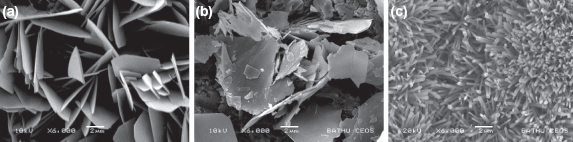
Recently, a number of tests have been completed in water.35–39 According to the literature, the results from the tests carried out in water demonstrated dissolution but no precipitation.36–39 However, precipitates were observed on glass-reinforce hydroxyapatite after three days of immersion in deionised water by Queiroz et al.35 Similar observations were found in the authors' research work. Figure 1 displays calcium phosphate based samples after immersion in distilled water at pH 7.2 for up to 26 weeks. Precipitates with significantly different morphologies but the same chemical composition were found for the samples after different immersion periods. These results show apatite formation behaviours can be observed in both SBF and distilled water.
SEM micrographs of surface microstructures of calcium phosphate based bioceramics after immersion in distilled water at pH 7.2 for a) 4 b) 7 and c) 26 weeks.
In 2009, Bohner and Lemaitre40 published a review paper entitled “Can bioactivity be tested in vitro with SBF solution?” which questioned whether there was currently enough scientific evidence to support the assumptions around the use of the SBF method. The paper concluded that although the use of SBF was valid the variability in the way the tests were carried out left room for improvement. The findings collated by Bohner and Lemaitre40 indicated that for the most significant mineral bone substitutes used in vivo (bioglass, β-TCP, CSH, HA, DCPD), bioactivity testing with SBF may lead not only to false positive but also to false negative results. The authors40 reported that serum and SBF are supersaturated towards apatite crystals and as such, the system is metastable and will thermodynamically stabilise by the formation of apatite crystals. Consequently, the validity of use of the SBF method to predict the in vivo bone bonding ability of a material may be open to question. Bohner and Lemaitre40 proposed the use of an alternative simplified preparation of SBF solution and that the test should be performed at p(CO2) = 0.05 atm (5%) to replicate the equilibrium state found in human serum.
From reviewing the literature it can be seen that various solutions and SBFs with slightly different compositions have been used by different research groups. The testing conditions vary between groups making direct comparison of the results difficult. In order to be able to compare the results directly, an identical solution and standard testing method need to be established and adopted widely.
Cell Culture Studies
Cell culture experiments are commonly used to evaluate the in vitro bioactivity of bioceramics. However, these methods also have a number of limitations which have been well reviewed by Wu and Xiao.41 As with the SBF studies, the experiments have not been standardised with respect to criteria such as cell type and number, media used, surface roughness of samples, all of which will affect the results recorded.
In conclusion, the two methods reviewed by the authors, SBF and cell culture experiments, have their own drawbacks with respect to the evaluation of the in vitro bioactivity of bioceramics. For that reason, Wu and Xiao recommend the combination of SBF and cell experiment methods to evaluate the in vitro bioactivity. This is on the basis that, if a novel bioceramic not only has the ability to induce apatite deposition in SBF but also stimulate a cell response, such a bioceramic would most likely also to have excellent in vivo bioactivity.
Commentary
The suggestion made by Wu and Xiao might be a useful approach to establish which ceramics demonstrate good bioactivity. However, this selection process may perhaps overlook a potential novel bioceramic which has excellent in vivo bone formation ability but does not show a positive response in both SBF and cell experiment methods.
As mentioned before, various testing conditions are used for in vitro bioactivity testing. The results from each research group are not directly comparable particularly when predicting the in vivo bone bioactivity of the material quantitatively. To this end, standard test methods need to be established both for the SBF and cell culture experiments to allow direct comparison and evaluation of the results.
Footnotes
This manuscript has been read and approved by all authors. This paper is unique and is not under consideration by any other publication and has not been published elsewhere. The authors report no conflicts of interest.
Izquierdo-BarbaI., SalinasA.J., Valet-RegiM.Effect of the continuous solution exchange on the in vitro reactivity of a CaO-SiO2 sol-gel glass.Journal of Biomedical Materials Research.2000; 51: 191–9.
3.
KokuboT.Bioactive glass ceramics: properties and applications.Biomaterials1991; 12: 155–63.
4.
RamilaA., Vallet-RegiM.Static and dynamic in vitro study of a sol-gel glass bioactivity.Biomaterials.2001; 22: 2301–6.
5.
FujibayashiS., NeoM., KimH.M., KokuboT., NakamuraT.A comparative study between in vivo bone growth and in vitro apatite formation on Na2O-CaO-SiO2 glasses.Biomaterials.2003; 24: 1349–56.
6.
RagelC.V., Vallet-RegiM., Rodriguez-LorenzoL.M.Preparation and in vitro bioactivity of hydroxyapatite/solgel glass biphasic material.Biomaterials.2002; 23: 1865–72.
7.
KokuboT., TakadamaH.How useful is SBF in predicting in vivo bone bioactivity?Biomaterials.2006; 27: 2907–15.
8.
OhtsukiC., AokiY., KokuboT., FujitaY., KotaniS., YamamuroT.Bioactivity of limestone and abalone shell.Transactions of the 11th annual meeting of Japanese Society for Biomaterials.1989. p. 12.
9.
XinR., LengY., ChenJ., ZhangQ.A comparative study of calcium phosphate formation on bioceramics in vitro and in vivo.Biomaterials.2005; 26: 6477–86.
10.
KotaniS., FujitaY., KitsugiT., NakamuraT., YamamuroT.Bone bonding mechanism of β-tricalcium phosphate.Journal of Biomedical Materials Research.1991; 25: 1303–15.
11.
NeoM., NakamuraT., OhtsukiC., KokuboT., YamamuroT.Apatite formation of three kinds of bioactive materials at early stage in vivo: a comparative study by transmission electron microscopy.Journal of Biomedical Materials Research.1993; 27: 999–1006.
12.
FujitaY., YamamuroT., NakamuraT., KotaniS.The bonding behavior of calcite to bone.Journal of Biomedical Materials Research.1991; 25: 991–1003.
13.
JudaszJ.A., BestS.M., BonfieldW., KawashitaM., MiyataN., KokuboT., NakamuraT.Apatite-forming ability of glass-ceramic apatite-wollastonite-polyethylene composites: effect of filler content.Journal of Materials Science: Materials in Medicine.2003; 14: 489–95.
14.
RibeiroC., RigoE.C.S., SepulvedaP., BressianiJ.C., BressianiA.H.A.Formation of calcium phosphate layer on ceramics with different reactivities.Materials Science and Engineering C.2004; 24: 631–6.
15.
LegerosR.Z., LinS., RohanizadehR., MijaresD., LegerosJ.P.Biphasic calcium phosphate bioceramics: preparation, properties and applications.Journal of Materials Science: Materials in Medicine.2003; 14: 201–9.
16.
LengY., ChenJ., QuS.TEM study of calcium phosphate precipitation on HA/TCP ceramics.Biomaterials.2003; 24: 2125–31.
17.
DuanY.R., ZhangZ.R., WangC.Y., ChenJ.Y., ZhangX.D.Dynamic study of calcium phosphate formation on porous HA/TCP ceramics.Journal of Materials Science: Materials in Medicine.2004; 15: 1205–11.
18.
KimH.M., HimenoT., KawashitaM., KokuboT., NakamuraT.The mechanism of biomineralization of bone-like apatite on synthetic hydroxyapatite: an in vitro assessment.Journal of the Royal Society Interface.2004; 1: 17–22.
19.
SiriphannonP., KameshimaY., YasumoriA., OkadaK., HayashiS.Comparative study of the formation of hydroxyapatite in simulate body fluid under static and flowing system.Journal of Biomedical Materials Research.2002; 60: 175–85.
20.
LeonorI.B., ItoA., OnumaK., KanzakiN., ReisR.L.In vitro bioactivity of starch thermoplastic/hydroxyapatite composite biomaterials an in situ study using atomic force microscopy.Biomaterials.2003; 24: 579–85.
21.
NusM., Sachez-MunizF.J., Sanchez-MonteroJ.M.A new method for the determination of arylesterase activity in human serum using simulated body fluid.Atherosclerosis.2006; 188: 155–9.
22.
KokuboT.Surface chemistry of bioactive glass-ceramics.Journal of Non-Crystalline Solids.1990; 120: 138–51.
23.
LeeuwenburghS.C.G., WolkeJ.G.C., SiebersM.C., SchoonmanJ., JansenJ.A.In vitro and in vivo reactivity of porous, electrosprayed calcium phosphate coatings.Biomaterials.2006; 27: 3368–78.
24.
LuX., LengY.TEM study of calcium phosphate precipitation on bioactive titanium surfaces.Biomaterials.2004; 25: 1779–86.
25.
DuanY.R., ZhangZ.R., WangC.Y., ChenJ.Y., ZhangX.D.Dynamic study of calcium phosphate formation on porous HA/TCP ceramics.Journal of Materials Science: Materials in Medicine.2005; 16: 795–801.
26.
JalotaS., BhaduriS.B., TasA.C.Osteoblast proliferation on neat and apatite-like calcium phosphate-coated titanium foam scaffolds.Materials Science and Engineering.2007; C27: 432–40.
27.
KokuboT.Surface chemistry of bioactive glass-ceramics.Journal of Non-Crystalline Solids.1990; 120: 138–51.
28.
BayraktarD., TasA.C.Chemical preparation of carbonated calcium hydroxyapatite powders at 37 °C in urea-containing synthetic body fluids.Journal of the European Ceramic Society.1999; 19: 2573–79.
29.
TasA.C.Synthesis of biomimetic Ca-hydroxyapatite powders at 37 °C in synthetic body fluids.Biomaterials.2000; 21: 1429–38.
30.
BigiA., BoaniniE., PanzavoltaS., RoveriN.Biomimetic Growth of Hydroxyapatite on Gelatin Films Doped with Sodium Polyacrylate.Biomacromolecules.2000; 1: 752–6.
31.
KimH.M., KishimotoK., MiyajiF., KobuboT., YaoT., SuetsuguY., TanakaJ., NakamuraT.Composition and structure of apatite formed on organic polymer in simulated body fluid with a high content of carbonate ion.Journal of Materials Science: Materials in Medicine.2000; 11: 421–6.
32.
OyaneA., OnumaK., ItoA., KimH.M., KokuboT., NakamuraT.Formation and growth of clusters in conventional and new kinds of simulated body fluids.Journal of Biomedical Materials Research.2003; 64A: 339–48.
33.
SerroA.P., SaramagoB.Influence of srerilization on the mineralization of titanium implants induced by incubation in various biological model fluids.Biomaterials.2003; 24: 4749–60.
34.
TasA.C., BhaduriS.B.Rapid coating of Ti6Al4V at room temperature with a calcium phosphate solution similar to 10x simulated body fluid.Journal of Materials Research.2004; 19: 2742–9.
35.
QueirozA.C., SantosJ.D., MonteiroF.J., Prado da SilvaM.H.Dissolution studies of hydroxyapatite and glass-reinforced hydroxyapatite ceramics.Materials Characterization.2003; 50: 197–202.
36.
SeoD.S., KimH., HwangK.H., LeeJ.K.Dissolution and mechanical properties of sintered hydroxyapatite immersed in water.Key engineering Materials.2006; 317–318: 789–92.
37.
PilliarR.M., FiliaggiM.J., WellsJ.D., GrynpasM.D., KandelR.A.Porous calcium polyphosphate scaffolds for bone substitute applications-in virto characterization.Biomaterials.2001; 22: 963–72.
38.
SunR., LiM., LuY., LiS.Dissolution behaviour of hollow hydroxyapatite microspheres immersed in deionized water.Materials Research Bulletin.2006; 41: 1138–45.
39.
RaynaudS., ChampionE., Bernache-AssolantD., TetardD.Dynamic fatigue and degradation in solution of hydroxyapatite ceramics.Journal of Materials Science: Materials in Medicine.1998; 9: 221–7.
40.
BohnerM., LemaitreJ.Can bioactivity be tested in vitro with SBF solution?Biomaterials.2009; 30(12): 2175–9.
41.
WuC., XiaoY.Evaluation of the in vitro bioactivity of bioceramics.Bone and Tissue Regeneration Insights.2009; 2: 25–9.