






Abstract
Cluster of differentiation 151 (CD151) is a member of the mammalian tetraspanin family, which is involved in diverse functions such as maintaining normal cellular integrity, cell-to-cell communication, wound healing, platelet aggregation, trafficking, cell motility and angiogenesis. CD151 also supports de novo carcinogenesis in human skin squamous cell carcinoma (SCC) and tumor metastasis. CD151 interacts with α3β1 and α6β4 integrins through palmitoylation where cysteine plays an important role in the association of CD151 with integrins and non-integrin proteins. Invasion and metastasis of cancer cells were diminished by decreasing CD151 association with integrins. CD151 functions at various stages of cancer, including metastatic cascade and primary tumor growth, thus reinforcing the importance of CD151 as a target in oncology. The present review highlights the role of CD151 in tumor metastasis and its importance in cancer therapy.
Insight on CD151 (Cluster of Differentiation 151)
Tetraspanins are four-transmembrane-spanning proteins with short cytoplasmic N- and C-termini and one small and one large extracellular domain, namely (EC1 and EC2), with a unique cysteine motif in EC2 domain. 1 They are highly expressed on cell surface and/or intracellular vesicle. Palmitoylation of intracellular and juxtamembrane cysteine of tetraspanins along with specific integrins contributes to tetraspanin complex formation. This complex formation protects tetraspanins from lysosomal degradation and promotes increased cell–cell interaction. 2
CD151 (glycoprotein-27 (GP-27)/Red blood cell antigen MER 2 (MER 2)/platelet-endothelial tetraspan antigen-3 (PETA-3)/Raph blood group antigen (RAPH)/Membrane Glycoprotein SFA-1 (SFA-1)./tetraspanin-24 (TSPAN-24)) is a plasma membrane protein that belongs to tetraspanin superfamily. CD151 forms tetraspanin web with integrins such as α3β1, α6β1, αβ1, and α6β4; 2 membrane receptors; intracellular signaling molecules such as phosphoinositide 4-kinase (PI4K) and protein kinase C (PKC);3,4 immunoglobulin super family proteins and other tetraspanins such as CD9, CD81 and CD63. These tetraspanin-enriched microdomains (TEMs) serve as molecular facilitator. 5 CD151 contains a potential tyrosine-based sorting motif in the C-terminal domain. The YXXϕ (tyrosine linked with hydrophobic amino acid) motif (where ϕ is a hydrophobic residue) is required for endocytosis and sorting of proteins from the trans-Golgi network (TGN) to lysosomes for degradation. A mutation in the CD151 YXXϕ motif diminishes CD151 internalization and affects integrin-dependent cell migration.6,7 The major functions of CD151 are maintenance of epithelial cell integrity, wound healing, platelet aggregation, regulation of membrane fusion, trafficking, cell motility, angiogenesis and tumor metastasis. 8 It is normally expressed in endothelial cells and platelets and frequently overexpressed in cancer cells where it is functionally associated with cancer progression and metastasis. 9
Genetics of CD151
CD151 (Raph blood group) gene is represented as CD151, which is located on the short (p) arm of chromosome 11 at position 15.5. More precisely, CD151 gene is located from base pair 832, 951 to base pair 838, 834 on chromosome 11. 10 It is an autosomal gene with sexually dimorphic expression, involved in signal transduction, cell proliferation and death. It is also involved in differential neural development, cognitive function and neurological diseases. 11
Association of CD151 with Integrins and other Proteins
Metastasis is facilitated by cell–cell interactions between tumor cells and endothelium in which cell-adhesion molecules, such as integrins and selectins, play an important role. Hemler 12 has demonstrated that CD151 interacts directly with α3β1 and α6β4 integrins through their palmitoylated cysteine residues. CD151 acts as master regulators of α6β4, α6β1 and α3β1 integrin-assembly into TEMs. 13 The major laminin-332 cellular receptors with α3β1 and α6β4 integrins-dependent adhesion, migration and signaling are impaired or altered by CD151 excision, indicating the vital role of CD151 in association with integrins.14,15 Mapping of the integrin-CD151 association was performed using chimeric α6/α3 integrins and CD151/NAG2 TM4SF proteins, which showed an interaction of amino acids from 570 to 705 at the extracellular sites of α3 integrin and amino acids from 186 to 217 on a large extracellular loop of CD151. 16 Devbhandari et al 17 reviewed the role of CD151/integrin β1 complex in cancer metastasis. Yauch et al 3 reported that specific site on the large extracellular loop of CD151 associates with α3β1 integrin with unusually high stoichiometry, proximity and stability. In the same year, Sterk et al 18 reported that CD151 uses the same site for interaction with α6β1, α6β4 and other integrins.
Role of CD151 in De Novo Carcinogenesis
CD151, in association with laminin and laminin-binding integrins, involves in the regulation of carcinogenesis. Li et al 19 evaluated the role of CD151 in de novo carcinogenesis, multiplicity and progression of skin squamous cell carcinoma (SCC) in comparison with normal cells. CD151 supports survival and proliferation of keratinocytes by activation of transcription factor STAT3, a regulator of cell proliferation and apoptosis. CD151 regulates α6β4 distribution by enhancing protein kinase Cα (PKCα)—α6β4 integrin association and PKC-dependent β4 S1424 phosphorylation. CD151 in complex with PKCα enhances invasive behavior by phoshorylating β4 integrin, thus affects subcellular localization and epithelial disruption. In addition, CD151 knockout mice showed a decrease in tumor latency, tumor incidence, multiplicity and size. Hence, CD151 targeting may be therapeutically beneficial in cancer therapy.
CD151 and Cancer Metastasis
Deregulation of various tetraspanins is reported in human malignancy. 20 Overexpression of CD151 was also reported to associate with poor prognosis of lung, 21 colon, 22 esophageal, 23 pancreatic 24 and endometrial cancers. 25 In addition, several evidences have supported the contribution of CD151 in cancer metastasis. 26 Loss of CD151 decreased the integrin-mediated cell migration, spreading, and invasion through FAK and Rac1-mediated signaling. 13 Earlier reports have shown that downregulation of CD151 by short-hairpin RNA decreased the tumorigenicity and communication between tumor and endothelial cells. This emphasizes CD151 as a potential prognostic marker. 27 CD151 also modulates the activity of cytokine-like transforming growth factor-β (TGF-β). CD151 in association with dimerized TGF-β receptor promotes invasion and metastasis through the activation of Smad2/3, c-Akt, Erk1/2, JNK, JUN and matrix metalloproteinase-9 (MMP-9) signaling pathways (Fig. 1). Sadej et al reported that CD151 is a positive regulator of TGF-β-induced signaling in cancer metastasis. 28
Studies on CD151-null mice showed impaired pathological angiogenesis without vascular defect during normal development.
29
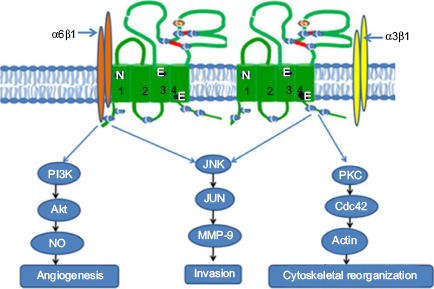
Adhesion-dependent activation of endothelial cells caused diminished expressions of PKC/c-Akt, e-NO, Rac and Cdc42, which are important signaling pathways of angiogenesis and cytoskeleton reorganization without altering the expression of Raf, ERK, p38, MAP kinase, FAK and Src. CD151 regulates cytoskeletal reorganization, invasion and cell-adhesion functions of endothelial cells during pathological angiogenesis by modulating laminin-binding integrins-mediated activation of PI3K/Akt, JNK and PKC pathways
29
(Fig. 2). Evaluation of prognostic significance of CD151 expression with estrogen receptor (ER), progesterone receptor (PR), human epidermal growth factor receptor-2 “(HER-2) and E-cadherin indicated a strong concordance of CD151 with E-cadherin in type 2 endometrial cancer. Kohno et al demonstrated that CD151 also enhanced cell motility, invasion and metastasis through focal adhesion kinase (FAK).
30
Tumor growth factor beta 1 (TGF-β1) and CD151-mediated signaling. TGF-β1 binds to TGF-β1 receptors and leads to dimerization of receptors. These receptors associate with CD151 and activate JNK, JUN, MMP-9, smad 2/3, c-Akt, and Erk1/2 signaling pathways involved in invasion and metastasis. Yellow circle—TGF-β; double-headed arrow—TGF-β receptor. Role of CD151 in angiogenesis, invasion, and cytoskeleton reorganization. An association of integrin α6β1 (orange) with CD151 activates PI3K, Akt, NOS, JNK, JUN, and MMP-9 signaling, leading to angiogenesis and invasion. CD151 interacts with α3β1 (yellow) and causes activation of invasive signaling, PKC, and cdc42, leading to cytoskeleton reorganization.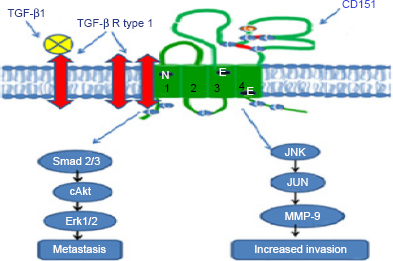
Haeuw et al 31 reported that monoclonal antibodies (mAbs) targeted to CD151 inhibited cell motility. Similarly, Fei et al 32 reported that CD151-AAA mutant inhibited cell-proliferation, migration and chemotaxis in HepG2 cells. Genetic ablation of CD151 inhibited metastasis in a transgenic mouse model without showing any noticeable effect on expression of markers associated with proliferation, apoptosis or angiogenesis in primary tumors. 33
Shanmukhappa et al have demonstrated for the first time that CD151siRNA and anti-CD151 antibodies significantly reduced the porcine reproductive and respiratory syndrome virus (PRRSV) infection. 34 One recent study showed that simultaneous inhibition of CD9/CD81 and CD151 has a profound inhibitory effect on cancer metastasis through α3β1-PKCα-mediated signaling in MDA-MB 231 breast cancer cells. 35
Several studies have demonstrated that CD151 is involved in cell-adhesion and formation of hemidesmosomes; thus, inhibition of CD151 expression by hypoxia decreased the cell-cell interaction and cell–matrix adhesion. 36 A study by RR Malla et al have demonstrated that silencing of cathepsin B and uPAR using siRNA decreased the interactions of CD151 with laminin-binding integrin α3β1 and inhibits cell-adhesion and invasion in glioma. 37
CD151 Pathogenesis and Clinical Studies
CD151 is implicated in pathological processes associated with cancer progression, neoangiogenesis and epithelial-mesenchymal transition (EMT).38–41 CD151 overexpressing cancer cells acquired high migratory abilities, which are crucial for tumor cell invasion. 42 Overexpression of CD151 was also reported to associate with intercellular adhesiveness and wound healing. 43 CD151 plays a crucial role in the interaction of podocyte-GBM binding adhesion receptor and integrin α3β1. Deletion of CD151 leads to reduced adhesiveness at cell-matrix interface, leading to glomerular nephropathy. 44
CD151-null mice showed diminished tumor cell residence in the lungs after injection with Lewis lung carcinoma, which may be because of inhibition of angiogenesis. 45 In vitro studies showed that tumor-endothelial adhesion, tumor-transendothelial migration and tumor -induced permeability were defective in CD151-null endothelial cells. 46 Blocking of CD151 using specific mAbs inhibited invasion without affecting primary tumor growth and tumor cell arrest or growth at the secondary site. 26 Knockdown of CD151 inhibited downstream signaling through Akt, ErK1/2 and FAK and markedly sensitizes ErbB2+ cancers. 47
Kwon et al reported that overexpression of CD151 may be a potential molecular therapeutic target in advanced stages of breast cancer. 48 Recent clinical studies have demonstrated that a positive correlation exists between CD151 expression and progression of cancer cells. 33 An interesting fact has been reported recently that integrin-free CD151 can promote tumor cell migration without binding to integrin. This study suggests that CD151 can control migration, independent of integrin association. 49
Expression Levels of CD151
Expression of tetraspanins in different cancers.
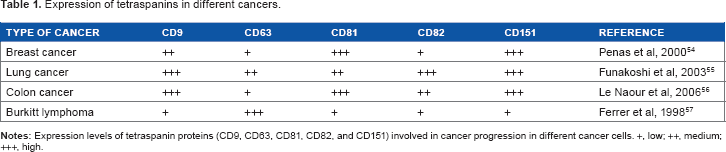
low;
medium;
high.
Future Prospects
This review explores the importance of CD151 in the maintenance of cellular integrity and cell communication. It also imparts the role of CD151 in cancer cell migration, invasion, and metastasis. Thus, CD151 is a crucial target for cancer therapy. Disruption of tetraspanin web by targeting CD151 may affect the signaling pathways involved in cell survival and cancer progression. CD151 can be downregulated using mAbs, shRNA or gene knockout, which may find application in cancer therapy. Understanding the mechanism of palmitoylation of CD151 may give a wide scope for cancer research. Studying the role of CD151 in molecular mechanisms associated with self-renewal, differentiation, DNA damage response, epigenetic mechanisms and anchorage-dependent and -independent tumor cell survival using gene silencing methods may provide an ample scope for future cancer research.
Abbreviations
CD151, cluster of differentiation 151; GP-27, glycoprotein-27; PETA-3, platelet-endothelial tetraspan antigen-3; TSPAN-24, tetraspanin-24; TEM, tetraspanin-enriched microdomains; ECM, extracellular membrane; MMP, matrix metalloproteinase.
Author Contributions
Conceived and designed the experiments: RM. Analyzed the data: SK. Wrote the first draft of the manuscript: GV. Contributed to the writing of the manuscript: AB. Agree with the manuscript results and conclusions: SK. Jointly developed the structure and arguments for the paper: RM. Made critical revisions and approved final version: RM and VRD. All authors reviewed and approved of the manuscript.