






Abstract
Polynuclear Aromatic Hydrocarbons (PAHs) are a major component of fuel generator fumes. Carcinogenicity of these compounds has long been established. In this study, 37 Swiss albino rats were exposed to generator fumes at varied distances for 8 hours per day for a period of 42 days and the level of 1-hydroxypyrene in their blood was evaluated. This study also tried to correlate the level of blood 1-hyroxypyrene with the distance from the source of pollution. Plasma was collected by centrifuging the whole blood sample followed by complete hydrolysis of the conjugated 1-hydroxypyrene glucuronide to yield the analyte of interest, 1-hydroxypyrene, which was achieved using beta glucuronidase. High performance liquid chromatography (HPLC) with UV detector was used to determine the 1-hydroxypyrene concentrations in the blood samples. The mobile phase was water:methanol (12:88 v/v) isocratic run at the flow rate of 1.2 mL/min with CI8 stationary phase at 250 run. After 42 days of exposure, blood concentration level of 1-hydroxypyrene ranged from 34 μg/mL to 26.29 μg/mL depending on the distance from source of exposure. The control group had no 1-hydroxypyrene in their blood. After the period of exposure, percentage of death correlated with the distance from the source of exposure. Percentage of death ranged from 56% to zero depending on the proximity to source of pollution.
Introduction
The hazardous impact of air pollution on both human health and the global environment has been on the rise, particularly in the developing countries where most people still generate their own electricity supply by means of petroleum derived power generator engines. Several researchers have implicated electric generator engines in the emission of large amounts of gaseous and particulate pollutants in the environment where they are used.1–3 Some reported adverse effects of exhaust pollutants include increased infant mortality, 4 acute heart attacks, 5 chronic deficits in lung development of children aged 10–18 years, 6 and ovarian cancer. 7 Numerous epidemiological studies have also shown that exposure to a large amount of petroleum related particles causes an increase in morbidity and mortality which often arises from respiratory diseases and their negative impact on human health.8–10 Researchers have also proven that both solid organic matter and gaseous volatile organic compounds in petroleum related particles can trigger the mutation of cells, resulting in teratogenesis and other hazards.10–13
Studies have shown that exhaust fumes contain many known or suspected carcinogens. 12 They pose a cancer risk that is 7.5 times higher than the combined risk from all other air toxins. The lung cancer risk in urban area is 3 times higher than those found in rural area. 14 Exhaust fume from petrol and diesel engines have been found to be around 40 times more carcinogenic than cigarette smoke on a weight/volume basis. 15 Witten et al 16 suggested that exposure to generator engine exhausts may increase the risk of lung cancer and neurological conditions in rats.
Of all the gaseous and particulate pollutants associated with petroleum related exhaust fumes, polycyclic aromatic hydrocarbons (PAHs) and carbon monoxide (CO) are of great significance due to their carcinogenic and acute CO intoxication (tissue hypoxia) respectively. PAHs exert their toxicity through the formation of mutagenic and carcinogenic PAH-DNA adducts while CO exerts its toxicity by binding irreversibly to haemoglobin. CO has 200–250 times higher affinity than oxygen (O2), thereby reducing the O2 carrying capacity of haemoglobin and thus impairing the release of O2 to the brain, heart, and other body tissues. The mechanism of death from carbon monoxide-haemoglobin adduct (COHgb) has been suggested to be hypoxia induced cardiac dysrhythmia.11,13 Whereas the mechanism of death from PAH-DNA adduct arises from the body cells undergoing cell metastasis.17–21
PAHs comprise the largest class of chemical compound known to be cancer-causing agents and are included in the European Union (EU) and United States Environmental Protection Agency (USEPA) priority pollutant list due to their mutagenic and carcinogenic properties. 22 In 2001, PAHs were ranked ninth most threatening chemical compounds to human health. 23 Many of the PAHs are genotoxic, mutagenic, teratogenic, carcinogenic, and tend to bioaccumulate in the soft tissues of living organisms.17,20,24 PAHs can be more easily adsorbed into fine particles and nano particles due to the higher surface area-to-volume ratio when compared to coarse particles; thus fine particles are expected to have higher PAH-toxicity than the coarse particles in an equal mixture of both.25–27 Lin et al 28 reported that the cytotoxicity of traffic related nano/ultrafine particle extracts was significantly higher than coarser particles.
A major biomarker for PAHs exposure is 1-hydroxypyrene, a byproduct of phase I metabolism of pyrene. 1-hydroxypyene has been used extensively as a biological monitoring indicator of exposure to PAHs.29–31 It has been established as the most relevant parameter for estimating an individual's exposure to PAH. 32 This study was designed in order to establish the impact of petrol generator engine fumes on human health. In the present study, blood samples of albino rats exposed to petrol generator engine fume at various distances over a 42 day period were screened for the level of 1-hydroxypyrene using HPLC.
Materials and Methods
Petrol generator engine
A brand new blue small capacity Tiger TG950 portable gasoline generator with a maximum output power of 800 W was employed in this study. It is easy to carry and use. The generator has low fuel consumption, low noise, and low pollution. The voltage and frequency were stable with Maximum Power (W) 800, Rated Power (W) 650, Voltage (V) 220, Frequency (HZ) 50, Current (A) 2.9, Engine Type W Force air-cooled, 2 strokes Displacement (cc) 63, Starting System C.D.I, Fuel tank (L) 4, Dimension (L × W × H) mm 380 × 330 × 320, Net Weight (kg) 21, 20 FCL (pcs) 750.
Test animals
37 Swiss Albino rats were obtained from the Physiology Department, University of Lagos. The average weight of the rats was 300 ± 20 g. They were allowed to acclimatize to the new environmental conditions for a period of 30 days. The animals were well fed, kept in clean cages, and handled with proper animal care in accordance with the Institute for Laboratory Animal Research (ILAR) guidelines.
Chemicals
All chemicals used in this study were of pure analytical grade standards. 1-hydroxypyrene standard, beta glucuronidase, HPLC grade acetonitrile and methanol were all purchased from Sigma Aldrich (Saint Louis, MO, USA). Standard stock solution (100 mg/L) was prepared by dissolving an appropriate amount of 1-hydroxypyrene in a few drops of methanol before making it up to the 1 L mark. Working solutions were prepared by an appropriate dilution of the stock solutions with pure methanol. All solutions were stored in the refrigerator (4 °C) to avoid degradation.
Mode of exposure to generator fumes
The test animals were weighed and divided into four groups. Group A, B and C had nine animals each while group D had ten. The animals in group A were placed one meter away from the base of the generator exhaust. The animals in group B were placed two meters away from the generator exhaust. The animals in group C were placed three meters away from the exhaust of the generator. The ten rats in group D were used as controls hence they were not exposed to the generator fume. This represents the usual distance between the generator and most people that make use of it for their work place. The generator was left on for 8 hours daily for a period of 42 days. Most workers that generate their own power are exposed for 8 hours daily.
Mortality rate
The mortality number was checked daily and percentage casualties were recorded after exposing the animals for a period 42 days (8 hr/day) to generator fumes.
Extraction of 1-hydroxypyrene
After 42 days of exposure of the rats to 8 hours of generator fumes daily, the rats underwent cervical dislocation and their blood samples were collected by ocular puncture via heparinized capillary tubes into well-labeled heparinized bottles. The whole blood was centrifuged (4000 ×g, 10 min) in a Cencom bench centrifuge and then 2 mL of clear plasma supernatant collected. 1 mL of 2000 units of the beta glucuronidase was added to the decanted supernatant and incubated for 14 hr at 37 °C. This step was to enable the complete hydrolysis of the conjugated 1-hydroxypyrene glucuronide to yield the analyte of interest: 1-hydroxypyrene. Thereafter, 2.5 mL of acetonitrile (ACN) was added to the incubated sample, shaken for 2 min, allowed to settle for 10 min, centrifuged again, and decanted into a clean measuring cylinder. This step was repeated twice. The combined clear supernatants obtained were made up to the 7.5 mL with acetonitrile.
1-Hydroxypyrene Determination by HPLC
An Agilent 1100 series HPLC machine with a UV detector was used for the determination of 1-hydroxypyrene in the blood samples of the exposed rats. An X-bridge C-18 column (150 × 4.6 mm) 5 μm was used as the stationary phase. The mobile phase composition was Methanol:Water (88:12) at a flow rate of 1.2 mL/min in an isocratic run with a 3 min run time. The separation was carried out at an injection volume of 5 μL, wavelength 250 nm and temperature at 30 °C. This method was used for both the standards and the samples.
Results and Discussion
The mortality rate of the animals after 42 days of exposure to generator fume is shown in Figure 1. In group A, 56% of rats were found dead, 22% died in group B, while no casualties were recorded from group C and the control. For group A, two rats died in the first week, and another in the second week. None died in the third week, but last death was recorded in the fourth week. For group B, two out of nine died. None died in the first week, but the second and third week had one casualty each. The 1-hydroxypyrene concentrations in the plasma of the exposed rats were 34.05 ±2.11 μg/mL (Group A), 30.85 ± 2.65 μg/mL (Group B), 27.29 ± 3.94 μg/mL (Group C) while the control group had no detectable 1-hydroxypyrene in their blood samples as shown in Figure 2. This investigation has corroborated various findings that PAHs are a major component of generator exhaust fume and there is rapid absorption and metabolism of these compounds in the animals, leading to the high 1-hydroxypyrene concentration observed in their blood samples.13,17,33,34
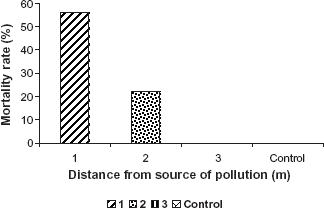
Mortality rate profile of the rats after a prolonged exposure to generator fumes.
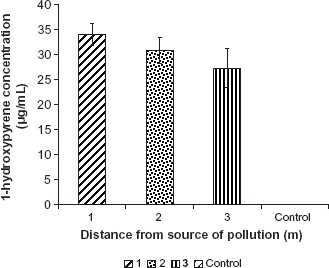
Serum 1-hydroxypyrene concentration in the different groups of Albino rat placed at various distances from the generator exhaust.
The detection of 1-hydroxypyrene concentration as high as 34 μg/mL in the present study suggests some detrimental consequences on the exposed animals, as previously established by many research works on the level of 1-hydroxypyrene and its consequences.10,12,17,35–37 These consequences can be extrapolated to humans with a similar type of exposure. This study was not able to ascertain if the generator fume was mainly absorbed through inhalation or dermal exposure, but the most probable mode of absorption due to the high 1-hydroxypyrene concentration observed is inhalation of the generator fumes by the exposed rats.
The experimental design was put in place to see the effect of 8 hours of daily exposure to generator fume on a given population. In a number of countries in the third world, where power supply is still not guaranteed, many small businesses rely on their own power supply. Usually the distance from these generator engines is less than three meters. The level of 1-hydroxypyrene detected in the rats is an indication of the level of exposure to this population. Therefore this practice is a major public health issue. There is an overwhelming amount of literature linking these exposures to lung cancer. 38 Due to paucity of data on disease conditions in these countries, most times the connection is not so obvious.
Lung cancer is the major cancer thought to be linked to the inhalation of generator exhaust fume.33,34 Several studies on workers exposed to exhaust fumes have shown small but significant increases in risk of lung cancer. Prolonged exposures, such as railroad workers, heavy equipment operators, miners, and truck drivers, have been found to have higher lung cancer death rates than unexposed workers.39,40 Several researchers have reported the carcinogenicity of these compounds even in lower concentration than those obtained in this study17,24 and many of these studies have implicated them either as carcinogens or cancer synergists. 22 Witten et al 16 suggested that exposure to petrol or diesel engine exhausts may increase the risk of lung cancer and neurological conditions in rats. A recent study in the US showed that breathing air polluted by exhaust fumes was responsible for more than 70% of the cancer risk in the South Coast Air Basin in California. 41 Lopez-Abente et al 42 correlated gastric cancer risk to consumption of a local wine sealed with a tar like substance obtained through boiling and distilling fir and pinewood which contains PAHs. Sinha et al 43 associated increased risk of colorectal adenomas with benzo(a)pyrene intake in food. Tobacco smoke, which contains PAHs, has been implicated in the lung cancer. 44 An association between PAH-DNA adducts and breast cancer incidences have also been reported.18,19,36,45
Furthermore, there was a positive correlation regarding the distance to source of pollution and the level of 1-hydroxypyrene in blood samples of exposed animals. 1-hydroxypyrene level was significantly (P < 0.05) increased in groups of rats that had experienced dermal and inhaled exposure to the generator fumes compared to the group of unexposed rats (control). This points to the fact that the closer the rat to the generator exhaust source, the higher the absorption of these carcinogens after inhalation and dermal contact. Reports have suggested that most PAHs are well absorbed in mammals.30,46 Rapid absorption has been recorded in rats exposed to benzo(a)pyrene through inhalation. 46
There is a high tendency of malignant tumor development in these PAH poisoned rats due to mutation arising from PAH-DNA adducts disrupting normal DNA transcription, translation, and replication. However, gene polymorphisms in most enzymes have been identified in human beings and this could modulate individual cancer susceptibility. Ueng et al 47 reported that exposure of rats to motorcycle exhaust and organic extracts of the exhaust particulate causes a dose- and time-dependent increase in cytochrome P-450-dependent monooxygenases as well as glutathione-S-transferase in the liver, kidney, and lung microsomes. This occurs as these enzymes metabolize the PAHs to polar nucleophilic metabolites that bind with the adenine and guanine bases of the DNA. 47 Lin et al 28 reported that the cytotoxicity of traffic related nano/ultrafine particle extracts was significantly higher than for coarser particles. This would be most likely due to the higher PAH concentration in the fine generator exhaust particles.
Conclusion
The data available from this study shows that generator fumes contribute significantly to the atmospheric level of PAHs and that the level is dependent on the distance from the point of generation. This suggests significant risk of cancer to the population in an environment where the use of generator is commonplace. Considering the lipophilicity of PAHs, small concentrations can accumulate over a long period of time.
Author Contributions
Conceived and designed the experiment: CA, ME. Analyzed the data: CI, KO, CA, ME, NO, EA. Wrote the first draft: CI, CA. Contributed to writing the manuscript: ME, NO. Agreed with manuscript result and conclusion: CI, ME, CA, NO, KO, EA. Jointly developed the structure and argument for the paper: CA, CI, ME, NO. Made critical revision and approved final version: ME, NO. All authors reviewed and approved of the final manuscript.
Funding
Author(s) disclose no funding sources.
Competing Interests
Author(s) disclose no potential conflicts of interest.
Disclosures and Ethics
As a requirement of publication author(s) have provided to the publisher signed confirmation of compliance with legal and ethical obligations including but not limited to the following: authorship and contributorship, conflicts of interest, privacy and confidentiality and (where applicable) protection of human and animal research subjects. The authors have read and confirmed their agreement with the ICMJE authorship and conflict of interest criteria. The authors have also confirmed that this article is unique and not under consideration or published in any other publication, and that they have permission from rights holders to reproduce any copyrighted material. Any disclosures are made in this section. The external blind peer reviewers report no conflicts of interest.