






Abstract
Chemo-enzymatic synthesis of glycolyl-ester-linked taxol-glucose conjugate, ie, 7-glycolyltaxol 2′-O-α-D-glucoside, was achieved by using α-glucosidase as a biocatalyst. The water-solubility of 7-glycolyltaxol 2′-O-α-D-glucoside (21 μM) was 53 fold higher than that of taxol. The hepatitis B virus envelope L particles (bio-nanocapsules) are effective for delivering 7-glycolyltaxol 2′-O-α-D-glucoside to human hepatocellular carcinoma NuE cells.
Introduction
Taxol is one of the most potent anticancer agents used in the treatment of breast and ovarian cancers. It presents disadvantages such as low water-solubility and toxicity toward normal tissues. To date many efforts have been made to modify taxol chemically in order to create a more soluble and more easily delivered drug.1–4 Taxol derivatives, that incorporate acids, have attracted much attention, because an ester linkage improves the solubility of taxol and can be hydrolyzed by hydrolytic enzymes to release taxol.1–4 However, little attention has been paid to chemo-enzymatic synthesis of ester-linked taxol-glycoside conjugates as water-soluble taxol derivatives, which employ enzymatic cleavage by hydrolytic enzymes including esterases and glycosidases as their mode of activation. On the other hand, convenient drug delivery system (DDS) using hepatitis B virus surface antigen L particles has been recently reported. 5 However, this DDS system is not effective for delivering taxol, because the present nano-particles can incorporate only soluble drugs.
On continuing the study to develope the technology for delivering taxol, we report the chemo-enzymatic synthesis of glycolyl-ester-linked taxol-sugar conjugate, ie, 7-glycolyltaxol 2′-O-α-D-glucoside, and its new delivery system using hepatitis B virus envelope L particles to human hepatocellular carcinomas.
Experimental
General
Taxol was a gift from Ensuiko Sugar Refining Co., Ltd. The 1 H and 13C nuclear magnetic resonance (NMR), H-H correlation spectroscopy (COSY), C-H COSY, and heteronuclear multiple-bond correlation (HMBC) spectra were recorded in CD3OD using a Varian XL-400 spectrometer (Varian Inc). The chemical shifts were expressed in δ (ppm) referring to tetramethylsilane. The fast atom bombardment mass spectrometry (FABMS) spectra were measured using a JEOLMStation JMS-700 spectrometer (JEOL Ltd.). High performance liquid chromatography (HPLC) was carried out on Crestpak C18S column (4.6 x 150 mm, JASCO) [solvent: MeOH-H2O (2:3,v/v); detection: UV (228 nm); flow rate: 1.0 mL/min].
Synthesis of 7-glycolyltaxol 2′-O-α-D-glucoside
Glycolic acid was glucosylated by α-glucosidase as follows.
6
To a solution of maltose (0.2 mol) and glycolic acid (0.02 mol) in DMSO-H2O was added α-glucosidase (500 U). The mixture was stirred for 24 h at 40 °C and then was extracted with n-butanol. The organic layer was concentrated and purified by column chromatography on silica gel to afford carboxymethyl α-D-glucopyranoside (
Synthesis of 7-glycolyltaxol 2′-O-α-D-glucoside was carried out as follows. To a solution of BnBr/NaH (0.15 mol) in DMF was added carboxymethyl α-D-glucopyranoside (
Spectral data of 7-glycolyltaxol 2V′-O-α-D-glucoside are as follows.
7-Glycolyltaxol 2′-O-α-D-glucopyranoside (
Water-solubility of 7-glycolyltaxol 2″-O-α-D-glucoside
Water-solubility of 7-glycolyltaxol 2″-O-α-D-glucoside was examined as follows. The compound was stirred in water for 24 h at 25 °C. The mixture was centrifuged at 100000 g for 30 min at 25 °C. The concentration of test compounds was estimated on the basis of their peak areas using calibration curves prepared by HPLC analyses of authentic samples.
Preparation of hepatitis B virus surface antigen L particles
The hepatitis B virus surface antigen L particles were prepared according to the previously reported procedures. 5 The L particles were overexpressed in Saccharomyces cerevisiae AH22R– carrying hepatitis B virus envelope L expression plasmid pGLDLIIP39-RcT and purified by precipitation with polyethylene glycol 6000, CsCl isopycnic ultracentrifugation and sucrose density gradient ultracentrifugation. About 4 mg of purified L particles were obtained from wet wt. 20 g of the yeast cells. The solution including purified L particles was concentrated by Vinapspin Concentrator-1000,000 MWCO (Vivascience Ltd.) to 200 ng/mL.
Cytotoxicity assay in vitro
The sensitivity of human hepatocellular carcinoma NuE cells to 7-glycolyltaxol 2″-O-α-D-glucoside or 7-glycolyltaxol 2″-O-α-D-glucoside electroporated into L particles was determined according to the previously reported method. 5 Cells were diluted with culture medium to the seeding density (10 5 cells/mL), suspended in 96-well tissue culture plates (100 μL/well), preincubated at 37 °C for 4 h, and then treated for 24 h with 7-glycolyltaxol 2″-O-α-D-glucoside or 7-glycolyltaxol 2″-O-α-D-glucoside electroporated into L particles at various concentrations to obtain a dose–response curve for each compound. After incubation, 20 μL MTT (3-(4,5-dimethylthiazol-2-yl)-2, 5-diphenyltetrazolium bromide, yellow tetrazole) solution (2.5 mg/mL) was added to each well and the plates were further incubated for 4 h. Absorbance at 570 nm was measured with a microplate reader model 450 (BIO-RAD). Dose-response curves were plotted on a semi-log scale as percentage of the cell numbers in control cultures not exposed to test compounds.
Results and Discussions
The water soluble taxol derivative, ie, 7-glycolyltaxol 2″-O-α-D-glucoside (
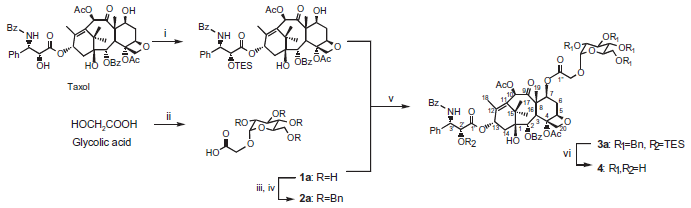
Synthesis of 7-glycolyltaxol 2″-O-α-D-glucopyranoside (4).
The water-solubility of 7-glycolyltaxol 2″-O-α-D-glucoside (
Water-solubility of 7-glycolyltaxol 2″-O-α-D-glucoside.
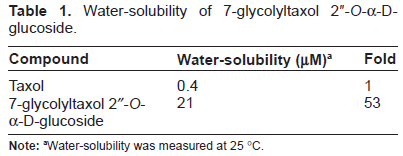
Water-solubility was measured at 25 °C.
Hepatitis B virus is a human liver-specific virus, the genome of which harbors three overlapping envelope genes in a single open reading frame, encoding small, medium, and large proteins. Recently, hepatitis B virus envelope large (L) protein was produced in yeast cells as hollow particles with no hepatitis B genome inside and the particle was used as immunogens in hepatitis B vaccines that were proven safe for humans. The N-terminal amino acid residues 108–119 of the L protein displayed on the surface of L particles functions as the specific ligand for receptor binding on human hepatocytes and are crucial for hepatitis B virus infectivity. The L particles could be used as a safe vehicle for delivering drugs with high targetting specificity to human hepatocyte-derived cells. The hepatitis B virus surface antigen L particles were prepared according to the previously reported procedures.
5
Taxol-prodrug, 7-glycolyltaxol 2″-O-β-D-glycoside, was electroporated into L particles with a Gene Pulser II electroporation system (Bio-Rad Laboratories Inc.). The mixture of taxol-prodrug (final cencentration of 2.1, 4.2, 8.3, 17, and 33 μg/mL) and 500 μL of L particles solution (100 ng of protein) was electroporated in a 4-mm gap cuvette at 220 V and 950 μF for 20 min. To clarify the efficient incorporation of taxol-prodrug in the L particles, the filtrate of L particles solution after centifugation by Vinapspin Concentrator-1000,000 MWCO was analyzed by HPLC and no taxol-prodrug was detected. After adding the same volume of water as the filtrate, the cytotoxic activity of taxol derivative
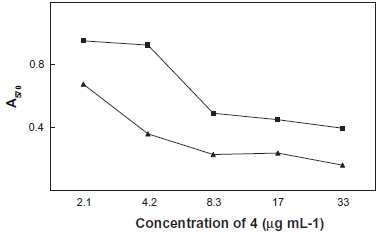
Dose-response curves in MTT assay of 7-glycolyltaxol 2″-O-α-d-glucoside (¦) and 7-glycolyltaxol 2″-O-α-D-glucoside incorporated in hepatitis B virus envelope L particles (▲).
In summary, a water-soluble taxol derivative, ie, 7-glycolyltaxol 2″-O-α-D-glucoside, was successfully synthesized by chemo-enzymatic procedures. The drug delivery system using hepatitis B virus surface antigen L particles was effective for delivering 7-glycolyltaxol 2″-O-α-D-glucoside to human hepatocellular carcinoma NuE cells. Further studies on in vivo thrapeutic values of taxol derivative, that is incorporated in L particles, are now in progress.
Author contributions
KS, MH, MS, TM, and HH were responsible for data collection/entry/analysis and assistance with manuscript preparation. HH was responsible for the study design and preparation of the manuscript. All authors read and approved the final manuscript.
Funding
Author(s) disclose no funding sources.
Competing Interests
Author(s) disclose no potential conflicts of interest.
Disclosures and Ethics
As a requirement of publication author(s) have provided to the publisher signed confirmation of compliance with legal and ethical obligations including but not limited to the following: authorship and contributorship, conflicts of interest, privacy and confidentiality and (where applicable) protection of human and animal research subjects. The authors have read and confirmed their agreement with the ICMJE authorship and conflict of interest criteria. The authors have also confirmed that this article is unique and not under consideration or published in any other publication, and that they have permission from rights holders to reproduce any copyrighted material. Any disclosures are made in this section. The external blind peer reviewers report no conflicts of interest.