






Abstract
The stereoselective reduction of an aromatic α-keto amide with actinomycete strains was investigated. It was found that 2-chlorobenzoylformamide was reduced to the corresponding 2-chloromandelamide by mesophilic and thermophilic strains of actinomycetes. Among the strains tested, the reduction of 2-chlorobenzoylformamide by Streptomyces thermocyaneoviolaceus (one of thermophilic strains) in the presence of glycerol as an additive produced only (S)-2-chloromandelamide in >99% conversion with >99% enantiomeric excess (e.e.). On the other hand, the reduction by Streptomyces thermocarboxydovorans NBRC16324 at 45 °C or Thermoactinomyces vulgaris NBRC15851 cultivated in a soluble starch-based medium gave the corresponding (R)-hydroxy amide (conversion, 99%; >99% e.e.). Mesophilic and other thermophilic actinomycete strains also catalyzed the reduction to the corresponding (R)-hydroxy amide with 85%–>99% e.e. Thus, the syntheses of both enantiomers of 2-chloromandelamide was achieved though the reduction of 2-chlorobenzoylformamide with different actinomycete strains.
Introduction
The α-keto amide structure can be found in many pharmacologically interesting compounds, the most well-known examples being calpain or lipase inhibitors, macrocyclic polyketides FK506 and rapamycin.1–3 Mandipropamid, one of fungicides for target pathogens in plants, contain the α-hydroxy amide moiety in their molecules.4,5 Further, clopidogrel (plavix®), an anti-platelet therapy drug, 6 has (R)-2-chloroman-delate skeleton that is easily accessible from (R)- 2-chloromandelamide. Therefore, the synthesis of the compounds having α-keto and α-hydroxy amide structures has become one of the important goals in the field of organic chemistry, biochemistry, agricultural chemistry, and pharmacology.
To date, biotransformations of various exogenous substances have been investigated and used to synthesize such bioactive compounds.7–9 For example, there are a few reports that the reduction of benzoyl-formamide, one of the aromatic α-keto amides, with Saccharomyces cerevisiae gave to the corresponding (R)-mandelamide in 60%–70% yield.10,11 Furthermore, yeast and fungi such as Candida, Pichia, and Geotrichum species have a reducing activity toward 2-chlorobenzoylfomamide to the corresponding (R)-hydroxy amide.12,13 However, little information is known about the reduction of α-keto amide with other microorganisms.
In previously, we reported that thermophilic actinomycete strains had a high reducing activity toward α-keto esters. 14 Therefore, actinomycete strains can be expected to catalyze the reduction of keto ester analogues.
In this paper, we report the stereoselective reduction of 2-chlorobenzoylformamide, an aromatic α-keto amide, with mesophilic and thermophilic actinomycetes.
Materials and Methods
Instruments and chemicals
Gas chromatography was performed using GL Science GC-353 (TC-1, 0.25 mm x 30 m, GL Science; GAMMA DEX™ 225, Supelco, 0.25 mm x 30 m) gas chromatographs. 2-Chlorobenzoylformamide and 2-chloromandelamide were synthesized according the literature. 15 Diatomaceous earth (granular) was purchased from Wako Pure Chemicals, Japan. All other chemicals used in this study were of analytical grade and commercially available.
Microorganism and cultivation
Streptomyces avermitilis NBRC14893 (mesophilic strain), Streptomyces coelicolor A3(2) NBRC15146 (mesophilic strain), Streptomyces thermocyaneoviolaceus NBRC14271, Streptomyces thermocoerulescens NBRC14273, Streptomyces thermolilacinusNBRC14274, Streptomyces thermoalcalitolerans NBRC16322, Streptomyces thermocarboxydovorans NBRC16324, Streptomyces thermospinosisporus NBRC100043, Streptomyces thermogriseus NBRC100772, Thermoactinomyces intermedius NBRC14230, Thermoactinomyces vulgaris NBRC15851, Thermoactinomyces putidus NBRC15871, Thermomonospora curvata NBRC15933, and Thermomonospora chromegena NBRC16096 were purchased from the National Institute of Technology and Evaluation, Biological Resource Center, Japan. The actinomycete strains were maintained at 25 °C in the following synthetic media (Media A–C) solidified 1.5%–2.0% agar. Medium-A (for Streptomyces strains) is comprised of 15 g bactopeptone, 2 g yeast extract, 2 g meat extract, 2 g glycerol, 2 g KH2PO4, 2 g K2HPO4, and 0.1 g MgSO4 • 7H2O per 1 liter of distilled water (pH 7.2). Medium-B (for Thermoactinomyces and Thermomonospora strains) is comprised of 4 g yeast extract, 1 g malt extract, and 4 g glucose per 1 liter of distilled water (pH 7.3). Medium-C is comprised of 2 g yeast extract and 10 g soluble starch per 1 liter of distilled water (pH 7.3). The actinomycete strains were grown in each maintained medium (500 ml) for 24–72 h at 25 °C (for mesophile) or 45 °C (for thermophile) with aerobic shaking in baffled 2-liter flasks in the dark condition. The cells were collected by filtration on filter paper in vacuo and washed with saline (0.85% NaCl aq.).
Reduction of α-keto amide with actinomycete whole cells
The saline-washed cell (0.5 g, corresponding 0.2 g of dry weight) was resuspended in a large test tube (Φ30 mm x 200 mm) containing 20 ml of saline, and then the substrate (0.15 mmol, corresponding substrate concentration is 7.5 mM) and additive were added and incubated aerobically at 25 °C (for mesophile) or 45 °C (for thermophile). A portion of the reaction mixture was filtered using a diatomaceous earth short column and extracted with ether, and then concentrated under reduced pressure.
Analysis
The conversion of the reduction was determined using a GLC equipped with a capillary TC-1 column (0.25 mm x 30 m, 175 °C; He, 100 kPa, 2-chlorobenzoylformate, 6.85 min; 2-chloromandelamide, 8.34 min). Chemical yield was determined also GLC equipped with a TC-1 column with the internal standard (n-tetradecane). The enantiomeric excess (e.e.) of the product was determined using a GLC equipped with an optically active capillary Gamma-DEX 225 (0.25 mm x 30 m, 190 °C; He, 100 kPa; (S)-2-chloromandelamide, 26.99 min; (R)-2-chloromandelamide, 28.03 min) column. The absolute configuration of the isomer was determined by comparing its retention time with that of authentic samples.
Results and Discussion
Screening of 2-chlorobenzoylformamide reducing activity in actinomycete strains. Fourteen selected actinomycete strains (2 mesophiles and 12 thermophiles) were tested for the reducing activity toward 2-chlorobenzoylformamide (
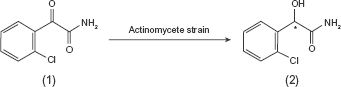
The reduction of 2-chlorobenzoylformamide (1) to 2-chloromandelamide (2) with actinomycete strain.
The reduction of 2-chlorobenzoylformamide with actinomycete strains. a
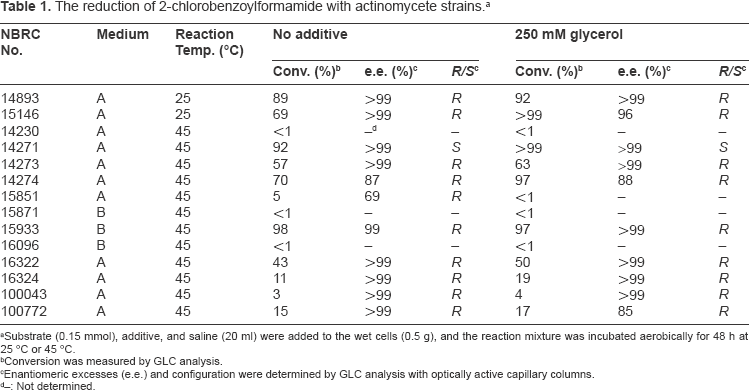
Substrate (0.15 mmol), additive, and saline (20 ml) were added to the wet cells (0.5 g), and the reaction mixture was incubated aerobically for 48 h at 25 °C or 45 °C.
Conversion was measured by GLC analysis.
Enantiomeric excesses (e.e.) and configuration were determined by GLC analysis with optically active capillary columns.
d–: Not determined.
In the stereochemistry of the product, the reduction of
Effect of cultivation medium on the reduction
The improvement of low conversion ratio in the reduction with 4 thermophilic actinomycete strains (NBRC14230, 15851, 15871, and 16096)was attempted by changing the cultivating medium and introduction of glycerol as a hydride source (see Table 2). 17 As a result, the conversion ratio in the reduction with T. vulgaris NBRC15851 was increased dramatically (from 5% to 99%), however the improvement in the reduction with other 3 strains (NBRC14230, 15871, and 16096) was not observed. Furthermore, growth rates of these 3 strains were very slow, compared with other thermophilic actinomycete strains. Therefore, it seems that these 3 strains is not suitable as a biocata-lyst for the reduction of 2-chlorobenzoylformamide.
Effect of culture media on the reduction of 2-chlorobenzoylformamide with actinomycete strains. a
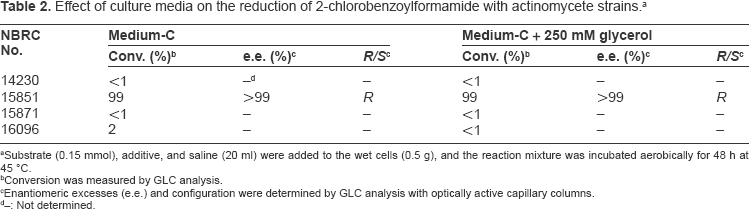
Substrate (0.15 mmol), additive, and saline (20 ml) were added to the wet cells (0.5 g), and the reaction mixture was incubated aerobically for 48 h at 45 °C.
Conversion was measured by GLC analysis.
Enantiomeric excesses (e.e.) and configuration were determined by GLC analysis with optically active capillary columns.
d–: Not determined.
Effect of temperature on the reduction
The reduction of
Effect of temperature on the reduction of 2-chlorobenzformamide with actinomycete strains. a
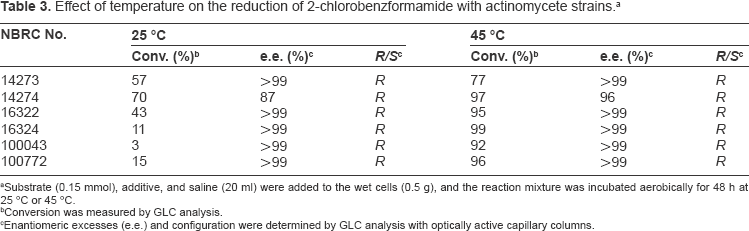
Substrate (0.15 mmol), additive, and saline (20 ml) were added to the wet cells (0.5 g), and the reaction mixture was incubated aerobically for 48 h at 25 °C or 45 °C.
Conversion was measured by GLC analysis.
Enantiomeric excesses (e.e.) and configuration were determined by GLC analysis with optically active capillary columns.
Effect of the substrate concentration and productivity
The effects of the substrate concentration on the reduction of 2-chlorobenzoylformamide with two actinomycete strains (NBRC 14271 and 16324) are summarized in Table 4. When the concentration was low (below 22.5 mM), the substrate was reduced to the corresponding hydroxy amide in high yield (97%), however the conversion showed low values (below 40%) at high substrate concentration (75.0 mM). The decrease of the conversion may be caused by a toxic effect against actinomycete cells. It is worth noting that the enantioselectivity of the produced hydroxy amide has over 99% in any substrate concentration tested.
Effect of substrate concentration on the reduction of 2-chlorobenzformamide with two actinomycete strains.
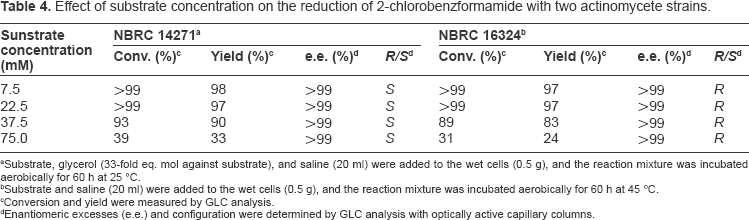
Substrate, glycerol (33-fold eq. mol against substrate), and saline (20 ml) were added to the wet cells (0.5 g), and the reaction mixture was incubated aerobically for 60 h at 25 °C.
Substrate and saline (20 ml) were added to the wet cells (0.5 g), and the reaction mixture was incubated aerobically for 60 h at 45 °C.
Conversion and yield were measured by GLC analysis.
Enantiomeric excesses (e.e.) and configuration were determined by GLC analysis with optically active capillary columns.
The productivity of (S)- and (R)-2-chloroman-delamide via the reduction of 2-chlorobenzoylformamide with two actinomycete strains were 58.0 and 52.0 μmol/h/g of dry cells, respectively (initial substrate concentration is 37.5 mM).
Conclusion
We demonstrated the stereoselective reduction of aromatic α-keto amide to the corresponding α-hydroxy amide with actinomycetes. It was found that 2-chlorobenzoylformamide was reduced to 2-chloromandelamide with mesophilic and thermophilic actinomycete strains. The reduction of 2-chlorobenzoylformamide by S. thermocyaneoviolaceus NBRC14271 in the presence of glycerol produced (S)-2-chloromandelamide specifically (conversion, >99%; >99% e.e.), while the reduction of the substrate by S. thermocarboxydovorans NBRC16324 at 45 °C or T. vulgaris NBRC15851 cultivated in Medium-C gave the corresponding (R)-hydroxy amide (conversion, 99%; >99% e.e.). Thus, the synthesis of both enantiomers of 2-chloromandelamide was achieved though the reduction of 2-chlorobenzoylformamide with different actinomycete strains.
Disclosures
This manuscript has been read and approved by all authors. This paper is unique and is not under consideration by any other publication and has not been published elsewhere. The authors report no conflicts of interest.
Footnotes
Acknowledgement
This study was partially supported by the Ministry of Education, Culture, Sports, Science and Technology of Japan though a Financial Assistance Program for Social Collaborative Research (2006–2010).