






Abstract
The enzymatic synthesis of capsaicin glycosides and 8-nordihydrocapsaicin glycosides was investigated using almond β-glucosidase and cyclodextrin glucanotransferase (CGTase). Capsaicin and 8-nordihydrocapsaicin were converted into their β-glucoside and β-maltooligosaccharide (amylose conjugate), i.e. β-maltoside and β-maltotrioside, by sequencial glycosylation with almond β-glucosidase and CGTase. The β-glucoside and β-maltoside of capsaicin and β-glucoside of 8-nordihydrocapsaicin showed inhibitory effects on high-fat-diet-induced elevations in body weight of mice.
Keywords
Introduction
The Capsicum sp. have been used as spices and medicines for centuries worldwide. The chemical constituents in the fruits of Capsicum plants are capsaicinoids, which are responsible for the sensory effects associated with pungency. 1 Capsaicin, N-[(4-hydroxy-3-methoxyphenyl)methyl]-8-methyl-(E)-6-nonenamide, is the most pungent principle among naturally occurring capsaicinoids. 1 It has been reported that capsaicin decreased adipose tissue weight and serum triacylglycerol content in rats by enhancing energy metabolism. 2 Furthermore, capsaicin has been reported to show pharmacological properties, such as analgesic, antigenotoxic, antimutagenic, and anticarcinogenic effects.3–6 It has been used to treat various peripheral painful conditions, including rheumatoid arthritis and diabetic neuropathy.
Capsaicinoids are scarcely soluble in water and poorly absorbed after oral administration. Additionally, capsaicinoids have extensive neurological toxicity, and direct irritant effects on skin and mucous membrane. 7 These shortcomings prevent capsaicinoids from being used as food additives and medicines. Glycosylation of capsaicinoids may reduce their pungency and enhance their water-solubility and absorbability after oral administration. We report here the sequential glycosylations of capsaicin and 8-nordihydrocapsaicin by almond β-glucosidase and cyclodextrin glucanotransferase (CGTase) to the corresponding β-glucosides and β-maltooligosaccharides, i.e. β-maltosides and β-maltotriosides, and their anti-obese properties.
Materials and Methods
Materials
The substrates capsaicin (
Glycosylation procedures
A typical glycosylation procedure with almond β-glucosidase was as follows. To the mixture (200 mL) of 90% MeCN containing 70 mmol of D-glucose and 2000 U of almond β-D-glucosidase was added 30 mmol of substrate, capsaicinoid. The mixture was incubated for 48 h at 40 °C. Concentration of the reaction mixture by evaporation under reduced pressure followed by purification using column chromatography on silica gel afforded product, capsaicinoid β-D-glucoside.
Capsaicinoid β-D-glucoside (10 mmol) was subjected to further glycosylation with CGTase. The substrate, capsaicinoid β-D-glucoside, was incubated with 1000 U of CGTase in 200 mL of 25 mM sodium phosphate buffer (pH 7.0) containing 50 g of soluble starch at 40 °C for 24 h. After incubation, the reaction mixture was centrifuged at 3000 g for 10 min. The supernatant was applied to a Sephadex G-25 column equilibrated with water. Fractions that contained glycosides were lyophilized, re-dissolved with water, and purified by preparative HPLC. The capsaicinoid β-glycosides, the amount of which was enough for anti-obese assay, were prepared by large scale synthesis enlarged 20 times as large as the normal synthetic procedures.
Analysis
HPLC was carried out with a YMC-Pack R&D ODS column (150 x 30 mm) using MeOH-H2O (9:11, v/v) as the eluent [detection: UV (280 nm); flow rate: 1.0 mL/min]. 1H and 13C NMR (nuclear magnetic resonance), H-H COSY (correlation spectroscopy), C-H COSY, and HMBC (heteronuclear multiple-bond correlation) spectra were measured in CD3OD on a Varian XL-400 spectrometer. HRFABMS spectra were taken on a JEOL MStation JMS-700 spectrometer. The structures of the products were determined by HRFABMS, 1H and 13C NMR, H-H COSY, C-H COSY, and HMBC spectra.
Anti-obese activity
The anti-obese action of test compounds was examined according to the reported procedure. 8 Male mice, which were 4-weeks old, were used for the experiment. After mice were given a standard laboratory diet and water ad libitum for 1 week, they were divided into groups matched for body weight. One group, the normal diet group used as the control, was fed a standard laboratory diet (n = 5). The other experimental groups were fed either of two experimental diets, the high-fat diet and the high-fat diet plus test compound. The experimental diets shared the following basic composition: beef tallow 40%, casein 36%, corn starch 10%, sugar 9%, vitamin mixture 1%, and mineral mixture 4% (w/w per 100 g diet) with water ad libitum. The compositions for the respective experimental groups were as follows (each n = 5): high-fat diet group, basic components; high-fat diet plus test compound group, basic components and test compound 4 mmol per 100 g diet. The body weight of each mouse was recorded once weekly until 10 week after initiation of feeding on the indicated experimental diet. The inhibitory effects of test compounds on obesity were expressed in terms of the percentage reduction of the high-fat-diet-induced elevations in average of body weight of five mice at 10 week by the test compounds.
Results and Discussion
After 48 h incubation of almond β-glucosidase with capsaicin (

Synthesis of capsaicin β-maltooligosacharides by almond β-glucosidase and CGTase.

Synthesis of 8-nordihydrocapsaicin β-maltooligosacharides by almond β-glucosidase and CGTase.
13C chemical shifts of the glycosylation products 3–8 in CD3OD.
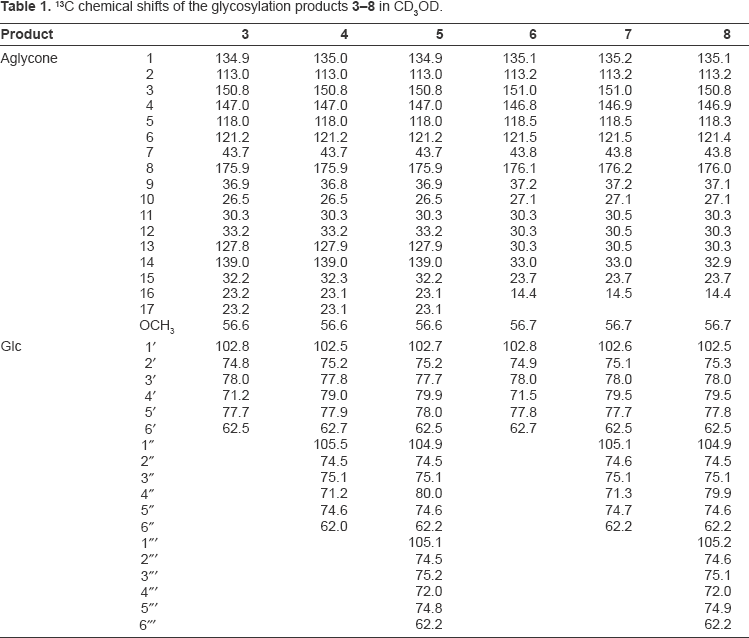
The HRFABMS spectra of
The HRFABMS spectra of
The anti-obese activities of capsaicinoids and their glycosides were examined. The entire experiments were repeated three times with essentially the same result. One representative data set of anti-obese activities is as follows:
The present study demonstrated that β-maltooligosaccharides of capsaicin and 8-nordihydrocapsaicin can be prepared by sequencial glycosylation with almond β-glucosidase and CGTase. The β-glucoside and β-maltoside of capsaicin and β-glucoside of 8-nordihydrocapsaicin showed potent anti-obese activity, whereas weak activity was observed in the cases of capsaicin β-maltotrioside and two 8-nordihydrocapsaicin β-maltooligosides. Further studies on the physiological activities of capsaicinoid β-glycosides are currently in progress.
Disclosures
This manuscript has been read and approved by all authors. This paper is unique and is not under consideration by any other publication and has not been published elsewhere. The authors report no conflicts of interest.