




Abstract
Background:
In previous decades, large-scale research has been carried out on bacterial meningitis. In every field, citation analysis is the most significant contribution. The study’s objective was to identify and analyze the 100 articles on bacterial meningitis that received the most citations between 2000 and 2023, highlighting the most significant developments in the field.
Objective:
The objective of this study was to find out what makes a highly influential article by identifying and analyzing the characteristics of the 100 articles in the field of bacterial meningitis that receive the most citations. The goal of this study was to find and examine the 100 articles on bacterial meningitis that received the most citations.
Methodology:
We identified the top 100 most-cited papers in the field of bacterial meningitis from 55 journals using the Dimensions AI database. The results of each author’s analysis of 100 articles were then compared. We gathered fundamental data such as the journal’s title, country of publication, and study type. Descriptive counts or percentages were used to compare the various categories.
Results:
Between the year 2000 and the year 2023, articles were published. The total number of citations ranged from 115 to 1176, with 42 papers receiving more than 200 citations. In 2008, 14 articles were published, followed by 10 in 2000 and 2007. One thousand one hundred and seventy-six times were given to the most-cited paper, whereas 115 times were given to the least-cited article. “Clinical Features and Prognostic Factors in Adults with Bacterial Meningitis,” by Diederik van de Beek, et al. (2004) was the article that received the most citations. 1176 people have cited this article. van de Beek Diederik of the Academic Medical Center in The Netherlands is the author who has written the most articles, was mentioned in 14 of the top 100 articles. Papers were primarily published in Pediatrics (n = 9) publication with 1861 citations. The Netherlands came in second with 18 publications, followed by the United States (n = 46).
Conclusion:
Our study uses bibliometrics and visualization analysis of the most important articles in this field to show the current state of research in the area of bacterial meningitis, provide a history of research trends, and offer a perspective for future bacterial predicts the growth of meningitis.
INTRODUCTION
Meningitis is a life-threatening infection with a high death rate and can cause serious long-haul complexities.[1,2] Meningitis remains a huge overall general clinical issue. Meningitis is exacerbation of the tissues including the cerebrum and spinal rope.[3] It is normally brought about by an infection. This can be hazardous and requires speedy clinical thought. Many sorts of microscopic organisms, infections, growths, and parasites can cause meningitis.[2] Most infections can be spread starting with one individual then onto the next. Most bacteria that cause meningitis, for example, For example H. influenzae, M. tuberculosis, and S. pneumoniae: These bacteria are spread by coughing or sneezing in close proximity to others, who then breathe in the bacteria, Group B Streptococcus and E. coli: these bacteria can be passed from mothers to babies during childbirth, and N. meningitidis: : these bacteria are transmitted by sharing respiratory or throat secretions.[3,4] Injuries, cancers, and medications represent few cases. Bacterial meningitis is of explicit concern. Around 1 out of 6 people who get this kind of meningitis die and 1 of every 5 have serious intricacies.[4] Protected and modest antibodies are the best method for guaranteeing long-haul protection.[2,3] Antibodies are the best method for safeguarding against specific kinds of bacterial meningitis. There are vaccines for 4 types of bacteria that can cause meningitis: Meningococcal vaccines help protect against N. meningitidis; Pneumococcal vaccines help protect against S. pneumoniae; Haemophilus influenzae serotype b (Hib) vaccines help protect against Hib.[2-7]
Bacterial meningitis is caused by bacteria entering the bloodstream and traveling to the brain and spinal cord.[4,5] Notwithstanding, bacterial meningitis can likewise happen when bacteria attack the meninges straightforwardly. This can be brought about by an ear or sinus infection, a fractured skull, or, rarely, certain surgeries. Bacterial meningitis is serious. A few infected individuals pass on, and demise can happen in only a couple of hours. However, most people recover from bacterial meningitis. The people who recover may have superdurable wounds, for example, cerebrum harm, hearing misfortune, and learning disabilities.[5]
METHODOLOGY
Search strategy
Applicable records were recovered from the Dimensions AI database on May 26, 2023. The keywords used for the search were “bacterial meningitis” or “bacterial meningitis” as the “topic” (title, abstract), a year-of publication range from 2000 to 2023. No restrictions were forced on distribution language or distribution type. From the Dimensions AI Database, a total of 4431 articles were retrieved using the search term “‘bacterial meningitis” or “bacterial meningitis’” in the “Title” field. After choices of time span 2000–2023, outcomes show 2986 articles. The writing that was found was organized in sliding request by the number of citations.
Literature inclusion
Researchers utilized the “double evaluation” method to examine each piece of literature they had found to ensure the title and abstract contained the word “bacterial meningitis” or its derivatives and its content was relevant to bacterial meningitis. Retracted articles were excluded. Eventually, the top 100 connected literary works were identified.
Data extraction and analysis
VOSviewer and Microsoft Excel 2013 programming were utilized to break down and visualize the articles on bacterial meningitis. The accompanying data were separated and dissected for the included papers: article title, distribution type, distribution year, reference recurrence, country, establishments, writer, diary, and watchwords.
RESULTS
General outcomes
Important literature were recovered from the Dimensions AI database on May 26, 2023. The pursuit technique brought about all-out 4431 paper reports. After determinations of time span 2000–2023, outcomes show 2986 articles. Eventually, 100 related literary works with the most citations were obtained. The most 10 cited articles in the field of bacterial meningitis research are listed in Table 1, and the number of references to the 100 most frequently cited articles increased from 115 to 1176. Averaging 229.32 citations per paper, the top 100 most-cited papers have received 22,932 citations. There were 27 publications with citations between 115 and 150, 32 between 15 and 297, 27 between 208 and 300, 8 between 305 and 390, and 6 between 441 and 176. The most-cited article is named “Clinical Elements and Prognostic Variables in Grown-ups with Bacterial Meningitis” and was distributed in 2004 by Diederik et al.[6] The Academic Medical Center in The Netherlands drove the rundown with (n = 15) distributions with 3554 references and an average of 236.93 citations per paper. The author with the most articles is Diederik van de Beek of the Medical Center Academic of The Netherlands, whose name showed up in 14 of the main 100 articles with 4321 citations, an average of 308.64 citations per paper. The Pediatrics had the highest number of publications (n = 9), with 1861 citations and a Citation per Paper of 206.77. This was followed by Clinical Infectious Diseases, which had 6 publications with 1347 citations, yielding a citation per paper of 224.5. These 100 papers were published between 2000 and 2023 by 143 nations and 57 establishments.
The top 10 most-cited publications in bacterial meningitis

Top 10 most-cited publications in bacterial meningitis
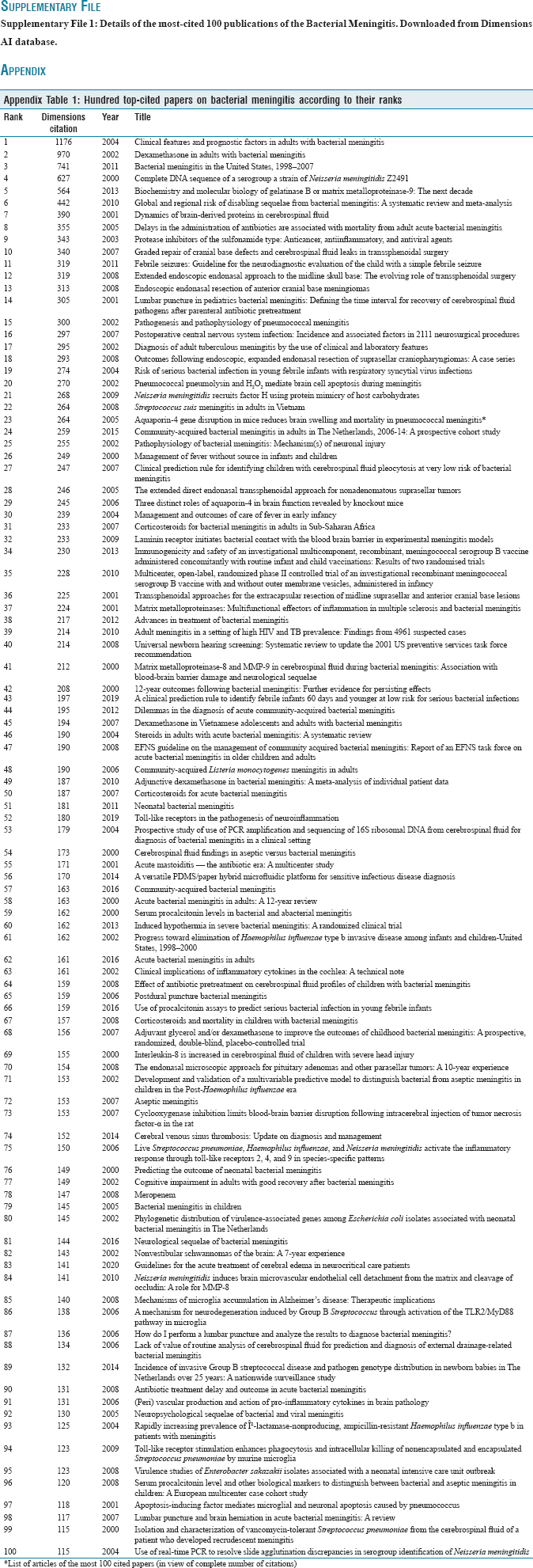
The article “Clinical Features and Prognostic Factors in Adults with Bacterial Meningitis” by Diederik van de Beek et al., published in the “New England Journal of Medicine” in 2004, received the most citations. The work received 1176 citations. Dexamethasone in Adults with Bacterial Meningitis by Jan de Gans and Diederik van de Beek was published in the New England Journal of Medicine in 2002. Nine hundred and seventy people cited the paper. The majority of the publications were released between 2000 and 2010 [Table 1]. The list of top 10 cited publications of 100 top cited papers is available as an [Appendix Table 1] [Supplementary File 1], for a reference.
Publication year
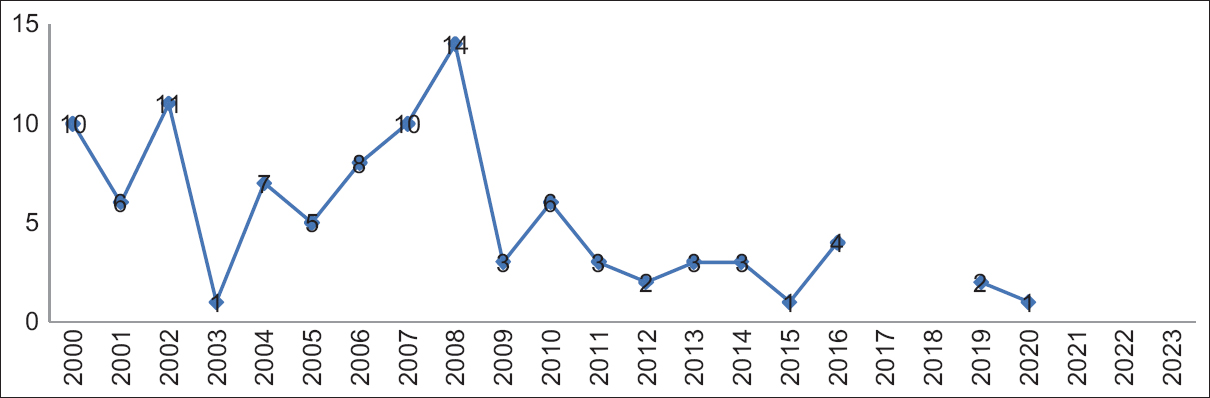
The primary 100 cited publications were published during the years 2000 and 2023. Table 2 presents the number of articles published annually over this 24 year period, as well as the total number of articles published. The most T100 papers were published in 2008 (n = 14), followed by the years 2000 and 2007 (n = 10). Figure 1 depicts the quantity of articles issued each year. There have been 22,932 citations for the top 100 most cited papers or an average of 229.32 citation per paper. There were 27 articles with citations from 115 to 150, 32 with citations from 152 to 197, 27 with citations from 208 to 300, 8 with citations from 305 to 390, and 6 with citations from 442 to 1176.
The publication year of the most-cited publications

Publication year of the most-cited articles
Contributions of institutions
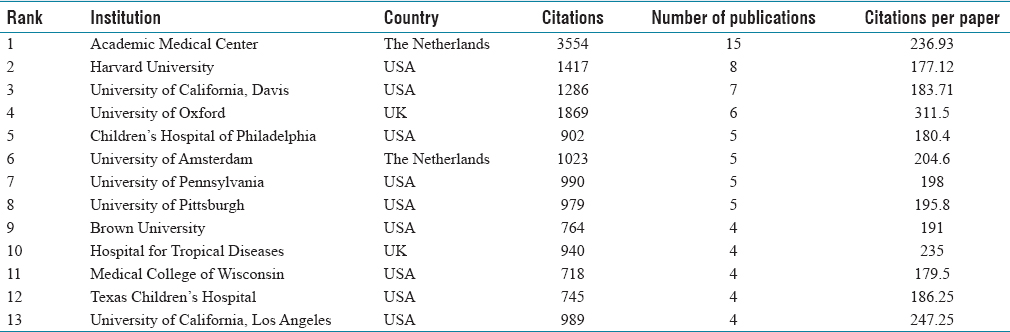
As per VOSviewer, the accompanying institutions are the most applicable. As far as the quantity of the top 100 cited articles distributed, the best 13 institutions all had something like four papers [Table 3]. The Academic Medical Center in The Netherlands drove the rundown with (n = 15) distributions with 3554 references and an average of 236.93 citations per paper, trailed by Harvard University in the US (n = 8) and the University of California, Davis in the US (n = 7), both with 1417 and 1286 references, an average of 177.12 and 183.71 citations per paper individually [Figure 2 and Table 3].

Most-cited paper institutions’ network visualization
Institution with at least four publications
Author analysis
A sum of 750 writers were associated with the 100 most-referred articles on bacterial meningitis, and the writers with the quantity of distributed articles ≥3 are introduced in Table 4 and Figure 3. The writer who distributed most articles was Diederik van de Beek from the Academic Medical Center, The Netherlands, whose name showed up in 14 of the main 100 articles with 4321 citations, an average of 308.64 citations per paper. The second most distributed writer, Jan De Gans[8], came from a similar organization, arriving at a sum of 7 articles with 3049 citations, with 435.57 citations per paper. The third most distributed writer was Kuppermann Nathan from University of California, Davis, US, with 6 articles with 1145 citations, an average of 190.83 citations per paper. Furthermore, there were two writers who distributed four articles and 14 writers who distributed three articles. Of the 19 authors with ≥3 documents, ten were from the US, five from The Netherlands, two from Germany, and one from the UK and Austria.
Writers of the 100 articles on bacterial meningitis with the most citations (number of articles ≥3)


Network visualization map for author analysis of the 100 top-cited papers on bacterial meningitis
Top journals
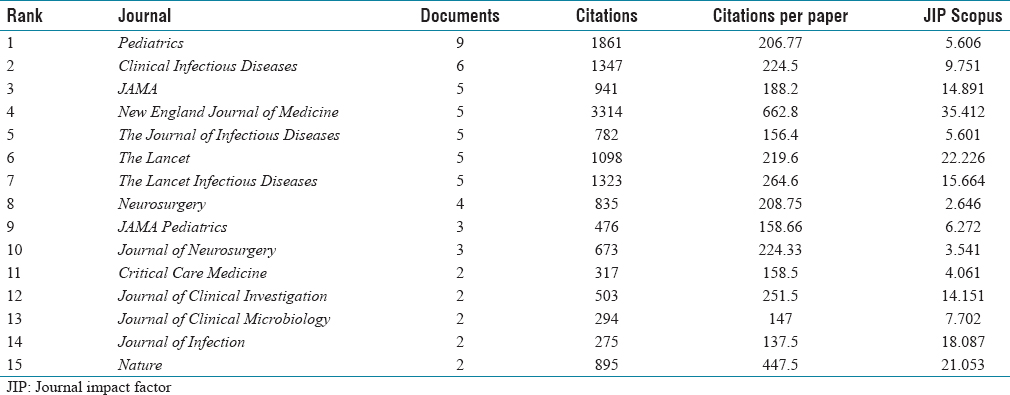
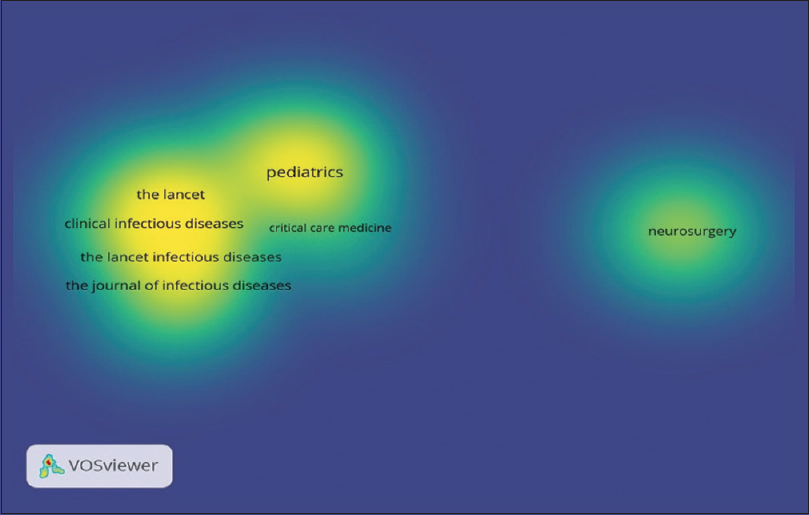
Fifty-five journals published the top 100 cited articles. The journals that had no less than two publications are recorded in Table 5 and Figure 4. Pediatrics had the highest publication (n = 9) with 1861 citations, a citation per paper of 206.77, and Clinical Infectious Diseases had the (n = 6) publication with 1347 citations, a citation per paper of 224.5. JAMA, the New England Journal of Medicine, The Journal of Infectious Diseases, The Lancet, and The Lancet Infectious Diseases had the publication (n = 5) with 941, 3314, 782, 1098, and 1323 citations and 188.2, 662.8, 156.4, 219.6, and 264.6 citations per paper individually.
The top journals with at least two publications
Top journals’ network visualization in the 100 top-cited papers on bacterial meningitis
Countries with at least two publications
The selected top 100 cited papers were published across 143 countries or regions [Table 6]. Among them, the United States had the highest contribution of 46 papers with 9878 citations, averaging 214.739 citations per paper, followed by The Netherlands 18 papers with 4009 citations, averaging 222.722 citations per paper, followed by the UK 13 papers with 3411 citations, averaging 262.384 citations per paper and Germany were 11 papers with 2547 citations, averaging 231.545 citations per paper. The other countries contributed to less than six publications. The network overlay visualizations of the co-authorship of countries are shown in Figure 5.
Countries with at least two publications

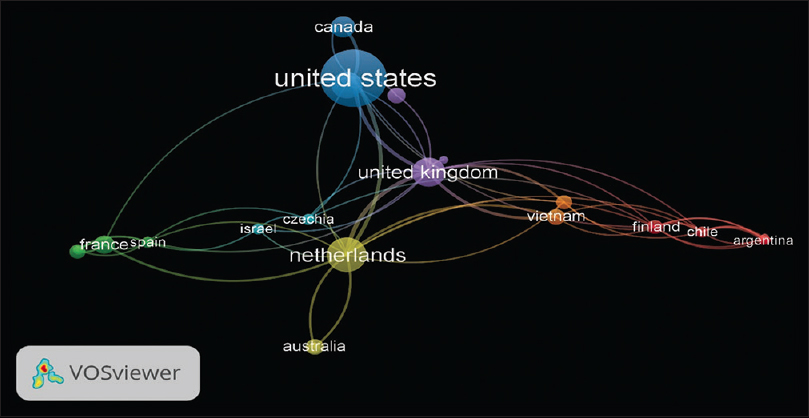
Network visualization map of country analysis
DISCUSSION
The present bibliometrics approach of citation investigation gave us a chance to recover the most referred articles on bacterial meningitis.[9] Significant literature was retrieved from the Dimensions AI database. The pursuit technique brought about an all-out 4431 paper report. After conclusions of the period of time 2000–2023, the results show 2986 articles. In the end, 100 linked works were found, with the most-cited papers being acquired. This bibliometric analysis focused on the 100 most cited articles related to bacterial meningitis.VOSviewer software was utilized to break down and visualize the articles on bacterial meningitis. The accompanying data were separated and dissected for the included papers: article title, distribution type, distribution year, reference recurrence, country, establishments, writer, diary, and watchwords. This bibliometric investigation of the main 100 most-referred papers on bacterial meningitis permitted a quantitative and subjective examination of this exceptionally encouraging exploration field, uncovering a net of coordinated effort and the significance of this point in meningitis.[10]
The main 100 articles were composed somewhere in the range of 2000 and 2023. Table 2 shows the quantity of articles distributed yearly as well as the general number of articles distributed during this 24-year time frame. The year 2008 had the most T100 papers distributed (n = 14), trailed by 2000 and 2007 (n = 10). Figure 1 portrays the quantity of papers distributed every year. The absolute number of references ran somewhere in the range of 115 and 1176 and 42 articles got in excess of 200 references. Averaging 229.32 citations per paper, the top 100 most-cited papers have received 22,932 citations. There were 27 publications with citations between 115 and 150, 32 between 15 and 297, 27 between 208 and 300, 8 between 305 and 390, and 6 between 441 and 176. The article “Clinical Features and Prognostic Factors in Adults with Bacterial Meningitis” by Diederik van de Beek et al., published in the “New England Journal of Medicine” in 2004, received 1176 citations. This record was cited multiple times.
The top 13 institutions generally delivered somewhere around four distributions, as per the number of papers cited in the main 100 [Table 3]. The Academic Medical Center in The Netherlands topped the list (n = 15) with 3554 references and an average of 236.93 citations per paper. Harvard University in the United States (n = 8) and the University of California, Davis in the United States (n = 7) came in second and third, respectively, with 1417 and 1286 references, respectively, and an average of 177.12 and 183.71 citations per paper, respectively [Figures 3 and 4].
The quantity of 750 writers partook in the main 100 articles on bacterial meningitis, and writers with something like three articles are displayed in Table 4 and Figure 5. The writer with the most articles is Diederik van de Beek of the Medical Center Academic of The Netherlands, whose name showed up in 14 of the main 100 articles with 4321 citations, an average of 308.64 citations per paper. The second most appropriated creator by Jan De Gans[8] is from a similar establishment, 7 things altogether with 3049 citations, with 435.57 citations per paper.
Journals with somewhere around two articles are displayed in Table 5. Pediatrics had the most publications (n = 9) with 1861 citations and a citation per paper of 206.77, followed by Clinical Infectious Diseases with 1347 citations and a citation per paper of 224.5. The publication (n = 5) was in JAMA, the New England Journal of Medicine, The Journal of Infectious Diseases, The Lancet, and The Lancet Infectious Diseases, with 941, 3314, 782, 1098, and 1323 citations and 188.2, 662.8, 156.4, 219.6, and 264.6 citations each paper individually. The impact Factor (IF) is used to determine the importance of a journal. IF is calculated as the average number of citations per year for articles recently published in this publication. Journals in the same subject area are often compared using this method. The higher the impact Factor, the higher the journal’s rating. The study found that the New England Journal of Medicine had the highest impact factor at 35.412, followed by The Lancet with an impact factor of 22.226.[11-15]
The main limitation of this study is that the papers were published between 2000 and 2023. We chose to use data from the Dimensions AI database, which is a freely accessible database compared to other databases such as WoS and Scopus Access via subscription access is required.[16-19]
CONCLUSION
Meningitis continues to be a significant public health issue worldwide. Bacterial meningitis has been extensively researched in various medical fields, and it is crucial to encourage further research to make a positive impact on public health. Our review utilizes bibliometrics and perception examination of the main articles in the field of bacterial meningitis exploration to show the present status of examination around here, give a past filled with research drifts. This examination included a bibliometric investigation of the 100 most-cited papers on bacterial meningitis, using different bibliometric and reference measurements. The quantity of citations went from 115 to 1176, with 42 papers getting in excess of 200 citations. The top-cited paper was “Clinical Features and Prognostic Factors in Adults with Bacterial Meningitis” by van de Beek Diederik et al. (2004). The writer with the most distributed articles was Diederik van de Beek from the Academic Medical Center in The Netherlands. The Academic Medical Center in The Netherlands topped the list (n = 15) with 3554 references and an average of 236.93 citations per paper. The Journal of Pediatrics distributed most of the T100 papers.
Hundred top-cited papers on bacterial meningitis according to their ranks
Supplemental Material
Supplemental material for this article is available online.
Footnotes
Conflicts of interest
There are no conflicts of interest.
Funding
Nil.
Author’s contribution
The author was involved in manuscript design, article drafting, and critical revision of the paper and final approval of the version to be published.