






Abstract
Incidence of gastrointestinal malignancy is gradually increasing. The aim of the study is to investigate age, sex and relative frequencies of various gastrointestinal malignancies diagnosed between January 2007 and December 2014 in the University of Uyo Teaching Hospital, and in a Private Specialist Laboratory, Uyo, Akwa Ibom State, Nigeria. All histological-diagnosed cases of gastrointestinal malignancies seen during the study period were recruited noting their bio-data and histopathological characteristics. A total of 67 patients aged 6-77 years (mean 58.0, SD 7.4) were enrolled; a male to female ratio of 1.3:1 was recorded. The most common age group and anatomical site affected with gastrointestinal malignancy were 61-70 years (23 cases, 34.3%) and colo-rectum cancers (36 cases, 53.7%). The small intestine and stomach were second and third leading anatomic sites involved in gastrointestinal malignancies, accounting for 13 (19.4%) and 8 (11.9%) cases respectively. Adenocarcinoma accounted for the majority of gastrointestinal malignancies (57 cases, 85.1%). Lymphoma and carcinoid tumor were also common, accounting for 3 (4.5%) cases each. Colorectal carcinoma was the most common type of gastrointestinal malignancies (53.7%) with adenocarcinoma being the predominant histological subtype of gastrointestinal malignancies.
Introduction
Cancer can affect any organ in humans. 1 The gastrointestinal (GI) tract along with its accessory glands is not spared by various cancers. 1 In fact, cancer is a major public health concern in the world which continues to pose serious burden on the patients and their family owing to its associated undesirable mortality and morbidity.2–7 Gastrointestinal malignancy is not uncommon in our environment and its incidence varies from region to region.1,3,6,8–11
Although risk factors vary with various types of GI malignancy, genetic abnormalities, familial polyposis syndromes, obesity, alcohol, cigarette smoking, dietary factors and infections including human papilloma virus (HPV), hepatitis B virus (HBV), hepatitis C virus (HCV) and Helicobacter pylori have been widely implicated in their aetiopathogenesis.1,4,6–8,10
The pattern of primary GI cancer differs in different regions of the world depending upon the genetic, cultural, dietary and socioeconomic factors.1,4,6–8,10 Malignancies of the colo-rectum, stomach, esophagus, anal canal, pancreas and liver have been reported in various proportions by many studies while gastric cancer was the leading gastrointestinal malignancy in Iran and Togo.1,2,5,6,8,9,11Also, it has been reported that GI malignancies are notorious for frequently progressing to advanced stages even in the absence of serious symptoms, thus leading to delayed diagnoses and dismal prognoses. 1 Thus, secondary prevention of GI malignancies through early detection and treatment of cancer-precursor/premalignant lesions had been advocated. 1 This study is aimed at determining the age, sex, relative frequencies of various gastrointestinal malignancies diagnosed in Uyo city of Niger-Delta region of Nigeria.
Materials and Methods
We conducted a retrospective study using the data base of 67 patients of primary gastrointestinal malignancy diagnosed in the Department of Histopathology, University of Uyo Teaching Hospital, and a Private Specialist Laboratory, Uyo City of Niger Delta Region of Nigeria from January 2007 to December 2014. The diagnosis was confirmed pathologically after the histopathological examination of either the resected specimens or the endoscopic biopsy specimens. All the patients with confirmed primary gastrointestinal malignancy were included in the study. Demographic and histopathologic data were retrieved from the case files, and histopathologic request forms.
Slides and paraffin-embedded blocks of the pathological specimens of the gastrointestinal tissues were retrieved from the archive of the department and private specialist laboratory; where necessary, new sections were cut from the paraffin-embedded blocks and processed with hematoxylin and eosin stains. The slides were microscopically reviewed to confirm the diagnosis.
Descriptive statistics were used for analyzing the data using SPSS version 19 (Chicago, IL, USA) and results were presented below.
Results
A total of 966 cases of malignancies were recorded during years under study with GI malignancies accounting for 6.9% of these cases; representing an average annual frequency of 8.4 cases. A total of 67 patients of age range 6-77 years with a mean of 58.0 years (SD 7.4) and a male to female ratio of 1.3:1 were seen. The most common age group affected in gastrointestinal malignancies was 61-70 years (23 cases, 34.3%) while patients within the 71-80 years age group are the second most commonly affected (14 cases, 20.9%). Fifty-four (80.6%) of the patients were aged above 40 years while 13 (19.4%) were aged below 40 years (Table 1).
Age distribution of patients with gastrointestinal malignancies.
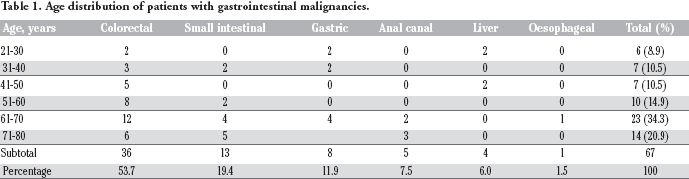
The majority of GI malignancies were found in colo-rectum (36 cases, 53.7%). The small intestine and stomach were second and third leading anatomic sites involved in gastrointestinal malignancies, accounting for 13 (19.4%) and 8 (11.9%) cases respectively. The other anatomic sites affected in GI malignancies were anal canal, liver and oesophagus in 5 (7.5%), 4 (6.0%) and 1 (1.5%) cases respectively (Table 2).
Age distribution of histologic subtype of gastrointestinal malignancies.
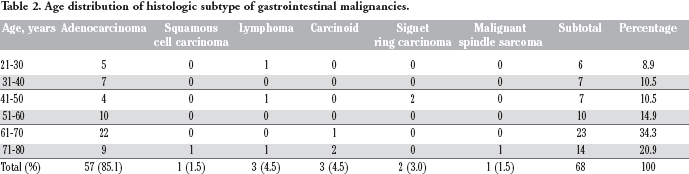
Colorectal carcinoma (CRC) was found to be the most common gastrointestinal malignancy in our study accounting for 53.7% of cases with a mean age of 57.4 years and a male to female ratio of 1.3:1. Majority of patients with CRC are older than 40 years (86.1%).
Adenocarcinoma accounted for the majority of gastrointestinal malignancies (57 cases, 85.1%) with over half of these patients being males within the 51-80 years age group. Lymphoma and carcinoid tumor were also common histologic subtypes, accounting for 3 (4.5%) cases each. Signet ring carcinoma was also seen in 2 (3.0%) cases while squamous cell carcinoma and malignant spindle sarcoma contributed 1 (1.5%) case each (Table 2).
Discussion and Conclusions
Cancer continues to pose serious burden on the patients and their relations owing to its associated undesirable mortality and morbidity.2–7 Gastrointestinal malignancy is not uncommon in our environment and its incidence varies from region to region.1,3,6,8–11 In our study, gastrointestinal malignancy accounted for 6.9% of all cancers diagnosed which is slightly higher than 6.6% reported in Jos, Nigeria, but lower than 12.9% in Benin, Nigeria, 20.0% in Europe and 29.3% in Saudi Arabia. 3 Studies in Togo and Saudi Arabia reported average annual frequencies of GI malignancy to be 27.0 and 50.0 cases respectively; these figures are however higher than 8.4 cases per year recorded in our study. 11 Although low incidence of GI malignancy was recorded in our study, however, studies by Mohamad Amin and Mosavi-Jarrahi et al. in Iran supported other contrast views with high incidence of GI malignancy in their series.3,5
Peculiarities of our findings could be adduced to under-estimation following missing biopsy reports or gross specimens, failure of patients to seek medical intervention in well equipped hospitals with highly skillful medical experts, non-availability of investigative endoscopic equipment including colonoscopy and absence of well structured screening programs for GI malignancies including fecal occult blood test. 11 Another factor that may contribute to the low incidence of GI malignancy in Uyo city is high intake of high fiber diets by the citizenry including different types of local vegetables and fruits which have been known to be protective against GI malignancies. On the other hand, higher incidence of GI malignancies reported in other parts of the world including Togo, Saudi Arabia and Europe have been linked to diverse etiopathogenic variables prevailing in these regions.3,10 These could be ascribed to rapid economic development, improved awareness of GI malignancy, and the westernization of lifestyle including smoking, alcoholism, low fiber diets as well as other risk factors including obesity, high prevalence of Helicobacter pylori, HBV and HCV.3,10
This study also showed that gastrointestinal malignancies affected more males than females by a ratio of 1.3:1 with a mean age of 58.0 years. This finding conforms to a male preponderance reported in most studies with a male to female ratio ranging from 1.35:1 to 2.24:1.1,5,8,11 In contrast to most studies, Zahra et al. in Iran reported a female preponderance for GI malignances with a male to female ratio of 1:1.73. 10 The mean age of our patients at the time of diagnosis was comparable to that reported for Saudi Arabians (ranged from 58±16 years to 60±16 years), 1 but higher than the 48.9 years and 51.7 years reported in South Western Nigeria and Togo respectively. 11 In our study, majority of patients with gastrointestinal malignancies were aged above 40 years (80.6%) while the rest were aged below 40 years (19.4% which concurs with a study conducted in Saudi Arabia, Sudan and Pakistan. 1 In this series, the peak of onset for most of the gastrointestinal malignancies was between 61 and 70 years which agree with the findings of two studies conducted in South Western Nigeria and Sudan. 1 This finding is further buttressed by a study conducted in Boston, USA where more than two thirds of gastrointestinal cancers occur in persons aged 65 years and above. On the contrary, studies in Ibadan, Sudan, Surat and India recorded more cases of GI malignancies in relatively younger population with the peak age incidence in the 41-50 years age group.1,8 From the foregoing, it is obvious that the male patients aged above 40 years are commonly affected in gastrointestinal malignancies. This interesting pattern may be a coincidental finding or probably related to the cultural and social behavior of some adult males with regard to engagement in certain risk factors associated with gastrointestinal malignancies including cigarette smoking, alcoholism and unsterilizing barbering with resultant HBV and HCV infections.
Colorectal carcinoma (CRC) was found to be the most common gastrointestinal malignancy in our study accounting for 53.7% of cases with a mean age of 57.4 years and a male to female ratio of 1.3:1. Majority of patients with CRC are older than 40 years (86.1%). The small intestine and gastric malignancies were the second (19.4%) and third (11.9%) leading gastrointestinal malignancies respectively. Similarly, CRC was also the most common gastrointestinal malignancy reported in most studies.5,6,9 This finding is in sharp contrast to the findings from studies conducted in Asia and Ibadan, South Western Nigeria where primary liver cancer was the most common gastrointestinal malignancy with frequencies ranging from 29.0% to 34.0% while gastric and colorectal cancers were the second and third leading types of gastrointestinal malignancies respectively. 2 In variance to most studies, pancreatic cancer and esophageal carcinoma were the most common gastrointestinal malignancy in Sudan, and India respectively,1,8 while gastric cancer was the leading gastrointestinal malignancy in Iran and Togo. 11
Although predominant anatomical types of gastrointestinal malignancy varies from region to region. CRC appears to be the commonest gastrointestinal malignancy globally.5,6,9 Recent studies have shown gradual increase in trend of CRC in Africa including our study; these findings could be explained by the facts that some African citizens have adopted the westernized life style including ingestion of low fiber and high fat diets, and cigarette smoking. Comparatively, higher incidence of CRC was reported in regions other than Africa.5,6,9 From the foregoing, the observed geographic difference of gastrointestinal malignancy could be explained by the prevailing predisposing factors including increasing age, genetic and environmental disposition, changing behaviors including dietary habit, life style as well as availability of diagnostic and therapeutic medical facilities, improved public education and availability of screening programs.1,4,6–8,10
Adenocarcinoma was ranked the most common histologic subtype of GI malignancy (85.1%) in our study; higher and nearly equal frequencies have been reported from West Africa, Asia, and Europe.9,11 These findings are consistent with the histogenesis of gastrointestinal tract, most of which are glandular tissues. Carcinoid tumor, lymphoma, squamous cell carcinoma, spindle cell sarcoma were other histologic subtypes of gastrointestinal malignancy seen in this study; these are comparable with other studies, though reported in varying proportions.9,11
Thus, active campaign on reducing the incidence of GI malignancies including CRC by governmental agencies, non-governmental organization (NGO) and various medical associations has shown a positive influence on the patients including early presentation of patients with rectal bleeding and features of intestinal obstruction to the hospital for treatment. In addition, it is imperative for the government to institute a well structured screening program for gastrointestinal malignancies including serology for HBV, HCV, and H. pylori, colonoscopy, as well as fecal occult blood test.
Footnotes
Acknowledgements
The authors appreciate the supports from the management and staff of University of Uyo Teaching Hospital, Uyo, Akwa-Ibom state, Nigeria in ensuring the success of the manuscript.