






Abstract
Background
Parkinson's disease (PD), which occurs in 1% of the population, is the second most common neurodegenerative disorder. Despite the broad spectrum of PD manifestations and high disease prevalence, there are insufficient data on medicine utilization and prescription strategies. The purpose of the current study was to analyze published data concerning treatment approaches and to compare them with Bulgarian therapeutic practice.
Design and methods
We conducted a systematic review of the PubMed and Google Scholar databases, and we calculated medicine utilization in Bulgaria during 2018 and 2019 using the WHO methodology.
Results
The literature search identified a total of 311 publications, but only 12 met the inclusion criteria. Eleven studies pointed out that levodopa-containing medicine are the most frequently used, followed by dopamine agonists. The highest rate was found for levodopa-containing products and decarboxylase inhibitor (1.06 and 1.33 DDD/1000 inh/day), followed by anticholinergic Biperiden (0.494 and 0.455 DDD/1000 inh/day) during 2018 and 2019 in Bulgaria.
Conclusion
Overall, the treatment approaches used in the last decade comply with guideline recommendations, despite variations in levodopa and dopamine agonist utilization. Even though new medicines have been approved for PD management, levodopa- containing products are still most often prescribed and used worldwide.
Significance for public health
Parkinson's disease is the second most common neurodegenerative disorder affecting high number of the population. The achieved clinical results and disease control depending on early patients’ diagnostic and treatment. This study emphasizes on medicines utilization and most often used treatment approaches on Parkinson's disease management. In addition, this is the first study exploring medicines utilization in Bulgaria. The findings reveal real medicines utilization in Bulgaria during 2018-2019 and its comparison with those found in the other countries. Regardless development of new therapies, levodopa-containing products reveals the highest rate of utilization as in most of the compared countries as in Bulgaria
Introduction
Parkinson's disease (PD) is the second most common neurodegenerative disorder. About 6.1 million individuals suffered from Parkinson's disease in 2016; in 1990, it was 2.5 million. 1 Parkinson's disease is one of the most common diseases in the population after 60 years of age and affects men more often than women. 2
The cause of PD remains unknown. It could be a result of the interaction between genetic and environmental factors that act upon fundamental cellular processes. There are no treatments that slow the degeneration. 3 PD has been explained as a paradigmatic movement disorder determined by the presence of bradykinesia plus at least one additional motor function disorder during rest, tremor, rigidity, and impaired postural reflexes. 4 Neuropathological diagnosis requires dopaminergic neuron loss in the substantia nigra (SN), leading to more than 80% deficiency of striatal DA. 5 Clinical PD manifestations include asymmetric resting tremor, rigidity, bradykinesia, and non-motor symptoms (NMS), which include autonomic dysfunction, sleep disorders, and sensory and neuropsychiatric features. Despite a lack of cure for Parkinson's disease, a large number of medicines are available for the management of motor and nonmotor symptoms. 6 Novel drugs should cover dopaminergic neuroprotection to reduce neurodegeneration and improve dopaminergic neurotransmission. 7
The study identified 145 registered and ongoing clinical trials for therapeutics targeting PD, with 57 trials focused on long-term disease-modifying therapies, and the remaining 88 trials focused on therapies for symptomatic relief. 8 A large number of therapies are currently being tested in clinical trials, including new approaches depending on disease cause, complications, or level of hepatotoxicity and antihypoxic activity of new molecules.9-11
Despite the high disease prevalence, there are limited data regarding medicine utilization and prescription strategies in Bulgaria. There are 15,150 PD patients receiving medication therapy in the country; however, its cost is 20th out of total reimbursed expenditures 12 . This fact prompted our interest to examine medicine utilization in Bulgaria and to compare the results with those found in other countries.
Design and Methods
Study design
Systematic review of literature data
A retrospective search of available published data on medicine utilization and prescribed treatment regimens was conducted. The data on the most often prescribed or used medicines for the treatment of PD have been compared. A prisma flow diagram for the literature search was used to present complete information regarding study identification and selection. The systematic review aimed to collect evidence on all studies presenting the utilization patterns of anti-Parkinson medication.
Utilization of PD medicines in Bulgaria
The medicine utilization for Bulgaria has been calculated retrospectively using the WHO methodology to establish the trend of utilization and settled prescription patterns in PD management.
A total of nine international nonproprietary name (INN) monoproducts and combinations (ATC code N04) reimbursed in Bulgaria and included in the Positive Drug List (PDL) were observed from January 2018 to December 2019. The medicine utilization in DDD/1000 inh/day is calculated according to WHO formulas used for defined daily dose (DDD) calculation based on annual sales data per INN within a country: 13

Data collection and analysis
Systematic review of literature data
The first part of the study was a systematic review of published studies in the PubMed and Google Scholar databases. The used key words are “utilization of anti-Parkinson drugs” or “prescribing pattern in Parkinson disease” or “prescribing trend in Parkinson disease”. The search encompassed a 10-year period from 2010 to 2020. To be considered for this review, studies had to meet the following inclusion criteria: i) Clinical Trial, Meta-Analysis, Randomized Controlled Trial, Review, or Systematic Review concerning humans; ii) provide data for prescribing or utilization of medicines for PD, even if the abstract is published in English. There were no restrictions with regard to disease stage or patient characteristics. Despite the different approaches used in the observed studies, the main inclusion criteria require both data on prescribing or utilization and the range of medicines used in management of PD. Studies exploring complications of treatment, comorbidity, and disease epidemiology were excluded.
Utilization of PD medicines in Bulgaria
Sales data were collected from the National Health Insurance Fund (NHIF) database. 12 Available data are used for calculation of utilization only of reimbursed-by-NHIF medicines, which does not cover the overall antiparkinsonian medicine market. DDD of the observed medicines was extracted from the World Health Organization database. 14 The number of inhabitants in Bulgaria was selected from National Statistical Institute (NSI) database, which showed the population in 2018 to be 7,000,039.00 people, whereas in 2019 it is 6,951,482. 15 Medicine utilization for each individual INN was calculated in DDD/1000 inhabitants/day, revealing the most frequently used medicines for PD in Bulgaria during 2018 and 2019.
Results
Systematic review of published data about medicines utilization and prescription
A literature search identified 311 publications screened for eligibility. After title and abstract screening, 92 articles were left for full-text screening. When abstracts concerning disease epidemiology, treatment recommendations, and management of complications were excluded, we found 22 studies concerning medicine prescription and utilization. Finally, we identified only 12 studies that met the inclusion criteria,in which the real data on trends of prescription and consumption were published. A flow diagram of the literature search is presented in Figure 1. The published data providing information on medicine utilization or prescribing trends are summarized in Table 1.

Prisma flow diagram of the literature search and process of study selection, adapted from the PRISMA statement.19
Publications concerning measuring or comparing of medicine utilization/prescription in Parkinson's disease.

There are limited data regarding drug utilization and its measurement. Overall, 12 studies explored prescribing trends and the utilization of medicines in Parkinson's disease management. The diversity of the published data and methodologies in the included studies did not allow comparison of prescription or utilization of all groups of medicines used for PD therapy. In total, nine studies observed the trend by measuring medicines prescribed, whereas three studies were based on the WHO methodology for calculation of DDD/1000 inh/day. This fact makes comparison difficult, and only the final trend considering medicine rating could be compared.
Eleven studies pointed out that levodopa-containing medicines are the most frequently prescribed or used, followed by dopamine agonists. Studies measuring the prescription of levodopa-containing products reveal that it covers the highest market share of the anti-Parkinson medicine market.
The percentage of prescriptions varies between 19.7% (as levodopa is the third most prescribed medicine in Japan) and 94%, as found in Germany.
Utilization of medicines for treatment of PD in Bulgaria
Medicines for the management of PD are reimbursed for both inpatient and outpatient treatment in Bulgaria. The reimbursed value paid by NHIF for hospital treatment is 100%, whereas for ambulatory treatment, medicines are reimbursed at either 75% or 100% (except for rasagiline, which is reimbursed at 25%), which supposes that they are affordable for patients. According to the mechanism of action, the reimbursed products are divided into the following groups: dopa and dopa derivatives, dopamineagonists, anticholinergics (tertiaryamines, ethers, chemically related to antihistamines, ethers of tropicortropin derivatives), MAO-B inhibitors, amantidine derivatives, and drugs with other mechanisms of action.
A review of utilization calculated in DDD/1000 inh/day shows the highest rate of utilization of products containing levodopa and decarboxylase inhibitors and triple levodopa-containing combinations (1.06 and 1.33 DDD/1000 inh/day) in Bulgaria, followed by anticholinergic Biperiden (0.494 and 0.455 DDD/1000 inh/day) and MAO-B inhibitor selegiline (0.462 and 0.357 DDD/1000 inh/day) during 2018 and 2019.
The utilization of the newer product rasagaline is still low, despite a slight increase in 2019. It is higher than the utilization of older and well-established products such as apomorphine and similar to that of pramipexole (Figure 3).
Discussion
A report in Italy revealed that benserazide and levodopa (0.7-0.8), as well as carbidopa and levodopa (0.7-0.9) DDD/1000 inh/ day, followed by pramipexole (0.1-0.4) and biperidene (0.4-0.5), were the most prescribed medicines between 2000 and 2008. 29 Similar results were published by the Finnish Medicines Agency, revealing the highest utilization rates for levodopa and decarboxylase inhibitor (between 1.58-1.56 DDD/1000 inh/ day during 2016 and 2018), and levodopa, decarboxylase inhibitor, and COMT inhibitor (0.70-0.72 DDD/1000 inh/day) during 2016–2018. 30
According to the European Physiotherapy Guideline for PD, symptomatic relief recommendations are based mainly on the utilization of the dopamine precursor levodopa and dopamine agonists. Levodopa treatment results in rigidity, tremor, and bradykinesia. In addition to levodopa, dopamine agonists are prescribed for other complications, such as restless legs syndrome, sleep fragmentation, and akinesia or dystonia. Over the past decade, treatment strategieshave revealed that initial therapy with an agonist is well-tolerated, and levodopa could be added later if symptoms worsened. Dopamine agonists are prescribed in the early stages of the disease, preferably in young people who are more prone to developing motor complications later. MAO-B inhibitors are used in the early disease stage or as an adjuvant to levodopa for motor complication control. Relief of motor complications could be achieved after increasing the dose of levodopa,use of COMT or MAO-B inhibitors, addition of apomorphine (to reduce the duration and frequency of unpredictable off-states) and amantadine, and intraduodenal levodopa (for unpredictable motor complications). Once the disease has progressed, deep-brain stimulation using a pacemaker is useful, which mimics the effect of the lesion without destroying brain tissue. 31
The National Institute for Health and Care Excellence (NICE) guidelines of the United Kingdom suggest that initial treatment of early motor symptoms should include levodopa, dopamine agonists, or MAO-B inhibitors for people in the early stages of Parkinson's disease whose motor symptoms do not affect their quality of life. The treatment regimen should be based on levodopa if a patient's quality of life is affected. The addition of dopamine agonists, MAO-B inhibitors, or catechol-O-methyl transferase (COMT) inhibitors as adjuncts to levodopa is recommended for people with Parkinson's disease who have developed dyskinesia or motor fluctuations despite optimal levodopa therapy. When symptoms are not adequately controlled by medical therapy for patients with advanced Parkinson's disease, deep-brain stimulation is recommended. 32
A Japanese study investigated adherence to the 2011 Japanese guidelines 33 for the treatment of Parkinson's disease (PD) in reallife practice. The results revealed that the highest number of patients (49.6%) received levodopa (L-dopa) monotherapy, followed by non-ergot dopamine agonists (DA) prescribed as monotherapy (8.3%) or levodopa (8.1%). Inconsistent with the guidelines, levodopa monotherapy was the most prescribed drug in patients between 51 and 69 years of age. The prescription of levodopa monotherapy and non-ergot DA monotherapy decreased in the span of 4 years, whereas those of combination therapy including levodopa and non-ergot DA increased. Nearly 75% of patients started initial treatment within 13 days of diagnosis. Levodopa monotherapy is the most frequently prescribed medicine for the treatment of patients older than 70 years, consistent with the guidelines. The article concluded that PD treatment in Japan followed most of the recommendations in the 2011 national guidelines.
The treatment of Parkinson's disease in Bulgaria is performed by specialized neurological commissions according to the National Consensus for Diagnosis and Treatment of PD adopted and updated by the Bulgarian Society of Neurology at the end of 2018. Therapeutic approaches are similar to those of other countries and depend on the severity and progression of the disease. Prescription of levodopa-containing medicines at minimal effective doses is recommended in the advanced stages of disease. If motor and nonmotor complications appear, combination therapy is preferred, whereas in the final disease stages, deep-brain stimulation or levodopa/ carbidopa intestinal gel pump therapy, both paid by public funds in Bulgaria, may be used. 34
The utilization of anti-Parkinson medicines in Bulgaria is similar to that found in other countries. The results reveal that the utilization of levodopa-containing medicines in the country was the highest in both 2018 and 2019. This is almost twice as highas that of biperiden. On the other hand, dopamine agonists are the secondmost prescribed medicines in most studies. However, their consumption in Bulgaria is lower than that in other countries. The study also found that rasagaline utilization remains very low, significantly lower than that of selegiline (0.224 vs 0.462 DDD/1000 inh/day). This could be a result of differences in prices, despite similar clinical characteristics. Another study in Italy also found that higher rasagiline utilization leads to an increase in both overall treatment costs and PD-related costs. 35

Percentage of levodopa prescription from overall antiparkinson medicine market.
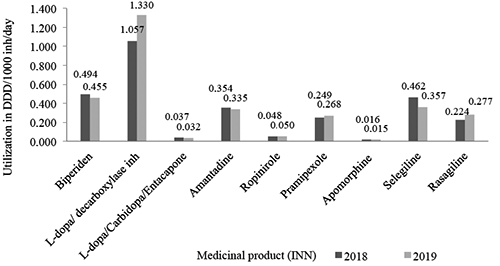
Antiparkinson medicine utilization in DDD/1000 inh/day during 2018 and 2019.
The main guideline recommendations include approaches based on dopamine agonist utilization, preferably for younger patients and those with relatively mild symptoms. The established high rate of prescription and utilization of dopamine agonists suggests that they are a preferable choice for patients as initial treatment if the disease has not progressed yet.
Limited knowledge about the mechanisms of neurodegeneration in PD and the heterogeneity of the pathology are the main challenges in the field of neurology. New diagnostic methods, gene therapy, 36 non-dopaminergic strategy for neuroprotection, xanthine derivatives research,37,38 approaches for antagonism of adenosine A2A receptors, monoamine oxidase type-B inhibition (MAOB), 39,40 and deep-brain stimulation 41 are promising tools for achieving better clinical results in disease management.
To the best of our knowledge, this is the first study toinvestigate the use of medicines for the management of PD in Bulgaria and compares the results with those published in other countries. As PD is the second most common neurodegenerative disorder affecting older people, preferred treatment approaches in relation to established recommendations are crucial. This can provide data on the overall prevalence and progression of the disease, as well as a review of currently used treatment regimens.
A limitation of our study is that we used data on prescribing and utilization to define overall medicine consumption. We recognize that these are different methods, and not all prescribed medicines could be assessed as consumed. As there is limited data measuring utilization alone, we consider that our results based on prescription are relevant to evaluate the trend in medicine consumption and development of prescribing approaches.
Conclusions
The overall treatment approaches used within the last decade comply with the guideline recommendations. We found some variations in levodopa and dopamine agonist utilization from country to country. Despite the high number of new medicines approved for PD management, levodopa-containing products are still the most frequently prescribed and used medicines in Bulgarian recent years.
The limited published data exploring medicine prescribing and utilization reveal that further studies are needed to confirm this conclusion.