






Abstract
Background
Stroke is the fifth cause of death and disability, leading also to depression. However, depression in stroke patients is hardly handled optimally. The purpose of this study therefore is to determine the effectiveness of instrumental music therapy in reducing depressive symptoms in stroke patients.
Design and methods
It used a quasi-experiment pre-post design with a simple random sampling with 59 respondents. The respondents were divided into 3 groups as follows; group A (standard treatment), group B (instrumental music therapy), and group C (combined treatment).
Results
The results show that the combined treatment provided the most significant influence on reducing the level of depression (P=0.001) with a contribution of 68.6% compared to the group A which was given standard treatment (P=0.001) with a contribution of 61.7%. Instrumental music therapy had no effect (P=0.986), though it contributed most among the three interventions, specifically 82.6%.
Conclusions
The study recommended further improvement to include music as treatment options for reducing depression among stroke patients.
Significance for public health
Stroke is the most significant cause of complex disability, with at least half of all stroke patients suffering disabilities, including depression. Depression often occurs in these patients and is hardly handled optimally, therefore, it is vital to identify appropriate interventions to help them adapt to the long terms effects of the stroke. Instrumental music therapy has been shown to promote cognitive recovery and mood improvement. This study describes the effectiveness of instrumental music therapy in reducing depressive symptoms in stroke patients.
Introduction
Stroke is a neurological disorder caused by the interruption of blood flow to parts of the brain. There are two main types of stroke, ischemic and hemorrhagic stroke. In general, ischemic accounts for 83% of all stroke cases while the remaining 17% is hemorrhagic. 1 Stroke is the most significant cause of complex disability, with at least half of all stroke patients suffering disabilities. In Indonesia, the highest prevalence of stroke was recorded in Yogyakarta, Central Java (14.6%), followed by North Sulawesi area (14%). The highest prevalence of stroke based on age is ≥75 years (50.2%), while according to sex, men account for 11.0% and women 10.9%. Based on the residence, stroke patients who live in the city accounts for 12.6% more than people live in the village. 2 In UK, more than one-third of sufferers’ were dependent on others, with 1 in 5 being treated by family and friends. Also, one third (33%) of sufferers developed post-stroke depression. 3
Post Stroke Depression (PSD) is a common complication that causes disability to stroke patients due to a lack of rehabilitation therapy and a decreased quality of life. 3 As a secondary type of depression, PSD inhibits the recovery of neurological and cognitive function, and increase mortality and disability rates. It often leads to marked mental and physical pain, increasing family's and social burden. The effects of stroke are unpredictable, as it can also lead to emotional and behavioural changes in the patient, as well as family issues that are not resolved peacefully and can trigger depression.4-6
Several strategies can be used to overcome depression in stroke, both non-pharmacological and pharmacological treatment. Non-pharmacological treatment includes music therapy and supportive therapy from caregivers, or people assisting stroke patients. People involved in helping sufferers are often called as caregivers, it can be a partner, family members, or friends. Partners, children, or parents provides most of the care to help stroke patients regain their physical and psychological abilities. 1 Pharmacological treatment is associated with medication therapy for stroke patients in managing the impacts of disease.
As one of non-pharmacological therapy, neurologic music therapy (NMT) has been developed as a new model for music therapy. The NMT techniques in stroke rehabilitation are mainly used to improve motor functions, especially in gait functions and upper limb motor skills. It was investigated that there was a decrease in depressive symptoms in stroke patients who received music therapy. 7 Therapeutic interventions include listening to music in groups, body movements, and painting with music and improvising singing. 8 Existing literatures show that listening to the preferred music could promote physical and cognitive recovery of the patient, along with mood improvement, thus helping for recovery after cerebral artery stroke.9,10 In caring for stroke patients, nurses are expected to include innovations in nursing interventions, especially aiming at functional and cognitive recovery after a stroke. Depression often occurs in stroke patients, and therefore it is vital to identify appropriate interventions to help them adapt to the long terms effects of the stroke. 11
The aim of this study, therefore, is to determine the effectiveness of instrumental music therapy in reducing depressive symptoms in stroke patients.
Design and methods
This research was conducted on stroke patients with moderate and severe depression classification based on the Hamilton Depression Scale (HAMD) criteria. It was conducted on April- June 2015 at public hospital in Manado, Indonesia. The study used a quasi-experiment research with a pretest-posttest group design. A total of 59 respondents were divided into three groups as follows: 20 respondents in group A (standard treatment), 19 respondents in group B (instrumental music therapy), and 20 respondents in group C (combined treatment). In the standard treatment group, the family member who became a primary caregiver was given training, education, and counseling on the way to care for stroke patients and to meet the daily needs of the patient. In the instrumental music therapy group, the patients also listen to instrumental music for 15 minutes, then rest, and continue listening to music again for 15 minutes. The combined intervention group was a blend of standard treatment and instrumental music therapy.
The study used MP-3 and questionnaires as the main instrument of analysis. Before the intervention, the level of depression was measured and the questionnaire was repeated afterwards. Data analysis consisted of univariate analysis on descriptive statistical data for the independent variables (age, sex, duration of the attack, and functional status). The dependent variable (level of depression) was analyzed through bivariate analysis with a paired different test (Wilcoxon test) and multivariate analysis using the Ordinal Logistic Regression test.
The clinical efficacy was evaluated using the HAMD-17 scores in all groups before and after treatment. The HAMD-17 score reduction rate as follows: score reduction rate = (score before treatment □ score after treatment) / score before treatment × 100%. The interpretation criteria of HAMD-17 score: cured >75 %, excellent 51-75%, effective 25-50%, and non-effective <25%). 12
Results and discussion
Data was analyzed using univariate test, bivariate test, and multivariate test. Table 1 shows the data about the patients; it emerges that the respondents mostly aged 45-57 years (50.8%), male and female were almost the same, the duration of the attack was 1-4 days (67.8%), and functional status with a moderate level of independence was 64.4%. Older age was characterized by more complex physical and psychological conditions. In the study emerges that almost half of respondents were middle aged. However, another study stated that younger age group had worse functional outcomes compared with older patients, and 1 in 8 stroke patients still was dependent on others 10 years after the stroke. 13 Depression has adverse effects on the functional outcome of stroke patients. Yet, individuals with lesions in the right hemisphere were less likely to experience depression. This is attributed to the incidence of sub-acute PSD, though the family also helped to reduce its frequency. 14
Characteristics of respondents.

The main components while dealing with depression include patients struggling with a new phase of life, having lost their independence and utilizing available resources from family and friends to help manage the impacts of stroke. Family members of individuals who survived a stroke responded practically to receive support from health care staff, friends and relatives for their daily needs. Family caregivers need a supportive program to encourage their positive behaviour and to get overall assistance to function properly at home.15-17
Stroke patients often feel helpless and worried about their prevailing conditions. Support from family and closest people helps them to obtain information about their health and manage their daily needs. Family caregivers are the primary source of support for stroke patients and are the first people to respond to the changes in status in the disease phase. Nurses also help in several ways, including preventing complications, reducing risk factors for recurrent strokes, identifying the needs for discharge planning according to family needs, providing the information needed, and encouraging families to be more effective and helpful. However, the central role of nurses in stroke patients is to offer health education to the families, describing pharmacological and non-pharmacological treatments, such as music therapy, to reduce patients’ depression. 18
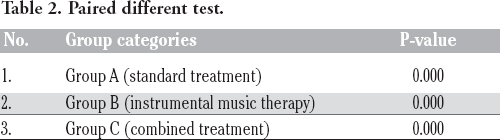
Based on Table 2, P<0.005 were obtained in all three intervention groups. This showed that statistically, there was a significant decrease in the level of depression before and after the interventions in all three groups.
Paired different test.
As can be seen in Table 3, the group that contributed the most to the dependent variable was the instrumental music therapy (82.6%). This means that simultaneous musical therapy interventions have the most significant contribution to depression rates. The results of P<0.10 were obtained in both the standard treatment and combined treatment groups. Both interventions had a significant influence on the level of depression. However, instrumental music therapy interventions alone had no statistically significant effect on depression levels. Judging from the magnitude of the estimated value obtained, standard treatment had the highest, 4.997. Statistically, the standard treatment had the most significant influence on the level of depression.
Pseudo R-square test between intervention group.

Music therapy has a positive influence on the mood of patients after stroke. Music is produced from stimuli sent from nerves and ascended to the reticular activating system (RAS) neurons. This stimulus is transmitted by specific nuclei from the thalamus through the cerebral cortex, limbic system, and corpus coliseum through the autonomic and neuroendocratic nervous system areas. The limbic system is formed by rings connected by cingulate gyrus, hippocampus, fornix, mammary bodies, hypothalamus, anterior thalamus, and olfactory bulb. When music is played, all areas related to the limbic system is stimulated to produce feelings and expressions.19-21
Music has complex effects on humans, both physiologically and spiritually. Individual responses to music are affected by personality, environment, education, and cultural factors. Music causes changes in the status of brain waves and the stress hormones of patients. There is an increase in frequency in the alpha rhythm group and a more significant (coherent) equation between different regions within the cerebral cortex, which most often occurs in the frontal lobe. Activation of the right frontal lobe decreases, reducing the secretion of cortisol and stress hormones to the normal range.22-24
The burden, anxiety, and depression of caregivers reflect the quality of life of stroke survivors. Financial issues (F=6.12, P=0.04), depression in stroke patients (F=20.8, P<0.001), and the burden of family caregivers (F=7.36, P=0.009) were significantly correlated with decreased patients’ quality of life. 25 On the other hand, other studies revealed that poverty, low educational attainment, poor health status, being a caregiver for a spouse, and longer length of stay in hospital could reduce the caregivers’ quality of life. Thus, family caregivers education programs should be more focused on enhancing health practices and behaviours for stroke survivors and caregivers too, such as developing and promoting adaptation techniques, accessing community services and support from stakeholders.26,27
Conclusions
Statistical tests show that standard treatment and the combined treatment have a significant effect on reducing the level of depression in stroke patients. However, standard treatment had the most significant effect in this study. Therefore, there is a need for primary caregivers to receive training, education, and counseling on treating stroke patients and for hospitals to provide media for listening to instrumental music during hospitalization.
Footnotes
Acknowledgments
The authors thanks to Faculty of Public Health, Universitas Airlangga for the continuous support during the study.