






Abstract
Background
Stroke patients often suffer from depression, a mental disorder that worsens their condition and slows down the recovery process. Depression is the leading cause of functional disability due to inability to cope with daily stressors and to function independently in their activities. The purpose of this study is to analyze the relationship between depression and functional disability levels in post-stroke patients.
Design and methods
This is an analytic observational research with a cross-sectional approach. The population in exam consisted of all 4-12 week post-stroke patient in the hospital (about 139 patients). The study focused on 104 respondents, who were selected using simple random sampling techniques.
Results
The results show that 62.5% stroke patients suffered mild depressive episodes after the stroke while 58.7% experienced mild disabilities. Analysis results using the Pearson Product Moment Test obtained P=0,000. This shows there is a relationship between the level of depression and the degree of functional disability in post-stroke patients.
Conclusions
It can be concluded that there is a significant relationship between the levels of post-stroke depression and the functional disability. Families are expected to provide a safe, supportive, and comfortable environment to lessen the level of depression.
Significance for public health
Post-stroke depression should be perceived as a psychological reaction to the clinical consequences caused by stroke. This condition can cause functional disability due to inability to cope with daily stressors and to function independently in activities. This study highlights the relationship between depression and functional disability levels in post-stroke patients.
Introduction
Stroke is a term used to describe neurological changes caused by interruption of blood supply to the parts of the brain. 1 Depression is the leading cause of functional disability due to inability of the patients to cope with daily stressors and to function independently in their activities. One-third of stroke patients experienced depression and a need for rehabilitation services.2,3 Poststroke depression should be perceived as a psychological reaction to the clinical consequences caused by stroke and the presence of specific lesions in the brain. This condition can cause functional disability due to inability to cope with daily stressors and to function independently in activities.4,5
Post-stroke functional disability can be influenced by several factors, including older age, lower education, severity of stroke symptoms at admission, depression, cognitive impairment at three months, and stroke recurrence within five years follow up. 3 Stroke is the major cause of disability in Indonesia. A total of 1.8% stroke patients in a public hospital, Surabaya, have psychological disabilities, while 56.1% have social disabilities, and 98 % motor disabilities. 6,7
Studies explained that post-stroke depression patients have functional disabilities that influence their daily lives. It was found that there are differences in levels of depression between stroke survivors with functional disabilities. Families and health professionals should pay more attention to help improve recovery process.8,9 Only a few studies analysed the physical and psychological consequences of stroke, such as depression and functional depression in stroke survivors. The purpose of this study is to analyze the relationship between depression and functional disability levels in post-stroke patients.
Design and Methods
This is an analytic observational research with a cross-sectional approach. The population in exam consisted of all the entire 4-12 week post-stroke patient in the hospital (about 139 patients). The study focused on 104 respondents who were selected using simple random sampling techniques. Two instruments were used in this study: (1) WHODAS (WORLD Health Organization Disability Assistance Schedule) questionnaires, used to measur disability level of stroke survivors, and (2) the PSDRS (Post Stroke Depression Rating Scale) questionnaires, which were used to measure post-stroke depression levels.10,11 Data were then analyzed by Product Moment Pearson correlation to investigate the correlation between depression and functional disability levels in post-stroke patients.
Results and Discussion
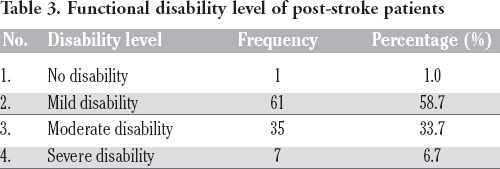
Table 1 shows the characteristics of respondents (age, gender, types of stroke, and ethnic group), Table 2 describes the levels of depression in post-stroke patients, Table 3 explains the functional disability levels, and finally Table 4 illustrates the correlation results between depression and functional disability levels in post stroke patients.
Characteristics of respondents.

Depression level of post-stroke patients.

Functional disability level of post-stroke patients
Correlation between depression and functional disability levels in post-stroke patients

Table 1 shows that almost half of stroke patients were between 45-60 years old (48.1%), more than half of respondents are male (67.3%), more than three quarters experienced an ischemic stroke (79.8%), and 71.1% of respondents are Javanese. Meanwhile, Table 2 shows that 78.1% had suffered from mild depression and 4.8% still suffered from severe depression.
Depression level was found higher in male respondents as most of them likes to spend their time on challenging activities at home. On the other hand, female respondents who experience similar disorders were often emotionally expressive than male respondents, and declared that sleeping affects their level of depression.12,13 The average patients get depressed and frustrated when thinking about the possibility of never recovering from the disease suffered.
Depression is caused by many factors, including hereditary and genetic factors, constitution, premorbid personality, physical, psychobiological, and neurological, biochemical factors, and electrolyte issues. The level of depression experienced by stroke patients is influenced by a serotonin dysfunction that causes its symptoms such as insomnia and anxiety. It is also affected by family and the closest person providing support. The results showed that respondents who were not depressed generally received support from both the environment and family. Most patients who experience moderate to severe depression do not carry out independent activities at home and outside. Further, this condition can be worsened by the absence of an adequate support system such as family, friends, mother, neighbors, and precarious economic conditions. 14-16
In addition to this, more than half of stroke patients have mild disabilities (58.7%). The level of disability experienced is related to the type of stroke patients suffered, as well as their medical history. Most of the respondents had a history of ischemic stroke. Besides being affected by the type of stroke experienced, patients who have had previous strokes know how to care and the rehabilitation process that should be carried out to avoid further complications. This is in line with Notoatmodjo, which established that someone who often experiences pain tends to pay attention to the symptoms in them and then seek help. 17
As can be seen from Table 4, the results of Pearson productmoment correlation test obtained value of P=0.000, which means that there is a correlation between the levels of depression and functional disability in post-stroke patients.
One of the factors that affect levels of functional disability of post-stroke patients is depression. This causes decreased motivation or imperfections and biological changes such as autonomic dysregulation in the transfer system, increasing disability levels. If patients receive support from the environment, they will be encouraged to think positively while dealing with the consequences of stroke. Most post-stroke patients often feel that they are not useful, that they are a burden to the family, and they think they may never recover from their illness. Most patients with moderate or severe disabilities admit that they do not do any activity at home other than sleeping and sitting on the terrace or living room. Increased levels of depression cause a decrease in patient motivation, negatively affecting the rehabilitation process and the level of disability experienced. 18-20 Families have the ability to provide emotional and psychological support to stroke patients, helping them in managing routine activities and assisting them in the recovery process.
Conclusions
It can be concluded that there is a significant relationship between the levels of post-stroke depression and the functional disability. Families are expected to provide a safe, supportive, and comfortable environment to lessen the level of depression.
Footnotes
Acknowledgments
The authors thank the teachers of the University for their friendly support.