






Abstract
Background
The relationship between nutritional status in early life and the risk of chronic diseases in the future development of the child is a critical factor that needs to be considered. The basic factors that can help in this case include thrifty phenotype hypothesis, developmental plasticity, fetal programming and weight gain regulation. This study aims to determine the average increase in weight gain before and after mentoring program.
Design and methods
The sample was taken randomly from 191 pregnant women. From number of women mentored, 106 that met the inclusion criteria. Wilcoxon Signed Ranks Test then was used in the data analysis.
Results
The results show that the average body weight of women increased 18.94%, while the BMI rose by 7.46%. Mentoring program led to an increase in maternal body weight, indicated with a P-value of 0.000.
Conclusions
In conclusion, mentoring program influences bodyweight in pregnant women. Therefore, it is vital to maintain a high nutritional status during pregnancy.
Significance for public health
Maternal weight gain during pregnancy is an important determinant of birth outcomes. Gestational weight gain is directly associated with birth weight for gestation length, a marker of fetal growth, which is directly associated with child health and non-communicable disease on the future. This paper describes the correlation between mentoring activity and weight gain during pregnancy.
Introduction
The first thousand days of life (HPK) is often referred to as a golden period since it determines the life one lives. 1 The nutritional status of women determines the outcome of pregnancy. 2 In this regard, the pre-pregnancy weight and maternal weight gain are often used to predict the outcome of the pregnancy. 3 In other words, these two aspects determine the nature of pregnancy and have long-term consequences on both the lives of mothers and babies. There are several mechanism of estimating the relationship between nutritional status in early life and the risk of chronic diseases, including the thrifty phenotype hypothesis, developmental plasticity, and fetal programming. 4
Pregnant women who gain adequate weight produce optimal maternal outcomes. This helps to prevent complications (during the pregnancy and postpartum) and maternal mortality, facilitates fetal growth and maturation. 5 Previous research show that the amount of weight gain during pregnancy is significant for mothers conceiving while in an unfavorable nutritional status. The most significant risk for giving birth to a baby with low birth weight and low birth length occurs due to a combination of low pre-pregnancy weight and weight gain. 6 During pregnancy, weight gain play an essential role in monitoring the nutritional status compared to other physical measurements such as height, weight, and BMI of pre-pregnant women 7 and upper arm circumference <23.5 cm. 6
Due to the significance of weight gain among pregnant women, the local government makes efforts to help assisting pregnant women. Weight determination during pregnancy helps to determine the right time for intervention. To obtain adequate data, it is necessary to note the pre-pregnancy weight or BMI 7 . Although this data is usually not available, the Surabaya City Health Office, East Java, Indonesia helps to obtain it. In case the data is entirely not available, it can be predicted using the approached developed by using first-trimester weight data. 8 From 2017 to 2019, mentoring was carried out for pregnant women in the certain parts of the Surabaya City. Although the program ended in April 2019, this article uses data for all women who received mentoring.
Design and methods
In early 2017, there was mentoring for pregnant women (all starting from pre-pregnancy) in certain parts in Surabaya City, East Java, Indonesia. Before mentoring started, data on height, weight, and upper arm circumference were collected for 229 women aged 20-35 years. The 229 women were followed up, and 191 were declared pregnant, though only 106 met the inclusion criteria. Individual interviews (home visits), measurements of body weight and upper arm circumference were carried out every month. The mother's height was measured once before pregnancy using a multi-function measuring instrument with a capacity of 2.0 meters and an accuracy of 0.1 cm. The weight was measured using a digital scale with a capacity of 150 kg and an accuracy of 50 grams. Maternal Body Mass Index (BMI, kg/m2) during pre-pregnancy was obtained from the bodyweight by dividing the prepregnant weight (kg) by height (meters) squared. BMI cut off points include BMI <18.5 kg/m2 - underweight; 18.5 ≤ BMI <25.0 kg/m2 - normal weight; 25.0 ≤ BMI <30.0 kg/m2 - overweight; and BMI ≥ 30.0 kg/m2- obese). 9 Statistical analysis includes a descriptive analysis of the characteristics of pregnant women and a Paired T-test to determine differences in pre-pregnancy maternal weight gain. In case the data are not normal, the Wilcoxon Signed Ranks Test was used.
Results and discussion
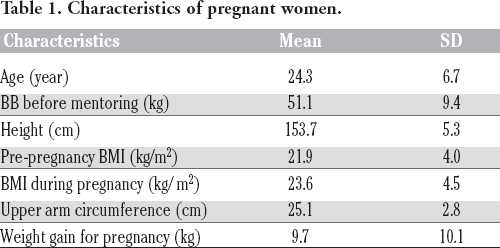
The total data analyzed are from 106 women, and their characteristics are presented in Table 1. The average age of 24 years was considered safe. The average pre-pregnancy bodyweight is 51.13 kg, with a height of 153.7 cm. The average arm circumference is 25.2 cm, and the average weight gain is 9.7 kg. Weight gain from pre-pregnancy is the most sensitive indicator for proxies and significantly influences the outcomes of the pregnancy 10 . The mean weight gain during pregnancy was 9.7 kg, higher than the previous cohort study of 9.0 kg at different study sites, though the characteristics of the population were almost the same 4 . According to IOM 2009, the recommended weight gain for mothers with normal pre-pregnancy BMI (18.5-24.9 kg/m2) is 12.5-17.5 kg, and BMI<18.5 kg/m2 of 14.0-20 kg. However, mothers with pre-pregnancy BMI 25-29 kg/m2 is 7.5 –12.5 kg; and 5.5 kg-10 for obese women (BMI> 30 kg/m2).
Characteristics of pregnant women.
Anthropometric measurements of weight gain and birthweight of pregnant women at risk include maternal height <150 cm, pre-pregnancy weight and Body Mass Index <45 and <18.5 kg/m2 respectively, risk of KEK (LiLA<23.5 cm), energy, protein, and micronutrient consumption (vitamin A, folic acid, Fe, and Zin) <100% RDA. 7
Table 2 shows that maternal body weight before and during pregnancy has increased with an average of 60.8 kg. From the statistical test, the P-value is significant. The weight gain of pregnant women on average increased, with only four individuals not recording an increase. In the 12th to 37th weeks, the pattern of weight gain follows the 2009 IOM, though lower than its recommendations as well as those of IOM 1990. The recommended weight gain according to IOM 1990 at 0-10 weeks is 0.065 kg/week, 10-20 weeks 0.335 kg/week, 20-30 weeks 0.450 kg/week, and 30-40 weeks 0.335 kg/week. Based on IOM 2009, that the average BMI of a mother is 23.6 kg/m2, and she should have gained 12.5 kg. Judging from the average pre-pregnancy weight, maternal height, and BMI, the women conceived with good nutritional status (mean pre-pregnancy weight 51.1 kg, mean maternal height 153, 7 cm, and mean pre-pregnancy BMI 21.9 kg/m2). This figure is better than previous studies in different locations (Bogor), though the characteristics are almost the same, with pre-pregnancy and maternal weight being 48.4 kg and 8.9kg respectively.11,12
Effects of mentoring on weight gain for pregnant women.

Pre-pregnancy BMI is the most significant risk factor for maternal weight gain. Although the average weight was above 45 kg, weight gain is very large in women with a deficit. This shows mothers conceiving with <45 kg do not lack adequate energy, protein, and micronutrients (over 100% RDA). The figures for Adequate consumption of energy, protein, and micronutrients (vitamin A, folic acid, Fe, and Zinc in women with <45 kg is respectively 48%, 41% and 17% (except for vitamin A around 70 %).
Although pre-pregnancy BMI has a genetic and nutritional component, a low value indicates a lack of tissue nutrient supply, may facilitate weight gain. Mothers who begin pregnancy with a low BMI need adequate energy and nutrients for appropriate weight gain during pregnancy. 13 Additionally, mentoring increases maternal weight as indicated by the P-value of 0.000.
Conclusions
In conclusion, mentoring program influences bodyweight in pregnant women. Therefore, it is vital to maintain a high nutritional status during pregnancy.
Footnotes
Acknowledgments
The authors express gratitude to the lecturers of the University for their friendly support and Mrs. Dian Sofiya, who support the study