






Abstract
Background
The high turnover rate in the healthcare industry needs serious attention since it influences hospital service quality. So, there is a need to develop a new framework known as people equity, that can be used to manage intangible assets and reduce employees’ intention to leave. The purpose of this study therefore was to develop a model of people equity as a strategy for enhancing employees’ intention to stay.
Design and methods
An analytical cross-sectional design was used to measure the associations between variables. 154 respondents were selected from stratified random sampling technique. Partial Least Squares Structural Equation Modelling (PLS-SEM) was used to analyze the measurement model.
Results
The results indicated that people equity was influenced by organizational factors (P=0.210), individual factors (P=0.183), and occupational factors (P=0.141). In addition to this, predictors for employees’ intention to stay were people equity (P=0.432), individual factors (P=0.308), and environmental factors (P=0.117). Conversely, working and marital status, environment, and workload have no significant effect on people equity and intention to stay.
Conclusions
People equity was influenced by organizational, individual, and occupational factors through the implementation of the Human Resources System. People equity model increased employees’ intention to stay by improving organizational factors.
Significance for public health
Introduction
The complex roles and functions of hospitals require a more consistent leader and competent Human Resources. Organizations that focus on managing talented employees are more likely to become business leaders in the next wave of growth. A shift in mindset from human resources to human capital is needed as an approach to measure progress and to make these intangible assets effective to provide more value and increase people equity (equity of human capital). This is a new paradigm for managing human capital.1-3 People equity improves the organization's financial and non-financial performance. Based on research by Schiemann in 70 hospitals, people equity score was strongly related to hospital turnover and financial performance. 4
Excellent performance can be disrupted by various employees’ behaviors, such as the decision to leave the workplace (turnover). This decision is usually motivated by their desire to change occupations. New institutions often provide better career opportunities to employees, increasing the intensity of turnover in the hospitals. Turnover indirectly reduces the level of productivity in a hospital and leads to other financial losses due to the the additional costs of recruiting new employees. Some managers are frustrated in learning that the recruitment process was ultimately vain because the newly recruited staff chose to work in another hospital. Studies showed that managers’ behaviors affected the productivity level of employees. Managers should make their working environment more engaging as this is the key to a better organizational performance.5-7
The annual turnover rate in the health industry was range from 28.8% to 49.6%, and nurses were accounted for the highest proportion of employees’ turnover. Based on a survey conducted by the American Organization of Nurse Executive, the national average turnover rate for Registered Nurse (RN) in 2000 was 21.3%. The national study by the Hodes Group (2005) on 138 recruiters in the health sector showed that the average turnover rate of RN was 13.9%. Also, the prevalence of nurse turnover events in the world ranged from 10% to 21% per year. 8 Despite the fact that individual factors were the causes of high turnover rates in the hospital, organizational factors should also be considered when developing the human capital. 9
In Indonesia, the data obtained from Surabaya Surgical Hospital also showed high turnover rates over the past four years, precisely 29.6%, 18.72%, 10.29%, and 9.71% from 2011 to 2014, respectively. There was an average turnover rate of around 12.22% in these years. The employee turnover rate at Muji Rahayu Private Hospital, Surabaya, from 2013 to 2015 was around 19.6%. Additionally, in the past three years, the rate of both alignment and capability were lower than that of engagement of 67%, 68%, and 74%, respectively. High employees’ engagement at the hospital occurred after the provision of rewards in the form of loans to employees during emergencies. With this loan facilitations, the employees might overcome their financial problems.
Previous studies stated that companies often ignore important things that make employees stay. These include the desire to understand the vision, mission and values and the urge to have both learning and developing opportunities, which are parts of alignment and capability.10-12 Further, a new leadership model should be developed to manage hospital employees’ intention to stay and keep turnover down. 13 The high turnover rate in the healthcare industry needs serious attention since it influences hospital service quality. So, there is a need to develop a new framework that can be used to manage intangible assets and reduce employees’ intention to leave, known as people equity. 14 The purpose of this study therefore was to develop a model of people equity as a strategy for enhancing employees’ intention to stay.
Design and methods
An analytical cross-sectional design was used to measure the associations between variables. This study examines the views of respondents in a hypothetical of equity model. In particular, it describes views with regards to hospital employees’ intention to stay. Here, the total population is stratified according to hospital units – Emergency Department, Polyclinic Outpatient, High Dependency Unit, Child Inpatient Care, Adult Inpatient Care, and Inpatient Gynaecology. 154 respondents were selected from stratified random sampling technique. Partial Least Squares Structural Equation Modelling (PLS-SEM) was used to analyze the measurement model.
Results
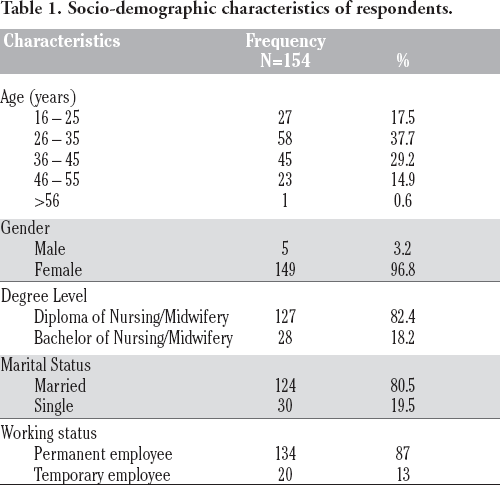
The characteristics of respondents were based on their demographic characteristics, including age, gender, degree level, marital, and working status, as shown in Table 1. The highest age of respondents were 26-35 years (37.7%), many being however above 35 years. The female were by far higher in number than males, specifically 149 (96.8%), respondents with Diploma degree were 127 (82.4%), 124 (80%) of the respondents were married, and 87% were permanent employees.
Socio-demographic characteristics of respondents.
Model Analysis with PLS (Partial Least Square)
Model analysis with PLS consists of two parts, including the evaluation of the outer and the inner models. The evaluation of the outer model is performed to determine the validity and reliability connecting indicators with latent variables, while the inner one determines the influence or causality relationship between variables in a study.
The test of the outer model in the indicators for each latent variable are presented in Table 2, which shows some invalid loading factors valued less than 0.5, including work status, marital status, workload, and other jobs opportunity. The loading factors valued less than 0.5 needs to be removed from the model.
Initial values of outer loading on the outer model of people equity in an effort to increase the intention to stay of hospitals’ employees.

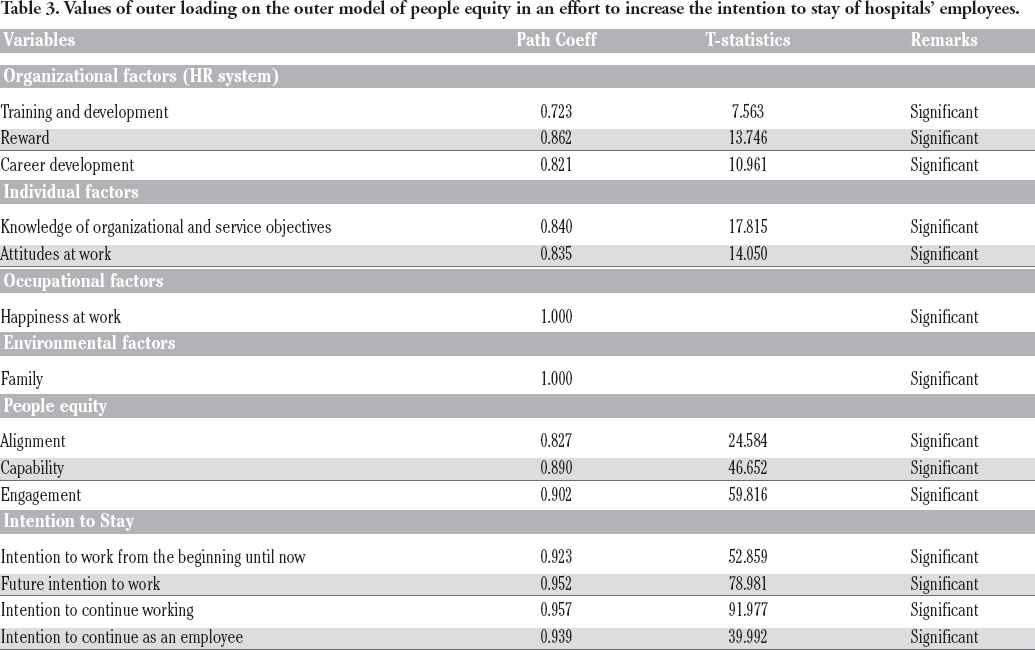
Table 3 presents a valid structural model for the values of loading factors of each question item for research variables. It shows that the loading factor of each item for all variables is more than 0.5. Therefore, they fulfilled the convergent validity.
Values of outer loading on the outer model of people equity in an effort to increase the intention to stay of hospitals’ employees.
The results of the model test of the indicators for each latent variable are presented in Table 4. Structural or inner model measurement is used to determine the relationship between variables through a bootstrapping process. Individual reflective size is said to be valid in case it has an at-statistic value greater than 1.96 (two-sided test). If the statistical significance of a variable is less than 1.96, then the variables do not affect each other. Variables which are not significant excluded from the model test, and the bootstrapping process is conducted 25 times to determine the results of the model test of the relationships between substantial variables. The complete test results of the final model are presented in Table 5. The variables have a positive and significant effect, as shown by the path coefficients marked positive with T-statistic values greater than the T-table value (T=1.96).
T-statistics values on the inner model of people equity in an effort to increase the intention to stay of hospitals’ employees.

T-statistics values on the inner model of people equity in an effort to increase the intention to stay of hospitals’ employees.

Discussion
Organizational factors
Organizational factors contribute to people equity. These factors consist of the Human Resources (HR) System, which includes training and development, reward, and career development. The results of the study indicate that these factors directly contributed to people equity. People equity consists of Alignment, Capability, and Engagement, which are parts of the HR system, it is the most critical people equity factor in managing and developing employees. The function of the HR system is to help organizations achieve their mission, objectives, and strategies.4,15
The results show that reward has the highest influence on people equity compared to training and and career development. It affects people equity because it is one of the factors that trigger engagement, which relates to satisfaction. This study is in line with previous studies which stated that compensation, career development, and work motivation have a positive and significant effect on satisfaction.16,17 A fair and decent reward system increases employee satisfaction since one of the main reasons a person works is to fulfill life needs. In order to make employees stay in an organization, they need to be supported by an effective reward system. Reward systems are strong predictors of turnover intention, thus management needs to build a good and balanced reward system, both financial and non-financial aspects.18,19A supportive training and development need to be improved so employess will gain new knowledge and skills needed in the future. Training and development focuses on changing or improving knowledge, skills, and attitudes – known as capability. Employees’ satisfaction is an indicator that affects engagement, and therefore, training and development affect people equity, including capability and engagement.20,21
Individual factors
Individual factors which influence people equity and intention to stay are knowledge of organizational and service objectives, and attitudes at work. Working and marital status do not influence people equity and intention to stay as most employees are married and have permanent status. Married employees have lower absenteeism and turnover rates, as well as higher job satisfaction compared to unmarried workers. 22 Additionally, permanent status does not affect the intention to stay because the employees have an attachment to the hospital, unlike those working on a temporary job basis. In case the work period runs out, these employees can either renew their contract if they have excellent performance or move to another hospital. This study shows that employees have high knowledge of organizational and service objectives, as well as attitudes at work, which are important for creating employee commitment. Commitment is an important behavioral dimension can be used to assess the tendency of employees to stay in the organization and willingness to strive to achieve organizational objectives. 23
Occupational factors
Occupational factors are formed by happiness at work and workload, which contributes to people equity. However, workloads do not affect people equity. Happiness at work is a new factor in this study that can affect people equity. By increasing the level of happiness, people equity in hospitals improves as well. Happiness at work has many contributions, both for organizations and individuals. Employees feel happy when they trust employers, if the people they work with make them feel comfortable. 24
Environment factors
Environmental factors contribute to the intention to stay. These factors emanated from other job opportunities and family, which affect the intention to stay. The results of the study show that job opportunity is in the moderate category, while the intention to stay is high. The findings are related to the high chances of being accepted in other hospitals, though employees feel they do not have a better alternative job. The absence of other employment alternatives facilitates the intention to leave.
Families have influence on the intention to stay due to the need for support among employees. The role of the family is vital and significantly affects individuals at work. The problem surrounding organizational commitment is associated with the absence of social and family support. Behavior and consequences in working are related to family life and the environment. The family, as the closest social sphere of an individual, has a vital role in working success. 25
People Equity and Intention to Stay
People equity, which consists of alignment, capability, and engagement has a significant influence on the intention to stay. The results showed that alignment had the lowest path coefficient value of 0.827. In case the organization has a low alignment, it cannot be detected by ordinary observers. Employees have strong involvement and attachments and the right capabilities. The organization has to create a clear line of insight for objectives and strategies to avoid wastage resources.
The element of people equity with the highest path coefficient value is engagement with 0.902. Engagement is the strongest predictor of employee turnover. Intuit, a software company, surveyed engagement and concluded that employees with high attachments had a performance of 1.3 times higher than employees lacking attachment, and were five times more likely to stay in the organization. However, self-attachment is not enough. Engagement is often affected by alignment and capability. Even when the attachment is high, low harmony and capability have negative consequences for the organization. In other words, attachment decreases over time if it is not supported by strength in the other two fields. 26
People equity model (alignment, capability, engagement) as an effort to increase intention to stay
This study shows that the people equity model increase intention to stay, as shown in Figure 1. This model focuses on improving HR systems of an organization, including training and development, reward and career development, on enhancing people equity and the intention to stay. This model was applied to private hospitals by reviewing factors according to the theory of people equity by Schiemann and intention to stay proposed by Cowden & Cumming,4,13 which covered organizational, individual, occupational, and environmental factors. The results of this study explain the new scientific findings, including (1) Adding individual and occupational factors as aspects that influence people equity; (2) Adding people equity as a variable that influences the intention to stay; (3) Organizational factors do not directly affect intention to stay, but through people equity; (4) Environmental factors affect the intention to stay.

Development of People Equity Model as an Effort to Increase Employees’ Intention to Stay.
This model finds new indicators that influence people equity, including career development, knowledge of organizational and service objectives, attitudes, and happiness at work. On the other hand, organizational factors, specifically the HR system, including training and development, reward, and career development, are factors that need detailed study since they have the greatest values. Detailed and in-depth studies related to training and development, reward, and career development help increase people equity and the employees’ intention to stay.
Conclusions
In conclusion, people equity was influenced by organizational, individual, and occupational factors through the implementation of the Human Resources System. People equity model increased employees’ intention to stay by improving organizational factors.
Footnotes
Acknowledgments
The authors thank our colleagues from Department of Health Policy and Administration, Faculty of Public Health, Universitas Airlangga who provided insight and expertise that greatly assisted the research.