




Abstract
The cardiac cavity of an isolated rat heart was filled with a Krebs-Henseleit (KH) solution, and the heart was hung in a high-pressure chamber. After the high-pressure chamber had been filled with a mixed gas (PCO = 400 hPa, PCO2 = 100 hPa, PO2 = 900 hPa, PHe = 5600 hPa) and preserved for 72 h, we performed a cervical ectopic heart transplantation on a recipient rat and resuscitated the preserved heart. This is the first incidence in the world of a mammalian organ having been successfully preserved and resuscitated after 72 h via a desiccation method.
Keywords
The following was originally published in Volume 19, Nos. 6/7, pages 707–712, 2010. Figure 2 appearing in the article was an incorrect figure. The correct figure that should have appeared is shown below.
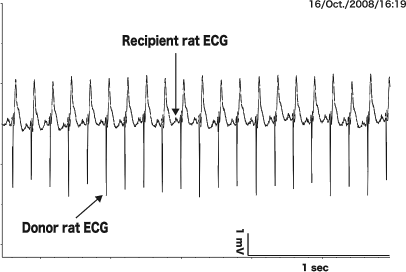
Electrocardiogram of a donor heart and a recipient heart after preserving the isolated rat heart for 72 h, performing cervical ectopic heart transplantation on October 16, 2008, and resuscitating the rat. The smaller electrical potential is the recipient rat's ECG, and the larger electrical potential is the donor rat's ECG, wherein pulsing at a constant interval can be observed in both.