




Abstract
The cardiac cavity of an isolated rat heart was filled with a Krebs-Henseleit (KH) solution, and the heart was hung in a high-pressure chamber. After the high-pressure chamber had been filled with a mixed gas (PCO = 400 hPa, PCO2 = 100 hPa, PO2 = 900 hPa, PHe = 5600 hPa) and preserved for 72 h, we performed a cervical ectopic heart transplantation on a recipient rat and resuscitated the preserved heart. This is the first incidence in the world of a mammalian organ having been successfully preserved and resuscitated after 72 h via a desiccation method.
Keywords
Introduction
Currently, organ transplantation is an established medical treatment for patients and it has already spread throughout the world. However, every country is facing the reality regarding the fact that there is difficulty in securing a sufficient number of donors to meet the demand, and thereby suffer from a serious shortage of donors. Therefore, there is no assurance that patients can always undergo transplantation, and it is not uncommon to have to wait for a long time, thus resulting in a substantial economic burden on patients and their families as well as the death of many patients who could not receive a transplantation, wherein the deficiency in the number of available organs has become a serious problem. The major reason for this is that organs cannot be preserved for a long period of time.
Clinical transplantation therapy for human lungs, heart, liver, and kidneys has become widely used and it has now become a common practice (11). Currently, the main method of preservation of human organs for transplantation is cryopreservation, which has a time limit of from 4–24 h for preservation (4). Many reasons have been identified as to why organs cannot be preserved for very long periods, including such problems as damage to the cell membranes caused by various factors such as the low temperature of 4°C and ischemia (10, 18, 19). However, it is believed that current systems of supplying organs can be considerably improved if organs can somehow be preserved for longer periods in a manner similar to that presently used to preserve blood, and there is thus an urgent need to establish new and effective techniques for long-term organ preservation (4).
Until now, 4–18 h has been the limit, even in the cryopreservation and resuscitation of isolated rat, rabbit, baboon, and human hearts using University of Wisconsin Solution (UWS) that has been clinically applied based on the simple method of immersion in a preservative solution (13, 28).
Both tissues and cells in organs decompose slightly even at low temperatures, but there have been reports of trial examinations in which the preservation times were extended by supplying oxygen to the preservation solution and perfusion solution (26).
Seki, who is one of the authors of this report, focused on cryptobiosis, which slows the metabolism by decreasing the moisture content within an organism and thus allowing it to adapt to extreme environments such as by desiccation or low temperatures. Seki suggested that tardigrades with this cryptobiosis could be resuscitated even after having been exposed to 600 MPa of pressure or lower (23). He applied the method of desiccation and low temperature to this organism in order to preserve a rat organ, decreased the moisture content with a PFC solution, and then performed an experiment of resuscitation, but no significant reproducibility was observed.
Subsequently, he focused on CO2 gas, which has an anesthetic action and metabolic suppression action in the organism, performed heart preservation experiments under the environmental conditions of decreased moisture content and high concentration (20%), thus preserving the heart for 24 h, and thereafter performed a cervical ectopic heart transplantation, and obtained constant successful resuscitation with 100% reproducibility (24).
Yoshida, who is also one of the authors of this report, added carbon monoxide (CO), which has a reversible relationship with oxygen, exposed the heart to carbon monoxide gas at high partial pressure (PCO = 400 hPa), preserved the heart for 24 h, performed a cervical ectopic heart transplantation, and obtained successful resuscitation with 100% reproducibility (29).
In this experiment, an isolated rat heart was placed in a high-pressure chamber, filled with high partial pressure carbon dioxide gas (PCO2 = 100 hPa), high partial pressure carbon monoxide gas (PCO = 400 hPa), oxygen, and helium, and was preserved at 4°C in refrigeration for 72 h, after which cervical ectopic heart transplantation was performed in a recipient rat before resuscitation, and an electrocardiogram was recorded and the transplanted heart was demonstrated to continue its normal function.
Materials and Methods
For this experiment, we used inbred LEW/SsN Slc (male, 6 weeks old) Wister Lewis rats that had been raised for transplantation by Japan SLC Inc. to prevent a rejection response. The experimental protocol was approved by the Animal Research Committee, Kanagawa University. The animals were maintained under standard conditions and given rodent food and water under the supervision of the Institute of Laboratory Animals, Kanagawa University. All experimental procedures were performed in accordance with NIH guidelines for the care and use of laboratory animals. We isolated the heart under ether anesthesia, cut the aorta and the pulmonary artery, removed blood with a KH solution, and further injected a preservative solution. We used a KH solution into which both antibiotics and warfarin were added and three times the normal levels of glucose were dissolved. The isolated heart was hung in a high-pressure chamber, which was cooled beforehand to 4°C. Subsequently, the high-pressure chamber was filled with mixed gas composed of PCO = 400 hPa + PCO2 = 100 hPa + PO2 = 900 hPa + PHe = 5600 hPa (Fig. 1). After having preserved the heart in refrigeration at 4°C for 72 h, the isolated heart was removed from the chamber, a right cervical ectopic heart transplantation was performed on the recipient rat, and the site was sutured after the pulsation had stabilized. We administered a beverage of dissolved antibacterial agent to the recipient rat, performed a follow-up observation in the animal room, and recorded the cardiac pulsation of the recipient rat and the donor rat with electrocardiograms (Fig. 2).
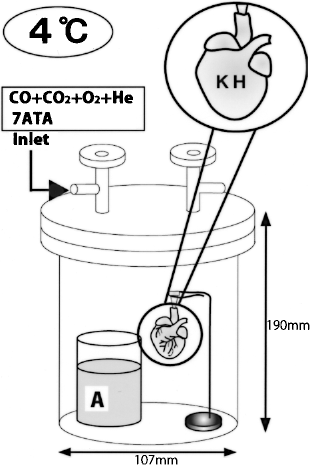
The experimental situation when applying an isolated rat heart to the preservation vessel and preserving it in refrigeration at 4°C. The preservation vessel was filled with PCO = 400 hPa + PCO2 = 100 hPa + PO2 = 900 hPa + PHe = 5600 hPa and it was preserved for 72 h.

Electrocardiogram of a donor heart and a recipient heart after preserving the isolated rat heart for 72 h, performing cervical ectopic heart transplantation on October 16, 2008, and resuscitating the rat. The smaller electrical potential is the recipient rat's ECG, and the larger electrical potential is the donor rat's ECG, wherein pulsing at a constant interval can be observed in both.
Results
After preservation for 72 h with four types of mixed gas (CO, CO2, O2, He), we performed end-to-end anastomosis between the common carotid artery and the aorta and between the external jugular vein and the pulmonary artery in the recipient rat, and performed six cases of ectopic heart transplantation, wherein there were six cases in which both the atrium and the ventricle pulsed and an electrocardiogram was recorded. Among these, there were two cases in which the pulsing continued even after 4 weeks. Furthermore, as control experiments, preservation with CO and O2, preservation with CO2 and O2, and preservation and resuscitation with the same conditions other than preservation with CO2, O2, and He were performed, and the gas was changed during the preservation (Table 1, Fig. 3).
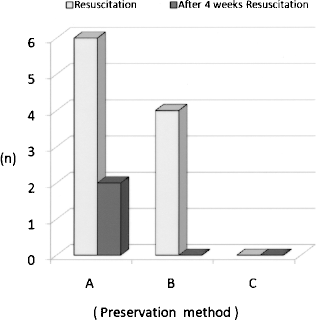
Representation of Table 1 graphically. A: The 72-h preservation with four types of mixed gas was resuscitated in 6/6 cases (100%), wherein 2/6 (33%) continued pulsing even after 4 weeks. B: The 72-h preservation led to resuscitation in 4/6 cases (66%), but none continued pulsing. C: The 72-h preservation led to resuscitation in 0/6 cases (0%).
Results of the Resuscitation Status According to Partial Pressure

A is preserved with four types of gas: CO, CO2, O2, and He; B is preserved with CO2, O2, and He; C is UWS. When observed from each resuscitation status preserved for 72 h, the organ preserved with four types of mixed gas (A) showed the best resuscitation status.
Discussion
Seki, who is one of the authors of this report, stated that tardigrades, which were in a state of decreased moisture content within the organism, could be resuscitated even under super-high pressure of 6000 atmospheres in perfluorocarbon (PFC) (23). The phenomenon of living organisms reducing their decomposition by decreasing the amount of water in their bodies in order to adapt to extreme environmental conditions such as dryness or low temperature is called cryptobiosis, and this phenomenon can be found in many forms in the natural world, such as drought dormancy of plants in the Arctic Circle or the phenomena in which many bacteria enter a dormant state when the relative humidity is 60% or less. Such bacteria and tissues are now being developed for practical use in preserving dryness (6). It is believed that one of the characteristics of this phenomenon is that part of the free water in the cells is lost but the bond water protecting the biopolymer surface remains, and decomposition in the cells is thereby reduced to the regenerable limit as the amount of free water decreases.
Accordingly, it is believed that if the structured water within the tissue or cell remains and free water is removed without damaging the tissue or cell, the metabolism would slow and the tissue could be preserved for a long period, so Seki worked on an experiment of preserving an isolated mammalian organ. At the beginning, he performed an experiment of decreasing the moisture content and resuscitating by using PFC solution in rats and swine for a number of times, wherein he occasionally obtained good results, but the reproducibility was found to be insufficient.
Subsequently, Seki focused on the fact that carbon dioxide gas has an anesthetic action and metabolic suppression action in an organism. He performed an experiment of preserving and resuscitating a heart in an environment of reduced moisture content and a high concentration of carbon dioxide gas, preserving the heart for 24 h, and performed an ectopic heart transplantation on the recipient rat, after which he stated that resuscitation was possible with reducibility (24).
Yoshida, who is also one of the authors of this report, used carbon monoxide (CO), which has a reversible relationship with oxygen, for preservation, exposed a heart to high partial pressure carbon monoxide gas (PCO = 400 hPa), preserved it for 24 h, performed ancervical ectopic heart transplantation before resuscitation, and obtained the results of resuscitation with 100% reproducibility (29).
We modified the methods above and were successful in resuscitating a preserved heart by filling a high-pressure chamber with mixed gas (PCO = 400 hPa, PCO2 = 100 hPa, PO2 = 900 hPa, PHe = 5600 hPa), thus preserving the heart for 72 h, and performing a cervical ectopic heart transplantation on a recipient rat.
The inactive gas (He) that was used for preservation has anesthetic action (8) and metabolic suppression action (3), and inactive gases such as Xe are used for preserving plants (31).
Furthermore, in many biological experiments, CO2 is mixed with O2 and used as O2 + CO2 = 95% + 5% (5% CO2 under atmospheric pressure is almost equal to 35 mmHg, the CO2 concentration of living organisms) in combination with a buffer. On the other hand, PCO2 of 150–200 hPa or more has both anesthetic and decomposition-inhibiting mechanisms (17, 22) and is commercially used as anesthesia for experimental animals (5) as well as for the preservation of grain and the transportation and preservation of fish (15, 16).
It is known that the mechanism for the effects of such carbon dioxide gas (CO2) and inactive gas (He) may mainly result from structuring an aggregate of water molecules (25). When CO2 and He are dissolved in water, the surrounding water thus becomes hydrophobically hydrated, and the thermal mobility of the water molecule is suppressed. It is believed that when nonpolar CO2 or Hem is dissolved in free water, the water increases the structuration and changes to a hydrophobic substance so as to increase the structuration of the water within the tissue and to suppress the vital activity.
Furthermore, there is a hypothesis that carbon dioxide gas adheres to the surface of a biomacromolecule of protein for protection (14).
Carbon monoxide gas has an action of binding with the Fe2+ of cytochrome oxydase, which is an essential enzyme for an organism to produce energy from glucose so as to suppress the activity of this enzyme (27). It is believed that, because carbon monoxide gas suppresses this enzyme, the metabolism itself within the cell was suppressed, and necrosis was thereby prevented. Furthermore, it is believed that, because the isolated heart was exposed to an environment with high pressure of 7ATA, carbon monoxide gas increases its ratio of binding with cytochrome oxydase, further suppressing the metabolism and increasing in the ratio of preventing necrosis. Moreover, it is believed that, in the cardiac cells and tissue under high pressure, the dynamic equilibrium between oxygen and carbon monoxide was established, components to be destroyed were dissolved preemptively via the law of entropy increase, reconstruction became possible before disarray accumulated, and necrosis was thereby prevented (7, 9, 20).
Also in this experiment, we used a KH solution rather than a UW solution. This is because, when performing a comparative experiment with a UW solution, a KH solution showed better results, but there is no reason to designate the KH solution as the best, so we will further study the optimal preservation solution.
Recently, we have also been performing the method whereby Yoshida et al. desiccated and preserved an organ with a PFC solution (30) and a two-layered method (TLM) whereby Salehi et al. evaluated the human pancreas (21), etc. Furthermore, in addition to basic studies regarding the effects of CO and CO2, ATP concentration within the tissue of the preserved organ, microscopic tissue images, and the isolated heart of large animals have been used in the applications of preservation and resuscitation experiments. With the aim of preservation for a longer period and in better conditions, we have been attempting to select and create an optimal gas partial pressure and preservation solution in order to maintain the dormant state of the cardiomyocytes.
These experiments were aimed at suppressing the metabolism of the heart with decreased moisture content or CO and CO2 gas and extending the preservation period. Other concepts for preserving organs include temporarily stopping the vital activity completely through low-temperature exposure (1) and inhibiting electron transfer enzymes (2) in a way that allows for resuscitation, and this method is called suspended animation.
Both cases involve the application of the dynamic equilibrium theory that aims to allow for switching between a living state and a material state (12). We would like to propose that this technique be called semibiology.
An automobile can be repaired in order for it to be able to be driven again when it breaks down, because there are design drawings, parts, and repair techniques. In the case of humans, design drawings (anatomical drawings) and repair techniques (surgery) have already been completed, but there are unfortunately still no spare parts (organs). These spare parts depend on a supply from brain-dead human donors, but the maximum preservation limit for such organs is 24 h.
Our organ preservation and resuscitation technique has extended the preservation time of these parts (organs) from 24 to 72 h. If the preservation time of organs can be extended to 1 year or more, then human life could then be made semipermanent, much like a semiconductor. It is believed that human life can someday be made semipermanent, much like automobiles, if semibiology techniques can be successfully developed in the future.
The natural phenomenon of plants and animals in the natural world entering drought dormancy almost every year and awakening in the following spring has already been applied to the cells and tissues of plants and animals, and advances are now being made toward the practical use of these same phenomena. In this experiment, we were able to show that this natural phenomenon, which is repeated in the natural world almost every year, can potentially also be applied to isolated mammalian organs, and moreover, we were able to verify its reproducibility.
This experiment is a completely new method of desiccating and preserving an organ by exposing it to the air for preservation. We believe that our presentation of the possibility of applying the desiccation and preservation method to the organs of other mammals in this experiment will make is possible to expand the future framework of “organ preservation.” The current organ preservation method is mostly an immersion and preservation method, and research on organ preservation mostly focuses on the preservation solution. When asked to provide examples, this is a study that takes a branch from the trunk of the tree of the immersion and preservation method. We believe that we were able to grow a completely new trunk of the tree of the desiccation and preservation method with organ preservation methods. On the tree of the desiccation and preservation method, no branches have yet been grown, and there are abundant new developments and possibilities for growing a number of branches.