




Abstract
BACKGROUND:
The International Labour Organization (ILO) and the United Nations (UN) have promoted the concept of decent work as a Sustainable Development Goal for 2030 to address critical global problems. Occupational safety and health (OSH) are components of decent work, primarily through the ILO social protection objective of the goal, and are linked to various other objectives.
OBJECTIVE:
This Commentary applies a previously published staging framework to stimulate thinking about how the OSH field can contribute further to the achievement of decent work.
METHODS:
To advance the contribution of the framework, the different functions of OSH (research, practice, advocacy, governance, and professional education) were used to identify impediments to achieving decent work and develop recommendations for each determinant in the framework.
RESULTS:
Promoting and achieving decent work are complex issues that require a multifactorial approach. Numerous recommendations supporting systems thinking and transdisciplinary approaches are provided.
CONCLUSIONS:
The OSH field can expand to further address decent work.
Introduction
Decent work is defined by the International Labour Organization (ILO) as “productive work for women and men in conditions of freedom, security, equity, and human dignity [1].” It is the sum of workers’ aspirations for opportunity and income; rights; voice and recognition; family stability; personal development; and fairness and gender equality [1, 2]. Decent work, as reflected in the United Nations (UN) Universal Declaration of Human Rights, [3] was a concept proposed by the ILO in 1999, [1] embodied in the Seoul Declaration on Safety and Health at Work, [4] and incorporated into the Sustainable Development Goals for 2030 by the United Nations [1, 5]. It represents the ILO’s response to the globalization and precarity of working life [6–8]. Although globalization had a relatively positive impact on the world economy, it resulted in vast inequality due to market forces. Consequently, workers’ opportunities and conditions of work are subject to growing levels of instability and insecurity, which by negatively affecting (at multiple levels) the main determinants of decent work, might worsen safety conditions or workplaces and threaten workers’ health and well-being, leading to greater levels of stress and anxiety [9].
Occupational safety and health issues have an outsized influence on the achievement of decent work because OSH is related directly or indirectly to all four pillars (objectives) of decent work (employment creation, social protection, rights of workers, and social dialogue). However, the interaction between OSH and the ILO pillars is complex and involves the values of freedom, equality, security, and human dignity which underpin those pillars.
The occupational safety and health (OSH) field is integral to achieving and maintaining decent work because it addresses working conditions, other stressors, and the work environment. Specifically, OSH is a component of decent work through the ILO social protection objective and links to the other objectives. The relationship between OSH and decent work should be explored so that the focus of OSH can be expanded to better contribute to achieving decent work. What is lacking for broadening the role of OSH is a comprehensive framework and intervention strategy for greater integration of OSH perspectives and tools in the construction of policies and practices supportive of decent work.
Because the nature of work, the workforce, and the workplace is changing rapidly, many have called for an expanded role for OSH [10–20]. This view focuses on decent work and workers’ well-being as goals for OSH, with a broader focus on threats to them and attention to the working lifetime rather than a single job [21, 22].
At the core of decent work, along with having work (employment creation), are the conditions of work, working time, fair treatment, stability and security of work, workers’ rights and voice, fair income/wage, health, and safe work. The criteria for a safe working environment are dynamic and evolving [17, 23, 24]. The evolution has progressed from concern about physical risks to concern about psychosocial ones and well-being. Worker well-being is a concept that encompasses aspiring to a good life and flourishing [24]. It is characterized by happiness, life satisfaction, positive emotion, and self-determination. It includes health in terms of physical, mental, and social well-being rather than merely the absence of disease or infirmity, and going beyond that, it is related to individual, enterprise, and national productivity and financial security [17, 25]. Decent work is a major component of workers’ well-being.
Staging framework for OSH and decent work
To expand the role of OSH in fostering and achieving decent work, a staging framework, an 8 × 4 matrix, was developed [22] (see Fig. 1 and Supplement Section IV). The staging framework is a systematic way to probe the OSH challenges arising where the determinants and pillars of decent work intersect. The tool can stimulate identification of issues and needed actions at each cell in the framework. Because the traditional OSH purview does not completely address every cell in the framework, the challenge is to identify what actions the OSH field can take in each cell. The x axis of the framework consists of the four ILO pillars (objectives) of decent work. These are job creation, social protection, rights of workers, and social dialogue. The y axis comprises eight major factors or determining conditions selected by the authors that affect decent work: new technologies and new forms of work; demographics (age and gender); informal work; migration; globalization; pandemics; climate change; and workplace policies. In a previous publication, the authors identified issues and concerns for each determinant and the influence of the pillars of decent work [22].
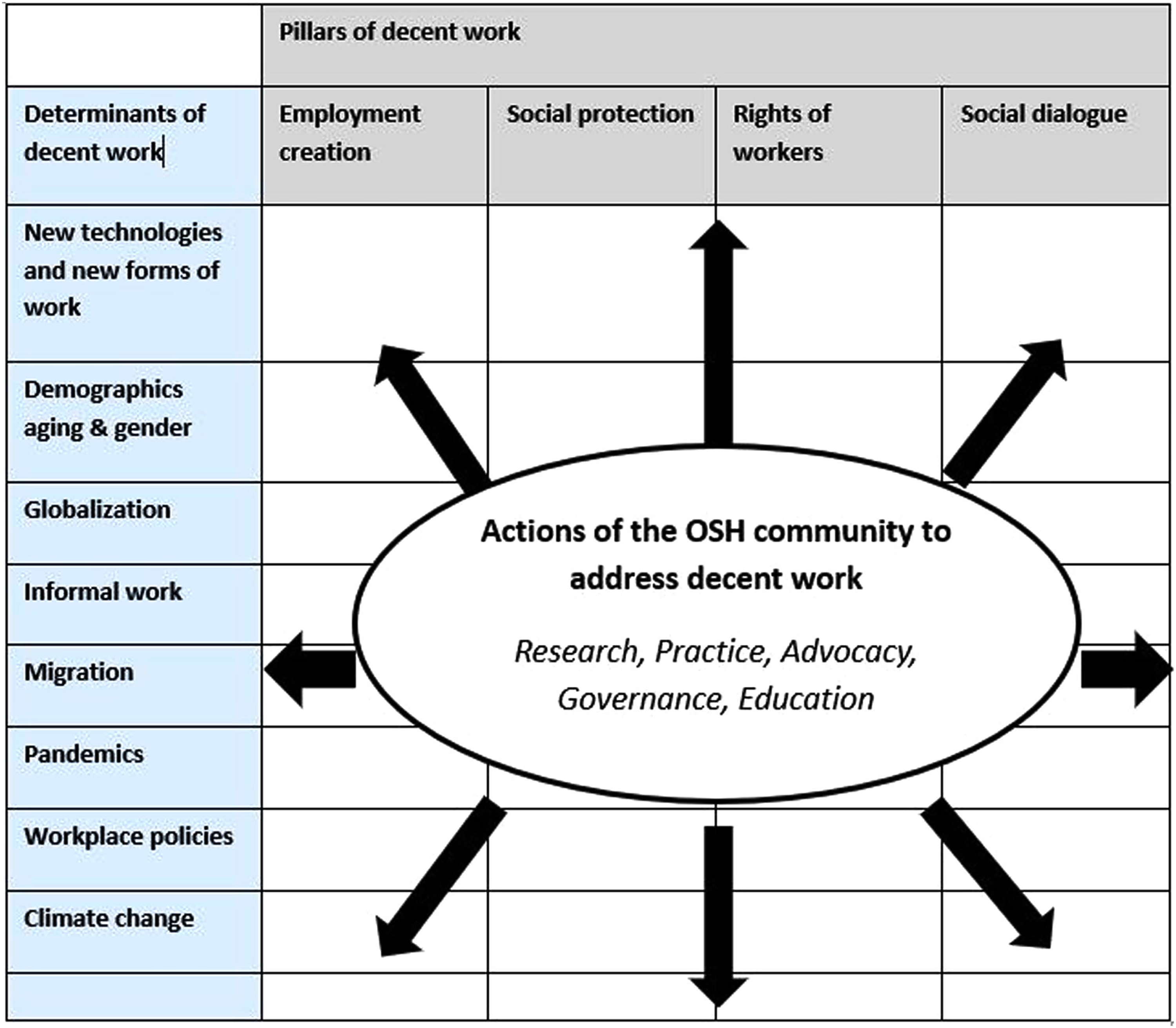
Staging framework to probe how OSH can further achieve decent work (adapted from [22]).
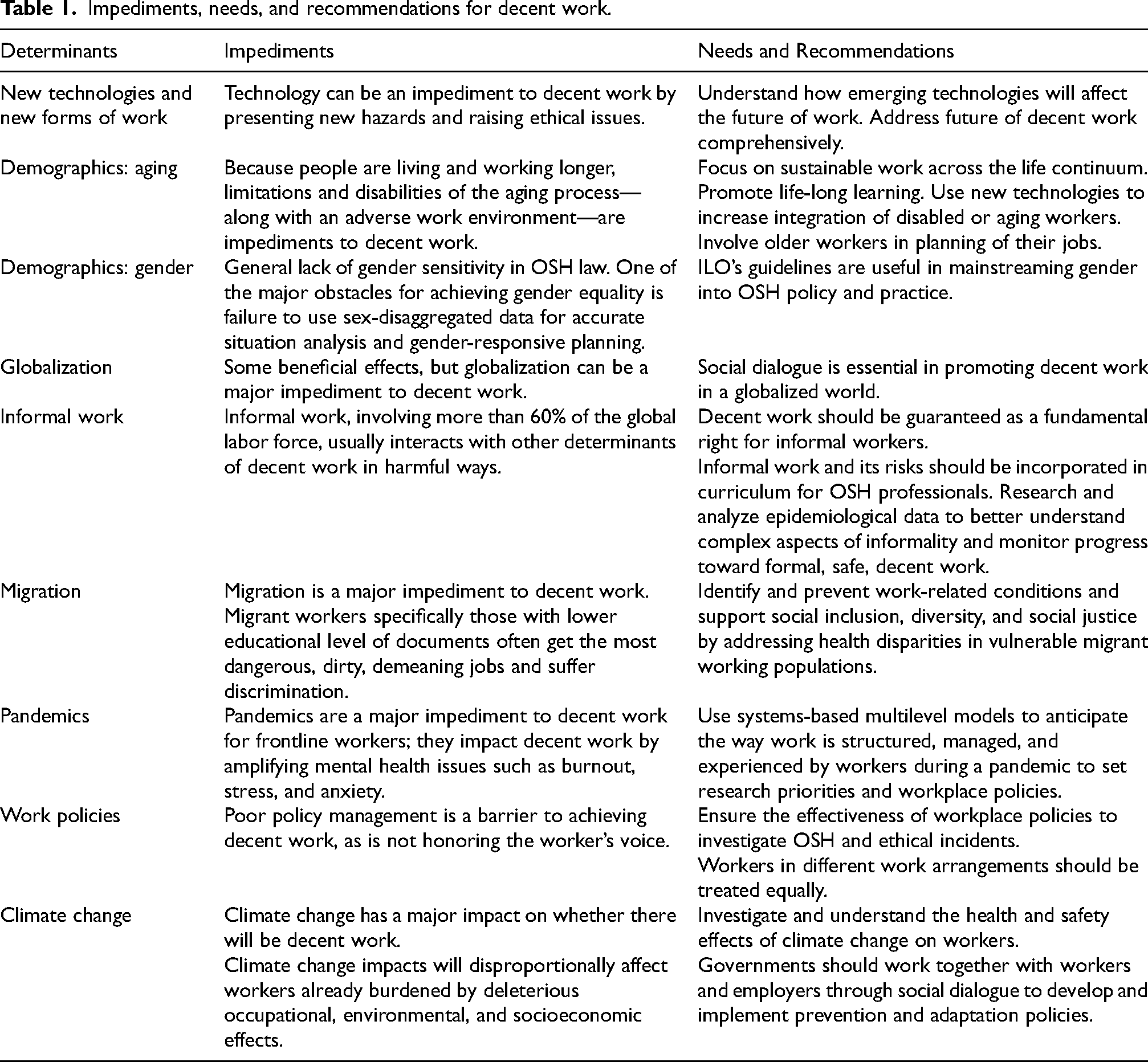
Another challenge is how to identify the impediments to realization of decent work and any needs and recommendation for the OSH field to address. In this Commentary, the authors advocate expanding the focus of the OSH field as a means to achieving decent work by exploring the major functions of the OSH field: research, practice, advocacy, governance, and OSH professional education. The authors considered the eight determinants of decent work, identified impediments to decent work for each determinant, and proposed needs and recommendations for achieving decent work across the four pillars (see Table and Supplement Section IV).
Research
OSH research historically focused on hazard identification, exposure and risk assessment, intervention, training effectiveness, and policy development. The primary hazards were chemical, physical, biological, ergonomic, and safety related. Increasingly, work-related psychosocial hazards have been the focus, and they are expected to be the primary threat to workers in the future [9, 26–32]. OSH research has contributed to decent work in terms of social protection and, specifically, good working conditions, hours of work, and OSH protections. In the past few decades, OSH research has branched out to include impact of technology, global health of workers, new employment patterns and arrangements, work organization, workplace benefit programs, lack of sick leave, workplace innovation, disability management, fruitful return to work, vocational rehabilitation, integrated interventions, and the business case for prevention [31, 33–39]. The large global burden of work-related psychosocial hazards and mental health issues has sparked research on these and other aspects of decent work such as work-life balance, non-work stressors, alcohol and substance use, wages, discrimination, unemployment, and job dissatisfaction.
Two research orientations particularly provided a pathway to decent work. These are Total Worker Health® (TWH) and Workplace Innovation [17, 33, 36, 40]. Both focus on workers’ well-being by improving performance and working hours; protecting workforce safety and enhancing health and productivity; encouraging the creativity of employees through positive organizational changes; combining leadership with hands-on, practical knowledge of frontline employees; and engaging all stakeholders in the process of change [17, 40]. These approaches expand the focus of OSH and also have research, practice, advocacy, policy, and education functions strictly related to the development of decent work conditions, with benefits for workers, employers, and the community. Recently, implementation research has been advocated as a necessary focus of OSH research [41]. Such research—as well as Total Worker Health and Workplace Innovation research—adjoins, overlaps, and addresses other elements of decent work not historically part of OSH [33, 34].
Research on decent work is still in its early stage and there is a strong need for an OSH agenda for research on decent work [2]. This research should include further assessment of those occupational (or otherwise work-related) factors that affect decent work, as well as effectiveness of interventions and strategies (currently available or to be identified) to address those factors [42]. Ultimately, it is necessary to determine how best to operationalize the concept of decent work in the OSH research field. Such an effort requires an innovative approach that, while starting from the traditional OSH model, focuses on a comprehensive, integrated, multidisciplinary research paradigm. This paradigm must analyze both occupational and work-related risk factors and personal health conditions and/or lifestyle factors and evaluate possible interactions and reciprocal influences between all these elements [36] (see Supplement Section IV).
Practice
OSH practitioners are the foundation of a safe and healthy workplace. They have focused on classic safety and health hazards and risks and provide guidance to workers and employers [43]. Although they generally have little experience with psychosocial hazards, that experience is changing [26]. OSH practice now includes considerations ranging from work-life balance to workers’ benefits. In addition to work-related factors, there is a growing emphasis on technology and employment conditions [44]. The widespread introduction of new and advanced technologies results in substantial changes in work organization and work processes. For OSH practitioners, these present a constant challenge as they are called to assess whether these changes also result in new occupational risks and (where this is the case) to develop appropriate risk assessment strategies, as well as control and prevention measures [44]. Also of increasing importance is the consideration of workforce structure, mobility, and migration.
In addition to traditional occupational risk factors, increasing scientific evidence suggests that a number of work-related risk factors (for example, shiftwork, long working hours, sedentary work, workloads, psychosocial work exposure) can contribute to the onset or worsening of several disorders, pathologies, and syndromes, such as obesity, diabetes, cardiovascular diseases, cognitive disorders, and sleep disorders [30, 45] (see Supplement Section IV). In this context it is quite evident that many (if not all) of these work-related risk factors are also closely associated to the realization or lack of decent working conditions. Therefore, to adequately address these issues, OSH practice must necessarily deal with all the pillars of decent work.
A further concept that is moving the OSH field closer to addressing more aspects of decent work is well-being [17, 25]. Well-being in OSH pertains to aspects of work beyond working conditions and risks, to include income, work schedule, possibilities for learning and advancement, and degree of individual control over work [44]. More broadly, well-being also includes a focus on living in communal harmony and in a sustainable manner [46].
Advocacy
Beyond pursuing basic OSH and broader incorporation of worker well-being, the critical role of OSH should be to serve as an advocate for the other aspects of decent work. The Partnership for European Research in Occupational Safety and Health (PEROSH) has supported worker well-being as a central theme adopted by both policymakers and researchers in Europe. As part of its efforts, PEROSH developed a model of well-being at work for employers [47].
Another good example of advocacy for decent work is the efforts of the Occupational Health Section of the American Public Health Association which has promoted decent work in the United States as a public health goal [48]. This provides a pathway for thinking about how OSH can be expanded to address decent work. Generally, occupational and public health scientists and advocates call for the legislature and governments to take steps to further promote decent work.
The efforts of the ILO have served as the foundation for advocating for decent work. Since fostering an agenda in 1999, the ILO has advocated for the promotion of decent work [8, 49–52]. Other examples of advocacy for decent work can be found in the organizational, psychological, and counseling literature, which may serve as models for the OSH field [53, 54]. Although some aspects of advocacy are intuitive, certain skills must be learned and honed. These skills would be useful when added to OSH skill sets [55, 56].
Ultimately, the primary advocates for decent work are workers themselves, as well as their organizations, associations, and unions [57]. The exercise of workers’ rights is one of the pillars of decent work. The OSH field can advocate for workers’ rights and, by doing so, further enable decent work.
Governance
The governance of workers’ well-being and the fostering of decent work are not solely the purview of OSH regulators and policymakers. Other social, economic, and human rights laws and policies must play a role in regulating the labor market, collective bargaining, unemployment benefits, health insurance, minimum wage, and freedom of association. Governance in these areas has been separate from OSH governance, but OSH researchers, practitioners, advocates, and policy makers can provide useful expertise to assist in the development of such policies and laws, while supporting and advocating for them. OSH-specific insights and perspectives are not always duly taken into account in the decision-making process leading to implementation of policies supporting decent work. However, it is plausible to assume that a greater and more structured involvement of the OSH community in these processes could lead to overall improvement in the governance of the decent work itself.
The governance of decent work has been hindered because decent work is an umbrella concept with various qualitative dimensions of work. Although there have been various attempts to develop targets and indicators of decent work, [8, 58] the only target of Sustainable Development Goal (SDG) 8 that deals directly with traditional OSH topics pertains to target 8.8: Protect labor rights and promote safe and secure working environments for all workers, including migrant workers, in particular women immigrants and those in precarious employments. The indicator for this target, 8.8.1, is the ‘frequency of fatal and nonfatal occupational injuries, by sex and migrant status [8].”
In some areas of the world, basic OSH practices and services are a challenge and are still lacking. Therefore, focusing on work-related health outcomes and expanding OSH to address various other components of decent work is not only beyond their current resources but also generally not even the main concern [59]. However, as Rantanen and colleagues [6] assessed, “Over 120 countries have joined the ILO for implementation of the Decent Work Country Plans (DWCPs) and succeeded in integrating DWCPs into national economic, employment, and social policies and programs. Occupational safety and health have been included in part, but not all DWCPs [6].” Critical in occupational practices and services is worker training in OSH. This should be built into policy and practice.
OSH professional education
Educating OSH professionals about decent work and the relationship with OSH is critical to achieve a larger impact on decent work. Examples exist of how such educational efforts are being realized. The European Network Education and Training in Occupational Safety and Health (ENETOSH) promoted a conference discussion on Europe and Africa to consider how SDG 8 could be integrated into university education programs. The focus was to reveal “what is necessary to enable future experts in various countries in occupational medicine, industrial hygiene, occupational safety and public health to improve working conditions in their country and promote sustainable economic development, considering climate change, growing social inequality, rapid technological change and associated health risks [60].”
Along similar lines as a foundation for training to address decent work, a workshop was conducted by the National Institute for Occupational Safety and Health and the University of Texas School of Public Health on how the future of work might shape OSH professionals of the future. This workshop considered the need to incorporate in training the concept of worker well-being, “which integrates the traditional OSH goal of protecting workers from occupational hazards with the promotion of health and illness prevention in the workplace [61].” This and the changing nature of work require a more expansive paradigm involving systems thinking to integrate traditional OSH with socioeconomic factors across the entire working life [61].
The workshop also considered the need to integrate training in specific skills in OSH and allied disciplines with training in “softer” skills, such as leadership, functioning in corporate culture, and promoting well-being [61]. In addition, the workshop identified the need “to incorporate multiple perspectives of different professions into OSH training and integrate different disciplines to create a transdisciplinary approach to problem solving. OSH professionals need greater interpersonal skills to help communicate up and down the line as well as across professions and stakeholder groups [61].” Ultimately, the connection between economic development, jobs, and population health must be better understood. OSH training also should include a foundational understanding of labor economics, labor relations, and market trends and cycles.
Expanding OSH to address decent work needs to be built on a broader foundation than currently exists [62]. According to the American College of Occupational and Environmental Medicine competence statement, [63] “In order to achieve this, it would therefore be necessary to broaden the base of skills, knowledge and competencies that are traditionally recognized as essential for OSH professionals (especially for physicians specializing in occupational and environmental medicine) by including the fundamental concepts of decent work in their specialization courses.” Key in this regard is the need to incorporate well-being as an endpoint of focus for OSH health professionals [25].
Psychosocial hazards prevention is critical in maintaining worker well-being and decent work. However, despite a rich history of occupational health psychology, [27, 64] as the ILO observed, “psychosocial hazard identification and management [have] traditionally been excluded from the OSH professional’s skill set...” [65] Exceptions are some European countries, where OSH services have employed occupational health psychologists or work and organization psychologists since the early nineties. In the Netherlands, this has led to a new profession with associated training and an officially recognized higher-education degree: the work and organization expert for occupational health and safety services. Recent work from Australia bears this out as well and moves to enrich the OSH skill set with psychosocial knowledge [26].
Impediments, needs, and recommendations
If the OSH field is to help achieve decent work, it should aim to overcome impediments related to each major determinant and regarding the different functions within the field (see Table and Supplement Section IV). This will require an expansion of the focus of OSH, education, and training on how to address aspects of decent work not currently in the purview of the field. A wider acceptance by social partners in general on the key role in bringing about decent work is necessary. Gaining this acceptance will require showing what OSH can further add to achieving the decent work goal and communicating that message. As a start, neither the occupational safety field nor the public health field have shown extensive familiarity (as evidenced by the dearth of publications) with SDG 8 or their role in it. The segmentation of the functions of the OSH field, as shown in this Commentary, may help to stimulate thinking about how the field can move forward.
Perspective on expanding the focus of OSH
Decent work is at the forefront of the UN sustainable development goals for 2030 because for the “…first time it explicitly refers to full and productive employment and decent work for all as a means for achieving sustained, inclusive, sustainable economic growth [66].” Health and workability of the working population are key assets to sustainability [67].
If the OSH field is to have an impact on decent work beyond the central purview of providing OSH services, there is a need to determine what choices the field has and which mechanisms and strategies it can use to bring about the expected effects [68]. In part, the answer to the questions relates to the burden of work-related injuries, occupational diseases, and distress. “Generally this burden has been incompletely portrayed and underestimated [21].” A comprehensive approach to burden should include at least four elements:
utilizing multiple domains, including the individual worker, the worker’s family, the community in which the workplace is located, the employer, and society as a whole taking a broader view of the work-relatedness of disease assessing the impact of the entire working-life continuum applying the comprehensive concept of well-being as an indicator in addressing contemporary change in the nature of work, the workforce, and the workplace [21].
Impediments, needs, and recommendations for decent work.
Measuring the burden on these elements and their composite may serve as benchmarks to gauge progress on meeting SDG targets for decent work. “For this to be practical, research is needed on developing and measuring these individual elements of burden and determining the methods to integrate them. This may involve looking beyond the traditional sources of surveillance data [21]. A broader view of the burden of work-related adverse effects is just the beginning of taking an expanded view of OSH and looking beyond it to decent work [69].
Promoting and achieving decent work are complex issues that require a multifactorial approach. The eight determinants in the staging framework were used as descriptors of specific conditions that could affect decent work. The ILO pillars of decent work identify the objectives that should be the target in each of the determinant conditions. Sometimes the targeted objectives are beyond the purview, even an expanded one, of the OSH field. But even in this case, the OSH field can be supportive of workers with an expanded scope that will help reach the objectives of job creation, social protection, realizing rights of workers, and social dialogue. Nevertheless, support and awareness are not the only aspects that can help bring about decent work. There is also a need for countervailing power by legislation, enforcement, and trade unions.
The complex, interlinked, changing world of work requires much needed enhanced competence to deal better with it and achieve decent work. One of the key competencies to address the achievement of decent work is systems thinking — the means to approaching the science of systems [70]. Systems thinking is distinguished from conventional thinking. In conventional thinking, the connection between problems and causes is obvious and easy to trace. In systems thinking, the relationship between problems and their causes is indirect and not obvious [71]. This requires seeing systems as part of larger systems and learning how to create desired outcomes [72, 73]. A system lens can reveal causal patterns for decent work that exist at multiple levels within and outside the workplace, and the possible resources and opportunities needed to address them. Achieving these outcomes will require collaboration across disciplinary boundaries. Transdisciplinary collaboration, adequate training on OSH and procedures that promote well-being (in line with the decent-work pillars), and appropriate information on targeted populations are essential to effectively develop decent work conditions. Technically, dynamic system modeling and multilevel analysis are useful foundations in addressing complex systems [74, 75].
Such transdisciplinarity requires new methods and research designs suited to promoting a common understanding of complex issues; intensive exchange between diverse knowledge producers and knowledge recipients; and involvement of actors outside of science in problem definitions and in the process of knowledge production [73]. Transdisciplinarity is also related to research integration and the disciplines of integration and implementation science [76, 77]. Curricula for OSH professionals need the holistic views of systems thinking and transdisciplinarity and the knowledge of how to integrate and implement information and knowledge to address issues of decent work [78] and labor relations. This may create a “decent work culture” among OSH professionals that they can spread and share in occupational settings and with peers. In this scenario, relevant issues for effectively achieving decent work conditions should include awareness about all aspects leading to acceptable and effective setting-oriented plans focused on decent work, specifically tailored to the characteristics of the workforce, workplace, and labor relations.
The process leading to this Commentary resulted in identifying impediments to achieving decent work and recommendations for overcoming them. Impediments were identified for each determinant, and recommendations were made for each of the 32 cells in the matrix. The functions of OSH (research, practice, advocacy, governance, and professional education) were shown to be useful channels for thinking about how the field can further address decent work.
In the recommendations presented and discussed in this Commentary and in identifying how OSH can impact decent work, the key is incorporating systems thinking and transdisciplinary approaches into research, practice, advocacy, governance, and OSH professional education. This is a difficult task in terms of all the components of OSH, because the field comprises and is related to various disciplines, primarily occupational medicine and nursing, industrial hygiene and engineering, safety, ergonomics, organization science, epidemiology, occupational psychology, toxicology, statistics, law, economics, and environmental health. One key need is to collaborate across these disciplines and with others outside of OSH, expanding the reach of OSH horizontally (personal, social, and economic risk factors) as well as vertically (well-being and working life continuum) [10].
The recommendations and insights in this Commentary are to promote discussion and debate and still need to be assessed in terms of how to incorporate them into strategic policies and address concerns of the various actors who will need to fund and implement them. However, they serve as guideposts for how the OSH field can move toward achieving decent work.
Supplementary Material
Footnotes
Acknowledgments
This work was conducted by a workgroup of the International Commission of Occupational Health (ICOH) as well as additional participants. The findings and conclusions in this report are those of the authors and do not necessarily represent the official position of ICOH or other affiliated organizations of the authors.
The authors thank Emma McAvoy, Antje Ruppert, and Seleen Collins for technical support. Frida Marina Fischer receives a grant from the Brazilian Federal Research Agency - CNPq (number 306963/2021-3).
Ethical approval
Not applicable.
Informed consent
Not applicable.
Conflict of interest
The authors declare no conflict of interest.
Author contributions
All authors participated in a group process for planning the manuscript. PAS conceptualized the manuscript and wrote the first draft; FP contributed to the conception of the manuscript and provided edits and inputs. II provided substantive input and contributed to writing the sections on new technologies and new forms of work, informal work, migration, pandemics, workplace policies and editing; VL provided substantive input and contributed to writing the sections on new technologies and new forms of work, informal work, migration, pandemics, workplace policies and editing; LF provided substantive input and contributed to writing the sections on new technologies and new forms of work, informal work, migration, pandemics, workplace policies and editing; EDA contributed to writing the section on workplace policies; TA contributed to writing the section on workplace policies; YC-A contributed to writing the section on migration; HB contributed to writing the section on informal work; RB provided comments and guidance and contributed to writing the section on informal work; W-JC contributed to writing the section on globalization; TC contributed to writing the section on demographics; FM Fischer was a co-organizer of the project and contributed to writing the section on workplace policies; DLF contributed to writing the section on new forms of work; IAM contributed to writing the section on new forms of work; MSM contributed to writing the section on aging; JO provided input to the manuscript and contributed to writing the section on demographics; KPKO contributed to writing the section on informal work; SO contributed to writing the section on informal work; SP contributed to writing the section on emerging hazards; HR contributed to writing the section on climate change; PP contributed to writing the section on migrants; AS-N contributed to writing the section on migrants; FSV contributed to writing the section on migration and new forms of work.
Funding
No organized funding source was used to conduct the study.
