



Abstract
Knowledge brokering has a crucial role in the field of international development because it is able to act as a cognitive bridge between many different types of knowledge, such as between local and global knowledge. Much of the research on knowledge brokering has focused on knowledge brokering between research, policy and practice, rather than looking at its wider implications. In addition, there appears to be no literature on the future of knowledge brokering, either within or outside the development sector. Given the apparent absence of literature on the future of knowledge brokering, a discussion group was held with experts in the field of knowledge management for development (KM4D) in April 2017 to consider their opinions on the future of knowledge brokering. Their opinions are then compared to the generational framework of KM4D, developed in a series of iterations by researchers in mainstream (non-development) knowledge management (KM) and KM4D researchers. In this framework, five generations of KM4D with different key perspectives, methods and tools have been identified. Based on the inputs from the experts in the discussion group, the future of knowledge brokering practice in international development appears to resemble practice-based, fourth generation KM4D, while there is some evidence of the emergence of fifth generation KM4D with its more systematic, societal perspective on knowledge. Given that the Sustainable Development Goals are providing a universal framework which is relevant to both organizational and societal KM4D, a new systemic conceptualization of KM4D is proposed which brings both of these strands together in one integrated framework linked to the SDGs. The SDGs also support the call for a new knowledge brokering practice with a greater emphasis on brokering knowledge between organizational and societal actors.
Keywords
Introduction
On 1 September 2015, at the United Nations (UN) General Assembly, UN member states ratified the Sustainable Development Goals (SDGs), thus establishing a transformational agenda to address the problems facing the global community. Broader in scope than the Millennium Development Goals (MDGs), the SDGs have “…added several areas of concern, such as economic growth, environmental protection, peace, justice, and accountability. And, unlike the MDGs, they were developed after wide consultation with people from all sectors of society” (Maurice, 2015: 1124). Thus, the UN and its members states ‘are committed to achieving sustainable development in its three dimensions — economic, social and environmental — in a balanced and integrated manner’ (United Nations 2015: 6). Ratification of Agenda 2030 has been hailed by Frans Timmermans, First Vice President of the European Commission (EC), as ‘a historic event, and a significant step forward for global action on sustainable development.’ 1 Agenda 2030 is probably the most influential international policy of the current era.
To achieve this ambitious agenda, global efforts to address the complex challenges identified by the SDGs will need to make the most of new developments and insights related to the role of knowledge in international development. Global knowledge sharing, capacity building and innovation will have a key role in the implementation of the SDGs because ‘…knowledge can break down silos and be the most natural integrative factor system-wide and for all the stakeholders in the implementation of the 2030 Agenda’ (Dumitriu 2017: vi). Martinuzzi and Sedlacko (2017) argue that policymakers, scientists and others will need to collaborate if they are to achieve the SDGs, and that knowledge brokering – although they call it brokerage – will have an important role in this process.
Against this background, the relationship between evidence and decision-making is becoming ever more challenging. According to the event ‘Evidence-informed decision-making in a complex world’
2
organised by the Overseas Development Institute (ODI), UK, for a diverse panel of donor, academic and non-governmental organizations in March 2017, the rise of populist politics and attacks on international development in a ‘post-truth’ environment may drive some development donors towards simpler, more technocratic definitions of impact. According to de Haan, ‘the widespread inability to resist “post-truth” and “fake news” shows not only a severe lack of political knowledge but also a problem with our local knowledge’ (de Haan 2017: 31). Post-truth politics has the potential to have a dramatic effect on knowledge brokering because it undermines the importance ascribed to evidence as the fundamental basis for policymaking. As a credible source of knowledge, knowledge brokering is needed to counteract this trend because: Brokerage has multiple dimensions – it must be able to deal with instant input in an emergency on one hand and assist with fore-sighting and horizon scanning on the other. Authoritative yet accessible, it must be able to rise above the cacophony of competing claims and social media trends. (Gluckman 2017: unpaginated)
Knowledge management for international development
The field of international development is supported by public and private finance. In total, public sector development finance or Official Development Assistance (ODA) reached USD 132 billion in 2015 (Organisation for Economic Cooeration and Development (OECD), 2016), roughly equivalent to the Gross Domestic Product of Kazakhstan. 3 In organizational terms, the field includes the international organizations, such as the UN organizations, the bilateral organizations, such as the Department for International Development (DFID) in the UK and the US Agency for International Development (USAID), as well as international and national non-governmental organizations (iNGOs and NGOs) which are concerned with development. For the purposes of this paper, development is defined as: ‘the synergy among millions of innovative initiatives people take every day in their local societies, generating new and more effective ways of producing, trading, and managing their resources and their institutions. The work of policy makers and development agencies may contribute greatly to the success of those initiatives, may shape them, or may undermine those efforts’ (Ferreira, 2009: 99). Development knowledge is knowledge which is relevant to development and includes global, national, regional and local knowledge. As authors, we recognise a mismatch between the definition of development above, which is focused on grassroots, local activity, and international development which is funded by the international community and particularly the governments of developed countries. The cognitive bridge between local initiatives and the international development sector has, to a large extent, been created by new approaches to knowledge management (Ferreira, 2009). The field of KM4D is generally recognized as having started some twenty years ago when the World Bank launched its first knowledge management (KM) strategy in 1996, followed by the publication of the seminal World Development Report 1998/99, ‘Knowledge for Development’ (World Bank 1999). The justification for the World Bank’s KM strategy was to provide decision makers with the knowledge and ideas for more successful policies because ‘we don’t yet have all the knowledge we need to address some of the major challenges before us’ (quoted in Parker 2000: 233). At this time, there was also discussion of whether KM in development organizations was a business strategy or a development strategy (Kalseth and Cummings, 2001). From these roots, the field of KM4D originated in the mainstream of KM which focuses on organizations and networks in the developed world. KM4D focuses on the management of development knowledge, and knowledge brokering represents one key aspect of this field.
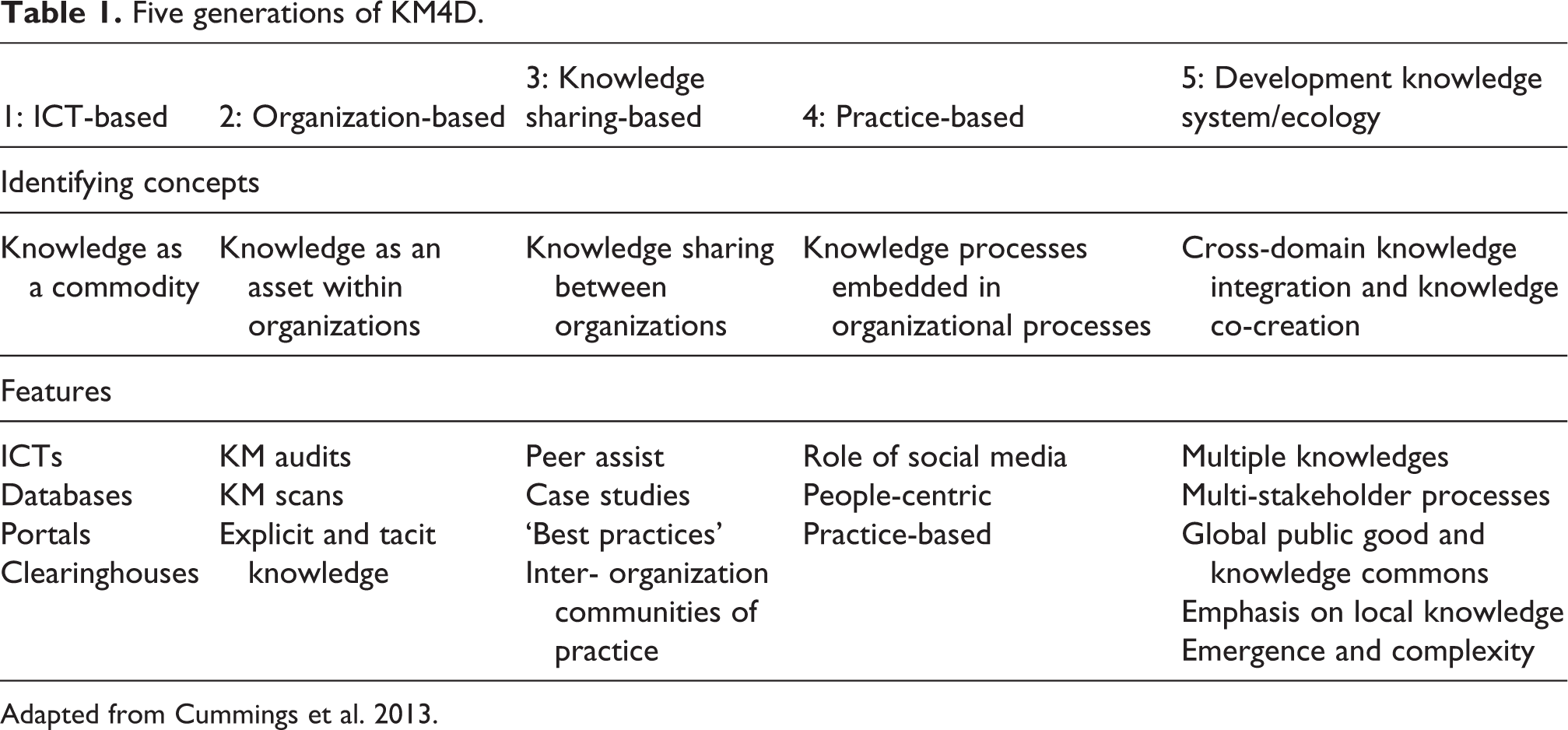
Since the emergence of KM4D, five generations with different key perspectives, methods and tools have been conceptualised (Cummings et al, 2013), based on generations identified by other authors from mainstream KM (Snowden 2002, Laszlo and Laszlo 2003, Koenig 2005, Huysman et al 2007) and KM4D (Ferguson and Cummings 2007, Ferguson et al 2008) (Table 1). The fifth generation is apparently characterised by a growing awareness of multiple knowledges and multi-stakeholder processes in the solution of ‘wicked’ problems (Brown, 2008; 2011); recognition of development knowledge as a global public good and the development knowledge commons (Cummings et al., 2011; Ferreira, 2012 respectively); increased emphasis on the role of local knowledge in development (see, for example, Mansell, 2010, Cummings et al 2017, Brander and Cummings 2017); an emphasis on cross-domain interactions and knowledge co-creation (Ho, 2011; Ho et al., 2012); and recognition of the importance of complexity and emergence (Ramalingam, 2008; Brown et al., 2013). All aspects of the fifth generation of KM4D are strongly linked to the societal role of knowledge rather than organizational KM practice.
Five generations of KM4D.
Adapted from Cummings et al. 2013.
Knowledge brokering
In the literature, knowledge brokering is seen as complex, diverse and contextual (Conklin et al, 2013, Kislov et al 2017). Indeed, there are many different definitions of knowledge brokering as is explained below: While models of knowledge brokering vary considerably, a number of key features are discernible. Foremost of these is the role of making connections between groups of people to facilitate the use of research evidence in policy making. Knowledge brokers build relationships and networks, and are well informed and up to date on what is happening in their domain. Secondly, knowledge brokers are trustworthy subject experts with a high level of credibility. They are not advocates or lobbyists for a cause, neither is their role simple communication of information. Beyond this, the role varies a great deal. Many more people engage in knowledge brokering activities than have the title knowledge broker. (Jackson-Bowers 2006: 2)
In international development, knowledge can be brokered at very many different levels, not just between research, policy and practice. For example, Brown (2008; 2011) argues that all individuals are part of different knowledge cultures, each with their own types of content, forms of inquiry and languages (Brown, 2008; 2011). Knowledge brokers at the grassroots make linkages between these different types of knowledge. Other development actors are making links between local knowledge and scientific knowledge, for example extension services aiming to improve farming practices, and between local and diverse sectoral knowledge, such as the health and the agricultural sector. Given the crucial role of knowledge brokering to international development as a cognitive bridge between these different types of knowledge, the future development of knowledge brokering is an important area of concern for international development as a whole but particularly for organizations and KM4D practitioners. The urgency of this issue has also been emphasized by the fact that the first impetus for this paper came from research commissioned by a prominent bilateral development organization.
Methodology
A literature review is a recognised methodology for investigating the development of an academic field. However, there is very little scientific or grey literature on the future of knowledge brokering in international development. For example, a search of ‘future of knowledge brokering’ on Google Scholar yielded two results, none of which were relevant 4 while a Google search of ‘the future of knowledge brokering’ combined with ‘international development’ yielded only two references, neither being relevant. 5 Although we could have done a systematic review of the literature, a more pragmatic procedure appeared to be to consult experts to gain their opinions on the future of the knowledge brokering. Given that a literature review provides ‘supporting evidence for a thesis (argument) by treating previous authors as “experts” and/or witnesses’ (Metcalf, 2003: 1), we decided to start with the testimony of expert witnesses, linking the issues they raised to the literature and to the main aspects of the KM4D generational framework. To explore experts’ insights on the future of knowledge brokering, a discussion group was held during a meeting of the Knowledge Management for Development (KM4Dev) 6 community on 2 April 2017 at the Information Hub in Geneva, Switzerland. There were approximately 55 participants at this meeting. 7
KM4Dev is a community of practice of international development practitioners who are interested in KM4D and related knowledge sharing issues and approaches. Founded by the International Development Research Council (IDRC), Canada, in 2001, KM4Dev currently has two community platforms: an e-mail communication group with 2496 registered members (6 December 2017)
8
as well as a website with 5013 members (6 December 2017)
9
. It is an active group with online discussions and face-to-face meetings. As Bator and Weatherly argue, ‘KM4Dev is a large, mature community that has had continuous membership growth and weathered many structural changes over the last 17 years’ (2017: 149). Ferreira (2009) considers that members of KM4Dev recognize the importance of knowledge to development and also desire to change how development is being done, leading to his claims that it represents the new Enlightenment: KM4Dev has become a global network of development agents who share the idea that knowledge can contribute to the development of poor countries and groups in a disadvantaged situation. KM4Dev is already playing the role of a cognitive bridge for development agents worldwide, and the demand of methodologies and tools of development agents have shaped the flow of knowledge among the members of the net. KM4Dev plays that role with a high level of efficiency, providing reliable answers to development agents on a daily basis, almost in real time, and at very low cost. (2009: 105).
The discussion group on the future of knowledge brokering was held in the afternoon as part of an Open Space session in which participants moved between different sessions. All participants were invited to the session ‘The future of knowledge brokering in international development’, scheduled parallel with another session. Open Space Technology is a methodology for organising events and conferences in which the programme is decided on by participants in real time. 10 No formal registration was held for those who attended the discussion group as is often the procedure with Open Space. Generally, there were 9 participants with a seated core group remaining for the whole period and a smaller, circulating group of cross-fertilizing ‘bumble bees’. The informal participants’ list for this session which is available online indicates that the session included some very experienced KM professionals from, for example, the UN Children’s Fund (UNICEF), the European Commission and the UN Development Programme (UNDP). The discussion was open with no agenda apart from the central theme, namely the future of knowledge brokering. Notes were made on a flip chart on the table – in knowledge café style – and afterwards the notes were shared on the Google sheet on which all sessions from the meeting reported. 11
Results
The participants started by defining knowledge brokering. They considered that knowledge brokering is defined by its functions, namely adapting, translating, connecting, acting as an intermediary, match-making, convening of networks and professional learning, connecting supply and demand for knowledge, catalysing and facilitating. In addition, it was agreed among participants that the word ‘broker’ means ‘adding value’. They considered that knowledge brokering is particularly valuable at the level of ‘weak signals’ where knowledge asymmetries are evident at the boundaries between networks. In the theoretical literature, these are known as ‘structural holes’ (Burt 1992). Themes raised by the participants included the practice-based approach to knowledge management, the role of inter-organizational communities of practice, multi-stakeholder processes, local knowledge, funding difficulties and the role of the SDGs, which we will discuss in more depth below.
The practice-based approach to knowledge management
Participants’ comments on knowledge brokering very much reflect the practice-based approach to KM which ‘emphatically takes into account the specific context in which knowledge is localized. The individual’s practices, situated at a community level, form the central pivot of knowledge creation’ (Ferguson et al, 2008: 10). This is a particularly relevant perspective for KM4D because it inherently includes the social context in which knowledge is generated, developed and applied. For most of these participants, their context was the UN system with its potentially hierarchical relations with other organizations in the development knowledge system. From their perspective, participants recognised that the UN was becoming more of a knowledge broker because the expertise was very much present at the national level in developing countries. Participants also had a specific contextual understanding of their own organization’s role as a knowledge broker.
Participants argued that the role of the UN organizations is changing, partly because of the falling level of operational finance. In addition, they considered that the UN no longer needs to provide expertise because there is sufficient expertise in developing countries with every country itself being a ‘knowledge centre.’ Instead, they considered that the UN itself is developing its niche as a knowledge broker, linking the knowledge of other parties. They emphasised the importance of the SDGs in facilitating this process by providing a universal, external framework, also for UN organizations: SDGs are very relevant to the knowledge brokering work across sectors because all organizations have the same framework, the same Goals and a global mandate. Knowledge management and knowledge sharing should become the core mission of the UN in which they facilitate external knowledge because there is much more knowledge outside the organizations than within them.
Inter-organizational communities of practice
The participants considered that inter-organizational communities of practice have an important role to play in the future of knowledge brokering. In particular, they were very positive about the role of KM4Dev as an interorganizational community of practice. They argued that the KM4Dev community has an important role in facilitating connections between professionals in the field of knowledge brokering across and between organizations. For example, they consider many development organizations are concerned about losing the expertise of employees who leave their organizations as well as the fact that consultants also have organizational knowledge which becomes lost to the host organization. In KM4Dev, individuals move between organizations and consultancies, and their expertise is not lost to the field.
Inter-organizational communities are included in the third generation of KM4D. The recognition of the importance of KM4Dev to the developing KM4D practice is not surprising as many authors have identified its role (see, for example, Ferguson et al 2008, Ferreira 2009, Brown et al 2013, Cummings et al 2013, Bannister et al 2017, Bator and Weatherly 2017) and many participants are, themselves, members. Inter-organizational communities of practice have also demonstrably kept their relevance to the field of KM4D because a recent issue of the Knowledge Management for Development Journal, linked to the KM4Dev community, has re-visited the concept of communities of practice, finding that it is still relevant and represents ‘a degree of continuity of thinking about [communities of practice] since they first made their way into development discourse in the mid-1990s’ (Bannister et al, 2017: 2). Consistent with this emphasis on the role of communities of practice, the participants have also stressed the importance of trust and legitimacy in knowledge brokering which resonates with recent challenges on the value of evidence.
Multi-stakeholder processes
Participants emphasized the importance of multi-stakeholder processes but they were particularly focused on the role of the private sector in knowledge brokering, although they did refer to the complementary role of NGOs and social entrepreneurs who were able to facilitate links – themselves acting as knowledge brokers – between the UN and local actors.
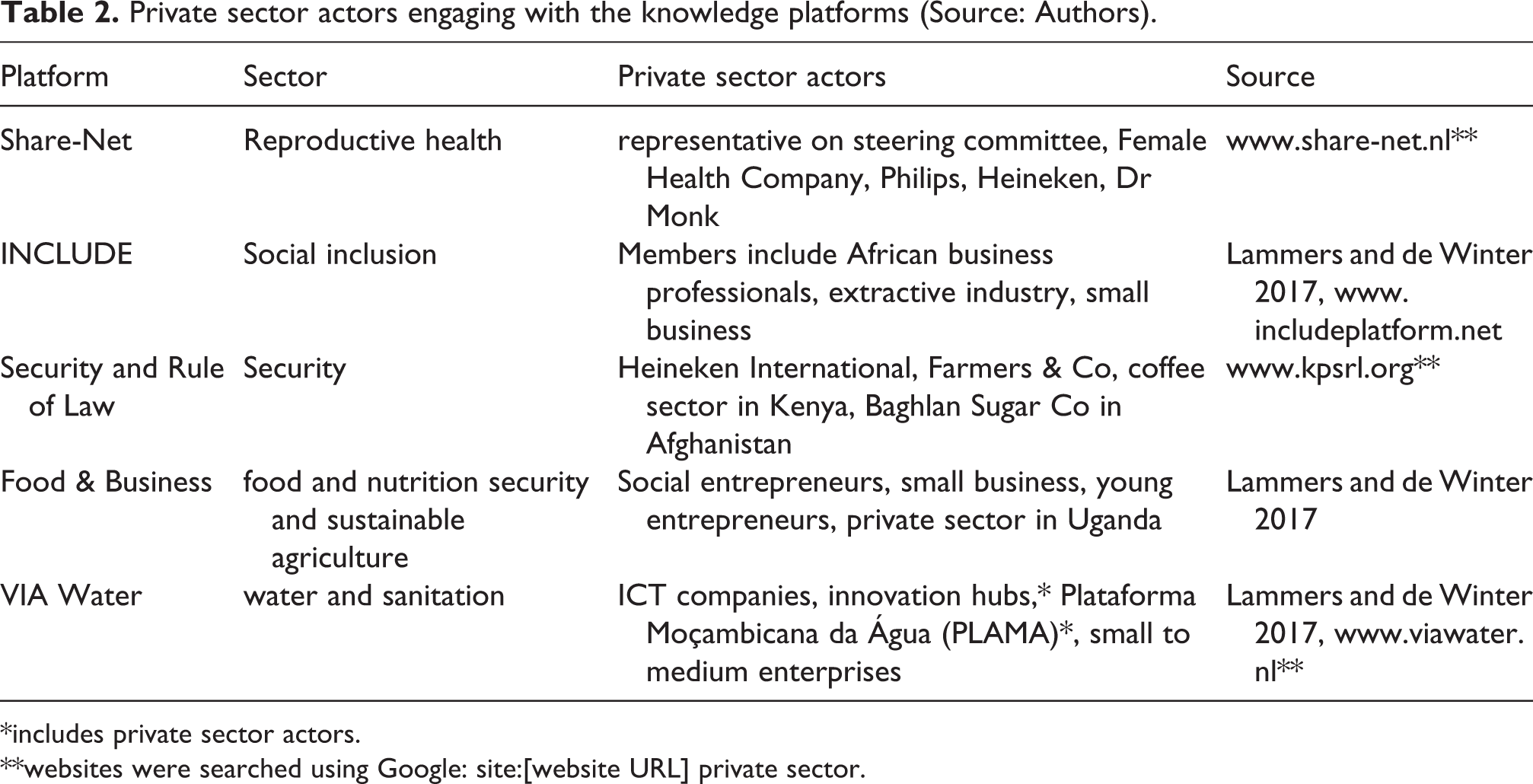
The private sector is increasingly being seen as an important actor in development because of its potential to ‘scale up the interventions that have proven most effective; to extend these approaches to new fields and unreached people’ (UK Department for International Development, 2011: 4). Reflecting this emphasis, Agenda 2030 and the SDGs call upon ‘all businesses to apply their creativity and innovation to solving sustainable development challenges’ (United Nations 2015: 34). Although the private sector is often viewed as a cluster of homogenous actors, roughly corresponding to multinational companies, it is enormously diverse, demonstrated by an analysis of private sector actors cooperating with the five Dutch knowledge brokering platforms, ranging from multinational corporations to small businesses (see Table 2). Despite this growing emphasis, a recent review by the Organization for Economic Cooperation and Development-Development Assistance Committee (OECD-DAC) indicates that ‘[t]he decision to partner with the private sector should be rooted in a theory of change that establishes whether and how the private sector is best placed to realise specific development results’ (2017: 11).
Private sector actors engaging with the knowledge platforms (Source: Authors).
*includes private sector actors.
**websites were searched using Google: site:[website URL] private sector.
Local knowledge
The importance of local knowledge was mentioned by the participants, although they also mentioned that NGOs and social entrepreneurs were better able to act at the grassroots than the United Nations organizations. Although participants consider that local knowledge is important to knowledge brokering, they did not refer to structural gaps between local communities and other development actors in which local knowledge is marginalized see, for example, Cummings 2017). Other commentators have argued that UN organizations might be drowning out local voices: There are many cases where voices from local communities and institutions are not taken seriously until a UN organization raises the same issues. For how long are UN organizations, the World Bank and other big organizations going to continue using their symbolic power to elevate issues that should be conveyed by local communities and institutions? Symbolic power in the form of logos and the convening power of UN organizations represents a hierarchy of credibility which makes it appear what these organizations say should be considered the first truth, followed by what comes from government authorities and lastly, local community views. Even if intuition from local communities are more authentic and reliable, symbolic power makes what comes from the UN agencies and the World Bank more believable to global audiences. (Dhewa 2017: 23).
SDGs
Participants recognized that the SDGs are important to knowledge brokering because they provide a universal external framework for development initiatives in terms of mandate and goals. Indeed, most development organizations are currently revisiting their organizational strategies and activities within the framework of the SDGs. The international organizations, such as the Food and Agriculture Organization of the United Nations (FAO) and the World Bank, and the world’s largest aid donor, namely the European Union and its member states, have embraced the new agenda, re-framing their development efforts in the light of the SDGs (Food and Agriculture Organization of the United Nations 2015, European Commission 2015). However, a number of commentators have argued that the SDGs do not pay enough attention to knowledge (for an overview, see Cummings et al 2017). In consequence, a civil society initiative, led by the Knowledge for Development Partnership, Austria, has developed an Agenda Knowledge for Development which aims to complement the SDGs from the perspective of knowledge (Brander and Cummings 2017). The Agenda Knowledge for Development with its 13 Knowledge Development Goals (KDGs) presents a universal agenda from the perspective of knowledge, focusing on both KM4D in organizations and from a societal perspective (see Figure 1). If broadly adopted, the Agenda Knowledge for Development could provide a universal framework for knowledge brokering in international development.
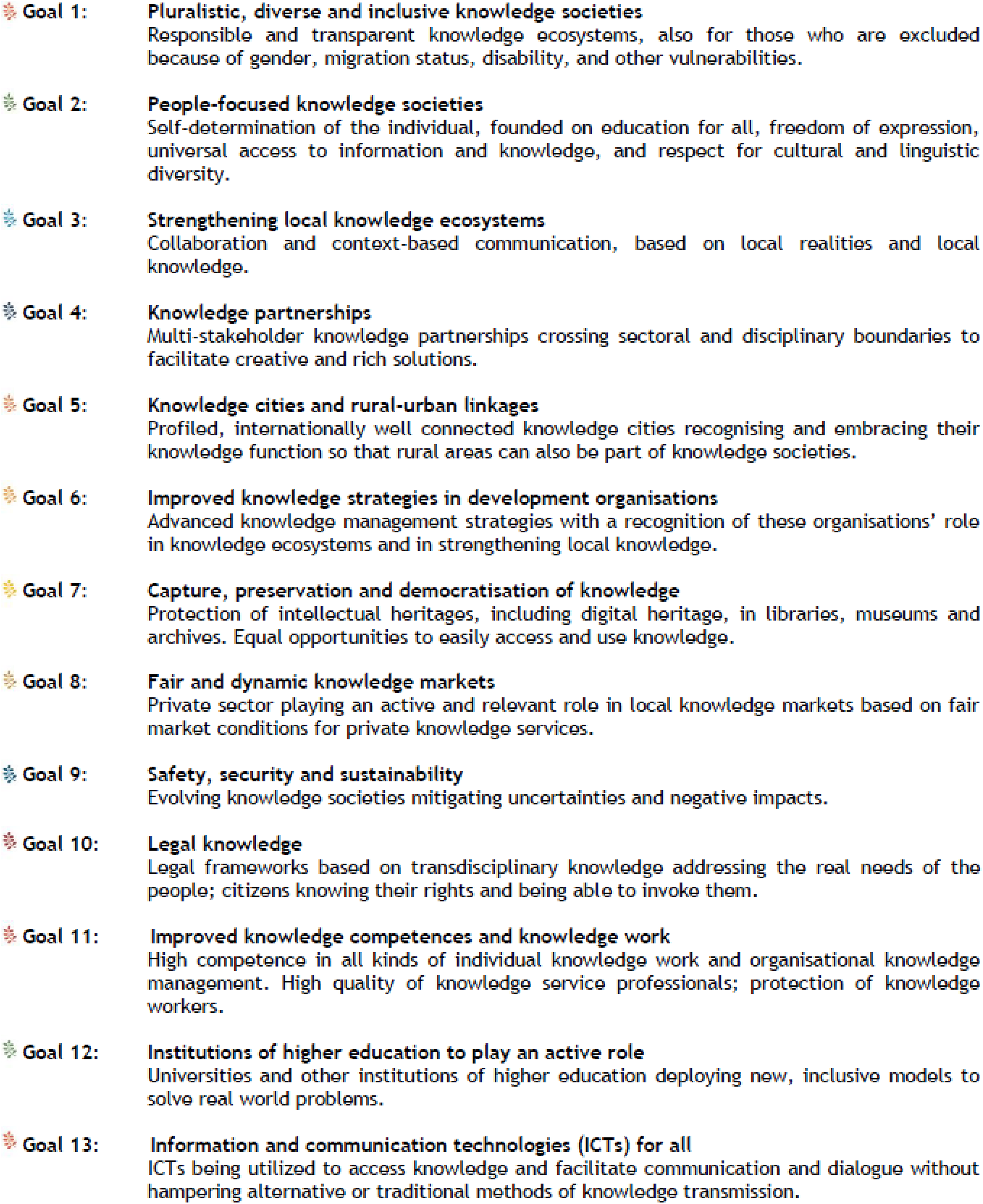
The Knowledge for Development Goals (Brandner and Cummings 2017).
Discussion
A number of issues found in the KM4D generational framework were identified by the participants; while others were not. In addition, a number of issues were raised which were not in the framework and could enrich the framework. These issues will be discussed in turn.
Issues in the generational framework
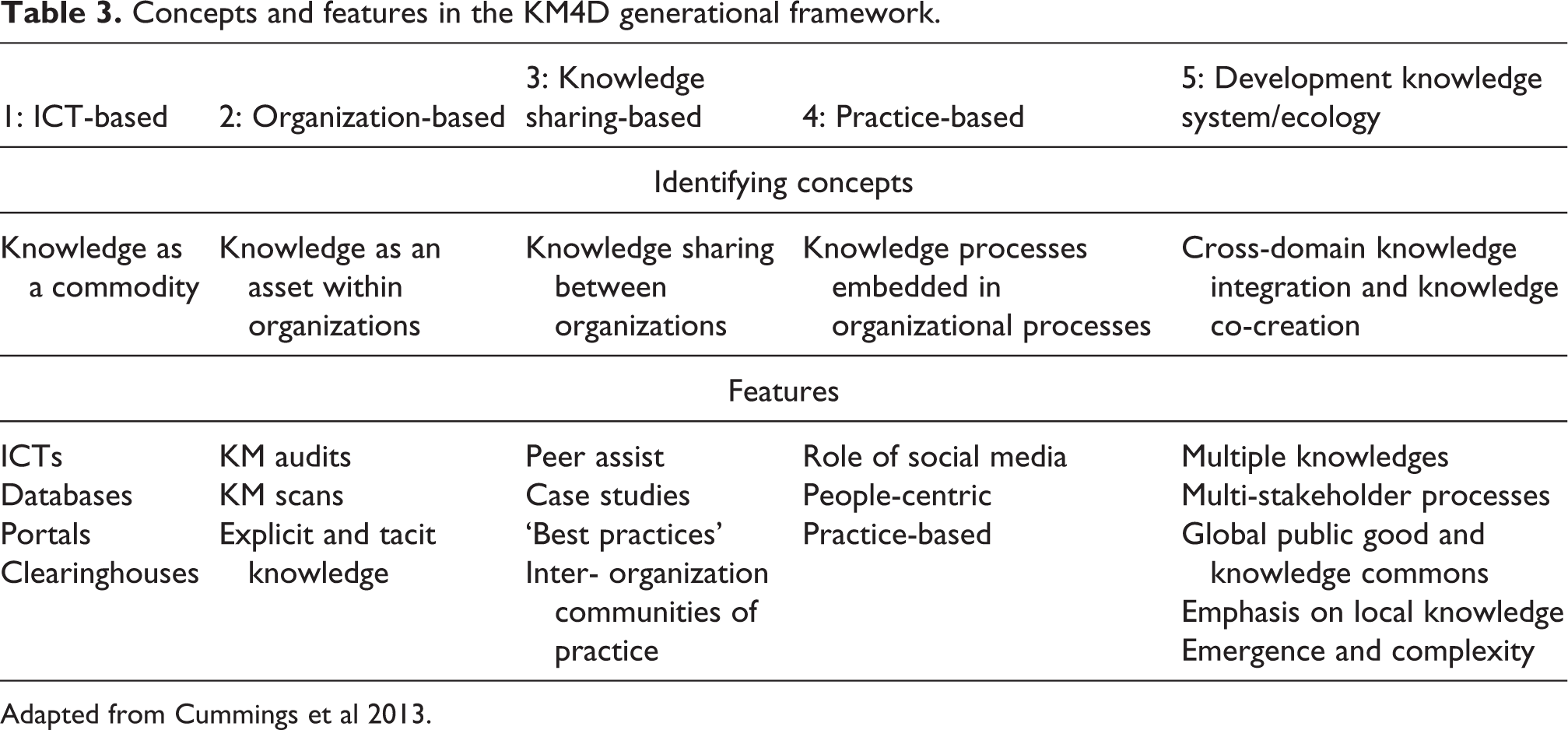
The participants identified five main concepts and features that were part of the generational framework (see Table 3). These include knowledge processes embedded in organizational processes and practice-based KM, both characteristic of the fourth generation of KM4D. Participants also referred to inter-organizational communities of practice, conceptualized as being part of third generation KM4D, and local knowledge and multi-stakeholder process, both of which have been identified as being part of the fifth generation. This appears to indicate that aspects of third, fourth and fifth generation KM are continuing to co-exist, predicted in the original conceptualization of the generational framework.
Concepts and features in the KM4D generational framework.
Adapted from Cummings et al 2013.
New issues
A number of issues were raised by participants which are not in the current generational framework, such as funding constraints which are forcing organizations to change in terms of their knowledge brokering ambitions and the role of the SDGs. Funding, and particularly continuity of funding, is an important issue for knowledge brokering as has been described by Geoff Barnard, former (1994-2005) Head of Information at the Institute of Development Studies, UK: Investments in knowledge and information need to be seen in the same way as investments in clean water systems, electricity supply grids or urban transport networks. These kinds of infrastructures are not something that will be here today and gone tomorrow – we’ll need them for hundreds of years ahead. The same is true of the ‘knowledge infrastructure’ we’ll need to achieve the SDGs. We’re not talking of a quick fix. We’re talking about putting in place the systems, skills, behaviours and networks that will support and sustain us for generations into the future. And there will be a need for all kinds of funding models – state funding, development assistance, commercial models, pay-as-you-go, and sponsorship, will all have a role to play. The point is that we need to be thinking long term. We need to be taking knowledge for development seriously and investing in it like our lives depended on it – because, ultimately, they do. (2017:13)
Proposing a new framework
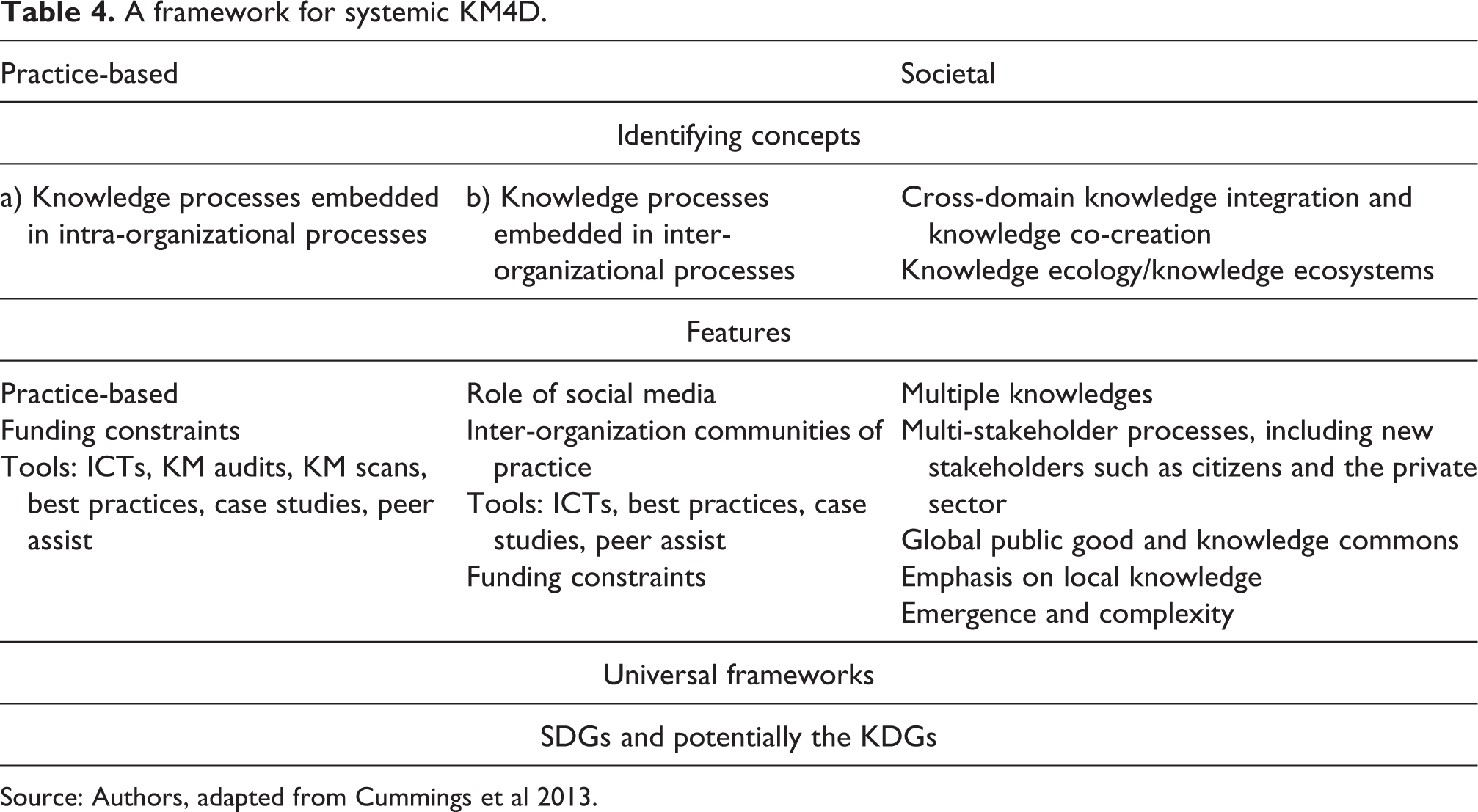
In this paper, we have considered the future of knowledge brokering using the conceptual lens of the generations of KM4D based on the understanding that knowledge brokering is an important aspect of KM4D. Looking at knowledge brokering from the generational perspective appears to indicate that the third, fourth and fifth generations of KM4D will continue to co-exist, something that was mentioned as a possibility by the original authors. The fourth generation, focused on organizational practice, is very much reflected in the future of knowledge brokering identified by the participants, although the participants also identified the importance of multi-stakeholder processes and local knowledge which are to be found in the fifth generation. Given the nature of international development with its intra-organizational, inter-organizational and societal perspectives, we propose a new systemic conceptualization of KM4D which includes all three perspectives, not based on generations but rather based on the fact that these perspectives will continue to co-exist into the future. The new systemic conceptualization which we are proposing has two practice-based elements, namely intra-organizational and inter-organization, and integrates the societal components which were previously seen as a separate fifth generation of KM4D (see Table 4). In this integration, the SDGs, and also the Knowledge Development Goals (KDGs, see Figure 1), provide a unifying framework as has been proposed by participants of the discussion group. Indeed, this new systemic perspective has been made possible by the universal framework provided by the SDGs to which all development initiatives are currently aiming to comply.
A framework for systemic KM4D.
Source: Authors, adapted from Cummings et al 2013.
What is the evidence of a newly emerging systemic KM4D? First, many scholars and practitioners have emphasized the societal aspects of KM4D as has been discussed previously (see, for example, Brown 2008, 2011 and Ferreira 2009). This approach is also fully integrated into the Agenda Knowledge for Development (Brander and Cummings 2017) with its associated 73 statements by individuals active in the field of KM4D, which embraces all three aspects in its 13 KDGs. While many of the Goals focus on societal aspects of KM4D, others focus on intra-organizational and inter-organizational aspects (Goals 4, 6, 7 and 11). Second, the systemic and integrative aspects of knowledge across the UN system has been recognised by the UN Joint Inspection Unit (Dumitriu 2016), while Gillman and others consider the potential of ‘…the theoretical and practical considerations and opportunities of taking a more systemic approach to KM, applying it to sectors and other broader concepts, such as “knowledge cities”, “the information society” and “the knowledge economy”’ (2018: 1) in a recent Call for Papers from the Knowledge Management for Development Journal.
What are the implications of the proposed systemic framework for knowledge brokering practice? Current conceptualization of knowledge brokering appears to be very linear, focusing on the spread of evidence from scientists to policymakers and others (for example, Martinuzzi and Sedlacko 2017) while the participants of the discussion group did take a broader perspective, including multi-stakeholder partnerships and local knowledge. We consider that the new framework calls for a new sort of knowledge brokering practice so that ‘knowledge brokers can effectively use their skills to redistribute power in ways that democratize knowledge’ (Dhewa 2017: 23). This will also require the re-assessment of hierarchies of knowledge, recognising that scientific and technical knowledge alone does not always provide the best solution to development problems. Given that current conceptualizations of knowledge brokering practice tend to be linear and involve moving evidence from the scientific domain to policy and practice, a new type of knowledge brokering is needed which is able to broker knowledge between local actors and development experts, recognizing that this is not just a one-way process.
Resolution of the structural gaps in which local knowledge is marginalized does not depend on knowledge brokering practice alone but rather on systematic changes. One systemic change which has the potential to bridge the gap between local communities and other development actors is the growing adoption of transdisciplinary research, action research and other forms of participatory development. The potential of transdisciplinary research to involve local people in research and development interventions has been recognised elsewhere (see, for example, Oldekop et al 2016, Cummings et al 2013 and Regeer and Bunders 2009). In addition, a basic re-assessment of development interventions is required in which local realities and local knowledge should be the starting point for development efforts, calling for effective knowledge brokering between local knowledge and other types of knowledge (Cummings, 2017, Cummings et al 2017).
Conclusions
Based on a discussion group with experts and on recent literature, this paper has considered the future of knowledge brokering with the help of a conceptual lens of a generational framework for KM4D. Based on this analysis, we have reached the conclusion that there needs to be a new systemic conceptualization of KM4D which brings together co-existing fourth and fifth generation KM4D in recognition of the universal framework of the SDGs which are relevant at the level of organizations and society. We, therefore, propose a new, systemic KM4D which is based on both practice-based and societal KM4D. From this perspective, we consider that there needs to be a re-assessment of the practice of knowledge brokering, recognizing a more pluralistic, complex role of knowledge broking than is currently present in the conceptualization of knowledge brokering as a linear process of evidence being transferred from research to policy and practice. The types of knowledge that will be involved in the knowledge brokering in the future are likely to be highly diverse and more pluralistic than they are today, particularly give the rising importance of social media and the potential breakdown of some of the silos between different domains of development knowledge. In particular, it appears that the role of the private sector in knowledge brokering requires further investigation.
Footnotes
Acknowledgements
The authors acknowledge with thanks that support from the Swiss Agency for Development and Cooperation (SDC) provided the original impetus for this article. We also acknowledge that this research has been undertaken as part of the project ‘An unusual suspect: the role of the private sector in knowledge brokering in international development’, funded by the Science for Using Research (SURe) programme, NWO-WOTRO Science for Global Development, The Netherlands.