




Abstract
BACKGROUND:
Virtual meetings have been widely utilized during the COVID-19 pandemic.
OBJECTIVE:
The purpose of this study was to explore the influence of organizational commitment on the perceived effectiveness of virtual meeting by Filipino professionals during the COVID-19 pandemic.
METHODS:
A total of 513 Filipino professionals answered an online questionnaire which covered four latent variables: organizational commitment to virtual meetings, attitude toward virtual meetings, perceived effectiveness of virtual meeting as collaboration tool, and perceived effectiveness of virtual meeting as a social tool. Structural Equation Modeling (SEM) was utilized to analyze the causal relationships between the latent variables construct.
RESULTS:
SEM showed that organizational commitment to virtual meeting during the COVID-19 pandemic influenced the positive attitude of the employees which subsequently led to the perceived effectiveness of virtual meeting as a collaboration and social tool.
CONCLUSIONS:
This study is the first study that analyzed the influence of organizational commitment on the perceived effectiveness of virtual meeting during the COVID-19 pandemic in the Philippines. Our SEM construct can be applied and extended further, particularly in analyzing factors influencing the perceived effectiveness of virtual meeting during the COVID-19 pandemic.
Introduction
The COVID-19 pandemic has changed the human behavior in information technology. As of September 9th 2021, there have been 222,406,582 confirmed cases of COVID-19, including 4,592,934 deaths [1], making governments worldwide to impose lockdown and aggressive restriction measures such as work-from-home (WFH). Various information technology sectors, businesses, and organizations around the world have also shown their cooperation by modifying their business operations and providing flexible services among its employees through several platforms. One of the most commonly information technology platforms that widely utilized during the COVID-19 pandemic is virtual meeting.
Virtual meetings are a form of communication technology perceived as a fundamental tool for work by organizations, particularly in keeping people connected and in establishing a virtual shared space [2]. It provides a platform for people to stay connected despite the physical and geographical constraints imposed by the government due to the COVID-19 pandemic. Several platforms such as Zoom and Google Meet have been widely utilized in various virtual meetings or virtual recruitment in different business to keep organizations and employees continue the work despite the challenges brought by COVID-19 pandemic [3]. Moreover, virtual meeting has also been utilized by hospitals and health facilities in holding health advising and counseling sessions. The most important consideration for virtual meeting, however, is making sure that every person has the communication facilities and devices for running and establishing virtual meetings [4].
Previously, there were several studies related to virtual meetings’ impacts on different organizations in several countries even before the COVID-19 pandemic. In Sweden, the national government supports the use of virtual meetings as it was found to reduce travel costs, reduce environmental impacts, increase business mobility, increase collaboration, and improve productivity of the employees [5]. In South Korea, Choi and Cho [6] found that coordination and cooperation in virtual teams with strong autonomy improve knowledge sharing were crucial aspects in collaborative functions, particularly as tasks or projects become more complex. Finally, in Taiwan, Chumg et al. [7] stated that the absence of physical contact and proximity gives employees a greater sense of responsibility for cooperation and coordination. Thus, virtual meetings mostly perceived as a good platform in which the organizations can practice and enhance their cultural intelligence [8].
Cultural intelligence contributes to the collaboration and coordination benefits in the organizations that operate on a global scale. In the Philippines, where global call and business process outsourcing (BPO) centers are commonly based, it was found that cultural intelligence promotes task performance, especially those that are accomplished through cross-cultural teams [9]. Since the interaction and collaboration among cross-cultural virtual teams are done and established over virtual meetings, employees become more culturally aware of their respective organizations’ and counterparts’ diverse backgrounds [8].
Despite the availabilities of many studies related to virtual meeting as a new platform during the COVID-19 pandemic, few studies highlighted the influence of organizational commitment on the perceived effectiveness of virtual meeting during the COVID-19 pandemic (Table 1). Most of the recent studies suggested several research directions such as exploring the organizational impacts of virtual meetings during the COVID-19 pandemic on various settings [3, 11] and exploring the impacts of certain aspects within the organizational sphere on the use of virtual meetings [6, 12]. Moreover, as one of the most countries with the most active cases of COVID-19 in the world, very few studies have been done in the Philippines particularly related to the virtual meeting. Most studies only focused on the clinical [13], perceived effectiveness of COVID-19 prevention measures [14], or COVID-19 model estimation [15]. Thus, it is valuable to analyze another impact of COVID-19 in the Philippines particularly related to the virtual meeting.
Research gaps
Research gaps
The purpose of this study was to explore the influence of organizational commitment on the perceived effectiveness of virtual meeting by Filipino professionals during the COVID-19 pandemic. Different from our previous study which mainly focused on the perceived effectiveness of COVID-19 prevention measures by the Philippines government [14], this study highlighted the important of virtual meeting as collaboration and social tool which supported by the organizational commitment. This study is one of the first study that analyzed the influence of organizational commitment on the perceived effectiveness of virtual meeting during the COVID-19 pandemic in the Philippines. Our structural equation modeling (SEM) construct can be applied and extended further, particularly in analyzing factors influencing the perceived effectiveness of virtual meeting or other platforms during the COVID-19 pandemic.
We came up with a straightforward research model that fits the hypotheses developed in this study. Since the implementation of the use of virtual meetings was an organizational initiative, the model started from an organizational-level influence going forward to individual- level perception which subsequently led to the perceived effectiveness of virtual meeting (Fig. 1).
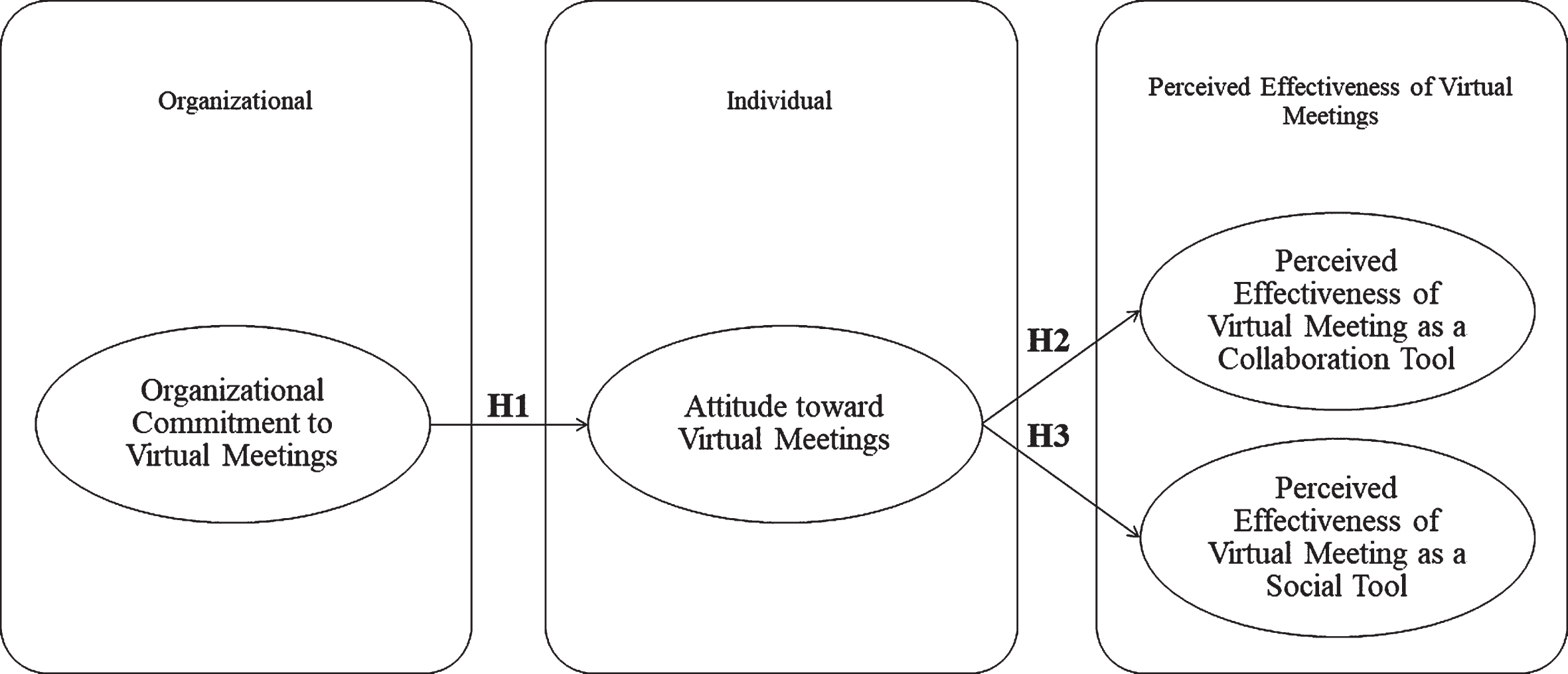
The research model and hypotheses construct.
The structural research model started from an organizational level of influence with organizational commitment to virtual meetings. Chumg et al. [7] showed that organizational culture promotes and influences collaboration among employees. It was also found that an organization’s eagerness and support toward virtual collaborations contribute to strengthened collaboration among employees [19]. These led to the first hypothesis:
Moving forward to an individual level of influence, the structural research model put employees’ attitudes toward virtual meetings in the center as the mediating factor that directly influenced perceived effectiveness. Their attitudes which covered how they perceived the virtual meetings’ usefulness in their work and utility in providing social connection despite physical constraint, how they inclined to the actual use of virtual meetings, and how usable of these technologies for them.
Finally, the final output of the model construct was the perceived effectiveness of virtual meeting. Aside from knowing the respondents’ perceived effectiveness of virtual meeting as a collaboration tool, the study also aimed to explore the respondents’ perceived effectiveness of virtual meeting as a social tool during the COVID-19 pandemic as the World Health Organization [1] consistently reiterates the relevance of keeping a community and an organization socially connected during this time. Thus, these considerations led to the second and third hypotheses: Employees’ attitudes toward virtual meetings had a significant effect on their perceived effectiveness of virtual meetings as a collaboration tool. Employees’ attitudes toward virtual meetings had a significant effect on their perceived effectiveness of virtual meetings as a social tool.
Participants
This study was approved by the School of Industrial Engineering and Engineering Management Mapua University Research Ethics Committees. A total of 513 Filipino professionals from different organizations and area of work voluntary participated in the current study (Table 2). 70% respondents were female, 29% respondents were male, and only one percent (1%) preferred not to disclose their gender. The youngest respondent was 19 years old while the oldest was 73 years old, giving a mean age of 32 years old (Std: 10.31). Half of the respondents (50%) had experiences of 1–5 years in their respective organizations, followed by 11–more years (21%), 6–10 years (17%) and lastly, less than 1 year (13%). Finally, the area or sphere where most respondents (39%) work was Education, followed by Customer Service (22%), Commerce (7%) and Industry (7%), Software (5%) then Marketing (4%), while the rest of the respondents (16%) were from other areas of work.
Demographic profile of respondents (n = 513)
Demographic profile of respondents (n = 513)
Following our previous studies [20, 21], a survey questionnaire delivered online and in English was used to gather data from the respondents. The questionnaire consisted of multiple choice and rating items which gave answers on the organizational commitment to virtual meetings, the respondents’ attitudes toward virtual meetings, and the respondents’ perceptions on the effectiveness of virtual meetings as a collaboration and social tool. A 5-point Likert scale: 5 –strongly agree, 4 –agree, 3 –neutral, 2 –disagree and 1 –strongly disagree was used for the rating items. Table 3 represents the summary of questions included in the quantitative measurement instrument.
The item constructs and measures
The item constructs and measures
Note 1. OC = Organizational Commitment, A = Attitude, PEC = Perceived Effectiveness as a Collaboration Tool, PES = Perceived Effectiveness as a Social Tool
This survey was conducted online during the General Community Quarantine (GCQ) in the Philippines from October 1st to December 18th, 2020 through Google Forms. The survey questionnaire consisted of an introductory section with a brief explanation the purpose of the study, the demographic part, and the main section which consisted of 29 questions. The link to the survey was sent personally to some respondents and posted on organizational pages, various groups on Facebook, and LinkedIn to gather more respondents.
Statistical analysis
SEM using AMOS 24 was utilized to analyze the proposed hypotheses of this study. Following our previous studies that utilized SEM [14, 21], six measurement indices were used to analyze the model: Incremental Fit Index (IFI), Tucker Lewis Index (TLI), Comparative Fit Index (CFI), Goodness of Fit Index (GFI), Adjusted Goodness of Fit Index (AGFI), Root Mean Square Error of Approximation (RMSEA). These measurement indices were the bases for the model fit for the data tested in this study [26].
Results
Figure 2 represents the SEM for evaluating the influence of organizational commitment on the perceived effectiveness of virtual meeting by Filipino professionals during the COVID-19 pandemic. The results showed that organizational commitment to virtual meetings (β= 0.47) positively influenced employees’ attitudes toward virtual meetings which subsequently influenced employees’ perceived effectiveness of virtual meeting as a collaboration tool (β= 0.88) and as a social tool (β= 0.62).
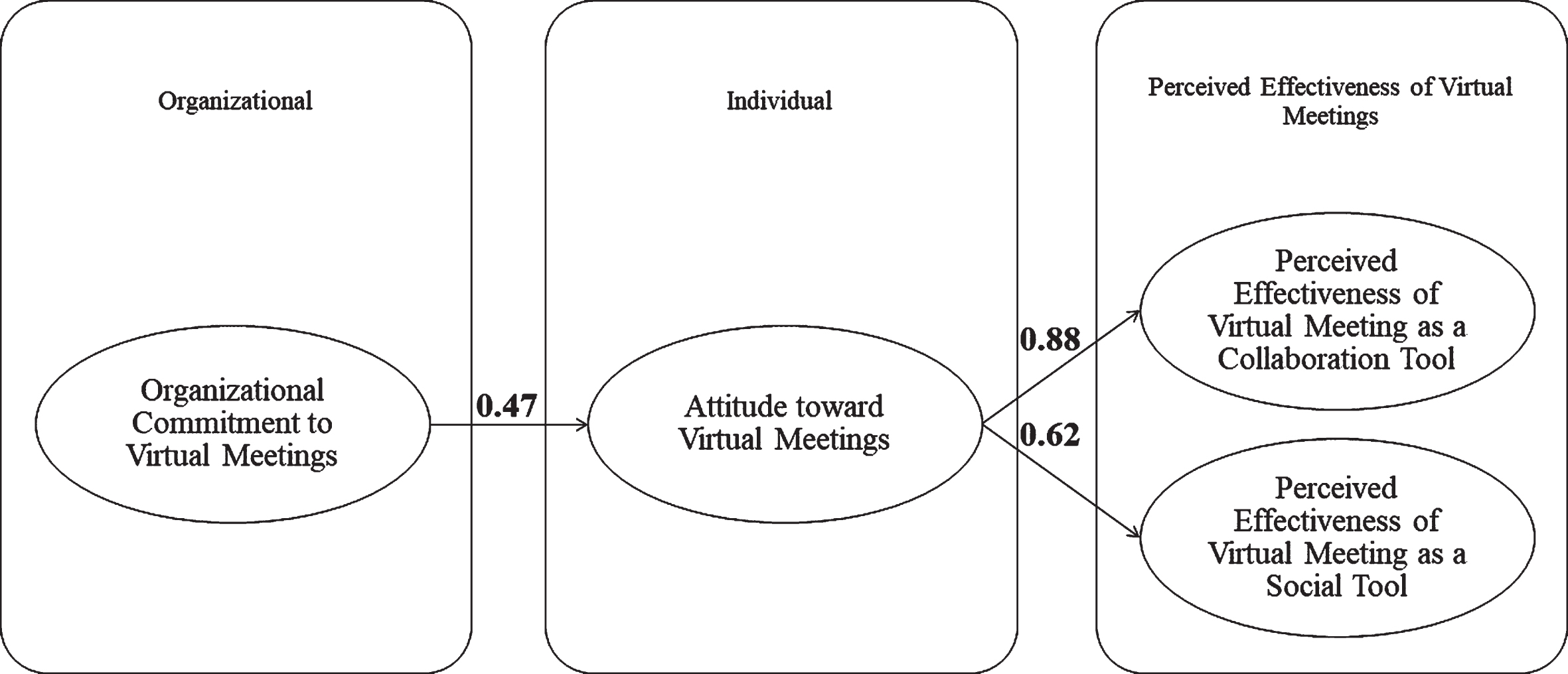
Analysis of direct effects in the structural research model.
Table 4 represents the details of the mean, standard deviation, and the factor loading for each indicator. As recommended by Hair, (2010), the factor loading should be higher or approaching to 0.7. There were 4 indicators which had factor loadings lower than 0.6: OC5 (0.471), A8 (0.572), PEC8 (0.593), and PES8 (0.552). Thus, we decided to eliminate these 4 indicators.
The relevant analytic values of the measurement model of the research
Note 1. Items (OC5, A8 and PES8) were removed from the instrument due to their lower value of factor loading. Note 2. StD = Standard Deviation, OC = Organizational Commitment, A = Attitude, PEC = Perceived Effectiveness as a Collaboration Tool, PES = Perceived Effectiveness as a Social Tool. Note 3. *p < 0.001.
Table 5 represents the model fit of the SEM construct. Based on this table, IFI, TLI, and CFI values were 0.924, 0.910, and 0.923 respectively, indicating that the model passed the suggested cut-off of 0.90 [26]. In addition, the GFI and AGFI values were 0.866 and 0.831 respectively, indicating that the model was also good [26]. Finally, the RMSEA value was 0.071 which also lower than the suggested cut-off of 0.80 [27], indicating that the model was a good representation of the observed data.
Model fit
Virtual meetings have been widely utilized during the COVID-19 pandemic. The purpose of this study was to explore the influence of organizational commitment on the perceived effectiveness of virtual meeting by Filipino professionals during the COVID-19 pandemic. A total of 513 Filipino professionals answered an online questionnaire which covered four latent variables: organizational commitment to virtual meetings, attitude toward virtual meetings, perceived effectiveness of virtual meeting as collaboration tool, and perceived effectiveness of virtual meeting as a social tool. This study highlighted the important of virtual meeting as collaboration and social tool which supported by the organizational commitment.
With a path coefficient of 0.47,
Meanwhile, Filipino professionals’ attitudes toward virtual meetings positively influenced their perceived effectiveness of virtual meeting as a collaboration tool. With a path coefficient of 0.88, this provided strong support for
Although not as high as the path coefficient for the attitudes’ influence on virtual meetings’ effectiveness as a collaboration tool, Filipino professionals’ attitudes toward virtual meeting still positively influenced their perceived effectiveness of virtual meeting as social tool with a path coefficient of 0.62. Thus, this result supported
Organizational commitment to virtual meetings
Items
Attitude toward virtual meetings
The attitudes of employees toward virtual meetings were reflected through items
Item
Perceived effectiveness of virtual meeting as a collaboration tool
Items
It was perceived, however, that virtual meetings do not provide the same level of collaboration as in-person meetings, which was evident to the 3.71 mean score of item
Another essential finding for this construct is that Filipino professionals strongly agree that virtual meeting has been a more valuable collaboration tool during COVID-19. Item
Perceived effectiveness of virtual meeting as a social tool
This latent construct focuses more on the effectiveness of virtual meeting as a tool for social interaction, more particularly in carrying non-work related activities out. Items
This finding supported the decision to remove item
Theoretical contributions
This study contributes to the use of communication technologies in organizations, particularly the use of virtual meetings. First, the study develops a model that evaluates perceived effectiveness of a certain technology based on two levels of influence—organizational and individual. It explores the influence of organizational endeavors on the attitude of and perceived effectiveness by employees toward a technology. The findings of the study supported the notion that an organization’s support and commitment to the implementation of a certain technology certainly have impacts on the attitudes of its employees on that particular technology. Concha et al. [19] have already pointed this out in their study, that an organization’s eagerness and commitment to implementing new technologies and changes provides strong contribution to the successful practice and use within the organization. Second, the study presents insights on how attitudes toward a certain technology used and deployed in the workplace are partly rooted from an organizational perspective. Employees’ attitudes on the acceptance and use of a certain technology is further motivated by how useful it is in their work and in carrying out their professional tasks and activities. Lastly, the study findings provided support to the notion that the attitudes of employees toward the technology translate to their perceived effectiveness. A technology that is both utilized and is strongly supported by the organization and its employees is perceived as an effective organizational tool.
Practical implications
The study holds relevant practical implications, especially during this era in which various organizational settings have been shifting toward WFH and remote setups. Organizations, particularly decision makers must consider strongly showing their support to the technologies deployed within their respective organizations. Currently, virtual meetings are at the forefront of these technologies as organizations across the globe have been working and collaborating virtually due to the risks posed by the COVID-19 pandemic.
Employees should also leverage and make the most out of these technologies to continue performing in their professional roles and sustain the services of their respective organizations through virtual meetings. Virtual meetings provide an avenue for professionals to collaborate, practice and carry out their work. Aside from work-related use, virtual meetings also allow employees to connect with their colleagues and flourish social connections despite the absence of personal and physical contact, especially during this pandemic. Maintaining social connections is extremely important these times as reiterated by the World Health Organization [1]. These technological capabilities translate to the perceptions and feedback on such technologies. Developers of virtual meetings could make use of the feedback and perceptions on these technologies and further improve their capabilities and potential to better support and deliver organizational needs along the way.
Despite the substantial and significant contributions, the authors would like to acknowledge two limitations of the current study. First, the current study mainly focused on the perceived effectiveness rather the effectiveness itself. A future study which correlate the subjective and objective measures of effectiveness study such as time efficiency through comprehensive usability will be a valuable topic. Second, our study did not correlate the employees’ personality to the attitude towards virtual meeting. Future research to incorporate employees’ personality will also be a very promising research topic.
Conclusions
Virtual meetings have been widely utilized during the COVID-19 pandemic [28, 29]. The purpose of this study was to explore the influence of organizational commitment on the perceived effectiveness of virtual meeting by Filipino professionals during the COVID-19 pandemic. A total of 513 Filipino professionals answered an online questionnaire which covered four latent variables: organizational commitment to virtual meetings, attitude toward virtual meetings, perceived effectiveness of virtual meeting as collaboration tool, and perceived effectiveness of virtual meeting as a social tool. SEM was utilized to analyze the causal relationships between the latent variables construct. SEM indicated that organizational commitment to virtual meeting during the COVID-19 pandemic influenced the positive attitude of the employees which subsequently led to the perceived effectiveness of virtual meeting as a collaboration and social tool. This study is one of the first studies that analyzed the influence of organizational commitment on the perceived effectiveness of virtual meeting during the global pandemic Our SEM construct can be applied and extended further, particularly in analyzing factors influencing the perceived effectiveness of virtual meeting during COVID-19.
Conflict of interest
The authors declare that they have no known competing financial interests or personal relationships that could have appeared to influence the work reported in this paper.
Footnotes
Acknowledgments
The authors would like to thank all participants in this study.