




Abstract
The Solid project aims to empower people with control over their own data through the separation of data, identity, and applications. The goal is an environment with clear interoperability between all servers and clients that adhere to the specification. Solid is a standards-driven way to extend the Linked Data vision from public to private data, and everything in between. Multiple implementations of the Solid Protocol exist, but due to the evolving nature of the ecosystem, there is a strong need for an implementation that enables qualitative and quantitative research into new features and allows developers to quickly set up varying development environments. To meet these demands, we created the Community Solid Server, a modular server that can be configured to suit the needs of researchers and developers. In this article, we provide an overview of the server architecture and how it is positioned within the Solid ecosystem. The server supports many orthogonal feature combinations on axes such as authorization, authentication, and data storage. The Community Solid Server comes with several predefined configurations that allow researchers and developers to quickly set up servers with different content and backends, and can easily be modified to change many of its features. The server will help evolve the specification, and support further research into Solid and its possibilities.
Keywords
Introduction
Data plays an important role in multiple aspects of our lives: from the data our government manages about us, to the items we store and share on the internet, to even everything about our online behavior that is being tracked online. Companies use that data to predict our future behavior and gain a competitive edge in their respective industries. This poses a considerable challenge for newcomers trying to establish themselves in a particular sector, as established companies have already amassed extensive data, creating a substantial barrier to outperforming them.
As companies wield considerable power over vast troves of data, individuals find themselves with minimal influence over the fate of their personal information. Due to companies’ control over such large data piles, individuals have very little influence over what happens to their own data. Fortunately, recent legislative changes, such as the GDPR in the EU and the CCPA in California, signal a positive shift, indicating that companies will eventually need to acknowledge their inability to exert complete control over all data. Once people regain control over their own data, they can decide with whom they wish to share it, thereby motivating companies to offer services of a high enough quality to earn that privilege. This dynamic would foster a mutually beneficial relationship, as end-users would experience tangible benefits from data sharing, such as personalized services, improved privacy, and greater transparency, ultimately resulting in a more valuable and sustainable data exchange.
Historically, Semantic Web research has focused on the exchange of Open Linked Data, with little consideration for data where access might be restricted by policies, as is the case with personal data. These restrictions drastically change the infrastructure and processes, such as publication and query processing. Nonetheless, Semantic Web technologies can play a crucial role in placing data closer to people, because they can give universal and connected semantics to data that is managed in a highly decentralized way.
Solid [22] is an ecosystem that rises to the challenge of tackling the private–public data spectrum. It does so by going from a horizontal centralization, where all data for a single company is centralized, to a vertical centralization, where data of all companies for a single user is centralized instead. The main idea is that everyone using Solid has one or more data pods containing their personal data. By setting relevant access policies, users can specify who can read or write parts of their data. Solid clients that know how to interact with such a server can then be used to access that data.
In an open ecosystem such as Solid, any party can implement a server, as long as they abide by the Solid Protocol specification [7]. Similarly, for the same reason anyone can also make a client to communicate with such a server. As a consequence – and this is a core part of Solid – any client can interact with the data created by any other client, on any Solid server. Since the data is stored in a user’s data pod and not in a specific client, clients should be seen as views and controls over that data. For example, one application could be used to set a person’s date of birth, which could then be used in a completely different one as a birthday reminder.
There are many invested parties in the Solid ecosystem: companies addressing real-world use cases, researchers want to evolve the specifications to suit the necessary demands, developers want to create clients and servers to extend the reach of Solid, and new users just want to try it out. In this paper we introduce the Community Solid Server (
The primary problem the
Our
In Section 2 we discuss related work. Section 3 covers specific use cases we want to solve with the server, which are generalized into requirements in Section 4. Section 5 and Section 6 explain how those requirements are fulfilled, the former through the software architecture and the latter through the configuration the server allows. Section 7 gives an overview of how the server is currently already being used, the impact it has, and how it solves the originally proposed use cases. Finally, we conclude in Section 8 where we also look towards the future of the server.
Preliminaries & related work
Before going into the specifics of our solution, we first give an overview of the relevant and related research.
Basic solid interaction
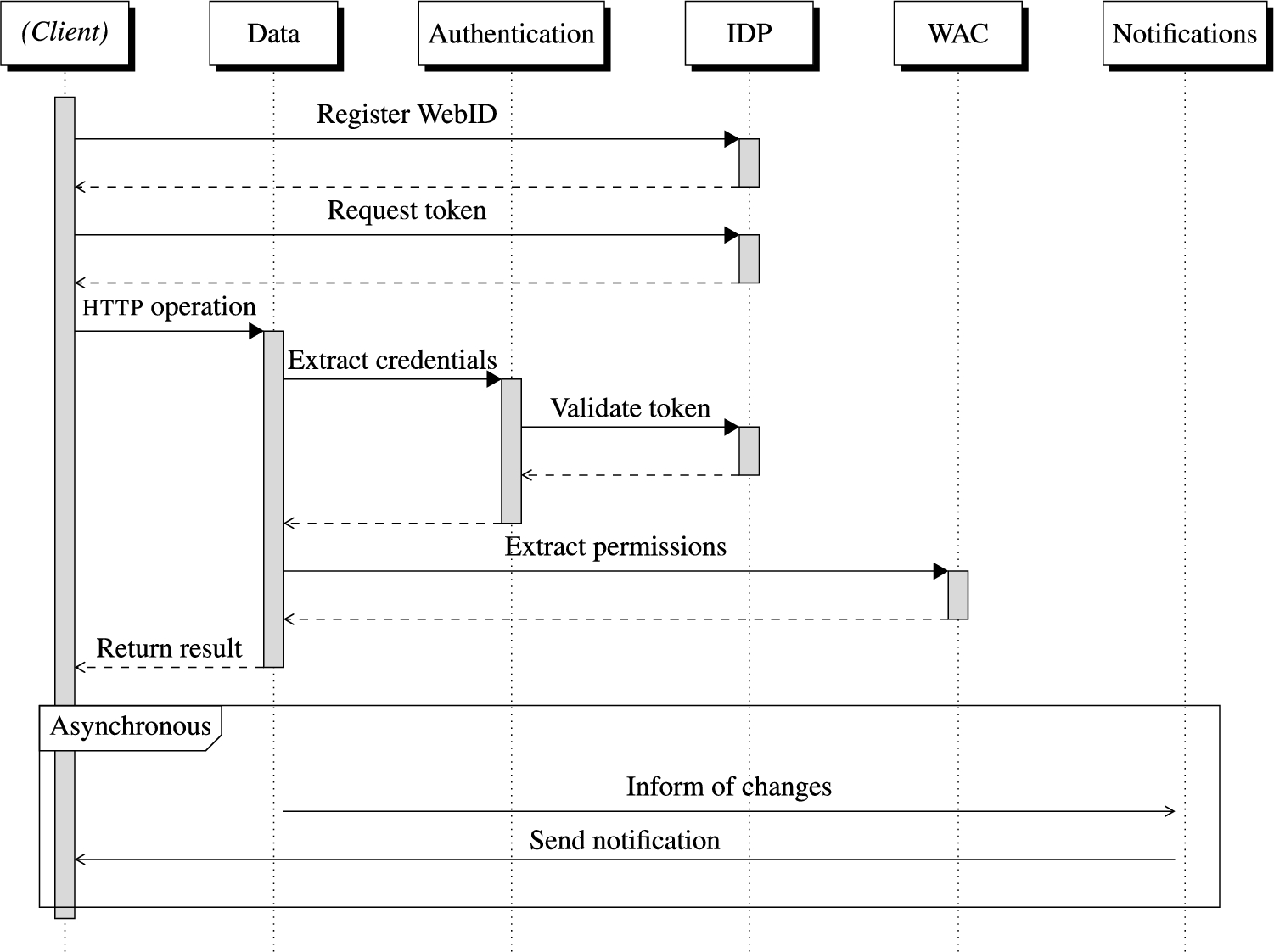
Before diving deeper into the specifications that define the client–server contract, we start with an overview of what happens during a request to such a server, in order to describe the high-level interaction.
Prerequisites
Combining Linked Data with authentication and authorization is an ongoing research topic with different potential solutions. One suggested solution is through the usage of WebIDs [20], which are
In the example below, we assume the user already registered their WebID with a Solid Identity Provider (
Performing an http request to a Solid server
When a client wants to access data on a Solid pod on behalf of a user, the following steps are performed:
The client asks the user to authenticate with their The client uses that authentication data to generate An The Solid pod contacts the If valid, the server uses those headers to determine the user’s credentials (such as the WebID) and their client. The server determines which permissions are available for the given credentials on the targeted resource, such as read, write, create, delete, etc. The server determines if the requested operation can be performed with the available permissions. If allowed, the server performs the operation and returns the result to the client.
Solid specification documents
The Solid ecosystem consists of a collection of specifications that clients and servers are required to adhere to. The interactions outlined above are captured in these specifications, of which the
History and current status
The initial version of Solid was developed in tandem with prototype implementations such as the Node Solid Server (
However, the Solid specifications are still evolving, with both changes to existing documents and additional documents being suggested as part of a multiphase process. Hence, there is a need for an implementation of the specifications that can be used to implement and test changes to the specifications, and to explore and prototype desired future behavior of Solid implementations.
Solid protocol
The Solid Protocol specification [7] is the main entry point into the collection of specification documents that define Solid. As the main entry point, it defines which other specifications are required to be fulfilled for a server to be Solid-compliant, which we will cover in the following subsections. In particular, it contains an adaptation of the Linked Data Platform (
Authentication
The Solid-
To conform to the Solid Protocol specification, a server of Solid pods needs to be able to accept requests containing these tokens and verify them. An OpenID Provider, on the other hand, is a server where clients can register to generate such tokens. To verify correctness of a token, the Solid server communicates with the OpenID Provider.
Authorization
A Solid server needs to be able to restrict access to private data. The specification defines two possible access control systems that can be used to do this: Web Access Control (
Notifications
The Notification specification [6] clarifies how users can register to specific resources, after which the server will inform them of any changes. At the time of writing, the specification only clarifies how clients can register, and the data models used during the communication process, but not which kind of messages need to be sent out. It also specifies many different methods a server is allowed to use to send out those notifications, such as WebSockets or Webhooks.
Existing implementations
Several implementations of the specification exist, both on the server side and on the client side; we provide a non-exhaustive list of server implementations.
Non-commercial implementations include projects such as the open-source Node Solid Server (
These implementations each have their own priorities, none of which is the core of what we want our server to focus on. This is why we created the server discussed in this paper, of which we will discuss the priorities in the following sections.
Solid Nextcloud adds support for the Solid protocol to Nextcloud, a collection of client and server software for using file hosting services. The main advantage here is that it builds on a known and stable storage method, adding extra functionality on top of it, which can be very useful for users already using Nextcloud as well.
The
TrinPod positions itself for Digital Twin use cases using the Solid specifications. It provides several utilities, independent of the Solid specification, focusing on supporting users working with such use cases, such as search functionality and advanced user interfaces.
Use cases
In this section, we give an overview of several use cases we wanted to support by creating a new server. These use cases were formulated based on discussions with community members and researchers who are familiar with the challenges and needs in developing and utilizing Solid servers. Each use case represents a practical scenario where the capabilities of the Community Solid Server (
Each of these builds upon the technology described in Section 2. In Section 7.2, we revisit these use cases and discuss how
Benchmarking the impact of authorization to inform the specification
A protocol researcher aims to benchmark the differences between
Performing user experience research on the onboarding experience
A societal researcher wants to compare different welcome experiences to a Solid server, specifically the sign-up experience and the initial layout and contents of a pod. This way they can determine what might be needed to improve the experience with Solid for new users. For this, they want to have a server where they can easily replace the contents that get provided to new users, without having to write any code.
Supporting new operations
The behavior of
Supporting the adaptation of research findings
Ongoing research looks at different aspects of the Solid Protocol and its implications on domains such as data management and security. Occasionally, findings from such research result in a necessity for changes or extensions to the specifications in order to alleviate the discovered concerns.
As a concrete example, recent research indicated a tension between the granularity of document organization and the granularity of the authorization system [10]. Their conclusion is that the same data needs to be exposed in different documents with different permissions. To investigate this, a server that allows for modifications in how to expose data is required.
Requirements
Out of the specific use cases in Section 3, we distilled several generic requirements that guide the design, architecture, and implementation of
Testable specification compliance
It stands to reason that the most important requirement for the server is that it is fully spec compliant. While that is an implementation objective, it is also necessary that we can verify and prove that this is the case. Ensuring compliance is critical for the use case of benchmarking authorization impacts, as it provides accurate and reliable results.
Evolve along with the specification
Solid is a combination of still evolving specification documents. It is imperative that the server can keep up with these changes; an outdated server could damage the ecosystem by sowing confusion about the correct behavior. Therefore, the server must be designed to be easily adapted with updates in the specifications.
Researchers and developers are at opposite ends here: researchers aim to inform the evolution of specifications, while developers prefer a more stable experience, yet want to be able to test their applications against the latest versions of the specifications. Both sides require a server that evolves to achieve their goals.
Since the server is a combination of several different specifications, the architecture needs to be designed in such a way that changes in one specification do not break a requirement of a different one: independence of all layers is important. This flexibility is necessary for the use cases of benchmarking authorization impacts and supporting new operations, ensuring the server remains relevant and accurate.
Support multiple server roles
Multiple servers are involved in a Solid interaction: the Solid server handles the core Solid protocol, and the OpenID Provider provides
Having an all-in-one system allows anyone to get started as easily as possible; modularity allows different kinds of instances from the same codebase. This modularity means different server roles can be configured and tested independently, allowing for comprehensive experimentation across the full range of Solid specifications. This requirement aligns with the use cases of performing user experience research and adapting research findings, providing a comprehensive testing environment.
Modularity and configurability
When conforming to the Solid specifications there is still room for variability, such as which authorization system to use, or even how the data is stored in the backend. Configuring changes like this in the server should be as easy as flicking a switch to go from one option to another.
For researchers, it is important to be able to compare different variations, so they can investigate the impact of certain changes. For example, having either
Developers want different server versions to make life easier for them when doing their work. Specifically, they need ways to simulate certain server situations to see how it reacts. E.g., force the authentication to extract specific credentials to simulate different users, disable authorization to focus on data management, cause the server to have faulty data for exception handling, etc. The use cases of benchmarking authorization impacts and supporting new operations benefit directly from this modularity, enabling varied configurations for thorough testing.
Allow extensions with new features
One part of doing research on Solid is designing new features based on emerging needs, with the ultimate aim of producing new specifications for uniform behavior. For example, currently the specification defines
Extensions could also replace existing parts of the server. Someone might want the data to be stored in a new type of backend for example, or provide a new implementation of a feature that is highly optimized for certain scenarios. The ability to extend and replace components is essential for all use cases, facilitating flexibility for new experiments and improvements.
Quick setup and teardown
A Solid server is not a simple piece of software. Generally there are additional steps that need to be taken before it can be started. These include configuration, starting external services, etc. Similarly, shutting down the server and resetting the system, so a clean restart is possible can also take multiple steps.
If we want the server to be used for rapid experimentation, it is important that there is as little overhead as possible. Researchers might want to quickly set up and switch between different kinds of servers to run their experimentation; for developers, this enables the server to be used within their test frameworks, automating the testing against a Solid server. For newcomers, it lowers the barrier of entry for getting started with Solid: the faster someone can go from reading about Solid to setting up a server, the better the introductory experience. This ease of setup and teardown supports all use cases, ensuring efficient experimentation and a smooth introduction to Solid.
Error handling and logging
Many steps happen during a Solid interaction, and when something goes wrong in a decentralized system, it is not always straightforward to determine which component is at fault. Therefore, it is necessary that the server has extensive error handling and logging. Researchers can use this to detect potential issues with specific interactions they might not have considered. Developers trying to debug or troubleshoot specific applications can receive better feedback this way. Extensive error handling and logging is crucial for all use cases, providing insights and feedback for debugging and improvements.
Architecture
Based on the requirements in the previous section, we now introduce the architecture of the Community Solid Server as an open-source implementation of the Solid specifications, tailored towards research and development.
For specification conformance,
Describes how the different components of the server interact with each other to resolve a request.
The different roles the server supports are independent of each other in the architecture. They might use some of the same utility classes and store data in the same way, but besides that, changes for one major component will have no bearing on one of the other ones. This allows us to limit the impact of evolving specifications as mentioned in the requirements.
As
The first step determines which major component should handle the request, based on the request type:
Requests for a fixed list of static resources, such as images and styling used on Interactions related to the Registering an account and pod on the server is completely independent of the The notification specification defines several interactions that need to be supported through an Any
Handling a Solid protocol operation
When handling a request targeting a Solid resource, 4 core steps need to happen sequentially:
Parsing the request.
Extracting and validating the credentials of the client.
Verifying the authorization of the request.
Performing the operation described in the request.
The result of these steps will then be used to generate the
Request parsing
In this step, the raw input is normalized and validated, so later classes do not have to worry about edge cases arising from permitted differences in description. The full
Finally, the body is processed in case of
Authentication
While authentication involves many separate steps,
Authorization
The authorization step determines if the agent identified by the credentials in the incoming request has the necessary permissions to perform the operation expressed therein. During the authorization step, we determine which internal access modes are required to fulfill the operation. For example, a
For each resource,
Once both of sets have been determined, they are compared to each other. If any of the required access modes is not found in the set of available modes, access to the resource will be forbidden, and the request will be terminated with an appropriate
Operation
After authorization succeeds, the request has to be handled according to rules defined in the Solid Protocol specification. There is a specific class for each
To support everything needed in the backend, we use multiple
Content negotiation The modular
To perform any kind of data conversion, we make use of a set of very narrowly focused conversion classes. All of these have a set of specific media types they can parse, and similarly a set it can convert to. For example, there is a converter that accepts various
A pathfinding algorithm chains multiple converters together as necessary to create a path starting from the resource media type as found in storage to the preferred type requested by the client, streaming data rather than materializing whenever possible. This allows for new conversion paths to be supported through a single new converter, rather than needing to implement all variations. For example,
Performing the requested operation Depending on the specific
Configuration
While we use the term “Solid server” throughout this paper, this can be a misnomer, as it might give the impression that a server is one opaque monolith. As indicated in Section 5, there are instead many components that play a role in a Solid operation. While these can all be realized on the same server, this is no such requirement; they could be split up over different servers with their own responsibility. Even then, there is still significant wiggle room as to how a server fulfills one or more of these roles.
One of the core parts of
All the
In Components.js, TypeScript class instantiations correspond to
To help users get started, the server comes with several pre-defined configurations, covering a range of possible feature combinations. These already cover several of the more expected server setups, with some variations in data storage methods or authorization systems for example. An overview of these can be seen in Table 1.
An overview of some preset configurations provided with the Community Solid Server. A more detailed overview can be found at https://github.com/CommunitySolidServer/CommunitySolidServer/tree/main/config
An overview of some preset configurations provided with the Community Solid Server. A more detailed overview can be found at
The preset configurations are made by clustering related components together in partial configuration files, and importing them in the main entry point. Features can then easily be chosen by changing what is imported. For example, to swap between
We chose TypeScript because of its inherent advantages such as design-time safety and the resulting typing documentation for developers who aim to reuse
In this section we give an overview of the support we provide to users wanting to get started with the server. We also provide several examples of people making use of the server, showcasing how what we described in the previous sections is well-received. We encourage readers to try out the server for themselves. A good starting point is following the tutorial at
All code of the Community Solid Server is open source under the
Sustainability
In the context of this work, sustainability refers to the ability of the server to remain reliable, maintainable, and up-to-date with evolving standards over time. During the development of the server, we have always focused on making sure the code base remained of high quality. One aspect of this is requiring the unit tests to always have 100% code coverage on all code in the project. While this is not immediately an indication of everything working as intended, it does make sure that a developer checks that new classes output data as expected. Besides the unit tests there are also extensive integration tests, setting up complete instances of the server and verifying these instances conform to all the necessary specifications.
The Conformance Test Harness (
This rigorous testing strategy contributes to the sustainability of the tool by ensuring that each new feature or change is thoroughly vetted for compliance and functionality. This helps maintain a high level of quality and reliability, ensuring that the server can evolve alongside the specifications without compromising on features.
This test harness is also an example of the community impact of creating this server. During the creation of this test harness, we provided feedback on certain tests being too strict or incorrect, while other tests showed us where the server implementation was wrong. This bidirectional approach caused both systems to improve.
Use case relevance
Having covered how the server works, we will now discuss how this solves the use cases described in Section 3.
Benchmarking the impact of authorization to inform the specification
A researcher aimed to compare
Configuring
In conclusion, they end up with three different configurations, which can all be used to independently set up the servers they need. Specifically the server without authorization can also be useful for developers not wanting to be bothered with restrictions during development.
Performing user experience research on the onboarding experience
The societal researcher wants to customize the welcome experience of a Solid server. Which
Supporting new operations
A researcher wants to support a new
Supporting the adaptation of research findings
Recent research showed that exposing the same data through different resources would solve several problems [10]. Even adding support for something like that in
Community impact
Since people started using the server, several of them have fed back input to help improve
Several external components have also been developed which either make use of the server, or create a new component that extends the server functionality, including:
integration with calendar management systems [16]
Internet of Things integrations [33]
Data-Kitchen, a desktop app combining local files and Solid pods [35]
Solid-Redis, a component for the server to use Redis as data storage [12]
input validation using shape files [21]
publishing event streams via Solid [34]
Another goal we wanted to achieve was to support client developers that need a server to test their client against during development. Below are some applications that use the server specifically for this purpose:
viewing and manipulating personal data in your Solid pod [24]
recipe manager to collect all your recipes [9]
The server has also been used for research & development by institutions, such as CERN, Geonovum, and Arbetsförmedlingen, the Swedish Public Employment Service.
Supporting people who use the server
Due to the server aiming to support many different scenarios, it can be overwhelming for new users to know how and where to start. To help users there, we have created extensive documentation, tutorials, and tools explaining and helping with different parts of the server.
The documentation [31] of the server is the best place to start as it links to all other resources available. The documentation itself covers several server-specific features and how to use them, such as automating pod creation on server startup for testing purposes. Besides the user documentation there is also an overview of core parts of the architecture. The components discussed in Section 5 are explored more deeply there. Finally, there are the full technical definitions of all the classes the package exports, which can be used by projects aiming to extend the server.
The server has extensive logging to help users keep track of the server internals. The logger makes use of log levels, so users can fine-tune the details of the output, going from just error levels that indicate an internal issue with the server, to debug levels where every resource lock is logged. It also includes additional details such as timestamps, the worker thread, and the component responsible
We created several extensive tutorials which guide the user along to solve specific problems. One tutorial [25] helps users who are completely new to Solid and shows how to interact with all the Solid core principles by setting up a CSS instance. It starts with showcasing the core Solid
An example repository [27] creates a Hello World component and extends
Many people prefer using a
Finally, as mentioned in Section 6, the server offers a very large number of configurable parameters for every one of its features. A disadvantage of using this method to configure a server, is that this can be overwhelming for users not familiar with Components.js. To this end, we created a Web-based graphical interface [30] that can generate such configurations automatically, based on the selection of desired features.
Conclusions & future work
We set out to create a Solid server with a specific set of requirements, focusing on flexibility, extensibility, and support for specific kinds of Solid users. Due to the usage of dependency injection, it is possible to run many variations of the server with different features, and to create new components that can be added. By structuring the configuration and providing plenty of supporting tools and documentation, we have lowered the barrier of entry as much as possible, making the server accessible for people looking to experience Solid, without hindering users looking for more advanced features.
There are several situations in which the server is being used: people created different components to be added to a default installation, it is being used during the testing of client applications, and there are several running Solid server instances making use of this software. More and more people are finding their way to the repository and interacting with it, showing a growing demand for a server that fulfills these needs.
Creating a new server in the Solid ecosystem also helps in improving the Solid specifications. By providing an alternative implementation it can reveal hidden assumptions that are not specified, but are depended upon due to the existing implementation having this specific behavior.
Work on the server is not finished yet, there are still many open issues that need to be resolved, many of which are feature requests on how the server can be extended. The
Footnotes
Acknowledgements
The research in this paper was supported by SolidLab Vlaanderen (Flemish Government, EWI and RRF project VV023/10). The development of the Community Solid Server has been supported by Inrupt, Inc.
The authors would like to thank Tim Berners-Lee for his dedication to the Solid project, with one of his many contributions being design and architecture for the Node Solid Server, which crucially informed