




Abstract
Knowledge Graph Question Answering (KGQA) has gained attention from both industry and academia over the past decade. Researchers proposed a substantial amount of benchmarking datasets with different properties, pushing the development in this field forward. Many of these benchmarks depend on Freebase, DBpedia, or Wikidata. However, KGQA benchmarks that depend on Freebase and DBpedia are gradually less studied and used, because Freebase is defunct and DBpedia lacks the structural validity of Wikidata. Therefore, research is gravitating toward Wikidata-based benchmarks. That is, new KGQA benchmarks are created on the basis of Wikidata and existing ones are migrated. We present a new, multilingual, complex KGQA benchmarking dataset as the 10th part of the Question Answering over Linked Data (QALD) benchmark series. This corpus formerly depended on DBpedia. Since QALD serves as a base for many machine-generated benchmarks, we increased the size and adjusted the benchmark to Wikidata and its ranking mechanism of properties. These measures foster novel KGQA developments by more demanding benchmarks. Creating a benchmark from scratch or migrating it from DBpedia to Wikidata is non-trivial due to the complexity of the Wikidata knowledge graph, mapping issues between different languages, and the ranking mechanism of properties using qualifiers. We present our creation strategy and the challenges we faced that will assist other researchers in their future work. Our case study, in the form of a conference challenge, is accompanied by an in-depth analysis of the created benchmark.
Introduction
Research on Knowledge Graph Question Answering (KGQA) aims to facilitate an interaction paradigm that allows users to access vast amounts of knowledge stored in a graph model using natural language questions. KGQA systems are either designed as complex pipelines of multiple downstream task components [4,9] or end-to-end solutions (primarily based on deep neural networks) [45] hidden behind an intuitive and easy-to-use interface. Developing high-performance KGQA systems has become more challenging as the data available on the Semantic Web, respectively in the Linked Open Data cloud, has proliferated and diversified. Newer systems must handle more volume and variety of knowledge. Finally, improved multilingual capabilities are urgently needed to increase the accessibility of KGQA systems to users around the world [23]. In the face of these requirements, we introduce QALD-10 as the newest successor of the Question Answering over Linked Data (QALD) benchmark series to facilitate the standardized evaluation of KGQA approaches.
The rise of Wikidata in KGQA
Among the general-domain KGs (knowledge graph) like Freebase [3], DBpedia [19], and Wikidata [44], the latter has become a focus of interest in the community. While Freebase was discontinued, DBpedia is still active and updated on a monthly basis. It contains information that is automatically extracted from Wikipedia infoboxes, causing an overlap. However, Wikidata is community-driven and continuously updated through user input. Moreover, the qualifier model1
Several works have contributed to the extension of the multilingual coverage of KGQA benchmarks. The authors of [48] were the first who manually translated LC-QuAD 2.0 [12] (an English KGQA benchmarking dataset on DBpedia) to Chinese. However, languages besides English and Chinese are not covered and the work does not provide a deeper analysis of the issues with the SPARQL query generation process faced when working with Wikidata. The RuBQ benchmark series [17,26] which was initially based on questions from Russian quizzes (totaling 2,910 questions) has also been translated to English via machine translation. The SPARQL queries over Wikidata were generated automatically and manually validated by the authors. The CWQ [8] benchmark provides questions in Hebrew, Kannada, Chinese, and English, with the non-English questions translated by machine translation with manual adjustments. The QALD-9-plus benchmark [22] introduced improvements and an extension of the multilingual translations in its previous version – QALD-9 [39] – by involving crowd-workers with native-level language skills for high-quality translations from English to their native languages as well as validation. In addition, the authors manually transformed gold standard queries from DBpedia to Wikidata.
Infobox for QALD-10
Infobox for QALD-10
In this paper, we present the latest version of the QALD benchmark series – QALD-10 – a novel Wikidata-based benchmarking dataset. It was piloted as a test set for the 10th QALD challenge within the 7th Workshop on Natural Language Interfaces for the Web of Data (NLIWoD) [47]. This challenge uses QALD-9-plus as training set and the QALD-10 benchmark dataset as test set. QALD-10 is publicly available in our GitHub repository.2
Benchmark repository:
A new complex, multilingual KGQA benchmark over Wikidata – QALD-10 – and a detailed description of its creation process;
An overview of the KGQA systems evaluated on QALD-10 and analysis of the corresponding results;
A concise benchmark analysis in terms of query complexity;
An overview and challenge analysis for the query creation process on Wikidata.
The QALD-10 benchmarking dataset is a part of the QALD challenge series, which has a long history of publishing KGQA benchmarks. The benchmark was released as part of the 10th QALD challenge within the 7th Workshop on Natural Language Interfaces for the Web of Data at European Semantic Web Conference (ESWC) 2022 [47].4
All the data for the challenge can be found in our project repository.5
The QALD-10 challenge training set includes 412 questions and the corresponding queries, which are runnable against our stable SPARQL endpoint. The SPARQL query transformation from DBpedia to Wikidata was done manually by a group of computer scientists who were the authors of the QALD-9-plus paper. As some of the queries were not transformable, the total number of questions decreased from 558 to 507 between QALD-9 and QALD-9-plus. The number of KGQA pairs further decreased to 412 with the introduction of our stable Wikidata endpoint. These 412 question-query pairs form the QALD-10 challenge train set.
The QALD-10 challenge test set (with 394 question pairs), in contrast, was created from scratch. In the first step, we collected 500 natural language questions in English from speakers with at least a C1-level language proficiency in accordance with the Common European Framework of Reference for Languages (CEFR) [7]. We collected equal amounts of questions from each participant to ensure that the questions are unbiased and express real-world information needs. Questions vary with respect to their complexity type, including questions with counts (e.g., How many children does Eddie Murphy have?), superlatives (e.g., Which museum in New York has the most visitors?), comparatives (e.g., Is Lake Baikal bigger than the Great Bear Lake?), and temporal aggregators (e.g., How many companies were founded in the same year as Google?).
Multilingual translations
To tackle the first challenge, the translations from English to Chinese, German, and Russian were created by crowd-workers in two steps: (1) each English question was translated into the target language by two native speakers, (2) the translations from the previous step were validated by another native speaker. To reduce ambiguity, the named entities in the questions were manually annotated with their Wikidata URIs (Uniform Resource Identifier) before translation. The crowd-workers were asked to follow the Wikidata label of a particular entity in their native language during the translation process. Note that 12 of the Wikidata items did not have Chinese versions so the respective questions could not be labeled accordingly. For instance, the entity “The Vanishing Half” (Wikidata ID: wd:Q98476957 ) in the question In which year was the author of “The Vanishing Half” born? did not have a Chinese entry.
From natural language question to SPARQL query
To tackle the
Stable SPARQL endpoint
Due to the constant updates of KGs like Wikidata, outdated SPARQL queries or changed answers can commonly cause problems for KGQA benchmarks. KG updates usually concern (1) structural changes, e.g., renaming of properties, or (2) alignment with changes in the real world, e.g., when a state has appointed a new president. According to our preliminary analysis on the LC-QuAD 2 benchmark [12], a large number of queries are no longer answerable on the current version of Wikidata. The original dump used to create the benchmark is no longer available online.7
Note, since the QALD-10 challenge training set was created before we set up this endpoint, some answers and queries had to be changed from the original release of QALD-9-plus. That is, the QALD-9-plus original data and the one used as QALD-10 challenge training data are different. Different versions are recorded as releases in the GitHub repository.10
To promote the FAIR principles (Findable, Accessible, Interoperable, and Reusable) [46] with respect to our experimental results, we utilize GERBIL QA [42],11
The F-measure is one of the most commonly used metrics to evaluate KGQA systems, according to an up-to-date leaderboard [24]. It is calculated based on Precision and Recall and, thus, indicates a system’s capacity to retrieve the right answer in terms of quality and quantity [21]. However, the KGQA evaluation has certain special cases due to empty answers (see also GERBIL QA [42]). Therefore, a modification was made to the standard F-measure to better indicate a system’s performance on KGQA benchmarks. More specifically, when the golden answer is empty, Precision, Recall, and F-measure of this question pair receive a value of 1 only if an empty answer is returned by the system. Otherwise, it is counted as a mismatch and the metrics are set to 0. Reversely, if the system gives an empty answer to a question for which the golden answer is not empty, this will also be counted as a mismatch. Our analyses consider both micro- and macro-averaging strategies. These two averaging strategies are automatically inferred by the GERBIL system.
During the challenge, only the Macro F1 QALD measure was used to rank the systems. This resulted from community requests12
The GERBIL system was originally created as a benchmarking system for named entity recognition and linking; it also follows the FAIR principles. It has been widely used for evaluation and shared tasks for its fast processing speed and availability. Later, it was extended to support the evaluation of the KGQA systems. While adopting the GERBIL framework, the evaluation can simply be done by uploading the answers produced by a system via web interface or RESTful API.13
See
To promote the reproducibility of the KGQA systems and open information access, we uploaded the test result of all systems to a curated leaderboard [24].15
After six registrations, five teams were able to join the final evaluation. Allowing file-based submissions rather than requiring web service-based submissions led to a higher number of submissions and fewer complaints by the participants compared to previous years. Thus, unfortunately, the goal of FAIR and replicable experiments is still unreached for KGQA. Among the participating systems, three systems papers were accepted to the workshop hosting the challenge.
QAnswer [10] is a rule-based system using a combinatorial approach to generate SPARQL queries from natural language questions, leveraging the semantics encoded in the underlying knowledge graph. It can answer questions on both DBpedia and Wikidata supporting English, French, German, Italian, Russian, Spanish, Portuguese, Arabic, and Chinese. This system, which does not require training, is run as a baseline system for our challenge due to its capacity to tackle multilingual data.
SPARQL-QA [ 30 ] is a QA system that exploits Neural Machine Translation (NMT) and Named Entity Recognition (NER) modules to create SPARQL queries from natural language questions. The MNT module translates the question into a SPARQL query template in which the KG resources are replaced by placeholders, while the NER module identifies and classifies the entities present in the question. The outputs of two modules are merged to produce a new equivalent of the original SPARQL query to be executed over Wikidata, by replacing the placeholders in the template with the corresponding named entities. An uniform input format, namely QQT (Question, Query Template and Tagging), is introduced to ensure training two modules together and reduce the impact of out-of-vocabulary (OOV) words.
Shivashankar et al. [ 31 ] presented a graph-to-graph transformation-based QA system using an Abstract Meaning Representation (AMR) graph to generate SPARQL queries, leveraging its ability to represent the semantics of a natural language. For a given question, its AMR graph is generated using a pre-trained multilingual AMR parser and simplified by removing unnecessary nodes and information. All possible executable SPARQL graphs are extracted from its simplified AMR graph. The system supports English and German questions.
Baramiia et al. [ 2 ] developed a QA system that first learns to predict representations of entities and properties which are close to correct queries and far from the others. It then finds the top-k nearest to the correct query via Scalable Nearest Neighbors method with the dot product similarity measure. It natively supports English but can be extended to the multilingual case using Transformers trained in other languages.
Suraj Singh and Dmitrii Gavrilev16
Their paper is not published in the proceedings.
All systems were evaluated on the test set of QALD-10 challenge before the challenge. Participants had to upload a file their QA system generates, upload it to the GERBIL system. which would output an URL based on submission. Participants submit the GERBIL URL with their final results. Table 2 shows the systems and their performances with links to GERBIL QA. In 2022, SPARQL-QA [30] won the QALD-10 challenge.
Evaluation results of the challenge participants’ systems
Evaluation results of the challenge participants’ systems
KGQA benchmarks should be complex enough to properly stress the underlying KGQA systems and hence not biased towards a specific system. Previous studies [28] have shown that various SPARQL features of the golden SPARQL queries, i.e, the corresponding SPARQL queries to QALD natural language questions, significantly affect the performance of the KGQA systems. These features include the number of triple patterns, the number of joins between triple patterns, the joint vertex degree, and various SPARQL modifiers such as LIMIT, ORDER BY, GROUP BY etc. At the same time, the KGQA research community defines “complex” questions based on the number of facts that a question is connected to. Specifically, complex questions contain multiple subjects, express compound relations and include numerical operations, according to [18]. Those questions are difficult to answer since they require systems to cope with multi-hop reasoning, constrained relations, numerical operations, or a combination of the above. As a result, KGQA systems need to perform aggregation operations and choose from more entity and relation candidates while dealing with those questions than on questions with one-hop relations.
In this section, we compare the complexity of the QALD-10 benchmark with QALD-9-plus with respect to the aforementioned SPARQL features. The statistics of the number of questions in different QALD series datasets is shown in Table 3. We use the Linked SPARQL Queries (LSQ) [33] framework to create the LSQ RDF (Resource Description Framework) datasets of both of the selected benchmarks for comparison. The LSQ framework converts the given SPARQL queries into RDF and attaches query features. The resulting RDF datasets can be used for the complexity analysis of SPARQL queries [27]. The resulting Python notebooks and the LSQ datasets can be found in our GitHub repository.17
Statistics of the number of questions in different QALD series datasets
When answering complex questions, KGQA systems are required to generate corresponding complex formal (SPARQL) queries, e.g., with multiple hops or constraint filters, that can represent and allow to answer them correctly. One way to represent the complexity of queries can be represented by the frequencies of modifiers (e.g.,
Frequencies of each modifier in different QALD series. Note that frequencies of modifiers with the “*” character are computed using keyword matching from SPARQL queries, while the others use the LSQ framework
Frequencies of each modifier in different QALD series. Note that frequencies of modifiers with the “*” character are computed using keyword matching from SPARQL queries, while the others use the LSQ framework
Structural complexity measured via the distribution of the number of triple patterns, the number of joins, and vertex degrees
To measure structural query complexity, we calculate the Mean and Standard Deviation (SD) values for the distributions of three query features respectively: number of triple patterns, number of join operators, as well as joint vertex degree (see the definitions in [29]). These features are often considered as a measure of structural query complexity when designing new SPARQL benchmarks [27–29]. The corresponding results are presented in Table 5. Again, the Wikidata-based datasets of QALD-9-plus have a lower distribution mean than their DBpedia counterparts and, thus, a lower complexity in general. Compared to the QALD-9-plus test sets, the QALD-10 test has a higher variation for the number of triple patterns and the number of join operators, as well as the second largest SD for joint vertex degree. This can be interpreted as getting the correct answers for the QALD-10 benchmark might be more difficult due to a wider range of possible SPARQL queries as compared to QALD-9-Plus
Query diversity score
From the previous results, it is still difficult to establish the final complexity of the complete benchmark. To this end, we calculate the diversity score (DS) of the complete benchmark B, formally defined as follows [29].
Query diversity score of different QALD benchmarks
Query diversity score of different QALD benchmarks
During the creation of QALD-10 test SPARQL queries for given natural language questions, we identified several challenges. Therefore in this section, we formulate our challenges and solutions during the SPARQL generation process to aid further research in KGQA dataset creation as well as Wikidata schema research. Below, we systematically classify the problems into seven categories: (1) the ambiguity of the questions’ intention, (2) incompleteness of Wikidata, (3) ambiguity of SPARQL queries, (4) limit on returned answers, (5) special vocabulary, (6) calculation limitation of SPARQL, and (7) endpoint version change. We discuss the cause of these issues and present our solutions.
Ambiguity of the natural language question
The question What is the biggest city in the world? could be asking for the most populous city or the geographically largest city. This is an example for an ambiguous natural language question. We tried to circumvent this type of questions by specifically, asking crowd-workers to phrase their questions precisely. After data collection, we chose the most reasonable interpretation based on real world experience, where necessary. Thus, in the example above, the question was changed to What is the most populous city in the world?. Some questions, however, remain vague and consequently correspond to multiple SPARQL queries. For instance, the question: How many spouses do head of states have on average? translates to:
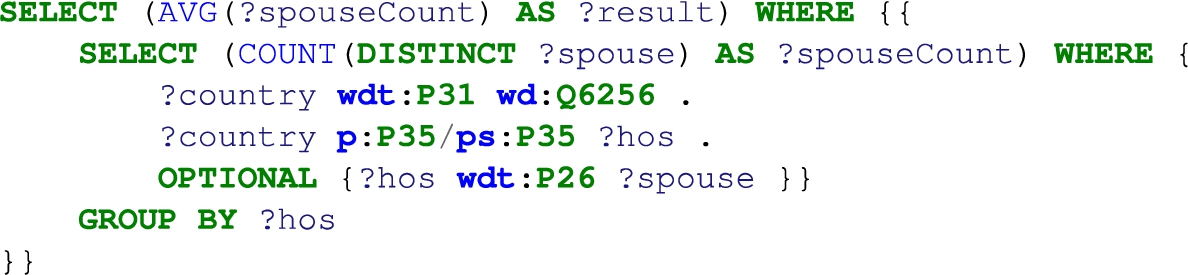
where we used a head of state-property. However, using a head of state-class would also be feasible, leading to the SPARQL query below. There is no good way to make the question clearer except if one specifies the actual Wikidata elements, which is not realistic for real-world questions.

Incompleteness of Wikidata
Due to the incompleteness of Wikidata, some of the entity labels do not translate to all languages of interest (see Section 2.2). To avoid unanswerable questions, we supplemented the online Wikidata by manually adding a translation approved by a linguist. However, this update is not shown in our stable endpoint which has a fixed Wikidata dump. Consequently, the labels are still missing but the questions-query-answer tuples are inserted into QALD-10 benchmark dataset.
Another issue that can arise from Wikidata’s incompleteness is that data necessary to answer specific SPARQL queries can be missing. In this case, the answer can not be retrieved by a correct SPARQL query since there are no suitable triples available directly. In our benchmark, questions of this category were deleted.
Ambiguity of SPARQL queries in Wikidata due to ranking of properties
Ambiguities of SPARQL queries in Wikidata are connected to the ranking mechanism of Wikidata. This mechanism allows to annotate statements with preference information.18
The “
The “
This makes “
When a question gets complex, it is problematic to guarantee the correctness and completeness of its query e.g., Which businesses are founded by the person in charge of Tesla?. Here, our intuitive solution would be:

Despite the exact term “business” being signified, in QALD-10 benchmark dataset, we use a property path in the last BGP 21
The limit on returned answers is a significant problem in creating this dataset. A substantial amount of questions have a limited result set due to Wikidata’s factual base. For instance, the question: List the novels that won the Modern Library 100 Best Novels ( wd:Q671613 )? has one answer although one would expect 100 results with common sense. As a result, we discarded such questions from QALD-10 test set to maintain a righteous benchmark.

Special characters
A number of questions are based on special characters. For instance questions, Find all Turkish verbs ending with “uş” in their lemma. and When did the district of Höxter come into existence? have special characters or ask for special Wikidata properties (see example below). We tried to keep those kinds of questions with their corresponding queries as much as possible to foster multilingual KGQA research.

Computational limitations in SPARQL
SPARQL has limited capabilities to deal with numbers. For instance, there is a lack of native normalization for numeric values in Wikidata. For instance, a comparison or SPARQL result modifier like below does not take units into account:

Therefore, 100 centimeters could be bigger than 10 meters. The following query takes units into account but requires a more complicated structure:

Hence, simple comparison queries may require a high level of expertise of the Wikidata schema, which makes the KGQA task on these questions more challenging. Also, there are rounding errors in calculations. For instance, corresponding to question: How many years did Steve Jobs take the role of Apple CEO?, the SPARQL would be:

The answer based on common sense is “14”, however, the query execution produces the following:
Endpoint version changes
Finally, version changes in the endpoint and endpoint technology, especially when switching between the graph stores HDT [13] and Fuseki,22
The QALD-10 benchmarking dataset is the latest version of the QALD benchmark series that introduces a complex, multilingual and replicable KGQA benchmark over Wikidata. We increased the size and complexity over existing QALD datasets in terms of query complexity, SPARQL solution modifiers, and functions. Also, we presented the issues and possible solutions while creating SPARQL queries from natural language. We have shown how QALD-10 has solved three major challenges of KGQA datasets, namely poor translation quality for languages other than English, low complexity of the gold standard SPARQL queries, and weak replicability. We deem solving the migration to Wikidata issue an important puzzle piece to providing high-quality, multilingual KGQA datasets in the future.
We were able to prove the appropriateness and robustness of the dataset by means of an ESWC challenge. Due to a pull request from the participant group,24
In the future, we will focus on generating and using existing complex, diverse KGQA datasets to develop large-scale KGQA datasets with advanced properties such as generalizability testing [14,15] to foster KGQA research.
Footnotes
Acknowledgements
This work has been partially supported by grants for the DFG project NFDI4DataScience project (DFG project no. 460234259) and by the Federal Ministry for Economics and Climate Action in the project CoyPu (project number 01MK21007G). We thank also Michael Röder for supporting the GERBIL extension