

Open information extraction approaches are useful but insufficient alone for populating
the Web with machine readable information as their results are not directly linkable to,
and immediately reusable from, other Linked Data sources. This work proposes a novel
paradigm, named Open Knowledge Extraction, and its implementation (Legalo) that performs
unsupervised, open domain, and abstractive knowledge extraction from text for producing
machine readable information. The implemented method is based on the hypothesis that
hyperlinks (either created by humans or knowledge extraction tools) provide a pragmatic
trace of semantic relations between two entities, and that such semantic relations, their
subjects and objects, can be revealed by processing their linguistic traces (i.e. the
sentences that embed the hyperlinks) and formalised as Semantic Web triples and ontology
axioms. Experimental evaluations conducted on validated text extracted from Wikipedia
pages, with the help of crowdsourcing, confirm this hypothesis showing high performances.
A demo is available at http://wit.istc.cnr.it/stlab-tools/legalo.
Populating the Semantic Web from natural language text
The vision of the Semantic Web is to populate the Web with machine understandable data so
that intelligent agents will be able to automatically interpret its content – just like
humans do by inspecting Web content – and assist users in performing a significant number of
tasks, relieving them of cognitive overload.
The Linked Data movement [2] realised the first
substantiation of this vision by bootstrapping the publication of machine understandable
information, mainly taken from structured data (mostly databases) or semi-structured data
(e.g. Wikipedia infoboxes). However, a large part of the Web content consists of natural
language text, hence a main challenge is to extract as much relevant knowledge as possible
from this content, and publish it in the form of Semantic Web triples. This work aims to
solve this problem by extracting relational knowledge that is “hidden” in hyperlinks, which
can be either defined manually by humans (e.g. Wikipedia pagelinks) or created automatically
by Knowledge Extraction (KE) systems (e.g. a KE system can automatically add links to
Wikipedia pages or to local datasets of Semantic Web entities).
Current KE systems address the task of linking pieces of text to Semantic Web entities very
well (e.g. owl:sameAs) by means of named entity linking methods, e.g.
NERD1
TAGME [14], Babelfy [29]. Some of them (e.g. NERD) also perform sense tagging, i.e. adding
knowledge about entity types (rdf:type).
Nevertheless, it is desirable to enrich Web content with other semantic relations than
owl:sameAs and rdf:type, i.e. factual
relations between entities. A pragmatic trace of a factual relation between
two entities is the presence of a hyperlink, which is associated with its linguistic
trace, i.e. the text surrounding the hyperlink. In fact, when we include a link
in a Web page, we usually have a semantic relation in mind between something we are
referring within the page, i.e. subject, and something referred by the target page, i.e.
object, and the text where the hyperlink is embedded often provides an explanation of what
such relation is. For example, a link to “Usenet” in the Wikipedia page of “John McCarthy”
suggests a semantic relation between those two entities, which is explained by the sentence:
“McCarthy often commented on world affairs on the Usenet
forums”.6
Besides common sense, this hypothesis is also supported by a previous study [33], which describes the extraction of encyclopedic
knowledge patterns for DBpedia types, based on links between Wikipedia pages. A user study
showed that hyperlinks between Wikipedia pages determine relevant descriptive contexts for
DBpedia entities at the type level, which suggests that these links mirror relevant semantic
relations between entities.
A hyperlink in a Web page can be produced either by a human or a KE system (e.g., by
linking a piece of text to a Wikipedia page, which in turn refers to a Semantic Web entity,
i.e. a DBpedia entity). If a KE system recognises two or more entities in a sentence, there
is a possibility that such sentence expresses some relation between them. For example, the
following sentence:
The New York Times reported that John McCarthy died. He
invented the programming language LISP.
can be automatically enriched
using a KE system by linking the text fragments “The New York Times”, “John MacCarthy”, and
“LISP” to the Wikipedia pages wikipedia:The_New_York_Times,7
Wikipedia:
stands for http://en.wikipedia.org/wiki/.
wiki-pedia:John_McCarthy_(computer_scientist) and
wikipedia:Lisp_(programming_language) (respectively), resulting in
the following:
The New York Times reported that
John McCarthy died. He invented the programming language
LISP.
In this example, the three hyperlinks
identify entities that are relevantly related by factual relations: “John McCarthy” with
“The New York Times”, and “John McCarthy” with “LISP”. By generalising this concept, any
recognised named entity in a sentence (even if not associated with an existing Web URI) can
be treated as a potential hyperlink target (e.g. to a local knowledge base). In the rest of
the paper we use examples with entities that can be resolved to DBpedia, for the sake of
simplicity. Revealing the semantics of hyperlinks (either defined by humans or KE systems)
has a high potential impact on the amount of Web knowledge that can be published in machine
readable form.
Comparison between relations resulting from extractive and abstractive approaches for
the sentence “John Stigall received a Bachelor of
arts from the State University of New York at
Cortland”
Subject
Predicate
Object
Approach
John Stigall
received
a Bachelor of arts
extractive
John Stigall
received
from the State University of New
York at Cortland
extractive
dbpedia:John_Stigall
myprop:receive_academic_degree
dbpedia:Bachelor_of_arts
abstractive
dbpedia:John_Stigall
myprop:receive_academic_degree_from
dbpedia:State_University_of_New_York
abstractive
In the Semantic Web era, such factual relations should be expressed as RDF triples where
subjects, objects, and predicates have a URI (except for literal objects and blank nodes),
and predicates are formalised as RDF/OWL properties, in order to facilitate their reuse and
alignment to existing vocabularies, and for example to annotate hyperlinks with RDFa, within
HTML anchor tags.
While subjects and objects can be mostly directly resolved through existing public or local
Semantic Web entities, predicates are to be defined by performing “paraphrasing”, a
summarisation task that abstracts over the text (when needed) in order to design labels that
are as close as possible to what a human would design for a Linked Data vocabulary. In this
respect, [40] distinguishes between extractive
and abstractive summarisation approaches. Extractive methods select pieces of texts from the
original source in order to define a summary (i.e. they rely only on the available text),
while abstractive techniques ideally rely on modelling the text, and then combining it with
other resources and language generation techniques for generating a summary. Abstractive
methods are usually applied to large documents to the aim of producing a meaningful summary
of their content.
This work proposes to apply the guiding principle of abstractive techniques to open
information extraction as a novel contribution. Open information extraction refers to an
open domain and unsupervised extraction paradigm. Existing open information extraction
approaches are mainly extractive, hence showing a complimentary nature to what we present in
this paper. They mostly focus on breaking text in meaningful fragments for building
resources of relational patterns (e.g. PATTY [30],8
),
in some cases disambiguated on external semantic resources such as WordNet.10
http://wordnet.princeton.edu/.
Others focus on extracting facts, which are represented as simplified strings between
entities (e.g. Open Information Extraction (OIE) [12,26]11
http://openie.cs.washington.edu/.
)
that are not given a Semantic Web identity.
Knowledge extraction for the Semantic Web should instead include an abstractive step, which
exploits a formal semantic representation of text, and produces output that is compliant
with Semantic Web principles and requirements. The method described in this paper
demonstrates this novel approach, called Open Knowledge Extraction (OKE).
For example, given the sentence:
John Stigall received
a Bachelor of arts from the State University of New
York at Cortland.
Table 1
compares the extracted relations resulting from an extractive approach (such as OIE [26]12
Notice that this is the output of OIE for this
sentence.
) – the first two rows – and from an abstractive approach – the last
two rows. The abstractive results exemplify the expected result of a OKE system. The main
difference is that with the abstractive approach, subjects and objects are identified as
Semantic Web entities, the predicate is as close as possible to what a human would define
for a Linked Data vocabulary by possibly using terms that are not mentioned in the original
text. In addition to what Table 1 shows, the predicate would be
formally defined in terms of OWL axioms and possibly aligned with existing Semantic Web
vocabularies.
Contribution
The main contributions of this work are:
the introduction of Open Knowledge Extraction (OKE), a paradigm
based on unsupervised, open domain, and abstractive knowledge extraction from text for
producing directly usable machine readable information;
an implementation of OKE, named Legalo that given an English
sentence produces a set of RDF triples representing relevant factual relations
expressed in the sentence, the predicates of which are formally defined in terms of
OWL axioms;
an evaluation of Legalo performed on a corpus of validated sentences from Wikipedia
pages that provide evidence of factual relations. The results have been evaluated with
the help of crowdsourcing and the creation of a gold standard, all showing high values
of precision, recall, and accuracy;
a discussion highlighting the current limits of the approach and possible ways of
improving it, and including an informal comparison of the proposed method with one of
the main existing open information extraction tools.
Additionally, the paper includes a brief description of a specific implementation of OKE,
specialised for extracting the semantics of Wikipedia pagelinks, which has been evaluated
in [39] showing promising results.
The paper is structured as follows: Section 2 introduces a
novel paradigm named Open Knowledge Extraction. Sections 3 and
4 describe the implementation of an OKE system, named
Legalo, focusing on the method implemented and the pipeline of
components, respectively. Legalo has been evaluated with the help of crowdsourcing, as
described in Section 5. Section 6 discusses the limits of the method and possible ways to improve it, and
informally compares Legalo with Open Information Extraction (OIE) [26]. Section 7 discusses relevant
related research work and finally, Section 8 summarises the
contribution of this work and indicates future works.
Introducing Open Knowledge Extraction
According to [12], an Open Information Extraction
(OIE) system: “facilitates domain independent discovery of relations extracted from text and
readily scales to the diversity and size of the Web corpus”. In other words, OIE
revolutionised the information extraction paradigm by introducing unsupervised learning,
domain-independence of the extracted relations, and the ability to scale both on size and
heterogeneity dimensions of the Web. The Open Knowledge Extraction (OKE) paradigm poses its
focus on making the extracted relations directly usable in a Semantic Web context.
An Open Knowledge Extraction (OKE) system is expected to perform unsupervised, open domain,
and web scale extraction and to additionally have the following capabilities:
Relation assessment
To assess if a natural language sentence provides an evidence of a relevant relation
between a given pair of entities, which may be identified by hyperlinks;
relevant here means that there are enough explicit traces in the
sentence to support the existence of a (conceptual) relation;
Label generation
To generate a predicate for this relation, with a label that is as close as possible
to what a human would define for a Linked Data vocabulary;
Property formalisation
To formalise this relation as an OWL object property with TBox axioms (conceptual
level), as well as to produce ABox axioms (factual level) using that property.
More formally:
(Relevant relation).
Let s be a natural language textual sentence embedding some hyperlinks,
and a pair of entities mentioned
in s, where and
are the target
entities referred by two hyperlinks in s, is a relevant relation
between and
, expressed in
s, with being the subject
of φ and being its object.
is a set of Linked Data labels generated by
humans for . Finally,
is a label generated by an OKE system for .
An OKE system is able to assess the existence of , to generate a label
equal or very similar to , and to formalise it as a
Semantic Web property. Notice that not all relations are binary, for example events have
time and space indexing, there are relations that naturally take more than two arguments
e.g. Mary gave a book to John, as present for his birthday. For this reason
an OKE system has to take into account the n-ary nature of relations and
cope with expressing them as triples, given the pragmatic constraint of Semantic Web
standard languages. This impacts on the complexity to assess the existence of
and to generate an adequate
label for it, especially when is the projection of a
n-ary relation.
Frame-based formal representation for the sentence: “The New York
Times reported that John McCarthy died.”.
Legalo: An OKE implementation that generates Semantic Web properties from text
One of the main contributions of this paper is the implementation (and evaluation, cf.
Section 5) of an OKE system, named
Legalo.13
A demo of Legalo is available at
http://wit.istc.cnr.it/stlab-tools/legalo/.
The method implemented by Legalo is based on six main steps:
internal formal representation of the sentence
(abstractive step);
assessment of the existence of a relevant relation between pairs of entities
identified in s, according to the content of the
sentence;
extraction of relevant terms for
the predicate (extractive step);
generation of the predicate label (abstractive
step);
formal definition of the
predicate within the scope of its linguistic evidence and formal representation
(abstractive step);
alignment (whenever possible) to existing Semantic Web
properties.
Frame-based formal representation of a sentence
Legalo relies on a set of rules to be applied to a frame-based formal representation
G of the sentence s (cf. Definition 2). G is a RDF graph designed following a
frame-based approach, where nodes represent entities mentioned in s.
(Frame-based graph).
Let s be a natural language text sentence and
a RDF (directed, multi-) graph modelling a
frame-based formal representation of s, where is the set of nodes (i.e. subjects and
objects from RDF triples) in G, is the set of edges (i.e. RDF triples) in
G, where , is a triple connecting
and with the RDF property
p in G, and is the node in
G representing the entity mentioned in
s.
Frame Semantics [15] is a formal theory of
meaning: its basic idea is that humans can better understand the meaning of a single word
by knowing the relational knowledge associated to that word. For example, the sense of the
word buy can be clarified in a certain context or task by knowing about
the situation of a commercial transfer that involves certain individuals playing specific
roles, e.g. a seller, a buyer, goods, money, etc.
In this work, frames are usually expressed by verbs or other linguistic constructions,
and their occurrences in a sentence are represented as RDF n-ary
relations, all being instances of some type of event or situation (e.g.
myont:buy_1 rdf:type myont:Buy), which is on its turn represented
as a subclass of dul:Event.14
Intuitively, dul:Event is the top category of all frames expressed
by verbs. In the context of this paper, the terms frame occurrence and event occurrences
are used as synonyms. Entities that are mentioned in s are represented as
individuals or classes, depending on their nature, which (ideally) have a type, defined
based on the information available in the sentence s. When appropriate,
entities are represented as arguments of n-ary relations, according to
the role they play in the corresponding frame occurrence. The role of an entity in an
event occurrence can be expressed either by a preposition, e.g. Rico Lebrun
taughtatthe Chouinard Art Institute, or it can be abstracted from the text and
represented by reusing the set of thematic roles defined by VerbNet [42], e.g. Rico Lebrun is the agent of the event
occurrence “teach” in the above sample sentence.
A formal and detailed discussion of the theory behind frame-based formal representation
of knowledge extracted from text, and used by Legalo is beyond the scope of this paper.
This modelling approach and its founding theories are extensively described in [15,32,38]. However, an example may be
useful to convey the intuition behind the theory. Figure 1
shows a frame-based representation of the sentence:
The New York
Times reported that John McCarthy
died.
The knowledge extracted from the sentence s is
formalised as a set of RDF triples G. The figure is derived from the
output of FRED [38] (see Section 4), the component providing the frame-based formal representation
within Legalo. The prefix fred: stands for a local configurable
namespace. Two entities can be identified in this sentence, i.e. “New York Times” and
“John McCarthy”, represented in G as individuals i.e.
fred:New_York_Times and
fred:John_McCarthy, respectively. Two frame occurrences can be
identified in the sentence: one expressed by (an inflected form of) the verb
report and the other expressed by the verb die. These
frame occurrences are represented as n-ary relations: i.e.,
fred:report_1 and fred:die_1, both being
instances of classes (fred:Report and
fred:Die respectively) that are of type
dul:Event. Let us consider the event occurrence
fred:report_1. Its arguments are: (i)
fred:New_York_Times, which plays an agentive
role in this event occurrence, formally expressed by the predicate
vn.role:Agent,15
Prefix vn.role: stands
for http://www.ontologydesignpatterns.org/ont/vn/abox/role/, which defines
all VerbNet [42] thematic roles.
and fred:John_McCarthy, who plays a passive role,
formalised by the predicate vn.role:Theme, both VerbNet thematic
roles.
Relevant relation assessment
To assess if a relevant relation exists in s
between a pair of entities , Legalo relies on the
analysis of the semantic structure of G. Firstly,
is assumed to hold only if
there is at least one path in G connecting and
, i.e. the nodes
representing and
in
G, regardless of the edge direction in G. This is
formally expressed by Axiom 1, given Definition 3.
(Graph path).
is the undirected version of
. A path with and
is any sequence
alternating nodes and edges in
connecting to
, or vice versa. The
set includes all edges and nodes in
excluding
and
.
(φ assessment: necessary condition).
If exists, Legalo distinguishes
whether contains an event
occurrence, or not. If does not contain any event
occurrence, then the existence of is a sufficient condition to
the existence of (cf. Axiom 2).
(Assessment of φ: sufficient condition without event
occurrences).
In the other case, i.e. the path includes an event occurrence, exists if
is the subject
of the event verb in the sentence. In the graph G this means that the
node representing
in
G participates in the event occurrence with an agentive role. This is
formalised by Axiom 3, given Definition 4.
Frame-based formal representation for the sentence: “After a move to
Southern California in 1938, Rico
Lebrun taught at the Chouinard Art Institute and
then at the Disney Studios”. Legalo will select the pairs of
entities
(fred:Rico_lebrun, Chouinard_art_institute),
(fred:Rico_lebrun,
fred:Disney_studios), and
(fred:Chouinard_art_institute,
fred:Southern_California).
(Agentive roles).
Let f be a node of G such that
is the set of possible roles participating
in f, is the set of VerbNet
agentive roles, with , and
is a role connecting the
event occurrence f to its participant (the node
representing ) in
s.
(Assessment of φ with event occurrences: sufficient
condition).
This axiom is based on linguistic typology results (e.g. [7]), by which SVO (Subject-Verb-Object) languages such as English
have almost always an explicit (or explicitable) subject. This subject is formalised in a
frame-based representation of s by means of an agentive role. Based on
this observation, our method assumes that exists if
is the subject
of a verb in s. This axiom is potentially restrictive with respect to the
idea of a relevant relation expressed in a sentence, which may consider any pair of
entities as related just because they are mentioned in a same sentence. In fact, this idea
is quite difficult to implement, since relations between pairs of entities that play e.g.
oblique roles (oblique roles are neither agentive or passive, e.g. “manner”, “location”,
etc.) in a frame occurrence are hard to paraphrase even for a human. For example, consider
the sentence:
After a move to Southern California in
1938, Rico Lebrun taught at the Chouinard Art
Institute and then at the Disney
Studios.
the frame-based representation of this sentence,
depicted in Fig. 2 identifies Rico Lebrun as the agent of a
“teach” frame occurrence, while Southern California, Chouinard Art Institute, and Disney
Studios participate in it with oblique roles. This sentence expresses three relevant
relations: one between Rico Lebrun and Chouinard Art Institute, one between Rico Lebrun
and Disney Studios, and another between Rico Lebrun and Southern California. All those
relations can be summarised and represented as RDF triples, by Legalo.
While it is correct to state that Chouinard Art Institute and Disney Studios
co-participate in an occurrence of the frame “teach”, it is far from straightforward to
paraphrase the meaning of this relation. E.g., one might say that Chouinard Art Institute
and Disney Studios are both places where Rico Lebrun used to teach, but this paraphrase is
not easily reconstructable from the text, and needs a stronger language generation
approach, which has not been tackled for the moment. Additionally, such a paraphrase would
not be usable for a binary predicate. A way to represent this relation is a generic
co-participation relation, which is however too generic to be considered as relevant.
For this reason, the investigation of paraphrases of relation between entities
co-participating in an event with oblique roles is left to further study. An interesting
analysis on this problem that could suggest new work directions is discussed in [8].
Frame-based formal representation for the sentence: “In February 2009
Evile began the pre-production process for their second album
with Russ Russell” The graph is enriched with verb senses to
disambiguate frame types, DBpedia entity resolutions, thematic roles played by DBpedia
entities participating in frame occurrences, and entity types.
Combining extractive and abstractive design for property label generation
As far as the generation of
is concerned (cf. Definition 1), Legalo combines extractive
with abstractive techniques [40]. It means that
it both reuses the terms in the text (extractive) and generates other terms derived from a
semantic analysis of the text (abstractive). To this aim, it uses the semantic information
provided by the frame-based representation G of the
sentence s, which is further enriched with knowledge retrieved from
external semantic resources. Legalo relies on the following knowledge resources:
DBpedia [3] is the RDF version
of Wikipedia and is used for resolving (disambiguating) the nodes
that represent the entities
in the sentence s, on
Linked Data;
is a set
of vocabularies for classifying entities on the Web. Schema.org is promoted by the
most important search engines (Google, Yahoo!, Bing, and Yandex) making it a reference
resource of its kind, which is why we decided to use it in Legalo for typing the
recognised entities;
WiBi [16] is a Wikipedia
bitaxonomy: a refined, rich and high quality taxonomy that integrates Wikipedia pages
and categories. Legalo uses WiBi as a reference semantic resource for designing the
labels of generated properties, in particular for its “paraphrasing” task (i.e.
abstractive step), when the extracted terms are too general to be informative enough;
WiBi resulted the best resource to be used for this task as compared to the DBpedia
ontology, and YAGO based on empirical tests conducted on a sample of
sentences;
VerbNet [42] is the largest
domain-independent hierarchical verb lexicon, available for English, which is one of
the reasons why we decided to use it. Additionally, Legalo inherits it from FRED, its
core component. VerbNet is organised into verb classes. Each verb class is described
by thematic roles, selectional restrictions on the arguments, and frames. From
VerbNet, Legalo obtains the thematic roles played by the DBpedia entities
participating in a frame occurrence. Additionally, it is used for disambiguating the
sense of frame occurrences. A subset of VerbNet thematic roles are mapped to specific
prepositions, which are used in the paraphrasing task. The map is provided later in
this section (cf. GR 3).
For example, consider the sentence:
In February 2009
Evile began the pre-production process for their second album
with Russ Russell.
Figure 3 shows the enriched frame-based formal representation of this sentence. The
graph does not show WiBi types but they are actually retrieved by Legalo, for each
resolved DBpedia entity. Two entities are resolved on DBpedia, i.e.
dbpedia:Evile, and dbpedia:Russ_Russell,
and two frame occurrences are identified, i.e. fred:begin_1 and
fred:process_1. Furthermore, each node is assigned with a type
that, when possible, is aligned to existing Linked Data vocabularies. For Example,
dbpedia:Evile has type
schema.org:MusicGroup (Prefix schema.org:
stands for http://schema.org), and the entity
fred:album_1 (representing the album mentioned in the sentence)
is typed by the taxonomy fred:SecondAlbum rdf:type fred:Album.
Following Axiom 1 and Axiom 3
(cf. Section 3.2), Legalo will select from the graph of
Fig. 3 the pair of (DBpedia) entities:
dbpedia:Evile, dbpedia:Russ_Russell
The Legalo design strategy for generating predicate labels is based on three main
generative rules (GR). The first one concerns the concatenation of the labels that are
used in the shortest path connecting the two nodes, including the labels of the edges and
the labels of the node types in the path. This rule is defined by GR 1. It is important to remark that the path used as a reference for generating
the predicate label is the one connecting the nodes and
and not the
corresponding resolved DBpedia entities.
(Labels concatenation).
Given a pair :
identify the shortest path(s)
connecting and
;
extract
all labels (matching sentence terms) of the edges in the
path;
extract all labels of the most general types of
the nodes that compose the path (if a node is typed by a taxonomy, the most
general type in the taxonomy is extracted), except the types of
and
;
concatenate
the extracted labels following their alternating sequence in
.
Hence, referring to Fig. 3, Legalo will produce a predicate
label for expressing
. Notice that the only labels that are included
in the concatenation are those with prefix fred: meaning that they
are extracted from s.
The second rule for generating predicate labels takes into account the possible presence
of an event occurrence in the path connecting the pair . Intuitively, in this case
the path is a tree, rooted in an event occurrence, i.e. a node f, such as
dul:Event. The labels in this cases
are extracted only from the path starting from f and ending in
(referred as the
right branch of the tree), including also the label of f type. The
rationale behind this rule is that the right branch of the tree including the root event
(i.e. its type) provides the relevant information expressing the relation between the two
nodes, according to an empirical observation conducted on a sample of
cases.
For example, consider the (excerpt of the) frame-based representation of the sentence
“Joey Foster Ellis has published on The New York
Times, and The Wall Street Journal.” shown in Example
3.1.
Additionally, if the right branch of the tree path is of length 1 and the only edge is a
passive role, i.e. participates with
a passive role to f, the label of the WiBi type of
is concatenated
to the predicate label. The rationale behind this rule is that when
and
play
respectively an agentive and a passive role in an event occurrence, the resulting
predicate label following only GR 1 would be too generic,
hence adding the WiBi type label makes the property label more specific and
informative.
For example, a frame-based representation of the sentence “Elton
John plays the piano” is given in Example 3.2:
(Right branch of tree path with only passive role).
If we apply the additional rules described so far to the pair
(dbpedia:Elton_John, dbpedia:Piano) we obtain a label
λ = “play musical instrument” for , which is more informative than a simple “play”
that would result without adding the WiBi type label of
dbpedia:Piano. This rule is defined by GR 2.
(Path including event occurrences).
Given a selected pair and the shortest path
connecting them. If
is a tree rooted in
f, such as dul:Event,
extract from
;
extract all
edge labels in that match with terms extracted from
s;
for each
(including
f and excluding ) in
extract the label of its more general
type;
concatenate the extracted labels following
their alternating sequence in ;
if
has only 1 edge (length = 1), and this
edge identifies a VerbNet passive role, than extract the WiBi type of
and
append it to the label concatenation.
The third rule for predicate label generation complements GR 1 and GR 2 by associating VerbNet roles to labels.
Such labels have been defined top-down by analysing VerbNet thematic roles and their usage
examples. The rule is defined in GR 3.
(Thematic roles labels).
If a path contains a VerbNet thematic role, replace its label with an empty one, unless
the role is associated with a non empty label according to the following scheme:
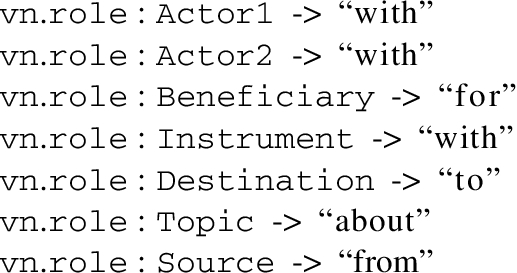
For example, consider the (excerpt of the) frame-based representation of the sentence
“Lincoln’s wife suspects that John Wilkes
Booth and Andrew Johnson conspired to kill
Lincoln.” shown in Example 3.3.
By applying GR 1, 2 and 3 to the path connecting the pair:
dbpedia:Andrew_Johnson, dbpedia:John_Wilkes_Booth
Legalo generates a label λ = “conspire with” for
. The mapping
scheme (role<->label) is an evolving resource, which improves based on the periodic
evaluation of Legalo outputs.
Formalisation of extracted knowledge
Frame-based formal representation for the sentence: “The New York
Times reported the death of John McCarthy. He
invented LISP.”
Given a textual sentence s and its frame-based formal representation
G, by following the generative rules described in Section 3.3 Legalo generates a label λ for each
relation that it is able to identify
in s, based on the shortest path connecting
in G (cf.
Definitions 1, 2, and 3). These labels constitute the basis for automatically
generating a set of RDF triples that can be used for semantically annotating the
hyperlinks included in s. Additionally, these set of triples provides a
(formalised) summary of s.
The aim of the formalisation step is to favour the reuse of the extracted knowledge by
representing it as RDF triples, by augmenting it with informative annotations and
axiomatisation, and by linking it to existing Semantic Web data. In particular, the
formalisation step addresses the following tasks:
producing a RDF triple for each hyperlink in
s associated with , such that
exists in
s, where is a predicate
having label λ, is the node
in G representing , and
is the node
in G representing ;
formally
defining : its domain
and range, and possible other OWL axioms that specify its formal
semantics;
annotating each triple
with information about
its linguistic evidence, i.e. the sentence
s;
annotating each triple and
predicate with information about the frame-based formal representation from which
they were extracted.
RDF triples can be used for annotating
hyperlinks, e.g. with RDFa, OWL axiomatisation supports ontology reuse, and scope
annotations (i.e. linguistic evidence and formal representation) support reuse in relation
extraction systems, e.g. relation extraction based on distant supervision [1,27].
Locality of produced predicates Our method works on the assumption that
each generated predicate and its associated formalisation are valid in the conceptual
scope identified by the sentence s. This means that s
identifies the scope of predicate names definitions, i.e. the namespace of a predicate
depends on s. Pragmatically, this is implemented in Legalo by including
the checksum of s in the predicate namespace. This strong locality
constraint may lead to producing a high number of potentially equivalent properties (i.e.
having the same intensional meaning) defined as they were different. This issue is tackled
by formalising all predicates with domain and range axioms having values, i.e. classes,
from external (open domain) resources, as well as by keeping the binding between a
predicate, its linguistic evidence, i.e. s, and its formal representation
source, i.e. G. The latter contains information about the disambiguated
senses of the verbs, i.e. frame occurrences, used in s. All these
features allow on one hand to inspect a specific property for understanding its meaning,
e.g. in case of manual reuse, on the other hand to automatically reconcile predicates by
computing a similarity measure based on them. In this paper, we focus on the generative
part of the problem, i.e. generating usable labels for predicates and producing their
formal definition, while we leave the reconciliation task to future work.
RDF factual statements For each hyperlink in s
associated with a true assessment of (cf. Axioms 1, 2, and 3), Legalo produces at least one RDF triple. As explained in Section 3.3, the nodes and
in
G representing and
are resolved on
DBpedia, when possible, which links the triples to the Linked Data cloud. The predicate is
formalised as an OWL object property having
as label and an ID derived by transforming
according to the CamelCase notation.17
According to a common Linked Data convention, using
the CamelCase notation for OWL object properties makes the first term of the ID start
with lower case, e.g. “invent programming language” ->
inventProgrammingLanguage.
For example, consider the enriched frame-based formal representation of the sentence
The New York Times reported the death of
John McCarthy. He invented the programming language
LISP.
depicted in Fig. 4, Legalo produces the triples depicted in Fig. 5,
according to the generative rules GR 1, 2, and 3, where the prefix
legalo: is a namespace defined using the checksum of the sentence
s. Notice that Fig. 5 shows the WiBi
types18
http://www.wibitaxonomy.org/.
for the resolved DBpedia entities.
OWL property formalisation For each generated property, Legalo produces
an additional set of OWL axioms that formally define it. The predicate formalisation
states that the predicate is an OWL object property, and includes domain and range axioms,
whose values are defined according to the WiBi types assigned to and
. In case of
multi-typing of an entity, the value is the union of all types. In case a WiBi type is not
available, the default type is owl:Thing. Example 3.4 shows the axioms formalising domain and range of the
properties shown in Fig. 5.
Legalo’s triples produced from the sentence: “The New York
Times reported the death of John McCarthy. He
invented LISP.”
(Domain and range axioms).
legalo:reportDeathOf a owl:ObjectProperty; rdfs:domain wibi:Newspaper; rdfs:range wibi:Computer_scientist.legalo:inventProgrammingLanguage a owl:ObjectProperty; rdfs:domain wibi:Computer_scientist; rdfs:range wibi:Programming_language; rdfs:subPropertyOf legalo:invent.
As the reader may notice, an additional rdfs:subPropertyOf axiom
is included in the formal definition of
legalo:inventProgrammingLanguage. In fact, if a predicate is
derived with GR 2, meaning that and
participate in
an event with respectively, an agentive and a passive role, then Legalo also generates a
more general property based on the event type, and produces a
rdfs:subPropertyOf axiom. We remind that in these cases, the rule
requires to generate a specialised property label by appending the WiBi type of
to the label of
the event type. Example 3.4 shows one of this cases. All
properties produced by Legalo are derived from a formal representation G
of the sentence s, meaning that G provides their formal
scope. Based on this principle, Legalo produces an additional set of triples, which
formalise the generated properties with reference to G. As stated by GR
1 and 2, there are two main
types of paths from which the properties can derive. In the first case, the path
connecting and
does not include
any event node. In this case, Legalo produces a OWL property chain axiom stating that the
generated property is implied by the chain of properties participating in the path, where
each property of the path is formalised with domain and range axioms according to the
locality of G. The same concept applies to the case of a path that
includes an event node. Similarly, Legalo produces a property chain axiom. However, in
this case the path has two different directions in G. For this types of
paths we define the concepts of left branch path, i.e. the one connecting
the event node with , and
right branch path, i.e. the one connecting the event node with
. For example, in
Fig. 4 the path P connecting
fred:John_Mccarthy with fred:Lisp includes
an event, i.e. fred:invent_1. Hence P is a tree,
which root is this event node. The left branch path of P is the one
connecting fred:invent_1 with fred:Lisp,
while the right branch path of P is the one connecting
fred:invent_1 with fred:John_Mccarthy. In
order to define a property chain axiom Legalo needs to define the inverses of all
properties in the left branch of P. However, these branch paths may
contain properties defined by VerbNet, i.e. thematic roles, which are independent of the
event they are associated with, in the scope of G, i.e. they are general
domain properties. In other words, these properties do not carry any information about the
event included in the path, which is relevant as far as the formal semantics of the
generated property is concerned. Legalo tackles this issue by defining a local thematic
role property for each VerbNet role participating in the event included in the path. For
example, let us consider the property
legalo:inventProgrammingLanguage in Fig. 5. Its reference path includes the two (thematic roles) properties
vn.role:Agent and vn.role:Product. Legalo
generates two new properties, legalo:AgentInvent and
legalo:ProductInvent, defined as sub-properties of
vn.role:Agent and vn.role:Product,
respectively. Given these two new properties, the axioms produced for formalising the
generated property legalo:inventProgrammingLanguage are given in
Example 3.5
The grounding vocabulary used for annotating the generated triples and properties
with information about their linguistic and formal representation scope.
(Property Chain Axiom when the connecting path includes an event).
Scope annotations Finally, Legalo annotates all generated properties and
triples with information related to the linguistic and formal representation scopes from
which they were derived. To this aim a specific OWL ontology has been defined, named
grounding,19
The vocabulary can be downloaded from
http://ontologydesignpatterns.org/cp/owl/grounding.owl.
depicted
in Fig. 6. This ontology reuses Earmark,20
http://www.essepuntato.it/2008/12/earmark.
a vocabulary for annotating textual content, and semiotics,21
a content ontology pattern that encodes
a simple semiotic theory. Earmark defines the class
earmark:Docuverse, which represents any container of strings that
may appear in a document. In the context of Legalo this class can be used for representing
a sentence s. The semiotics content pattern defines three main classes:
Expression, Meaning, Reference (the semiotic triangle). The class Expression is also
reused for representing a sentence s. As for the annotation of the
linguistic scope of a RDF triple, the grounding vocabulary defines the more specific
concept of “linguistic evidence”. In fact, according to the axioms defined in
Section 3.2 and the generative rules defined in
Section 3.3, a sentence s provides an
evidence of the relation , which is formalised by a
RDF triple . The concept of “linguistic
evidence” is represented by the class LinguisticEvidence that
specialises both earmark:Docuverse and
semiotics:Expression. The OWL property that relates a RDF triple
generated by Legalo and its linguistic evidence is
hasLinguisticEvidence. Additionally, the class
FrameBasedFormalModel is defined for representing the concept of
frame-based formal representation of a textual sentence, described in
detail in Section 3.1. This class is instantiated by the
graph G representing s, which provides the formal scope
for all generated properties and triples. The property
derivedFromFormalRepresentation of the grounding ontology,
connects a Legalo generated property as well as a RDF triple, with the graph
G from which they were derived. As an example, let us consider the
sentence represented by the graph in Fig. 4 and the generated
RDF triple of the property legalo:inventProgrammingLanguage
depicted in Fig. 5. The scope annotations shown in Example
3.6 are generated.
(Scope annotations of a generated property).
legalo:sentence a grounding:LinguisticEvidence; earmark:hasContent "The New York Timesreported the death of McCarthy. He inventedLISP.".[] a owl:Axiom; grounding:hasLinguisticEvidence legalo:sentence; owl:annotatedProperty legalo:inventProgrammingLanguage; owl:annotatedSource dbpedia:John_McCarthy_(computer_scientist); owl:annotatedTarget dbpedia:Lisp_(programming_language). legalo:inventProgrammingLanguage a owl:ObjectProperty; grounding:derivedFromFormalRepresentation krgraph:52f88ca22; grounding:definedFromLinguisticEvidence legalo:sentence.
The first two axioms create an individual of type
LinguisticEvidence for representing the sentence. The second
group of axioms annotates the RDF triple for “John McCarthy invented Lisp” with its
linguistic evidence. Finally, the legalo:inventProgrammingLanguage
property is annotated with its linguistic as well as its formal scope.
Alignment to Semantic Web vocabularies
This step has the goal of aligning the generated properties to existing Semantic Web
ones. The idea is to maximise reuse and linking of extracted knowledge to existing Linked
Data. Legalo implements a simple string matching technique based on the Levenshtein
distance measure for addressing this task. The implementation of more sophisticated
approaches for aligning generated properties to existing vocabularies is part of future
work. Relevant related work are ontology matching techniques such as [13] (cf. see the Ontology Alignment Evaluation
Initiative22
http://oaei.ontologymatching.org/.
).
A possible strategy is to apply state-of-the-art techniques in ontology matching
exploiting the information and features provided by the formalisation step (cf.
Section 3.4).
Legalo uses three semantic resources for identifying possible targets for property
alignment:
[5] is a machine learning system that
extracts structured data from unstructured Web pages and stores it in a knowledge
base. It runs continuously since 2010. From the learnt facts, NELL team has derived an
ontology of categories and properties: it includes 548 properties at the moment.26
http://nell-ld.telecom-st-etienne.fr/.
In principle other resources can be added and could be selected, we chose these three
resources because they allow us to both cover most of public linked data vocabularies
(i.e. LOV and Watson), and test with automatically generated resources (i.e. NELL).
Legalo pipeline and components
Legalo is based on a pipeline of components and data sources, executed in the sequence
illustrated in Fig. 7.
Pipeline implemented by Legalo for generating Semantic Web properties for semantic
annotation of hyperlinks based on their linguistic trace, i.e. natural language sentence
including the hyperlinks. Numbers indicate the order of execution of a component in the
pipeline. Edges indicates input/output flows. (*) denotes tools developed in this work,
which are part this paper contribution.
1. FRED: Semantic Web machine reader The core component of the system is
FRED [38], a Semantic Web
machine reader able to produce a RDF/OWL frame-based representation of a text. It integrates
the output of several NLP tools, enriches and transforms it by reusing Linguistic Frames
[32], Ontology Design Patterns [20], open data, and various vocabularies. FRED detects
events, roles, and n-ary relations and represents them in a RDF/OWL graph.
It also represents variable discourse referents, such as the variable in the first-order
predication Cat(x) extracted from the sentence The cat is on the
mat, they are formalised as reified individuals e.g.
cat_1. As far as Legalo is concerned, the most used features of FRED
are the frame-based graph representation based on VerbNet verbs and thematic roles, the
Named Entity Recognition (NER) and Resolution component i.e., TAGME [14], and the annotation of text fragments, based on the Earmark
vocabulary and annotation method [35].
All figures depicted in Section 2 show examples of FRED
outputs: the reader may want to consider Fig. 3, which shows the
RDF/OWL graph for the sentence “In February 2009 Evile began the pre-production process for
their second album with Russ Russell” as a representative output of FRED.
2. Entity pair selection This component is in charge of detecting the
resolved entities and associate them with their lexical surface in s. This
is done by querying FRED text span annotations. Another task of this component is, for each
pair of detected entities , to assess the existence of
between them. In
other words, this component checks the existence of paths between and
(cf. Axiom 1), selects the shortest one and verifies if there are event nodes
in the selected path. If so, it verifies if participates in the
event occurrence with an agentive role (cf. Axiom 3). All
selected pairs and associated paths are passed to the next component.
3. RDF/OWL writer This component is in charge of generating a predicate
for each pair of entities received in input from the previous component, by applying the
generative rules described in Section 3.3 to its associated
path. In addition, this component implements two more modules: the “Property matcher” and
the “Formaliser”.
The “Property matcher” is in charge of finding alignments between the generated predicate,
and existing Semantic Web vocabularies. As described in Section 3.5, three main sources are used for retrieving semantic property candidates. For
assessing their similarity with the generated predicate a string matching algorithm was
implemented, which computes a Levenshtein distance [31] between the IDs of the two predicates. This component is not intended to be a
contribution to advance the state of the art in ontology matching, its goal is to contribute
to a complete implementation of OKE and to provide a possible baseline for comparing results
with future improved versions.
Finally, the RDF/OWL writer includes the component “Formaliser”. This component implements
the formalisation step of the method (cf. Section 3.4). It is
in charge of producing the triples summarising the relation expressed in s,
and that can be used for annotating the corresponding hyperlink, to generate OWL axioms
defining domain and range of the generated predicates, and finally to annotate the produced
triples and predicates with scope information.
Legalo for typing Wikipedia pagelinks A specialised version of Legalo for
typing Wikipedia pagelinks (Legalo-Wikipedia)27
A demo is available at
http://wit.istc.cnr.it/stlab-tools/legalo/wikipedia.
was presented
in [39], however it relied on a previous version
of the tool. In fact, Legalo-Wikipedia depends on Legalo, hence it evolves with it, and
specialises it with two additional features: (i) a sentence extractor specialised for
Wikipedia HTML formatting, and (ii) a subject resolver specialised for Wikipedia. A detailed
description of this implementation can be found in [39].
Briefly, Legalo-Wikipedia takes in input a DBpedia entity URI, and retrieves all its
pagelinks triples from the Pagelinks DBpedia dataset. For each pagelink triple it extracts
all Wikipedia snippets containing an hyperlink corresponding to the triple by means of a
specialised sentence extractor. Then, the subject resolver selects all and only the snippets
that contain a lexicalisation of the Wikipedia page subject, by relying on the DBpedia
Lexicalisations Dataset.28
http://wiki.dbpedia.org/Datasets/NLP?v=yqj.
For example, the wikipage wp:Ron_Cobb includes a link to
wp:Sydney in the sentence:
“In 1972, Cobb moved to
Sydney, Australia, where his work appeared in alternative
magazines such as The Digger.”
This sentence will
be selected and stored as it contains the term “Cobb”, which is a lexicalisation of
dbpedia:Ron_Cobb. The same wikipage includes a link to
wp:Los_Angeles_Free_ Press in the sentence:
“Edited
and published by Art Kunkin, the Los
AngelesFree Press was one of the first of the underground newspapers of
the 1960s, noted for its radical politics.”
This sentence will be
discarded as it does not include any lexicalisation of
dbpedia:Ron_Cobb. This procedure is needed for identifying
pagelinks that actually convey a semantic factual relation between the Wikipedia page
subject and the target of the pagelink. Each snippet is then passed to Legalo as input for
generating the Semantic Web property. The version of Legalo-Wikipedia presented in [39] relied on a previous version of Legalo, which
supported less general generative rules and did not perform the relevant relation assessment
or the formalisation of the generated property.
Results and evaluation
Legalo-Wikipedia has been previously evaluated. For the sake of completeness, these results
are summarised in Section 5.2 (for additional details, the
reader can refer to [39]). With the help of
crowdsourcing an additional, more extensive evaluation of the current implementation of
Legalo was performed, which allowed us to better assess its performances and open issues.
This section reports this evaluation results in terms of precision, recall, and
accuracy.
Legalo working hypothesis
Legalo is based on two working hypotheses.
(Relevant relation assessment).
Legalo is able to assess if, given a sentence s, a relevant relation exists
which holds between two entities, according to the content of s:
This means that if s contains evidence of a relevant relation between
and
, then Legalo
returns a true value, otherwise it returns false.
(Usable predicate
generation).
Legalo is able to generate a usable
predicatefor a relevant relationbetween two entities, expressed in a sentence s: given,
a label generated by Legalo for, anda label generated by a human forthe following holds (cf. Definition
1
):
which means that the label
generated by Legalo is equal or very similar to a label that a human would
define in a Linked Data vocabulary for representing in a particular
textual occurrence.
This section reports the evaluation of Legalo based on the validation of Hypothesis 1 and Hypothesis 2.
Evaluation sample As evaluation data, a corpus for
relation extraction developed at Google research29
was used. There are five datasets available in this corpus, and each dataset is dedicated
to a specific relation: place of birth, attending or graduating from an institution, place
of death, date of death, degree of education. Each dataset includes a snippet from
Wikipedia, a pair (subject, object) of freebase entities, and at least five user
judgements that indicate if the snippet contains a sentence providing evidence of a
referenced relation (e.g., place of death) between the given pair of entities. It is
important to remark that Wikipedia snippets included in the corpus contain more than one
sentence, which can be evidence of other relations than the ones for which they were
evaluated. Based on this observation, the corpus has been used also for evaluating Legalo
on its ability to assess the existence of open-domain relations.
It has to be noticed that Legalo addresses all the capabilities of an OKE system (cf.
Section 2), however by using for its
evaluation and considering the homogeneous writing style of Wikipedia authors, additional
experiments are needed to properly assess Legalo scalability performance on Web diversity
(e.g. blogs, twitter, etc.). In other words, Legalo can be used with any input text, but
the different styles of the diverse Web sources could affect its performance. We leave the
investigation of possible bias caused by different writing styles to future
development.
The evaluation was performed using a subset of . More
specifically, three evaluation datasets were derived from and used
for performing different experimental tasks.
: a sample of
130 randomly selected snippets extracted from the file of
dedicated to evidence of relations expressing “attending or graduating from an
institution”. Legalo was executed on all 130 snippets, including in its input the pair
of freebase entities associated with the snippet in . For
each snippet, Legalo gave an output, either one or more predicates or “no relation
evidence” (i.e. false value);
: a sample of
130 randomly selected snippets extracted from the file of
dedicated to evidence of relations expressing “obtaining a degree of education”.
Legalo was executed on all 130 snippets, including in its input the pair of freebase
entities associated with the snippet in . For
each snippet Legalo gave always an output, either one or more predicates or “no
relation evidence”;
: a sample of 60
randomly selected snippets extracted from , 15
snippets from each file (excluding “date of death” as Legalo only deals with object
properties for the moment). The snippets were broken into single sentences and
pre-processed with Tagme [14] in order to
enrich them with hyperlinks referring to Wikipedia pages (i.e. DBpedia entities): 186
sentences with at least two recognised DBpedia entities were derived. In total, Legalo
produced 867 outputs, of which 262 predicates and 605 “no relation evidence”. Notice
that the high number of false values is not surprising as in many cases a single
sentence may contain a high number of entities, and Legalo had to assess the existence
of φ on all possible combinations of pairs.
The resulting triples, predicate formalisations, and scope annotations are accessible via
a Virtuoso SPARQL endpoint.30
Legalo results can be inspected at
http://wit.istc.cnr.it:8894/sparql. The reader can submit a pre-defined
default query for retrieving an overview of the dataset.
There are several works demonstrating that crowdsourcing can be successfully used for
building and evaluating semantic resources [17,34,47]. Following these experiences, Legalo was evaluated with the help
of crowdsourcing. Five different crowdsourced tasks were defined:
assessing if a sentence s provides
evidence for the referenced relation (i.e. either “institution” or “education”)
between two given entities and
mentioned in
s – based on data from
and ,
respectively;
assessing if a sentence
s provides evidence for any relation between two given entities
and
mentioned in
s – based on data from ;
judging if a predicate
generated by a machine adequately expresses (i.e. it is a good summarisation of) a
specific relation (i.e. either “institution” or “education”) between two given
entities and
mentioned in
s, according to the content of s – based on data
from
and ,
respectively;
judging if a predicate
generated by a machine adequately expresses (i.e. is a good summarisation of) any
relation expressed by the content of s, between two given entities
and
mentioned in
s – based on data from ;
creating a phrase λ that summarises the relation
expressed by the content of s, between two given entities
and
mentioned in
s – based on data from .
Tasks 1 and 2 were used for validating Hypothesis 1. The
results of these two tasks were then combined with those from Tasks 3 and 4, for
validating Hypothesis 2. Finally, Task 5 was used for
comparing the similarity between λ values generated by humans and
values generated by Legalo, for validating Hypothesis 2 from
a different perspective.
It is important to remark that Task 1 duplicates the information already available in
: this
choice was driven by the need for using smaller datasets ( samples)
as Legalo evaluation experiments needed to address different evaluation tasks. From an
analysis of it has
been noticed that some judgements were incorrect, which can be irrelevant on big numbers
while it can bias the results on smaller sets. Hence, the corpus samples were re-evaluated
on the evidence task, in order to ensure a high reliability of the judgements. Also, our
evaluation focused also on open domain relations, hence addressing a larger number of
relations than the one judged originally in the corpus.
was
used for conducting the crowdsourcing experiments. All tasks included a set of “gold
questions” used for computing a trust score t for each worker. Workers
had to first perform their job on 7 test questions, and only those reaching
were allowed to continue.
The value range of t is , the higher the score, the more reliable the
worker. Given the strong subjective nature of Task 5, only for this task a lower trust
score was considered
acceptable. Each run of a job for a worker contained 4 questions, and they were free to
stop contributing at any time. Each question was performed by at least three workers, in
order to allow the computation of inter-rater agreement. More precisely, Table 2 shows how many different workers performed each task, also
indicating the hypothesis associated with the task. Besides the initial test questions, in
order to keep monitoring workers’ reliability, each job contained one test questions.
Results from test questions were excluded from the computation of performance measures
(i.e., precision, recall, accuracy, agreement).
Number of different workers that performed the crowdsourced tasks
For Tasks 1 and 2, judgements were expressed as “yes” or “no” answers. For Tasks 3 and 4,
judgements could be assessed on a scale of three values: Agree (corresponding to a value 1
when computing relevance measures), Partly Agree (corresponding to a value 0.5 when
computing relevance measures), and Disagree (corresponding to a value 0 when computing
relevant measures). Task 5 was completely open. The confidence measure is
provided by CrowdFlower, it measures the inter-rater agreement between workers weighted by
their trust values, hence indicating both agreement and quality of judgements at the same
time. It is computed as described in Definition 5,32
Given a task unit u, a set of possible judgements
, with , a set of trust scores each representing a
rater , with , the sum of trust scores
of raters giving judgements on u, and the sum of
values of raters that
choose judgement , the confidence
score for judgement
on the task unit
u is computed as follows:
Example of confidence score computation for a task unit
Task unit
Judgement
t
582275117
yes
0.95
582275117
no
0.89
582275117
yes
0.98
(Confidence score for evidence judgement).
Table 3 shows the judgements of three raters on the same
task unit, where possible judgements are “yes” and “no”.
When aggregating results for a task unit, the judgement with the higher confidence score
is selected. Notice that when all
raters give the same judgement.
Results of Legalo performance in assessing the evidence of relations between entity
pairs in a given sentence s. Performance measures are computed on the
judgements collected in Tasks 1 and 2 based on data from ,
, and
Task
Relation
Precision
Recall
F-measure
Accuracy
Confidence
2
Any
0.83
0.92
0.87
0.82
0.82
1
Education
0.95
0.91
0.93
0.87
0.96
1
Institution
0.93
0.90
0.91
0.84
0.94
Evaluation of Hypothesis
1
Table 4
shows the results of the evaluation of Hypothesis 1, i.e.
Legalo’s ability to assess if a sentence s provides evidence of a
relation between two entities
. Task 1 was designed for
evaluating this capability on specific relations, while Task 2 was designed for evaluating
this capability on any relation. Each row shows the performance results for a specific run
of the task indicating the type of relation tackled and the crowdsourced task.
Results of Legalo performance in producing a usable label for relations between
entity pairs in a given sentence. Performance measures are computed on the judgements
collected in Tasks 3 and 4 based on data from ,
, and
Task
Relation
Precision
Recall
F-measure
Accuracy
Confidence
3
Education
0.92
0.91
0.91
0.85
0.80
3
Institution
0.65
0.91
0.76
0.62
0.59
3 (high confidence only)
Institution
0.74
0.89
0.81
0.68
0.71
4
Any
0.68
0.90
0.78
0.71
0.64
4 (high confidence only)
Any
0.73
0.87
0.80
0.75
0.76
Legalo’s performance is measured by means of standard metrics: precision, recall,
f-measure, and accuracy. With the aim of clarifying how to interpret them we briefly
report an informal definition of true/false positive, and true/false negative in the
context of Tasks 1 to 4. As for Tasks 1–2, given a sentence s, the crowd
would say “yes” if a relevant relation exists between a given subject/object pair, and
“no” if it does not. Legalo output means “true” (the relation exists) whenever it produces
a relation, while it means “false” (the relation does not exist) whenever it does not.
Hence, True positive = the number of (true, yes) pairs, False positive = the number of
(true, no) pairs, True negative = the number of (false, no) pairs, False negative = the
number of (false, yes) pairs.
The results of the crowdsourced tasks demonstrate that the Legalo method has high
performance (average F-measure = 0.92) on the assessment of existence (cf. Hypothesis
1). These results are highly satisfactory especially
compared with performance results of Legalo-Wikipedia [39], where this aspect was not tackled, and existence was partly
ensured by the nature of input data (cf. see also Section 5.2).
Evaluation of Hypothesis
2
Table 5
shows the results of the evaluation of Hypothesis 2, i.e.
Legalo’s ability of generating usable predicates for summarising relations between
entities, according to the content of a sentence. Task 3 was designed for evaluating this
capability on specific properties, while Task 4 was designed for evaluating this
capability on any property. Each row shows the performance results indicating the type of
relation tackled and the crowdsourced task. The results for “institution” relation and for
“any” relation are computed both on the overall set of results, as well as on a subset
that ensured a higher confidence rate (i.e., only results with are included). As
far as the evaluation of the “institution” relation is concerned, the subset of results
with high confidence is 68% of the whole evaluation dataset, while for “any” relation it
is 76%.
For these tasks, positive values (i.e. when Legalo generates a relation, i.e. “true”) can
be judged by the crowd with “agree”, “partly agree” and “disagree”. Let A
be the number of “agree”, the number of “partly
agree” and D the number of “disagree”. As for the negative values, the
definition is the same as for Tasks 1–2, and we reuse their results, as they are on the
same datasets. Hence, we compute: True positive = , False positive =
D, True negative = the number of (false, no) pairs, False negative =
the number of (false, yes) pairs.
Finally, Hypothesis 2 was evaluated also by computing a
similarity score between human created predicates and Legalo generated ones. Task 5 was
performed for collecting at least three labels for each triple
. As paraphrasing is a highly
subjective task, we expected a very low confidence value. Surprisingly, the average
confidence value on this task was not that low (0.59). We compared Legalo predicate
for a triple with all
created by the
users for that triple. Two different similarity measures were computed: a string
similarity score based on Jaccard distance measure,33
Given two strings
and ,
where
and
are the two character sets of
and ,
the Jaccard distance J(,)
is defined as .
and a semantic similarity measure based on the SimLibrary framework [36].34
http://simlibrary.wordpress.com/.
The latter is a semantic similarity score that extends string similarity with measures
exploiting external semantic resources such as WordNet, MeSH or the Gene Ontology. The
average Jaccard similarity score between Legalo labels and human ones is 0.63, while the
SimLibrary score is 0.80 (the interval value of both scores is , the higher the score, the more similar the
two phrases). Before computing the similarity a pre-processing step was performed to the
aim of transforming all verbs to their base form and removing all auxiliary verbs from
human predicates. The Stanford CoreNLP framework35
http://nlp.stanford.edu/software/corenlp.shtml.
was used to compute the lemma and POS tag of each term in the phrase. This lemmatisation
step was necessary in order to ensure a fair comparison of labels based on string
similarity as currently Legalo uses only base verb forms.
Also for Hypothesis 2, Legalo shows very satisfactory
performance. An impressive result is the high average value of the semantic similarity
score (0.80) between user created predicates and Legalo generated ones. This result
confirms the hypothesis discussed in [39],
saying that the Legalo design strategy was good at producing predicates that are very
close to what a human would do when creating a Linked Data vocabulary. In the context of
this work, this hypothesis can be extended to the capability to summarise such relations
in a way very close to what a generic user would do. This result is very promising from
the perspective of evolving Legalo into a summarisation tool, which is one of the
envisioned directions of research.
However, by inspecting the different relevance measures, it emerges that while recall is
very high on all tasks (0.90 on average), average accuracy is 0.73 and average precision
is 0.75. Although these are very satisfactory performances, it is worth identifying the
cases that cause the generation of less usable or even bad results. An insight is that
lower precision and accuracy are registered especially in the generation of predicates for
“institution” (accuracy 0.62, precision 0.65) relations and for “any” relations (accuracy
0.71, precision 0.68) while for “education” relations these measures show significantly
higher values (accuracy 0.85, precision 0.92). This turns out as an important lesson
learnt. In fact, less satisfactory precision seems due to the fact that many “institution”
relations between two entities are described in the form “X
received his Y from institution Z” (or similar), i.e. a ternary relation, which in a
frame-based representation G corresponds to something like:
Currently, based on this representation, Legalo would generate a predicate by following
the path connecting X to Y, hence without considering
the information on Y. The resulting predicate in this case would be “receive from”, while
a more informative and usable one would clearly be, e.g. “receive degree from”, assuming
that the type of Y is degree. The term degree is an example of a possible
type for Y, however whatever is the type of Y, including its type in the predicate would
make it much more informative and usable. This case can be easily generalised by
exploiting the semantic information about the thematic role that Y plays
in participating in the event .
In fact, a representation pattern can be recognised here: when participating in the event
,
X plays an agentive role (as expected from Axiom 3), Y plays a passive role, and Z plays an
oblique role. The type of an entity playing a passive role, i.e. Y in
this case, is a relevant information as far as the relation between an entity playing an
agentive role, and another playing an oblique role in an event, is concerned. This pattern
can be generalised to other relations than institution, which explains a similar behaviour
of Legalo in the two tasks focusing on assessing usability of predicates for “institution”
and “any” relations. Another example that shows this pattern is given by the sentence,
“Hassan Husseini became an organiser for the Communist
Party.”
taken from the dataset . In this case,
the representation is the following:
and Legalo would produce the predicate “become for”. By applying the new suggested
generative rule, the generated predicate would be instead, the more informative and usable
“become organiser for”. This type of observations leads to the definition of additional
generative rules that refine Legalo towards a highly probable improvement on precision and
accuracy. New rules are implemented based on the data collected from the evaluation
results, hence Legalo demo is constantly evolving.
Evaluating the alignment with existing Semantic Web vocabularies The
matching process performed against LOV, NELL [5], and Watson [9] returned a number of
proposed alignments between predicates generated by Legalo and existing properties in
Linked Data vocabularies. In order to accept an alignment and include it in the
formalisation of a Legalo property , a threshold
on the computed similarity score (i.e., normalised difference percentage based Levenshtein
distance36
http://bit.ly/1qd45AQ.
) was set,
i.e. only alignments between properties having were kept for the
evaluation. All alignments satisfying this requirements were included in the formalisation
of the properties generated during this study.37
All triples, property formalisations, and
alignments can be retrieved at
http://wit.istc.cnr.it:8894/sparql.
The alignment procedure was executed on 629 Legalo properties . For 250
, it produced at
least one alignment to a Semantic Web property with
. Three raters
independently judged on a scale of three values (Agree, Neutral, Disagree) the resulting
alignments based on the available metadata of i.e., comments,
labels, domain and range. Table 6 shows the results of the
user-based evaluation of the alignments between and
. The three raters
have independently judged the proposed alignment very accurate (Precision 0.84) with a
high inter-rater agreement (Kendall’s W 0.76). Although it was not possible to compute
recall for this evaluation, the low percentage of proposed alignments (only 40%) and the
simple method applied suggest that there is considerable room for improvement. This
evaluation and the implemented method are to be considered a baseline for future work on
this specific task.
Evaluation results on the accuracy of the alignment between and
# with at least
one
Total # of
(,
)
Levenshtein threshold
Precision
Kendall’s W
250
693
0.7
0.84
0.76
Results and evaluation of Legalo applied to Wikipedia pagelinks
A previous study [39] described the evaluation
of Legalo-Wikipedia. In this section the results of this evaluation are reported, for the
sake of completeness. The main difference between Legalo and its Wikipedia specialised
version is that in the latter, the subject of the predicate is always given and there is a
high probability that it is correct based on the design principles that guide Wikipedia
page writing. It is worth to remark that the evaluation experiment of Legalo-Wikipedia was
performed by Linked Data experts, hence comparing the new results with the previous ones
provides insights on the usability of the generated predicates, regardless the expertise
of the evaluators.
The evaluation results of Legalo-Wikipedia are published as RDF data and accessible
through a SPARQL endpoint.38
http://isotta.cs.unibo.it:9191/sparql.
The evaluated sample set consisted of 629 pairs , each associated with a FRED graph
G. Legalo was executed on this corpus and generated 629 predicates
(referred to as from now on). The
user-based evaluation involved three raters, who are computer science researchers familiar
with Linked Data, but not familiar with Legalo. Independently, they have judged the
results of Legalo based on two separate tasks, using a Likert scale of five values
(Strongly Agree, Agree, Partly Agree, Disagree, Strongly Disagree). When computing
performance measures the scale was reduced to three values. Specifically, Strongly
Disagree and Agree where associated with a value 1, Partly Agree with 0.5, and Disagree
and Strongly Disagree with 0.
The results of the user-based evaluation of are reported in
Table 7. The three raters have independently judged that
the generated predicates were very well
designed and accurate (F-measure 0.83) in capturing the semantics of their associated
pagelinks according to the content of the sentence s, with a high
inter-rater agreement (Kendall’s W 0.73).39
Kendall’s W measures the inter-rater agreement.
Values ranges from 0 (complete disagreement) to 1 (complete agreement).
Evaluation results on the accuracy of
Number of
Precision
Recall
F-measure
Kendall’s W
629
0.72
0.97
0.83
0.73
Discussion
Dependency on entity linking An aspect that requires improvement is the
potential dependency of Legalo performance on the recognition and linking of DBpedia
entities in a sentence: if an entity is not in DBpedia, the relation is not generated.
Ideally, this is easily solvable by treating any recognised named entity in a sentence as a
potential hyperlink, regardless if it has a URI (one can be locally created on the go). The
current version of Legalo shows this capability, however besides the need of rigorous
experiments for assessing its performance, anecdotical tests show that in some cases this
generalisation produces noise in the results. Identifying the causes and handling them is
one of our current focus.
Passive form and skolemised entities Identifying recurrent errors helps us
identifying new patterns for improving label generation. However, some recurrent mistakes
are not easily treatable. One of such cases can be exemplified by the following sentence:
In March 2008, Evile’s track was featured on the Wii, Xbox 360, and
PlayStation 3 video game Rock Band as downloadable content.
Currently,
Legalo cannot correctly handle this (type of) sentence. There are two main issues motivating
this lack: (i) the sentence is expressed in a passive mode, i.e. “was featured on” instead
of “features” and the use of the preposition “on” instead of “by” makes the agent “Rock
Band” became an oblique role. Hence, there is apparently no agentive role in this sentence,
making Axiom 1 (cf. 3) unsatisfied,
which causes Legalo to wrongly assess that there is no relevant relation between “Rock Band”
and “Evile”; (ii) even if the passive mode was recognised and handled in order to make Axiom
1 satisfied, the target of the passive relation would be
“Evile’s track”, which is a variable i.e. the entity representing it is skolemised. A way to
handle this is to name skolemised entities when they show certain characteristics. For
example in this case there is a relation between a named entity and the variable and such
relation is genitive, hence having a specific recognisable characteristic. However, naming
skolemised discourse referent should be done at the level of FRED result as this operation
can be useful in many other applications. For example, it can be relevant also for
aspect-based sentiment analysis.40
http://alt.qcri.org/semeval2015/task12/.
Sample sentences involving non-trivial relations, expressed in a generic logical
form
sentence
argument#1
binary relation
argument#2
Mr. Miller, 25, entered North Korea seven months ago.
Mr._Miller
enter
North_Korea
He was charged with unruly behaviour.
Mr._Miller
charge_with
x:unruly_behaviour
North Korean officials suspected he was trying to get inside one of the
country’s feared prison camps.
Open domain and any kind of text sources The OKE method is meant to
support knowledge extraction from text in the open domain. “Open domain” has a twofold
interpretation, both valid in this context: (i) any knowledge area: meaning that the
approach must be independent from the topics addressed by a text, in other word it should
not be tailored to specific languages, vocabularies or terminologies; (ii) any text style:
considering that natural language on the Web can have many different writing styles (e.g., a
text in a Wikipedia page is certainly cleaner than an average blog text,
which in turn has a complete different style than twitter writing). The implementation
presented in this paper shows very promising results as demonstrated by the performance
measured after the execution of a set of crowdsourcing tasks. This evaluation was based on
texts extracted from Wikipedia pages, focusing on both specific and general domains, hence
showing that the tool works well with any knowledge area. Nevertheless, it remains important
to investigate how the change of writing style impacts on the tool performance, in order to
assess its behaviour when coping with any text source (going beyond the style of Wikipedia
text). This investigation is a main action point in the next evolution of this work. It has
to be noticed that Legalo’s main tasks are the relation assessment and the label generation,
while parsing and role labelling, which are at the base of the frame-based graph
representation, are embedded in FRED. In other words, Legalo performance highly depends on
the ability of FRED to produce an accurate frame-based representation of the input sentence.
This means that intervening for minimising the performance bias due to different writing
styles requires to intervene on FRED components (especially parsing and role labelling).
Alignment to existing Semantic Web properties As for the alignment
procedure, there is also space for significant improvement, since this task was addressed by
computing a simple Levenshtein distance. More sophisticated alignment methods such as those
from the Ontology Alignment Initiative41
http://oaei.ontologymatching.org/.
or other approaches for entity linking such as SILK42
[22] can be investigated for enhancing the alignment
results. An interesting result is that our alignment results are good in terms of precision,
although all properties that have been matched with a distance score >0.70 came only from
Watson [9] and LOV. We observed that almost all
properties retrieved from NELL [5] had an editing
distance <0.70 hence almost none of them were judged appropriate. This reinforces the
hypothesis that OKE generative rules simulate very well the results of human property
creation, i.e. property names are cognitively well designed. In fact, Watson and LOV are
repositories of Semantic Web authored ontologies and vocabularies, while NELL properties
result from an artificial concatenation of categories learnt automatically.
As for the alignment recall, it was not possible to compute standard recall metrics because
it is impossible to compute False Negative results i.e., all existing Semantic Web
properties that would match but that we did not
retrieve. The relatively high number of missing properties suggests on one hand that a more
sophisticated alignment method is needed. On the other hand, if we combine this result with
the high value of accuracy of and the proposed
alignments between and
, it is reasonable
to hypothesise that many cases reveal a lack of intensional coverage in Semantic Web
vocabularies, and that OKE can help filling this gap.
Comparison to open information extraction Extracting, discovering, or
summarising relations from text is not an easy task. Natural language is very subtle in
providing forms that can express, allude, or entail relations, and syntax offers complex
solutions to relate explicitly named entities, anaphoras to mentioned or alluded entities,
concepts, and entire phrases, let alone tacit knowledge. Table 8 shows some kinds of (formalisable) relations that can be derived from text.
Some relations extracted bu OIE from sample sentences
segment #1
segment #2
segment #3
sentence
Eugene Nickerson
was quarterback of
the football team and
captain
At St. Mark’s School in Southborough, Massachusetts, Eugene Nickerson was
quarterback of the football team and captain of the hockey team.
President Vladimir Putin
faced
with a West angry over Russia’s
actions in Ukraine
President Vladimir Putin, faced with a West angry over Russia’s actions in
Ukraine, has been boosting ties to the East.
Florence May Harding
developed a passion for the
native flora of the arid West Darling region identifying
plants
Early in life Florence May Harding developed a passion for the native flora
of the arid West Darling region, collecting and identifying plants.
Two sample extractions by Legalo from the same sentences as in Table 9. For the sake of space we use prefix
d: instead of dbpedia:, and
l: instead of legalo:
rdf:subject
rdf:property
rdf:object
sentence
d:Eugene_Nickerson
l:quarterbackOf
d:American_Football
At St. Mark’s School in Southborough, Massachusetts, Eugene_Nickerson was
quarterback of the football team and captain of the hockey team.
d:Vladimir_Putin
l:faceWithAngryOverActionLocatedIn
d:Ukraine
President Vladimir Putin, faced with a West angry over Russia’s actions in
Ukraine, has been boosting ties to the East.
A full-fledged analysis of those texts is possible to a certain extent, specially if
associated with background knowledge (as FRED does), but the conciseness and directness of
hyper-linking based on binary relations is often lost. Hence the importance of tools like
Legalo, which are able to reconstruct binary relations from complex machine reading
graphs.
It would be natural to compare the results of Legalo to relation extraction systems, but
this would require to manipulate their output, which is beyond the scope of this work. Here
follows an explanation of the difficulties involved.
A state-of-art tool like Open Information Extraction (OIE, [26]) applies an extractive approach to relation extraction, and solves
the problem by extracting segments that can be assimilated to subjects, predicates, and
objects of a triplet. As reported in [19], its
accuracy was not very high with the version of OIE implemented as the ReVerb tool, but it
has sensibly improved recently. However, the segments that are extracted, though useful, are
not always intuitively reusable as formal RDF properties or individuals. Table 9 shows one case of a very complex segment #3, i.e. “with a West
angry over Russia’s actions in Ukraine”, which is a phrase to be further analysed in order
to be formalised, and typically leading to multiple triples; and another case of a complex
segment #2, i.e. “developed a passion for the native flora of the arid West Darling region
identifying”, which is not easily transformable into a RDF property.
The research presented here intends to go beyond text segmentation, by using an abstractive
approach that selects paths in RDF graphs in order to generate RDF properties. The
difference between the two approaches is striking, and leads to results that are difficult
to compare. Table 10 shows two of the examples from
Table 9 (the third one has no resolvable entity on the object
position), but as they are extracted and formalised by Legalo.
For the reasons described above, this work has not attempted a direct comparison in terms
of accuracy between OIE and Legalo: it would have needed the transformation and
formalisation of OIE text segments into individuals and properties, and arbitrary choices on
how to formalise complex segments. At the end, it is not a measure of their outputs that is
obtained, but a measure of authors’ ability to redesign OIE’s output. For those interested
in attempts to reuse heterogeneous NLP outputs for formal knowledge extraction, see [19].
Related work
The work presented here can be categorised as formal binary relation discovery and
labelling from arbitrary walks in connected fully-labelled multi-digraphs, which
means in practice that it is not just relation extraction (relations are extracted by
FRED [38], and Legalo reuses them), but Legalo
discovers complex relations that summarise information encoded in several nodes and edges in
the graph (RDF graphs are actually connected, fully-labelled multi-digraphs). It considers
certain paths along arbitrary directions of edges, aggregating some of the existing labels,
and concatenating them in order to provide property names that are typical of Linked Data
vocabularies, and finally axiomatising the properties with domain, range, subproperty, and
property chain axioms.
In other words, Legalo tries to answer the following question: what is the relation that
links two (possibly distant) entities in a RDF graph?
There is not much that can be directly comparable in the literature, but work from two
related fields can be contrasted with what Legalo does: relation
extraction, and automatic summarisation.
The term Open Knowledge Extraction was previously introduced in the context of Artificial
Intelligence [10]. This work defines OKE as
“conversion of arbitrary input sentences into general world knowledge represented in a
logical form possibly usable for inference”, hence perfectly compatible with what defined in
this paper. The cited work does not focus on Semantic Web technologies and languages,
although it provides further support to our claims and definitions.
The closest works in relation extraction include Open Information Extraction (e.g. [26,30]),
relation extraction exploiting Linked Data [24,46], and question answering on linked
data [25].
Relation extraction The main antecedent to Open Information Extraction is
probably the 1999 Open Mind Common Sense project [43], which adopted an ante-litteram crowdsourcing and games-with-a-purpose
approach to populate a large informal knowledge base of facts expressed in triplet-based
natural language. The crowd was left substantially free to express the subject, predicate,
and object of a triplet, but during its evolution, forms started stabilising, or were learnt
by machine learning algorithms. Currently Open Mind is being merged with several other
repositories in ConceptNet [21].
Open Information Extraction (aka Machine Reading) as it is currently known in the NLP
community performs bootstrapped (i.e. started with learning from a small
set of seed examples, and then recursively and incrementally applied to a huge corpus, cf.
[11]), open-domain, and
unsupervised information extraction. E.g. OIE is based on learning
frequent triplet patterns from a shallow parsing of the Web, in order to create a huge
knowledge base of triplets composed of text chunks.
This idea (on a smaller scale) was explored in [6], with the goal of resolving predicates to, or to enlarge, a biomedical ontology.
On the contrary, OIE extracts binary relations by segmenting the texts into triplets.
However, there is usually no attempt to resolve the subjects and objects of those triplets,
nor to disambiguate or harmonise the predicates used in the triples. Since predicates are
not formally represented, they are hardly reusable for e.g. annotating links with RDFa tags.
See Section 6 for a comparison between OIE and Legalo, proving
the difficulty of even designing a comparison test.
Overall, Open Information Extraction looks like a component for extractive summarisation
(see below). In [30], named entity resolution is
used to resolve the subjects and objects, and there is an attempt to build a taxonomy of
predicates, which are encoded as lexico-syntactic patterns rather than typical
predicates.
Another important Open Information Extraction project is Never Ending Language Learning
(NELL) [5], a learning tool that since 2010
processes the web for building an evolving knowledge base of facts, categories and
relations. In this case there is a (shallow) attempt to build a structured ontology of
recognised entities and predicates from the facts learnt by NELL. In this work, NELL is used
in an attempt to align the semantic relations resulting from Legalo to the NELL
ontology.
The main difference between approaches such as OIE and NELL, and Legalo is that the formers
focus on extracting mainly direct relations between entities, while Legalo focuses on
revealing the semantics of relations between entities that can be: a) directly linked, b)
implicitly linked, c) suggested by the presence of links in Web pages, d) indirectly linked,
i.e. expressed by longer paths or n-ary relations. Legalo novelty also
resides in performing property label generation. From the acquisition perspective, Legalo is
not bootstrapped, but it is open-domain and unsupervised.
Relation extraction and question answering targeted at Linked Data are quite different from
both Open Information Extraction and Legalo, since they are oriented at formal knowledge,
but they are not bootstrapped, open domain and unsupervised. They typically use a finite
vocabulary of predicates (e.g. from DBpedia ontology), and use their extensional
interpretation in data (e.g. DBpedia) to either link two entities recognised in some text
(as in [24,46]), or to find an answer to a question, from which some entities have been
recognised (as in [25]). Domain is therefore
limited to the coverage of the vocabulary, and distant supervision is provided by the
background knowledge (e.g. [1]. A growing
repository of relationships extracted with this specific distantly supervised approach is
sar-graphs [46].
Automatic summarisation Automatic summarisation deserves a short
discussion, since ultimately Legalo’s relation discovery can be used as a component for that
application task. According to [40], the main goal
of a summary is to present the main ideas from one or more documents in less space,
typically less than half of one document. Different categorisations of summaries have been
proposed: topic-based, indicative, generic, etc., but the most relevant seems to distinguish
between “extracts” and “abstracts”. Extracts are summaries created by reusing portions of
the input text verbatim, while abstracts are created by reformulating or regenerating the
extracted content. An extraction step is needed in any case, but while extracts
compress the text by squeezing out unimportant material, and
fuse the reused portions, abstracts typically model the
text, by accessing external information, applying frames, deep parsing, etc., eventually
generating a summary that in principle could contain no word in common with the original
text.
Extractive summarisation is now in mass usage, e.g. with snippets provided by search
engines. It has serious limits, because size and relevance of the extracts can be
questionable and not as accurate as a human may be.
Legalo can be considered closer to abstractive summarisation, since it can be used to build
frame-based abstractive summaries of texts, consisting in binary relation discovery, which
can then be filtered for relevance. The current implementation of Legalo is not designed in
view of abstractive summarisation, therefore it was not evaluated for that task, but it is
appropriate to report at least one relevant example of related work in this area.
Opinosis [18] is the state-of-the-art system for
abstractive summarisation. It performs graph-based summarisation, generating concise
abstractive summaries of highly redundant opinions. It uses a word graph data structure to
represent the text, whereas Legalo uses a semantic graph. As the authors say: “Opinosis is a
shallow abstractive summariser as it uses the original text itself to generate summaries.
This is unlike a true abstractive summariser that would need a deeper level of natural
language understanding”. Legalo is indeed based on FRED [38], which provides such deeper level of understanding.
In order to be considered an abstractive summariser, Legalo will need to be complemented
with more capabilities to rank discovered relations across an entire or even multiple texts,
to associate them in a way that final users can make sense of, and to evaluate summaries
appropriately. Results from both abstractive summarisation (e.g. [18,23,49]) and RDF graph summary (e.g. [4,37,48]) can be reused to that purpose.
Conclusion and future work
Conclusion This paper presents a novel approach for Open Knowledge
Extraction, and its implementation called Legalo, for uncovering the
semantics of hyperlinks based on frame-based formal representation of natural language text,
and heuristics associated with subgraph patterns. The main novel aspects of the approach
are: relevant relation assessment, label generation, Semantic Web property generation and
formalisation.
The working hypothesis is that hyperlinks (either created by humans or knowledge extraction
tools) provide a pragmatic trace of semantic relations between two entities, and that such
semantic relations, their subjects and objects, can be revealed by processing their
linguistic traces: the sentences that embed the hyperlinks. Evaluation experiments conducted
with the help of a crowdsourcing platform confirm this hypothesis, and show very high
performances: the method is able to assess the actual presence of a relation with a high
precision (average F-measure 0.92), and generate accurate RDF properties between the
hyperlinked entities in single-relation corpora (average F-measure 0.84), the Wikipedia page
link corpus (average F-measure 0.84), as well as in the challenging open domain corpus
(average F-measure 0.78). The accuracy remains constant across crowdsourced evaluation, and
comparison to (crowdsourced) gold standard for the open domain corpus. We also provide
alignments to Semantic Web vocabularies with a precision value of 0.84.
A demo of Legalo Web service is available online,13
as well as the prototype dedicated to Wikipedia pagelinks,27 and the binary properties produced in this study can be accessed by means of a
sparql endpoint.36
Ongoing work Current work concentrates on designing and testing new
heuristics, as required by evidence emerging from experiments and tests (cf. e.g.
Section 6), on identifying new ways of aligning the relations
generated by Legalo to existing ontologies, and on discovering regularities in the relation
taxonomies that are increasingly discovered. Additionally, new experiments are under
development for assessing Legalo scalability on the diversity and size of the Web.
Future work The main research line for the future is to apply Legalo to
application tasks. An obvious one is a real abstractive summarisation task, both at
single-text, and multiple-text level, evaluating the results against state-of-the-art tools.
The challenges there include at least: (i) managing multiple (and possibly dynamically
evolving) Open Knowledge Extraction graphs, (ii) assessing relevance of discovered
relations, and their dependence across a same text, or across multiple texts, and (iii)
generating factoid sequences that make sense to a final user of abstractive summaries. Also
other applications of Legalo are envisioned, including question answering and textual
entailment.
References
1.
I.Augenstein,
D.Maynard and
F.Ciravegna,
Relation extraction from the web using distant
supervision, in: Proc. of Knowledge Engineering and Knowledge
Management – 19th International Conference (EKAW 2014), Linköping,
Sweden, K.Janowicz, S.Schlobach, P.Lambrix and E.Hyvönen, eds,
Lecture Notes in Computer Science, Vol. 8876,
Springer, 2014,
pp. 26–41. doi:10.1007/978-3-319-13704-9_3.
2.
C.Bizer, T.Heath and T.Berners-Lee,
Linked Data – The story so far, International
Journal of Semantic Web Information Systems5(3) (2009),
1–22. doi:10.4018/jswis.2009081901.
3.
C.Bizer, J.Lehmann, G.Kobilarov, S.Auer, C.Becker, R.Cyganiak and
S.Hellmann,
DBpedia – A crystallization point for the web of data,
International Journal of Web Semantics7(3) (2009),
154–165. doi:10.1016/j.websem.2009.07.002.
4.
S.Campinas, T.E.Perry, D.Ceccarelli, R.Delbru and G.Tummarello,
Introducing rdf graph summary with application to assisted sparql
formulation, in: Proc. of the 23rd International Workshop on
Database and Expert Systems Applications (DEXA), Vienna,
Austria, A.Hameurlain,
A.M.Tjoa and
R.Wagner, eds,
IEEE Computer Society, 2012,
pp. 261–266. doi:10.1109/DEXA.2012.38.
5.
A.Carlson, J.Betteridge, B.Kisiel, B.Settles, E.R.HruschkaJr.
and T.M.Mitchell,
Toward an architecture for never-ending language
learning, in: Proc. of the Twenty-Fourth Conference on Artificial
Intelligence (AAAI), Georgia, USA, M.Fox
and D.Poole, eds,
AAAI Press, 2010,
pp. 1306–1313.
6.
M.Ciaramita,
A.Gangemi, E.Ratsch, J.Šaric and I.Rojas,
Unsupervised learning of semantic relations between concepts of a
molecular biology ontology, in: Proc. of the 19th International
Joint Conference on Artificial Intelligence (IJCAI), Edinburgh,
Scotland, L.P.Kaelbling and
A.Saffiotti, eds,
Professional Book Center, 2005,
pp. 659–664.
7.
B.Comrie,
Language Universals and Linguistic Typology: Syntax and Morphology,
University of Chicago Press, Chicago,
USA, 1989.
8.
W.Croft,
Syntactic Categories and Grammatical Relations: The Cognitive Organisation of
Information, University of Chicago Press,
Chicago, USA, 1991.
9.
M.d’Aquin, E.Motta, M.Sabou, S.Angeletou, L.Grindinoc, V.Lopez and D.Guidi,
Towards a new generation of Semantic Web applications,
IEEE Intelligent Systems23(3) (2008),
80–83. doi:10.1109/MIS.2008.54.
10.
B.V.Durme and
L.K.Schubert,
Open Knowledge Extraction using compositional language
processing, in: Proc. of the 2008 Conference on Semantics in
Text (STEP), Venice, Italy, R.Basili, J.Bos
and A.Copestake, eds,
The Association for Computational Linguistics,
2008, pp. 239–254. doi:10.3115/1626481.1626500.
11.
O.Etzioni, M.Banko and M.J.Cafarella,
Machine reading, in: Proc. of the Twenty-First
Conference on Artificial Intelligence (AAAI), Boston,
Massachusetts, Y.Gil and R.J.Mooney, eds,
AAAI Press, 2006,
pp. 1517–1519.
12.
O.Etzioni, M.Banko, S.Soderland and
D.S.Weld,
Open information extraction from the web,
Communications of the ACM51(12) (2008),
68–74. doi:10.1145/1409360.1409378.
P.Ferragina and
U.Scaiella,
TAGME: On-the-fly annotation of short text fragments (by Wikipedia
entities), in: Proc. of the 19th ACM International Conference on
Information and Knowledge Management (CIKM), Toronto,
Canada, J.Huang, N.Koudas, G.J.F.Jones, X.Wu,
K.Collins-Thompson and
A.An, eds,
ACM, 2010,
pp. 1625–1628, doi:10.1145/1871437.1871689.
15.
C.J.Fillmore,
Frame semantics, in: Linguistics in the Morning
Calm, Linguistic Society of
Korea, ed., Hanshin Publishing
Co., 1982, pp. 111–137.
doi:10.1016/B0-08-044854-2/00424-7.
16.
T.Flati, D.Vannella, T.Pasini and R.Navigli, Two is bigger
(and better) than one: The Wikipedia bitaxonomy project, in: Toutanova and Wu [44],
pp. 945–955.
17.
M.Fossati, C.Giuliano and
S.Tonelli,
Outsourcing framenet to the crowd, in: Proc. of
the 51st Annual Meeting of the Association for Computational Linguistics (ACL) Volume 2:
Short Papers, Sofia, Bulgaria, P.Fung
and M.Poesio, eds,
The Association for Computational Linguistics,
2013, pp. 742–747.
18.
K.Ganesan, C.Zhai
and J.Han,
Opinosis: A graph-based approach to abstractive summarization of highly
redundant opinions, in: Proc. of the 23rd International
Conference on Computational Linguistics (COLING), Beijing,
China, C.Huang and D.Jurafsky, eds,
Tsinghua University Press, 2010,
pp. 340–348.
19.
A.Gangemi,
A comparison of knowledge extraction tools for the semantic
web, in: Proc. of the 10th Extended Semantic Web Conference
(ESWC) the Semantic Web: Semantics and Big Data, Montpellier,
France, P.Cimiano, O.Corcho, V.Presutti, L.Hollink and S.Rudolph, eds,
Lecture Notes in Computer Science, Vol. 7882,
Springer, 2013,
pp. 351–366. doi:10.1007/978-3-642-38288-8_24.
20.
A.Gangemi and
V.Presutti,
Ontology design patterns, in: Handbook on
Ontologies, S.Staab and R.Studer, eds,
2nd edn, Springer Verlag,
2009, pp. 221–243. doi:10.1007/978-3-540-92673-3_10.
21.
C.Havasi, R.Speer and J.Alonso,
Conceptnet: A lexical resource for common sense
knowledge, in: Recent Advances in Natural Language Processing V:
Selected Papers from RANLP 2007, N.Nicolov, G.Angelova and
R.Mitkov, eds,
Current Issues in Linguistic Theory, Vol. 309,
John Benjamins Publishing Company, 2007,
pp. 269–280. doi:10.1075/cilt.309.22hav.
22.
R.Isele and C.Bizer,
Active learning of expressive linkage rules using genetic
programming, International Journal of Web Semantics23 (2013), 2–15. doi:10.1016/j.websem.2013.06.001.
23.
H.Ji, B.Favre, W.-P.Lin, D.Gillick, D.Hakkani-Tur and
R.Grishman,
Open-domain multi-document summarization via information extraction:
Challenges and prospects, in: Multi-Source, Multilingual
Information Extraction and Summarization, Theory and Applications of Natural Language
Processing, T.Poibeau, H.Saggion, J.Piskorski and
R.Yangarber, eds,
Springer, Berlin,
Heidelberg, 2013,
pp. 177–201.
24.
A.Khalili, S.Auer
and A.-C.Ngonga
Ngomo, conTEXT – lightweight text analytics
using Linked Data, in: Proc. of the Semantic Web: Trends and
Challenges – 11th International Conference (ESWC), Crete,
Greece, V.Presutti, C.d’Amato, F.Gandon, M.d’Aquin, S.Staab and A.Tordai, eds,
Lecture Notes in Computer Science, Vol. 8465,
Springer, 2014,
pp. 628–643. doi:10.1007/978-3-319-07443-6_42.
25.
V.Lopez, A.Nikolov, M.Sabou, V.S.Uren, E.Motta and M.d’Aquin,
Scaling up question-answering to linked data, in:
Proc. of the 17th International Conference on Knowledge Engineering and
Management by the Masses (EKAW), Lisbon, Portugal,
P.Cimiano and
H.S.Pinto, eds,
Springer, 2010,
pp. 193–210. doi:10.1007/978-3-642-16438-5_14.
26.
Mausam, M.Schmitz, R.Bart, S.Soderland and
O.Etzioni, Open language
learning for information extraction, in: Tsujii et al. [45], pp. 523–534.
27.
M.Mintz, S.Bills, R.Snow
and D.Jurafsky,
Distant supervision for relation extraction without labeled
data, in: Proc. of the Joint Conference of the 47th Annual
Meeting of the ACL and the 4th International Joint Conference on Natural Language
Processing of the AFNLP: 2 – Volume 2, Suntec, Singapore,
K.-Y.Su, ed.,
Association for Computational Linguistics,
2009, pp. 1003–1011. doi:10.3115/1690219.1690287.
28.
A.Moro and R.Navigli,
Integrating syntactic and semantic analysis into the open information
extraction paradigm, in: Proc. of the Twenty-Third International
Joint Conference on Artificial Intelligence (IJCAI), Beijing,
China, F.Rossi, ed.,
AAAI Press/IJCAI, 2013,
pp. 2148–2154.
29.
A.Moro, A.Raganato and
R.Navigli,
Entity linking meets word sense disambiguation: A unified
approach, Transactions of the Association for Computational
Linguistics (TACL)2 (2014), 231–244.
30.
N.Nakashole,
G.Weikum and
F.Suchanek, Patty: A
taxonomy of relational patterns with semantic types, in: Tsujii et al. [45],
pp. 1135–1145.
31.
G.Navarro,
A guided tour to approximate string matching, ACM
Computing Surveys33(1) (2001),
31–88. doi:10.1145/375360.375365.
32.
A.G.Nuzzolese,
A.Gangemi and
V.Presutti,
Gathering lexical Linked Data and knowledge patterns from
FrameNet, in: Proc. of the Sixth International Conference on
Knowledge Capture (K-CAP), Banff, AB, Canada, M.A.Musen and Ó.Corcho, eds,
ACM, 2011,
pp. 41–48. doi:10.1145/1999676.1999685.
33.
A.G.Nuzzolese,
A.Gangemi, V.Presutti and
P.Ciancarini,
Encyclopedic knowledge patterns from Wikipedia links, in:
Proc. of the 10th International Semantic Web Conference (ISWC), Part I,
Bonn, Germany, L.Aroyo, C.Welty, H.Alani, J.Taylor, A.Bernstein, L.Kagal, N.F.Noy and E.Blomqvist, eds,
Lecture Notes in Computer Science, Vol. 7031,
Springer, 2011,
pp. 520–536. doi:10.1007/978-3-642-25073-6_33.
34.
J.Oosterman,
A.Nottamkandath,
C.Dijkshoorn,
A.Bozzon, G.Houben and L.Aroyo,
Crowdsourcing knowledge-intensive tasks in cultural
heritage, in: ACM Web Science Conference (WebSci),
IN, USA, F.Menczer, J.Hendler, W.H.Dutton, M.Strohmaier, C.Cattuto and E.T.Meyer, eds,
ACM, 2014,
pp. 267–268. doi:10.1145/2615569.2615644.
35.
S.Peroni, A.Gangemi and F.Vitali,
Dealing with markup semantics, in: Proc. the 7th
International Conference on Semantic Systems (I-SEMANTICS), Graz,
Austria, C.Ghidini, A.N.Ngomo, S.N.Lindstaedt and
T.Pellegrini, eds,
ACM International Conference Proceeding Series,
ACM, 2011,
pp. 111–118. doi:10.1145/2063518.2063533.
36.
G.Pirrò and J.Euzenat,
A feature and information theoretic framework for semantic similarity and
relatedness, in: Proceedings of the 9th International Semantic
Web Conference (ISWC) Part I, P.F.Patel-Schneider,
Y.Pan, P.Hitzler, P.Mika, L.Zhang, J.Z.Pan, I.Horrocks and
B.Glimm, eds,
2010, pp. 615–630. doi:10.1007/978-3-642-17746-0_39.
37.
V.Presutti, L.Aroyo, A.Adamou, A.Gangemi and G.Schreiber,
Extracting core knowledge from linked data, in:
Proc. of the Second International Workshop on Consuming Linked Data
(COLD), Bonn, Germany, O.Hartig, A.Harth and J.Sequeda, eds,
CEUR Workshop Proceedings, Vol. 782,
CEUR-WS.org, 2011.
38.
V.Presutti, F.Draicchio and
A.Gangemi,
Knowledge extraction based on discourse representation theory and
linguistic frames, in: Knowledge Engineering and Knowledge
Management – Proc. of the 18th International Conference (EKAW),
Galway City, Ireland, A.ten Teije,
J.Völker, S.Handschuh, H.Stuckenschmidt,
M.d’Aquin, A.Nikolov, N.Aussenac-Gilles and
N.Hernandez, eds,
Lecture Notes in Computer Science, Vol. 7603,
Springer, 2012,
pp. 114–129. doi:10.1007/978-3-642-33876-2_12.
39.
V.Presutti, S.Consoli, A.G.Nuzzolese,
D.R.Recupero,
A.Gangemi, I.Bannour and H.Zargayouna,
Uncovering the semantics of Wikipedia pagelinks, in:
Knowledge Engineering and Knowledge Management – Proc. of the 19th International
Conference (EKAW), Linköping, Sweden, K.Janowicz, S.Schlobach, P.Lambrix and E.Hyvönen, eds,
Lecture Notes in Computer Science, Vol. 8876,
Springer, 2014,
pp. 413–428. doi:10.1007/978-3-319-13704-9_32.
40.
D.R.Radev, E.Hovy
and K.McKeown,
Introduction to the special issue on summarization,
Computational Linguistics28(4) (2002),
399–408. doi:10.1162/089120102762671927.
41.
G.Rizzo, R.Troncy, S.Hellmann and
M.Bruemmer,
NERD meets NIF: Lifting NLP extraction results to the linked data
cloud, in: Proc. of the 5th Workshop on Linked Data on the Web
(LDOW) Co-Located with the International World Wide Web Conference (WWW),
Lyon, France, C.Bizer, T.Heath, T.Berners-Lee and
M.Hausenblas, eds,
CEUR Workshop Proceedings, Vol. 937,
CEUR-WS.org, 2012.
42.
K.K.Schuler, VerbNet: A
broad-coverage, comprehensive verb lexicon, PhD thesis, University of Pennsylvania, 2006.
43.
P.Singh,
The public acquisition of commonsense knowledge, in:
Proc. of AAAI Spring Symposium: Acquiring (and Using) Linguistic (and World)
Knowledge for Information Access, Palo Alto, CA, USA,
J.Karlgren, ed.,
AAAI Press, 2002.
44.
K.Toutanova and
H.Wu (eds), Proc.
of the 52nd Annual Meeting of the Association for Computational Linguistics, (ACL)
Volume 1: Long Papers, Baltimore, Maryland,
The Association for Computer Linguistics,
2014.
45.
J.Tsujii, J.Henderson and
M.Pasca (eds),
Proc. of the 2012 Joint Conference on Empirical Methods in Natural Language
Processing and Computational Natural Language Learning (EMNLP-CoNLL),
Jeju Island, Korea, The Association of
Computational Linguistics, 2012.
46.
H.Uszkoreit and
F.Xu, From
strings to things sar-graphs: A new type of resource for connecting knowledge and
language, in: Proc. of the NLP & DBpedia Workshop Co-Located
with the 12th International Semantic Web Conference (ISWC 2013),
Sydney, Australia, S.Hellmann, A.Filipowska, C.Barrière, P.N.Mendes and
D.Kontokostas, eds,
CEUR Workshop Proceedings, Vol. 1064,
CEUR-WS.org, 2013.
47.
D.Vannella, D.Jurgens, D.Scarfini, D.Toscani and R.Navigli, Validating and
extending semantic knowledge bases using video games with a purpose, in: Toutanova and Wu
[44], pp. 1294–1304. doi:10.3115/v1/P14-1122.
48.
X.Zhang, G.Cheng and Y.Qu,
Ontology summarization based on rdf sentence graph, in:
Proc. of the 16th International Conference on World Wide Web,
Banff, Alberta, C.Williamson and
M.E.Zurko, eds,
ACM, 2007,
pp. 707–716. doi:10.1145/1242572.1242668.
49.
L.Zhou, C.-Y.Lin, D.S.Munteanu and
E.Hovy,
ParaEval: Using paraphrases to evaluate summaries
automatically, in: Proc. of the Human Language Technology
Conference of the North American Chapter of the Association of Computational Linguistics
(HLT-NAACL), New York, New York, R.C.Moore, J.A.Bilmes, J.Chu-Carroll and
M.Sanderson, eds,
The Association for Computational Linguistics,
2006, pp. 447–454.