




Abstract
Many subgroups remain marginalized from their larger communities. Technologies supporting community building have focused on apps, but many apps fall short of making subgroups such as the LGTBQ+, immigrant and black populations visible and heard. We report on design iterations and evaluations of communIT, a large-scale, cyber-physical platform for helping subgroups build community by making them visible and heard in public places. We conducted a design studio study (
Keywords
Introduction
Social, cultural, technological, and organizational difficulties confront local communities. Subgroups including the LGTBQ+, immigrant, refugee, and black populations are ostracized from, misunderstood by, or invisible to the mainstream of their larger, local community in many places [5,16]. Increased social mobilization in response to racial and sexual discrimination is evidence of a polarized society; more than ever, subgroups require assistance in having their voices heard and views conveyed in the greater community. In this context, we ask: Can interactive technologies support marginalized, misunderstood, or invisible subgroups co-generate media and make this media visible and “heard” in the larger community?
To begin answering this issue, we present findings from an assessment of communIT, a cyber-physical environment for community building [1,3,10,19,32,34]. communIT’s goal is to provide a platform for subgroups of local communities to collaborate on projects and then display the results as a way to share and build the wider community. In practice, communIT is a foldable, large-scale kirigami (origami with cuts and folds) with embedded lighting, audio, displays, and other peripherals that adjusts its physical form, lighting, and audio output to meet the needs of community groups as they co-create media and exhibit it publicly in community public spaces. We performed a pilot research with a local community partner and an online survey (
Background
Community engagement and object agency
According to Dewey [11], community is not something which is an a priori given. Instead, community forms around issues that deserve consideration and debate. Building atop of Dewey’s notion of community, Marres [27] states that community engagement occurs when people recognize, discuss, and collaboratively work on issues of mutual concern, as well as their consequences and connections. These connections, or “attachments” as Marres argues [27], involves the link issues have with the world – i.e. individuals, resources and objects in a community [27]. Marres’ notion of attachments is based on Latour and Weibel’s [24] concept of “object-oriented democracy”: the idea that resources and objects are important for people’s gathering around issues. Bringing an Actor-Network Theory (ANT) perspective, Latour and Weibel [24] advocates a symmetry between humans’ and nonhumans’ agencies in bringing about public matter issues. DiSalvo [13,14], Le Dantec [8,25], and Jenkins [22] further expand the discussion on the role objects have for building community. Jenkins, specifically, bring about a perspective in which objects – in his case, computing – should not merely be seem as augmenters of humans, but rather as participators – i.e. partners – in the creation and maintenance of public issues [22]. They argue that issues and their attachments not only arise from objects, but also give rise to them. Thus, the literature suggests that the sense of community arises from community engagement around issues, and that this community is not created around objects but rather with them.
Interactive artifact for community engagement
Within the HCI research community, prior projects on how artifacts support community engagement in public spaces have primarily focused on the development and evaluation of software and apps, mostly for smartphones and screens installed in public spaces. Relevant examples are CRM [26], a system composed of a mobile app and information kiosk that helps homeless people cope with several difficulties in a public shelter; Memarovic’s public display [31] stimulating social engagement among urbanites; numerous other projects investigate public spaces used for community purpose (e.g. [18,30]), civic engagement (e.g. [29,36,38,41]), and social interaction (e.g. [2,35,37]); and media facades (e.g. [15,42]) affording coordination and engagement of groups. But while these various projects investigated the intersection between interactive technology and community engagement within public space, their focus is primarily on software and app development for two-dimensional screens on smartphones, kiosks, and building facades. There is little research, however, on how cyber-physical artifacts, especially at a larger, “environmental” scale, may be used specifically for community engagement and community building in public spaces.
Community engagement and object agency
communIT takes inspiration from the collection of projects presented above. However, we differ in the kind of artifact – a cyber-physical, architectural installation – given the lack of research on how such artifacts might support subgroups to create and share media within the larger community. In response, communIT aims to provide diverse subgroups a platform, a “tangible information commons” [28], that transforms media-making into civic discourse, affording community groups to tell their stories, document and share their experiences and aspirations, and advocate within the larger community.
Scenario
Following Carrolls’ “scenario design” [6], we drafted a scenario to illustrate an instance of how communIT might help diverse groups co-create and communicate with the larger community. This scenario depicts a community subgroup using communIT to create and share content as a means to gain visibility and understanding within the larger community.
Our scenario begins with Jasmin, a Black woman leading a local African-American group. In response to George Floyd’s death, Jasmin’s group was seeking community channels to protest racial discrimination. Sam, a librarian at the downtown public library, invited Jasmin’s group to co-create and exhibit an interactive exhibition using communIT, a large-scale artifact recently installed in the library’s ample entry space. As encouraged by the librarian, six members of the group arrive at the library with a laptop filled with images, video, and texts that would form the core content of the exhibit. Upon arrival, the group encounters communIT for the first time, a free-standing, billboard-sized wall of hinged panels. Sam explains that the panels of communIT can reconfigure to create horizontal surfaces for collaborative work; that the panels on one face were a whiteboard and on the other face were a low-resolution display; and that some panels had embedded in them audio speakers (Fig. 1(a)). Additionally, the panels could be hinged via tablet control or by embedded proximity sensors so that the exhibit behaves as a kinetic sculpture. For the exhibit, using communIT’s surfaces, Jasmin’s group considers: the timing and location of the images and video-clips stored on the group’s laptop; how the artifact might be physically configured; and how numerous surfaces might move (“hinge”) over time. The group members advance their work (Fig. 1(b)): one member starts by scribbling notes on a panel’s surface, another member marks panels for the sequence of images they’d display, while still another member connects the laptop with to communIT to transfer files to it. Other members walk around communIT, discussing various plans and details for the exhibit. After a few hours, the group reconvenes to save the production. As they step-away from communIT, communIT assumes the starting configuration for the exhibit.
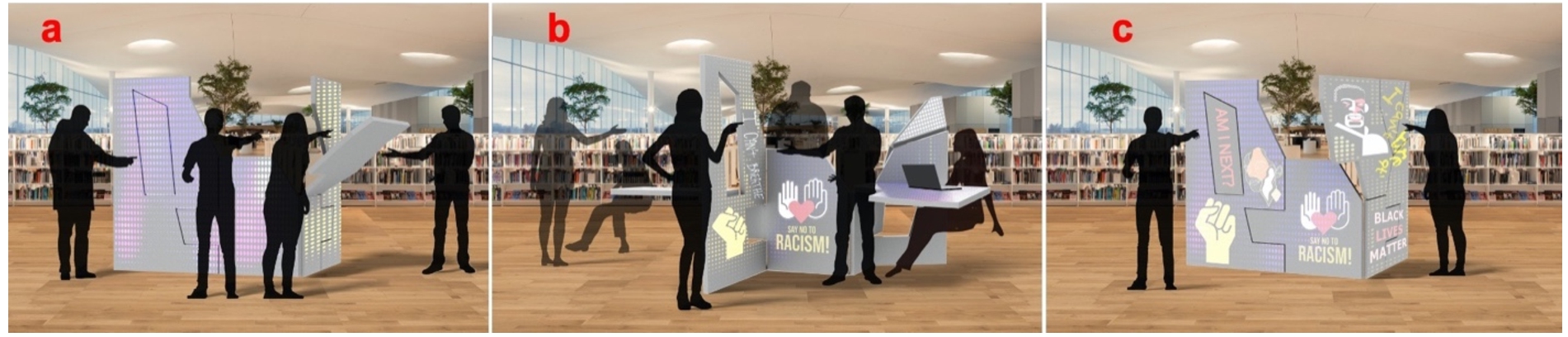
(a) Jasmin’s group configuring communIT; (b) Jasmin’s group using communIT to create and share content; (c) Mariana and Mathew interacting with communIT.
Among visitors to the library in the days that follow, Mariana, an immigrant from South America, and Mathew, a young gay man who works as an editor at a nearby publisher, are intrigued by the presence of communIT – its display of images, sounds, videos, and the scrawled drawings on moving hinged surfaces that appear to be about the urgent racial situation of this community and the nation at large. Mariana, ahead of Mathew, approaches communIT; she notices that her movements towards, around, and away from communIT have some impact on the sequencing of imagery and sounds and physical movements of the large-scale artifact. Mathew, too, comes closer to communIT, and the two library patrons recognize that their behavior and communIT’s is interlinked, enticing them to interact further with the content of Jasmin’s group.
Despite not being members of the Black community, Mariana and Mathew feel empathic to the group’s challenges – problems not unfamiliar to them and the subgroups they identify with. Upon leaving the library lobby, Mariana and Mathew see mounted, on a short column, a screen that invites them to answer two questions: Do they feel they understand better the struggles faced by members of the group that created the exhibit? and, After experiencing the exhibit, might they respond to members of that group in a more understanding way? (Fig. 1(c)). Mariana and Mathew both answer the two questions by pressing the green-lit “happy face” as their response to each of them before leaving communIT. In the days that follow, the impression of the exhibit stays with them.
What are communIT’s key design feature to support community members in creating and sharing content with the larger community? To explore this question, we examined existing interactive architecture and draw three key design considerations that informed our design. The first design consideration relates to the artifact’s form and physicality/spatiality. Most of the research on existing artifacts includes non-buildings, such as urban furniture (e.g. [33]), architectural follies (e.g. [17]), large-scale screens (e.g. [31]), and large-scale installations [21]. The second consideration is the selection and placement of analog and digital peripherals on this superstructure, which often include embedded speakers and displays (e.g. [12,31]). The third consideration involves the activities and interactions users would engage in when interacting with these artifacts. The three phases of communIT’s design described below consider these three elements.
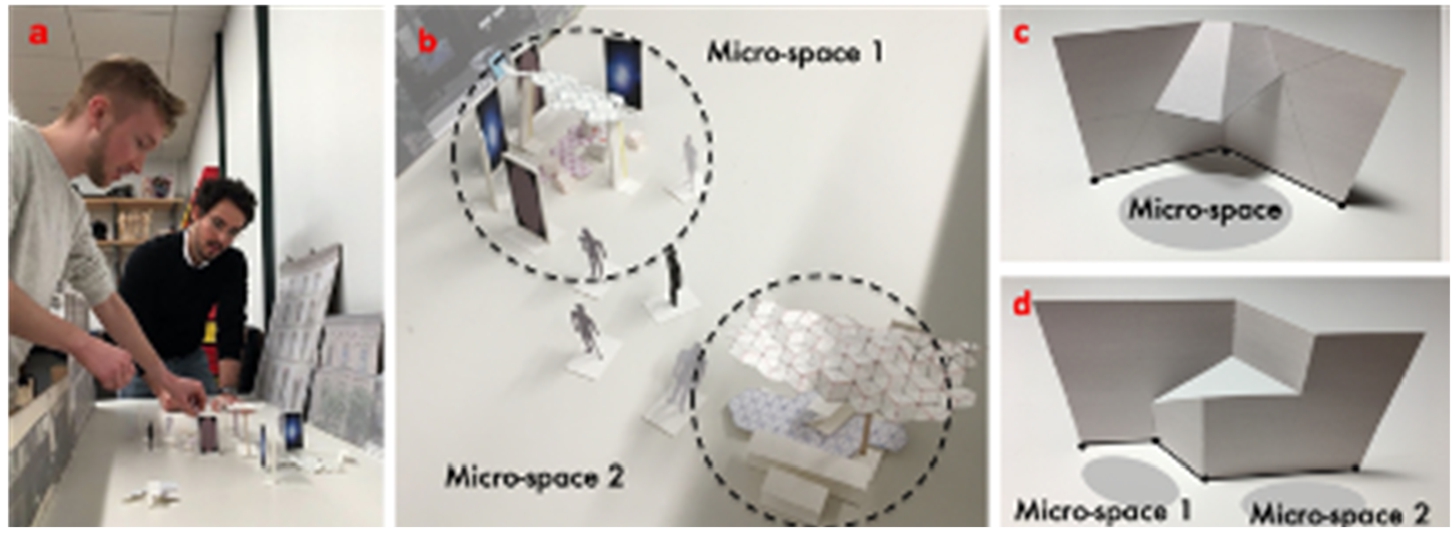
(a) A participant and a researcher co-designing communIT; (b) one design outcome with two micro-spaces; (c) and (d) researchers’ design exploration using kirigami concept.
We used CoDAS [9], a co-design method we developed to conducted a study with 12 local community participants (6 female, 6 male) at Cornell University (Fig. 2(a)) to begin understanding how the three feature above mentioned translated in communIT’s design,). We used small-scale props made of cardboard to design communIT with participants and to envision the artifact’s attributes. Props were representations of the artifact’s physicality, and analog and digital peripherals: large-scale screens, wall installations, speakers, and urban furniture (e.g. benches, tables and canopies). We also constructed a scale model of a local, familiar public space to contextualize the physical site for the artifact. We critically reviewed the 15 different design candidates and learned that participants (a) proposed multiple activities, and (b) divided the space in the physical site into micro-spaces, each matching an activity it supported or augmented. Each of these micro-spaces had specific attributes.
As one participant suggested, “I imagine this [Fig. 2(b), micro-space 1] as a quiet, confined place, with these elements [the canopy and the wall] blocking direct contact and giving some privacy
We used these initial findings to inform our initial design of communIT. At this stage, the research team agreed on a formal language following from what we learned and explored, taking inspiration from a variant of origami, kirigami [4,20], of folding and cut planes that might capture the behaviors and affordances fulfilling our ambition. We explored how kirigami changes the affordances of the artifact to create various micro-spaces [Fig. 2(c) and (d)]. There were two key strengths of the kirigami concept that motivated its selection as the formal grounding of the communIT design: (1) its economy in making multiple smaller spaces – one plane, when folded, could accomplish much of what we sought in a configurable design; (2) its capacity to serve as, at once, a functional and a sculptural artifact that may prove enticing to those encountering it.
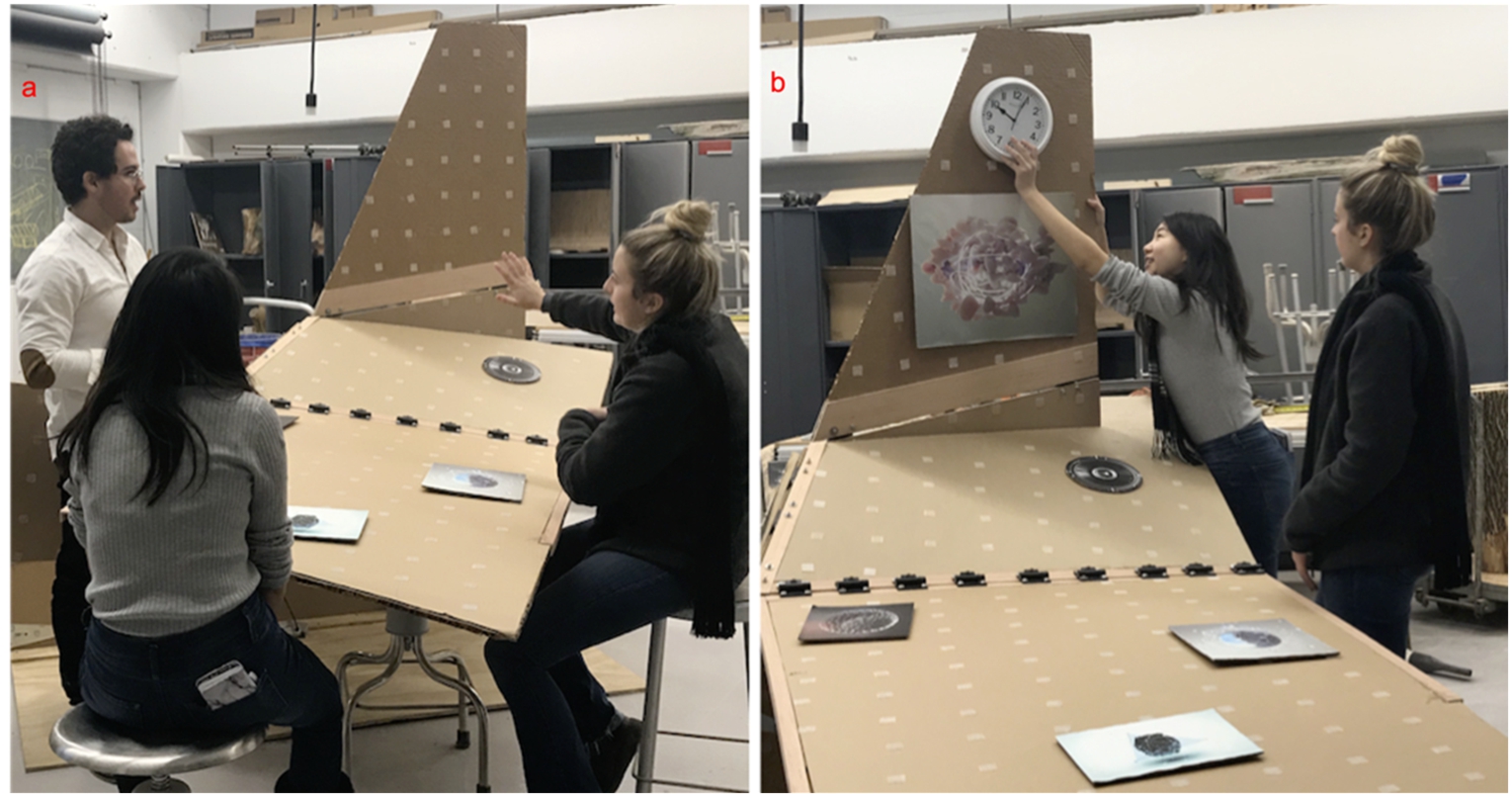
(a) and (b) Participants placing the IT elements onto communIT surface.
We fabricated a full-scale prototype of our kirigami design for communIT, and recruited 28 [place withheld for blind review] local community members (18 female, 10 male) to participate in a second co-design workshop to further iterate the design of communIT (Fig. 3(a) and (b)). We aimed to refine our understanding of preferred physical configurations of the prototype, the preferred positioning of analog and digital hardware, and the identified activities these configurations afforded. For each of five 30-minute co-design session, we introduced participants to the prototype and asked them to: (a) physically manipulate the prototype’s moving panels, determining their preferred physical configuration to support a specific activity; (b) attach the peripherals (i.e. cardboard printed images of display, speakers, etc.) onto the prototype’s surfaces to communicate to us which peripherals were preferred for supporting a given activity, and where the peripherals might best be located to best do so. We analyzed the 15 different designs produced in the co-design activity, finding five recurring design patterns (Fig. 4). Each design pattern suggested a particular relationship among the following elements: the physical configuration of the artifact, the activities participants would engage in, and the positioning of the peripherals on the artifact’s surfaces.
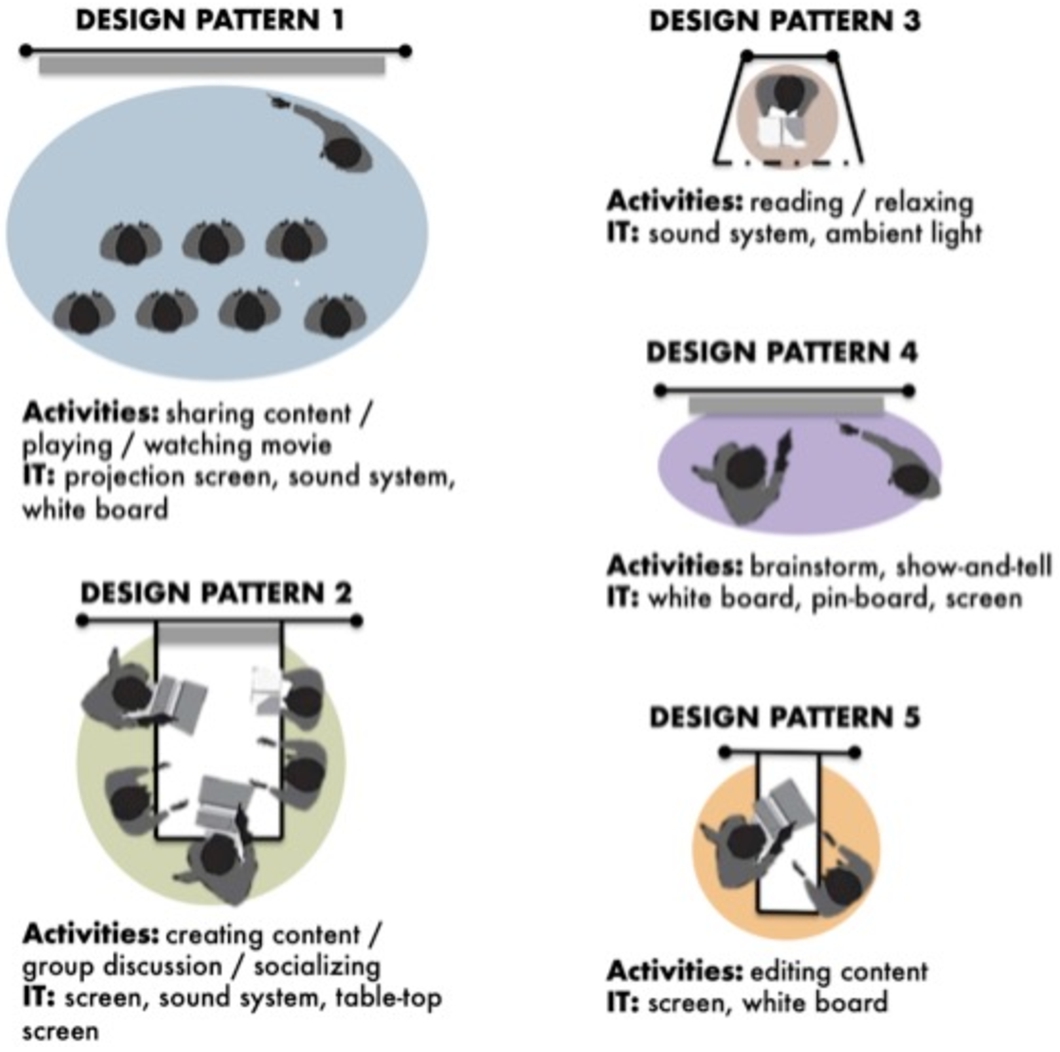
The five recurring design patterns found in communIT studies.
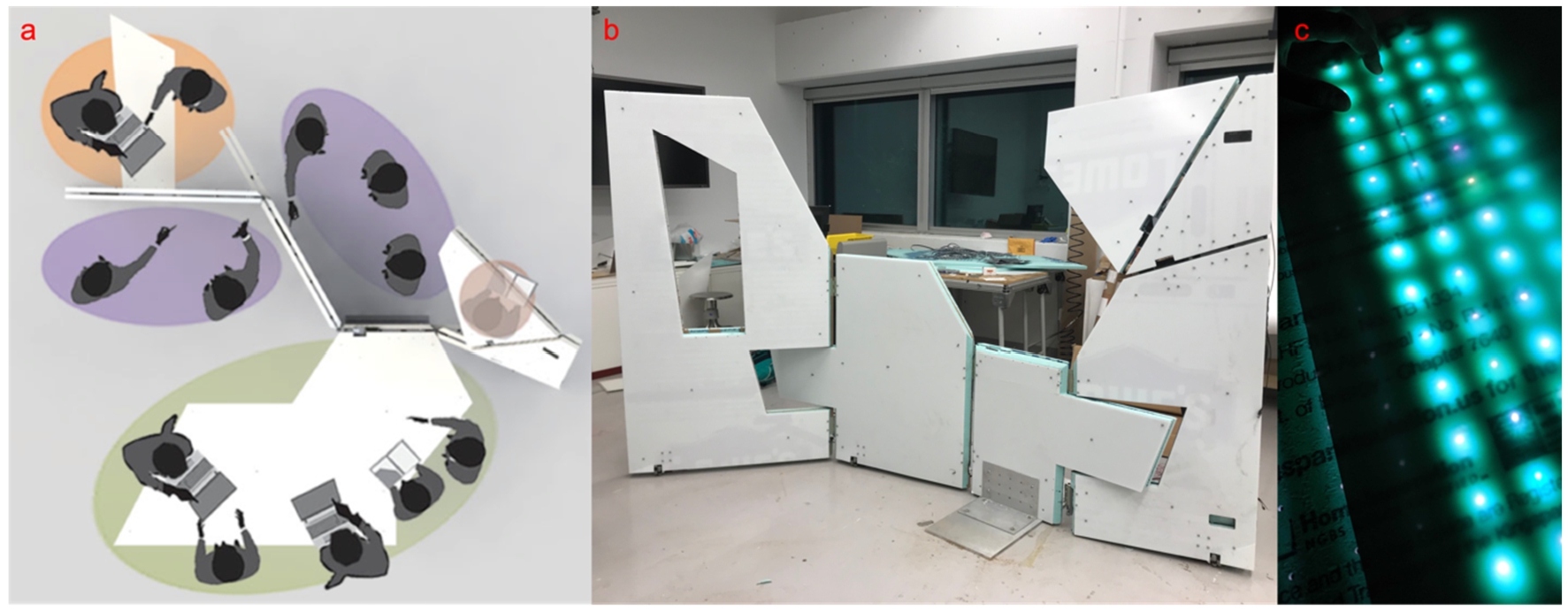
(a) and (b) Plan (top view) and large scale prototype of communIT; (c) communIT’s panel embedded with light.
One participant whose design was closely related to design-pattern 1 identified “a huge interactive wall that people can use to present work and ideas to others.” Another participant described her design (close related to design-pattern 2) as “a big-shared table to work and study.” We used the five design patterns found in Study 3 to, once again, iterate the design of communIT (Figs 5(a) and (b)). Our main design objective was to create a reconfigurable artifact that could capture the characteristics of the five design patterns in various combinations. After extensive exploration, we reached a design candidate that we judged met this objective and the various constraints as developed over the course of the user studies and design tasks.
We fabricated a full-scale prototype of design iteration 2 (Fig. 5(b)). Technically, the composition of communIT’s panels involves two layers of polystyrene foam CNC’d from a 4 ft. by 8 ft. insulation board. The layers of polystyrene foam are spaced 0.5 inches apart using 3D-printed plastic spacers forming a hollow core that both reduces overall weight and allows a conduit for wires to run through the panels. On one face of communIT, behind the acrylic, are embedded strips of LED lights that create a large and foldable, low-resolution display (Fig. 5(c)). Also embedded in the wall are four USB-powered speakers.
Due to the pandemic that halted in-person study, we conducted an online survey to further evaluate communIT. Although we would rather have continued our evaluation via our chosen, in-person field methods, an online survey would allow us to reach a wider geographically dispersed community. The survey we conducted follows the method of prior HCI research (e.g., [39,40]) that holds that, in an online study, participants can vividly transport themselves into the experimental settings and provide valid feedback on their perceptions and emotions. We therefore asked participants to imagine themselves interacting with communIT and then respond to our online survey. Primarily, we wanted to know if participants perceived communIT as suitable, useful, and impactful for their group; whether they recognized communIT as a tool to share, engage, and interact with the large community; whether they thought communIT might help them express their ideas, concerns, and aspirations to the larger community; and what they thought about communIT’s impact on how the larger community perceived their group.
Participants
One hundred and ninety-seven participants (57 male, 62 female and 29 other, with the remaining participants preferring not to answer) were recruited throughout the United States using CloudResearch, a platform powered by Amazon TurkPrime. For this study, we recruited only Master Turkers – more experienced Amazon Turk survey-takers. Workers were paid a higher market rate of 4 dollars (USD) for participating in the 15-minute, IRB-approved study. We did not collect demographic information other than gender.
Procedure and measures
We assessed participants’ perceptions toward communIT via a 19-question survey (Table 1) conducted using Qualtrics Survey Software. The survey was divided into two parts. The first part (Q1–Q7) aimed to understand which social groups each participant mostly identified with, and to assess each participant’s perceptions of (a) their groups’ beliefs as to how they were perceived by the community, (b) their group’s engagement with the larger community, and (c) the tools and resources their groups use to engage with others.
Before the second part of the survey, participants watched a video (1:32 minute duration;
Survey questions
Survey questions
Because we wanted to allow participants to self-define their subgroups, Q1 was open-ended (“Which social groups do you mostly identify with?”). To determine the groups that participants identify with, we coded the responses, identifying three major groups: Immigrants (
Two questions asked participants whether they understood and could explain communIT (Q8, Q9). For the statistical analysis, we only included participants who affirmatively (i.e., those who responded 5, 6, or 7) that they understood communIT (
Evaluating communIT – results
We first report on participants’ perceptions of how they are understood by and interact with the larger community. Then, we report on how participants perceive the suitability, usefulness, and impact of communIT to better engage with and be understood by the larger community. The findings include the statistical analysis to compare the Subgroups and Other Participants groups, followed by our qualitative open-ended analysis that provides a more nuanced understanding and interpretation of participants’ perceptions and thoughts.
Being perceived by and interacting with the larger communities
The first set of questions sought to understand the degree to which participants thought that the groups they identified with were understood by the larger community. Table 2 presents the descriptive statistics comparing the Subgroups and Other Participants groups; Table 3 presents statistics comparing the Immigrant, Black, and LGBTQ+ groups. The second part (Q8–Q19) assessed participants’ perception of communIT in relation to their groups’ internal interactions, as well as to their engagement with the larger community. Participants’ perception towards communIT, the central element of analysis, was divided into three elements: (a) suitability of communIT, (b) usefulness of communIT, and (c) impact of communIT, all measured on 1–7 Likert scales and followed up with open-ended questions. We also included three additional questions to further understand participants’ views toward communIT: whether participants were open to experiment with communIT (Q10); locations in which participants envisioned it installed (Q16); and any additional comments participants had about it (Q19).
Comparison between subgroups and other participants on being understood by the larger community
Comparison between subgroups and other participants on being understood by the larger community
Comparison between subgroups on being understood by the larger community
Participants in the Other Participants (
In their open-ended responses, participants from both groups reported similar ways as to how their groups interacted with the larger community (Q4) and the kinds of tools and resources they used to interact with others (Q7). Most resources involved social media, community forums, social events, community centers, and group clubs. Some participants did not specifically mention any tool or resource, but instead they specified some characteristics of the tool. One participant from Subgroups, for instance, mentioned a desire for “tools to share information about the history of our culture,” while a participant from Other Participants pointed to “a platform that shares plans and information regarding what the groups do and what they stand for.” Other participants described why they engage with the larger community. For instance, an LGBTQ+ participant offered that “we engage to inform people about our minority group and issues within,” while a participant from the Immigrant groups reported a need to be engaged with the larger community “to look out for each other and try to help others who are not in our group but part of our community.” Several participants sought the opportunity to interact with diverse groups to share their ideas and thoughts. A participant from the Subgroups groups wanted “to connect and discuss how to fit in better,” while another wanted the “
Table 4 presents descriptive statistics comparing the Subgroups and Other Participants groups on suitability, usefulness, and the impact of communIT for engaging within and across groups. We found strong correlations among these three measures: Suitability and Usefulness:
Comparison between subgroups and other participants on suitability, usefulness, and impact
Comparison between subgroups and other participants on suitability, usefulness, and impact
Comparison between subgroups on suitability, usefulness, and impact
The question on usefulness (Q13) was followed by two open-ended questions to further understand how participants think they would use communIT (Q14, Q15). In our qualitative analysis, we found no apparent differences between the two groups on how they would use communIT to interact, engage, and communicate, both within their groups and with the larger community. Overall, most activities engaged with communIT involved brainstorming, collaboration, discussion and sharing and producing content (e.g., infographics, pictures, cartoon, and videos). For example, one participant from Subgroups reported that their group “could develop videos, graphics, or texts to display on communIT for other groups to view and discuss our ideas.” Another participant from Other Participants intended to “use [communIT] to have discussion groups, learning forums, and for spreading the word about our ongoing charity projects...”.
Further, participants from both Subgroups and Other Participants groups reported similar purposes for these activities, most intending to use communIT to engage in debate and raise acceptance of different opinions. One participant from Other Participants offered that “our collaborative thoughts and even our divided opinions could be used as a mean to pull the larger community into our circle. This would be useful as such to generate discussion, which could in turn lead to more widespread involvement from others.” Other participants wanted to use communIT to raise understanding and inclusion among diverse populations. For example, an immigrant participant said, “we could use it as a tool to show our culture through video and music”, while a gay participant said, “communIT would make it easier for the community at large to see what my group is about.” These findings indicate that, regardless of whether individuals identify with a Subgroups group or not, they see the potential of communIT to serve as an engagement tool that bridges between groups in the community to increase understanding, acceptance, and discussion. In their open-ended responses, several participants referred to the physical characteristics of communIT as a multipurpose, reconfigurable platform for sharing, engaging, and interacting within and across groups. For example, one participant offered, “each person could work individually or [in] small teams and then come up with ideas to present to other members of the group
As a large-scale physical artifact, participants also saw communIT as a gathering place, “bringing people closer together through communication and learning.” Another participant saw communIT “as a focal point for bringing together members of my group and the larger community.” One participant said that “communIT provides a balance of both in-person and digital gatherings to share information with a broader audience.” Many expressed that the physicality of communIT would serve as a catalyst for social interaction: “It might broaden people’s social networks and make them interact with others they might not have before.” Other participants said their groups would use communIT, in the words of one participant, “as a place to spend a bit of time there before moving on to other things.” In the follow-up, open-ended question of the impact of communIT (Q18), many participants from all groups believed that communIT could instigate discussion and understandings across various populations, fostering, in the words of participants, “a greater feeling of community” and “a feeling of unity and mutual cooperation.” But, while we did not find apparent differences between the groups in their open-ended responses on how they would use communIT, our analysis did indicate a slight difference between the Subgroups and Other Participants on how participants see its impact. Specifically, the comments of participants in the Other Participants related to communIT’s general social impact. As one participant put it, “[communIT] would let society see different groups as more alike than different and they could relate to each other better.” On the other hand, the comments of participants in the Subgroups related to the impact of communIT on their specific subgroup. As one participant offered: “[communIT would] help us show others about our unique traditions and values, and try to involve them in understanding our identities”.
Finally, while most participants expressed enthusiasm about communIT, a few were reticent about its impact, saying that it would ultimately depend on how people end up using the artifact. One participant wrote that communIT “has the potential to have a positive impact albeit the magnitude of such an impact largely depends on the participators more than anything else.” Similarly, another participant said communIT’s impact “depends on how it’s perceived in the community.” One participant said that., “in a normal world, I could see [communIT] being useful for project collaborations, but in the covid-19 reality
Our quantitative results from Q12-suitable and Q13-useful indicate that participants feel communIT would be suitable and useful for their local group to engage in collaboratively creating and sharing their products with the larger community. This indication is positive – being useful and suitable for media making and sharing is the first step for communIT’s relevance in community engagement. One of the most basic form of protest involves, after all, making and displaying messages to others.
In parallel, findings from Q17-“impact,” indicate that the majority of participants believed that communIT may make an impact on how their groups are perceived by the larger community. We also were able to observe in Q15-“share larger” and Q18-“kind of impact” that participants believed that their groups could use communIT to express their ideas, concerns, and aspirations to the larger community. Participants expressed their intention to use communIT as a platform to communicate with the larger community. If, on one hand, Q12-“suitable” and Q13-“useful” suggested the usefulness and suitability of communIT for media making and sharing, on the other, findings from Q17-“impact,” Q15-“share larger” and Q18-“kind of impact” indicate that communIT is relevant for groups to express their views to the larger community.
These findings collectively and positively support communIT’s promise to play a role in community building as diverse groups engage in creating and sharing their products with the larger community. Moreover, the findings suggest that community engagement may arise out of the participation of community groups (i.e. the Subgroups) to create and share their outcomes (e.g. videos, text, etc.) using communIT. This corroborates with the literature presented in Chapter 1. Specifically, what we found goes in line with what Marres [27] suggests: that not only individuals, but also resources and objects are essential for a community engagement around issues of mutual concern. There is another relevant point: when we examine some participants’ extracts we discover that communIT goes in tandem with what Jenkins presented in [22]. For instance, a participant said “communIT would make it easier for the community at large to see what my group is about.” This align with Jenkins’ view that artifacts are not merely a tool but instead a partner in the creation and maintenance of public issues. Members of subgroups saw communIT as an important object to gather other people around issues of their concern; this also suggests communIT’s potential as an object-oriented democracy [24].
In addition, the results from Q14-“share within” and Q15-“share larger” indicate that participants recognized communIT as a platform to engage and interact with members of their own groups and share with the larger community. These findings resonate with the findings of Q6-“tools afford” and Q5-“better understood,” respectively: tools that afforded sharing, engaging, and interacting would help groups communicate to the larger community in a way that make them understand better; sharing, engaging, and interacting with others helps one feel better understood. We can imply that participants believed communIT may make an impact on how the groups are perceived by others because they recognize communIT as a tool that allows engagement and interaction across diverse community groups. Once again, this illustrate the potential of communIT to work as an object-oriented democracy, playing an active role in community engagement. Lastly, in Q18-“kind of impact,” several participants offered that communIT would create a place for gathering and, therefore, would increase social interaction. This also resonates with what we found in Q4-“how share” and Q7-“what tools,” where participants indicated they wanted a tool to promote informal gathering for social interaction.
Conclusion
Communities are complicated social forms [24] comprising both humans and nonhumans. They are also emergent forms and their future development is dependent upon how they articulate and enable their activities, interests, and aspirations, amongst themselves and with other groups [7,11,27]. The potential for such human and non-human gatherings is made evident, for instance, in Latour and Weibel’s notion of “object-oriented democracy” [24] which might characterize the capacity for communIT, an object drawing people to it, at the same time gather people around issues and their consequences. With communIT, the broader impact we strive for is articulated eloquently by Eric Klinenberg, in Palaces for the People: How Social Infrastructure Can Help Fight Inequality, Polarization, and the Decline of Civic Life:
People forge bonds in places that have healthy social infrastructures – not because they set out to build community, but because when people engage in sustained, recurrent interaction, particularly while doing things they enjoy, relationships inevitably grow [23].
But while apps are said to reanimate social and civic lives, our research team argues, instead, that the materiality of artifacts play a fundamental role in the way community is formed. Even more promising is the potential of embedding information technology in the physical fabric of the built environment, to augment the public, material space as loci for civic discourse and for addressing community challenges. As a cyber-physical, interactive, large-scale artifact, communIT is a way to bridge cyberspace and bricks-and-mortar to build local communities – the building blocks of a nation – through the interactions of individuals, groups, and the larger community.
Conflict of interest
None to report.