




Abstract
In the last decade, the world has witnessed increasing investments in smart city initiatives, which frequently employ data and emerging technologies to tackle complex urban challenges. Although existing literature has acknowledged the potential benefits of smart cities, such as increasing economic development and improving urban operations, their sustainability, understood as the enduring or long-term impact of specific outcomes, has been under-researched. Furthermore, the few studies touching on sustainability have focused on environmental or economic sustainability, mostly ignoring social sustainability. Therefore, this paper aims to review and synthesize the state-of-the-art research on social sustainability in smart cities. Our research questions are: (1) what are the main topics in the literature related to social sustainability in smart cities? and (2) what are the gaps that require further investigation? Our review shows that inclusion and equity are crucial components that must be considered. More specifically, civic engagement is an effective method for smart cities to better understand and respond to all residents’ social, economic, and environmental demands, enabling a more inclusive and equitable smart community.
Keywords
Introduction
In the last few decades, cities from around the world have been confronting and brainstorming creative solutions to address wicked social, economic, and environmental challenges emanating from increased urbanization. In parallel, the world has witnessed an unprecedented revolution related to the use and impact of information and communication technologies (ICTs). The confluence of these two trends gives birth to a global so-called “smart city” movement, where ICTs are expected to become crucial means to ameliorate the negative consequences of urban development and enhance residents’ quality of life [25]. While scholars across disciplines have conceptualized smart cities in varying ways, three common characteristics of smart cities can be derived from those conceptualizations [23]. First, a smart city adopts a global/integral view of the city, applying ICTs to produce a myriad of public services. Second, both technological and human factors are inherent in smart cities, highlighting that the utilization of ICTs in addressing urban challenges is developed in collaboration with citizens and other stakeholders. Third, smart cities pursue a triple goal: to enhance operational efficiency, improve citizens’ quality of life, and promote the local economy while maintaining environmental sustainability. Consequently, smart cities encompass a wide range of components directly or indirectly related to ICTs, but also to other aspects of urban settings [14], which could include technologies, data and information, government, society, the physical environment, policy context, economy, and built infrastructure [22,25].
As the definition above reveals, one critical purpose of smart cities is sustainability. Defined by the World Commission on Environment and Development [52] as the development that “meets the needs of the present without compromising the ability of future generations to meet their own needs,” sustainability has recently received growing attention among smart city researchers (e.g., [28,31,37]). Yet, the conceptualization of sustainability in smart cities has evolved over time. The earliest form of sustainability was proposed to enhance the public’s awareness of the need for natural environment protection and engage people in exploring ways to avoid over-consumption of environmental resources while still pursuing economic growth [27]. It was the result of the realization that economic activities and prosperity had resulted in unimaginable and irreversible damage to the natural environment. Later on, the concept involved other aspects of society, resulting in the “triple bottom line” or three pillars of sustainability [8,19,46]: economic development, social inclusion, and environmental protection. According to Colantonio and Dixon [16], social sustainability concerns “how individuals, communities and societies live with each other and set out to achieve the objectives of development models which they have chosen for themselves, also taking into account the physical boundaries of their places and planet earth as a whole (p4).” The pillar of social sustainability is also highlighted in the current Sustainable Development Goals (SDGs) agenda [49]. The agenda calls for attention and action to end inequity – embodied in various forms such as poverty, HIV, and discrimination against vulnerable populations – because inequity harms the well-being and social mobility of the current populations and their future generations. On the other hand, economic sustainability refers to inclusive and long-term economic growth, seeking to achieve full employment and decent work for all women and men, including for persons with disabilities, and equal pay for work of equal value. The three pillars of sustainability collectively delineate a perspective to balance sustained economic development, the preservation of environmental resources, and social equity as a strategy to develop the city, region, and country as a whole.
Recognizing sustainability as a crucial objective for smart cities, a vast body of research on “smart sustainable cities (SCC)” has been produced in an attempt to disentangle the relationships between technologies and urban sustainability [9]. Most literature argues that smart cities have the potential to enhance sustainability [6,7,9,20,21,44], whereas other studies explore the negative impact of smart cities on sustainability, pointing out that an over-emphasis on economic benefits and sophisticated technologies may create new or widen existing social and environmental problems [28,36]. Despite these contributions, it seems that the literature on sustainability in the context of smart cities faces a critical limitation: the majority of research has focused on the economic and environmental aspects of sustainability, while largely neglecting the social pillar [17,29,32,35,38]. This observation is corroborated by the results obtained from our search of the Web of Science (WoS) database. The search was conducted on November 13, 2021. The search words were specified as follows: (“smart city” OR “smart cities”) AND (“social sustainability”); (“smart city” OR “smart cities”) AND (“environmental sustainability”); (“smart city” OR “smart cities”) AND (“economic” OR “economy”). As indicated in Table 1, there has been an exponential growth in the study of economic development in smart cities over the past decade. Environmental sustainability has accumulated a considerable body of research as well. In contrast, in the last 10 years, less than ten publications were produced each year with regard to social sustainability.
Trends of topics in smart city research
Trends of topics in smart city research
Source: Web of Science.
In the smart city context, social sustainability is understood in many ways, such as social cohesion and sense of belonging [28,30], inequality [28,30], participation [10,28,29], quality of life [6,30], and human rights [35]. Despite some important differences, the literature on social sustainability shares a few things in common. First, existing studies argue that the conversations about smart cities have been, to a large extent, based on certain biased assumptions and ideologies regarding economy and technology [17,28,29,31,48]. They notice a hidden political agenda underlying the smart city trend in which ICTs are promoted by businesses and technology vendors as a panacea for different kinds of urban problems, particularly for revitalizing the economy. Second, the literature argues that not every individual and community is equally treated in the business-driven development model of smart cities. For example, Hollands’ [28] analysis of numerous smart city cases shows that those initiatives tend to prioritize business interests and be more attractive to educated, middle-class professionals and IT workers. In contrast, the poorer population and communities are absent from the scene. Additionally, research indicates that citizens’ experience with the use of new technology in smart cities is affected by some digital divide variables such as age, education level, and region, preventing disadvantaged groups to fully benefit from smart city initiatives [44]. It is also acknowledged that smart city initiatives may deepen some existing social gaps [17]. In light of such shortcomings, researchers strongly advocate bringing the residents and communities back into the planning and implementation of smart cities [18,35].
Therefore, given the importance of social sustainability in smart city development, in this study we attempt to fill some of the existing gaps in the literature by investigating the following two questions: (1) what are the main topics in the literature related to social sustainability in smart cities? and (2) what are the gaps that require further investigation? In order to examine how social sustainability has been addressed in smart city research, we review and synthesize existing research about this topic. We argue that a systematic understanding of social sustainability is valuable to both scholars and practitioners. For researchers, it shows how smart cities may contribute to or impose risks on communities’ welfare and rights to participate in urban affairs, both of which add new insights to our understanding of the impact of smart cities on their residents. As for public managers, the results could help to better serve citizens and deliver public value to everybody in the city by being more inclusive and promoting engagement with an emphasis on social equity.
Despite being widely used in research and practice, the notion of social sustainability is far from clear, particularly in the context of smart cities. Colantonio [15] notes that there is a lack of consensus on a single definition of social sustainability due to the fact that it has been studied from different disciplinary lenses. However, several studies have attempted to provide a holistic understanding of the social pillar of sustainability in urban contexts. For instance, based on a review of academic literature and practical assessment models, Colantonio [15] analyzes different concepts of social sustainability and categorized the themes included into traditional and emerging. They also argue that it seems that emerging themes tend to complement or replace the traditional ones. Traditional themes include basic needs, education and skills, employment, equity, human rights and gender, poverty, and social justice, while the emerging topics cover demographic change (such as aging, migration, and mobility), social mixing and cohesion, identity and sense of place, empowerment and participation, health and safety, social capital, and finally, well-being (used interchangeably with happiness and quality of life). A subsequent work elaborates on those emerging dimensions by adding a series of measurable indicators [16].
In a similar vein, Dempsey et al. [19] identified two overarching dimensions at the core of urban social sustainability – social equity and sustainability of a community. Social equity is concerned with social and environmental exclusion, stating that individuals should not be deprived of their chances of political, economic, and social participation in society because of exclusionary or discriminatory practices. The authors find that accessibility is the most-cited measure of social equity. Sustainability of a community relates to social cohesion and inclusion, aspects of social life that are conceived as the foundation of fairness and social justice. More specifically, the sustainability of a community manifests in five measurable aspects: social interaction or networks, participation in collective groups and networks, community stability, sense of place or pride, and safety and security.
While there are many conceptualizations of social sustainability, the definitions share a few critical aspects of urban development, communities, and residents as well as the dynamic interactions among them. First, it is acknowledged that the impacts of environmental externalities, such as natural disasters and climate change, are distributed heterogeneously and disproportionally among various populations [20]. In general, residents living in suburban and rural areas and/or with lower social-economic status are much more vulnerable to those environmental risks than the urban, wealthier population. Additionally, urban economic growth is not benefiting all residents equally. Urbanization has increased social inequality, polarization, and social segregation Dempsey et al. [19]. Finally, urban inequality also manifests as limited opportunities to engage in the political process [33]. In this regard, social sustainability is related to the actual impact of urban development on different communities and residents, the discrepancies in impact among populations, and the solutions to bridge those societal gaps.
Methodological approach
In order to critically analyze how social sustainability has been studied in smart city research, we conducted a comprehensive literature review to identify the main themes and then proposed a research agenda based on our main findings. The review flow is depicted in Fig. 1. First, both Google Scholar and Web of Science were utilized to search for published research with the following keywords: (“smart cities” OR “smart city” AND “social sustainability”). Thirty-five and thirteen publications were retrieved from Web of Science and Google Scholar, respectively. In addition, we solicited input from an expert in the field to complement our search results, adding four additional publications to the list. Thirteen duplicate articles were removed. Subsequently, we screened the title and abstract of each publication to identify whether it is relevant with social sustainability in the smart city context. After excluding irrelevant ones, twenty seven studies were selected for analysis. Lastly, a close full-text examination was conducted for each included study, particularly focusing on the publication year, research question, the theoretical approach, the empirical methodology, as well as findings and contributions. The main characteristics of the publications are presented in the Appendix, Table 3.
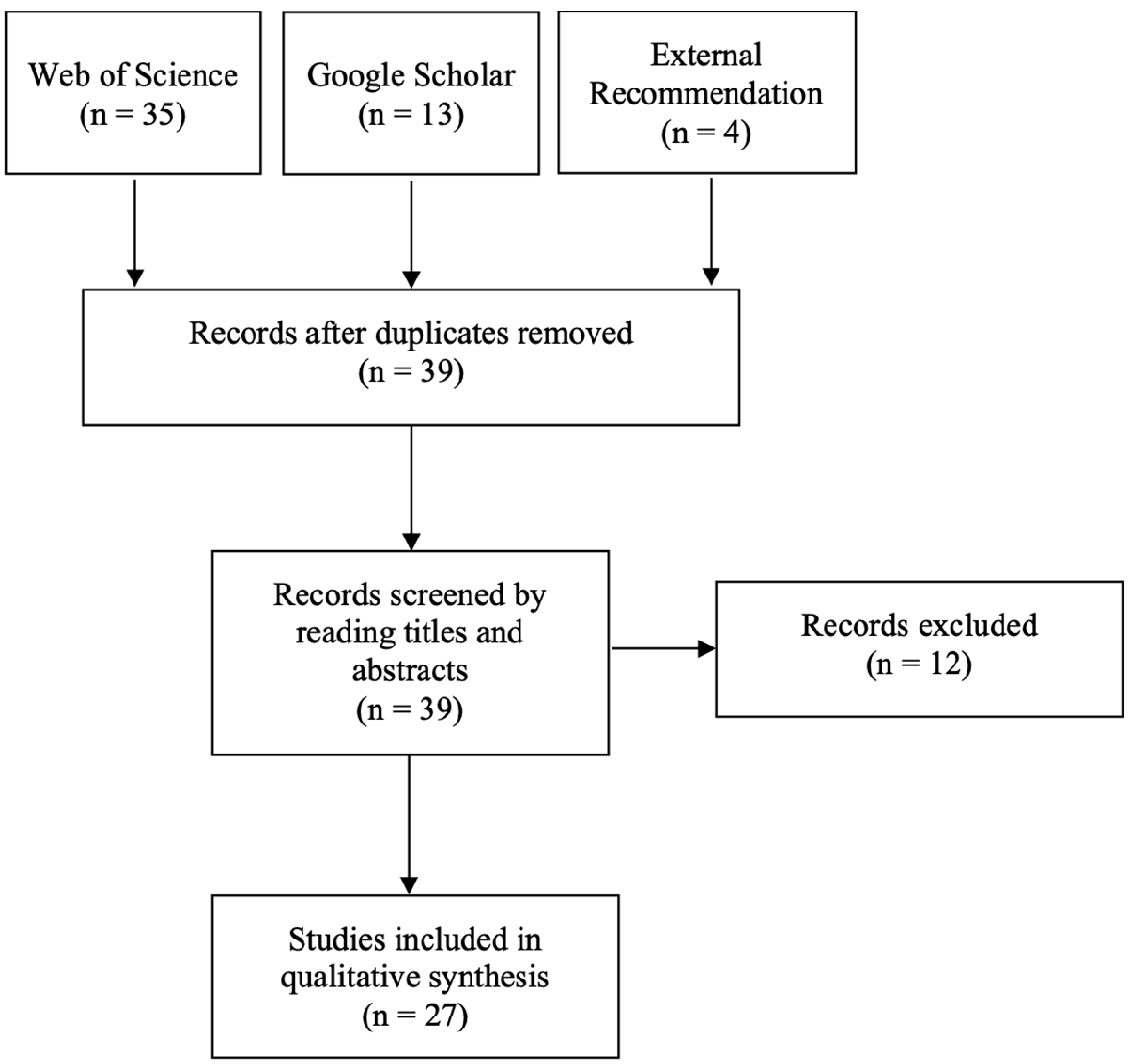
Comprehensive literature review flowchart.
Most of the studies were published in journal articles, except for two conference papers (see the Appendix, Table 3). In terms of publication year, there were merely one to two work(s) published per year (excluding 2009 and 2010) before 2016. Nonetheless, more publications were produced since 2017, accounting for approximately 74% of the total amount of published studies within the last ten years. With regard to the methodological approach, 41% of the studies are conceptual, dealing with social sustainability as a concept, proposing specific indicators, and, more broadly, articulating smart city models. On the other hand, around 52% of the literature collected and presented empirical evidence, with qualitative case studies being the most prominent method. Finally, the remaining 7% of the studies were literature reviews.
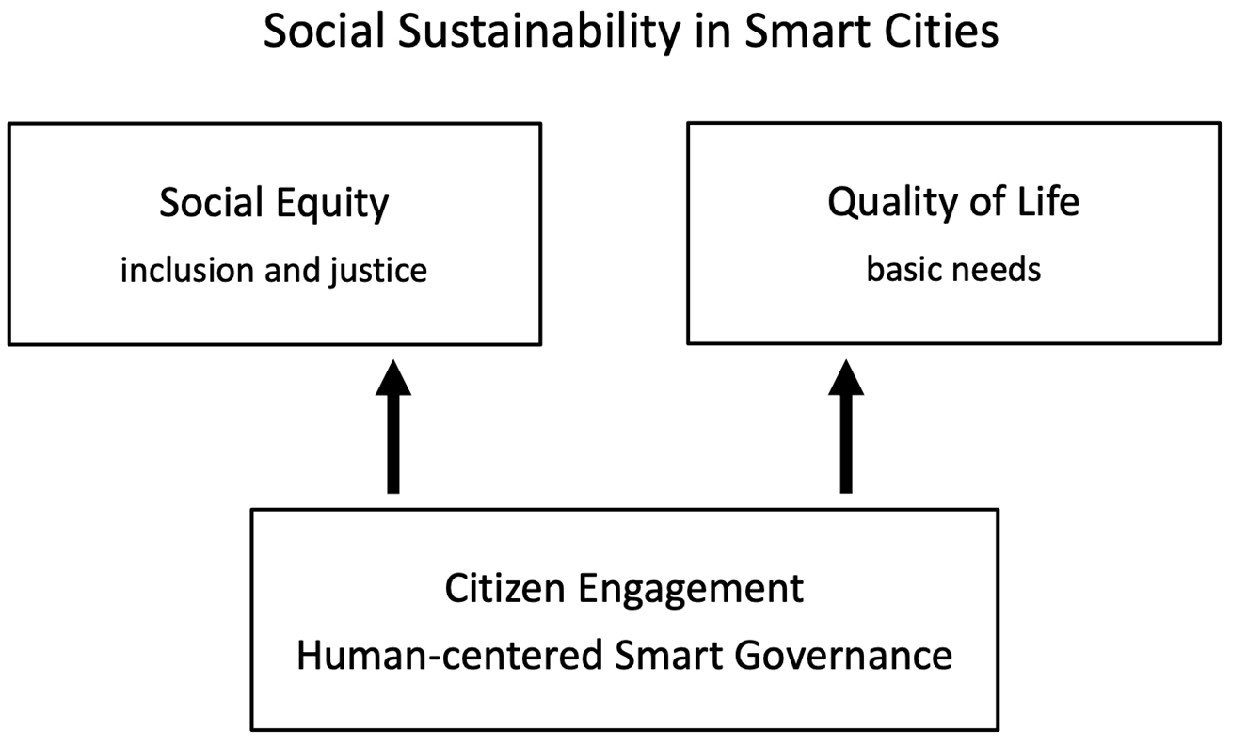
Main concepts about social sustainability in smart city literature.
Four major themes concerning social sustainability in smart cities can be identified from the literature: social equity, quality of life, human-centered smart governance, and citizen participation. The relationships among the themes are characterized in Fig. 2. First, social inclusion, equality, and justice have received wide recognition among scholars. It is argued that the urban space is a social structure consisting of culture, relations, and identity [45]. Consequently, smart cities must be aware of the diversity of social interactions within a city, pay attention to the existing social inequalities, and make efforts to address them [28,29]. Furthermore, as highlighted in the previous section, smart cities should acknowledge and respond to the fact that these initiatives could actually worsen the existing inequalities or even create new forms of social exclusion, widening the gaps between those who possess the access to and capability of using technology and those who do not [17,28,29,34,36,40]. According to Padrón Nápoles et al. [40], in a smart city context, social exclusion can be conceived as the lack of opportunities to access the services provided by smart cities or the use of social networks or technological tools that enhance citizens’ quality of life. More specifically, studies have focused on various types of social inequalities and exclusion in smart cities. For instance, Pérez-delHoyo et al. [42] investigate to what extent transport apps consider the needs of people with low income, a physical disability, and language barriers. Relatedly, Rebernik et al. [43] adopt a more holistic perspective to assess a smart city’s disability inclusion based on twenty indicators. Furthermore, age and gender discrimination are other dimensions that scholars have examined [34,40,41,51]. In sum, these studies illustrate that different populations, particularly vulnerable groups, may confront difficulties in accepting, accessing, and leveraging smart city solutions.
Another important theme refers to understanding social sustainability as the improvement of quality of life and well-being [6,11,38,47], which highlights the mission of smart cities to satisfy urban residents’ basic needs [30]. However, researchers have defined “basic needs” in very different ways. For instance, some scholars merely mention quality of life as a goal of smart city development without explaining what it refers to [1,6]. Others conceive well-being in terms of health, viewing improving residents’ lifestyles and increasing their health outcomes as goals that smart city initiatives can help achieve [11,45,47]. Finally, others perceive basic needs in a much broader sense, aiming to meet people’s physical, mental, social, and spiritual needs [45]. The indicators used in existing studies encompass individual income, poverty levels, income distribution, unemployment, education and further training, housing conditions, security, work satisfaction, sports, and leisure [30,45].
Several studies point out that establishing a citizen-centered smart governance system can make a contribution by taking equity, inclusion, and social justice into consideration at every stage of the development of smart city initiatives [34,41,45]. Prior to initiating a project, a context analysis that assesses diverse populations’ demands is instrumental. By factoring cultural and community diversity within the city in the planning of smart cities, policy makers can better allocate resources to address their needs [2,30,38,54]. Subsequently, this needs assessment can be considered in defining the vision and goals of a smart city [2,28,29,41]. Third, in the policy formulation stage, smart vision and goals are translated into specific legislation, structures, processes, and policies that help assign and coordinate the roles and responsibilities of each stakeholder [32]. It is important that the existing contexts such as legal environment and social dynamics are considered when designing the policies and guidelines to ensure that they will be realistic and implementable [45]. Lastly, the implementation and evaluation stage is concerned with the means-ends relationship, paying close attention to the influence of smart city initiatives on the target population [41,45]. For example, some authors noted that ICTs can be tailored to help residents connect, collaborate, and share, thereby establishing and strengthening social networks [38]. Aside from the technology per se, performance management, setting and tracking key performance indicators, has been proposed as another way to ensure an alignment between smart city inputs and socially equitable outputs [43,55]. Additionally, research indicates that establishing accessibility standards for ICT applications is conducive to ensuring that smart city solutions are more accessible to various populations [40]. Moreover, from a project management’s perspective, Spinosa and Costa [45] find a continuing engagement and support from the leaders across government bodies, industry, and academic society as well as stable financial investments to be crucial enablers for successful implementation.
In addition to building a governance structure as mentioned above, numerous studies have particularly investigated the role of civic engagement and political participation, particularly engaging residents and other urban stakeholders in the decision-making process in order to enhance social equity and inclusion. This line of research stems from the critique that smart cities are primarily driven by urban entrepreneurialism and a technocentric view, leaving little space for people to participate in smart city decisions [29]. It is suggested that smart city initiatives should start from people’s existing knowledge and skills instead of technology [4,28], acknowledge residents’ right to belong to and participate as a member of the community [38], and empower, educate, and engage people in the political debate concerning their lives and the urban society where they are situated [28].
In this regard, the existing literature has identified several ways that help broaden citizen engagement in smart cities. For instance, ICTs can promote online participation that brings together the local community of citizens and businesses, various levels of government, and IT experts in the co-design of smart cities [38]. Bouzguenda et al.’s [10] recent study corroborates this view by illustrating that the exchange of ideas between citizens and city planners on city design and planning can be facilitated by using a Three-Dimensional Digital Participatory Planning tool (3DPPP). Moreover, a mobile application can allow citizens to participate in urban governance in several ways such as (1) reporting non-emergencies in the city and adding photos and comments when necessary [31] and (2) sharing information about the specific places in the city that are unfriendly to people with disabilities [42]. While ICTs have considerable potential in fostering citizen engagement, a traditional approach without the assistance of ICTs is of immense value as well. For example, a municipality in Milan organized large public events to solicit input from citizens and stakeholders during the formulation stage of its smart city strategy [48]. These strategies enable and empower citizens to take part in the smart city design and implementation, making the process much more inclusive. Regarding the timing for citizens to participate, Costa [18] suggests that building the citizen-government partnership from the beginning of a project is more likely to succeed compared to inviting residents to comment on the policy details in the latter stages of project development.
As the previous section shows, the existing literature has considerably contributed to the knowledge of social sustainability in smart cities. Nevertheless, in order to deepen scholarly understanding of this subject, we propose a few directions for future research.
Administrator-citizen interactions
Administrator-citizen interactions
Source: Callahan [13].
Social sustainability is one of the objectives that smart city projects seek to pursue. However, scholars doing research about smart cities have paid relatively little attention to the social pillar of sustainability. Our review makes a contribution by examining the extent, range, and nature of existing research on smart cities and social sustainability. Our review results indicate that this research area is still in its infancy, given the limited number of publications compared to other types of sustainability, and has started to thrive in recent years. In terms of the specific topics scholars have addressed, social equity, quality of life, smart governance, and citizen engagement are prominent. It is noted that smart cities are situated in a local context, where heterogeneous residents and communities lie at the core, and therefore the inequitable gaps in the distribution of economic gains as well as political power within society cannot be ignored.
By including considerations about social inequality and exclusion at the initiation, deployment, and assessment of smart city projects combined with a bottom-up civic engagement approach, smart cities could be more capable of receiving and responding to the demands from various populations, giving rise to more equitable, inclusive results and enhancing overall residents’ quality of life. As Hollands [28] puts it, the study of social sustainability revisits and reshapes the meaning of smart, the purpose of smart cities, and the power dynamics among various actors. The review and synthesis of the literature on social sustainability in smart cities highlights the importance of a citizen-centric view of smart cities and the diverse ways to approach the concept.
The second contribution of this study is to propose a few ideas for future research based on existing literature. In this regard, we propose to more extensively develop and use theoretical or conceptual approaches to account for the individual, organizational, inter-organizational, and contextual enablers as well as challenges within a smart city that determine the level of equality, inclusion, and residents’ well-being. In addition, more in-depth analyses of the interconnectivity and multi-faceted relationships of different sustainability pillars are necessary in order to obtain a holistic understanding of the trade-offs and opportunities faced by smart cities. By incorporating these directions in future theoretical and empirical studies, academics and practitioners can more comprehensively understand smart sustainable cities. As a concept and development model, smart cities include not only economic returns and environmental protection in urban settings, but also social equality, inclusion, and residents’ quality of life.
Our review results also highlight some lessons for smart city practitioners and decision-makers. First, it would be helpful that the smart city unit and/or the governance board in charge of smart city projects have deep awareness about social sustainability and discuss issues related to social equity and quality of life. Their primary mission and responsibilities should be to analyze the impacts that smart city initiatives impose on various populations, and based on the analysis, design and monitor the actions necessary to address the potential negative impacts. In terms of analyzing and monitoring who is impacted by the project and in what ways, the board could consider using a mix of top-down and bottom-up approaches to collect inputs. On the one hand, government employees can explore the existing demographic data and anticipate the populations that may be potentially excluded from the project. On the other hand, the city government can hear residents’ voices and concerns via in-person meetings or virtual platforms. The analysis should provide insights into who might be worse off in terms of multiple social divides, like service availability, customizability, or skills and training, etc. City managers and other stakeholders could use this information to avoid, to the extent possible, negative affecting some sectors of the population.
In addition, the smart city unit or board needs to brainstorm and implement projects to tackle these identified discrepancies, which would require a joint effort from the city government, private entities, and people (the public-private-people partnerships approach, PPPP). As several cases cited in this review show, governments can collaborate with the technology vendors to provide services tailored to vulnerable groups and the necessary training to navigate the technology tools. Alternatively, other scholars propose a more open, bottom-up approach to empower residents to determine the overall direction or specific details of smart city development. It should be noted that there is no one-size-fits-all solution. Instead, the roles of governments, private companies, and residents, as well as their relative power will largely depend on the specific decisions and the contexts they are situated in. Lastly, the analysis and monitoring should be an ongoing process throughout the formulation and implementation stages, so that the smart city unit or board can assess how the gaps evolve over time and the effectiveness of the implemented strategies and specific programs.
Footnotes
Acknowledgements
The authors wish to thank the anonymous reviewers for their helpful comments and suggestions on the earlier versions of this article.
Conflict of interest
None to report.
Appendix
Social sustainability scholarship in smart city research
Year
Title
Authors
Journal or otherwise stated
Methodology
Theme(s)
2008
Will the real smart city please stand up? Intelligent, progressive or entrepreneurial?
Hollands
City
Conceptual development
Equity; Inclusion; Participation
2011
Smart Cities and Sustainability Models
Bătăgan
Informatica Economica
Conceptual development
Quality of life
2013
Smart City Reference Model: Assisting Planners to Conceptualize the Building of Smart City Innovation Ecosystems
Zygiaris
Journal of the Knowledge Economy
Conceptual development
Equity; Well-being
2013
Impacting Sustainable Behaviour and Planning in Smart City
Khansari et al.
International Journal of Sustainable Land Use and Urban Planning
Conceptual development
Quality of life (basic needs); Equity; Cohesion
2015
Critical interventions into the corporate smart city
Hollands
Cambridge Journal of Regions, Economy and Society
Conceptual development and case study
Equity; Inclusion; Participation
2015
Investigating social factors of sustainability in a smart city
Monfaredzadeh and Krueger
Conference paper
Conceptual development
Cohesion; Equity; Well-being; Participation
2016
City Indicators on Social Sustainability as Standardization Technologies for Smarter (Citizen-Centered) Governance of Cities
Marsal-Llacuna
Social Indicators Research
Indicator building and case study
Citizens’ rights
2017
An urban ecology critique on the Smart City model
Colding and Barthel
Journal of Cleaner Production
Conceptual development
Equity; Inclusion
2017
Building Universal Socio-cultural Indicators for Standardizing the Safeguarding of Citizens’ Rights in Smart Cities
Marsal-Llacuna
Social Indicators Research
Indicator building
Citizens’ rights
2017
How can ‘smart’ also be socially sustainable? Insights from the case of Milan
Trivellato
European Urban and Regional Studies
Case study
Well-being; Inclusion; Participation
2017
Urban and Building Accessibility Diagnosis using ‘Accessibility App’ in Smart Cities A Case Study
Pérez-delHoyo et al.
Conference paper
Case study
Equity; Inclusion; Participation
2017
What are the differences between sustainable and smart cities?
Ahvenniemi et al.
Cities
Conceptual development
Well-being
2018
Smart Tools for Socially Sustainable Transport: A Review of Mobility Apps
Gebresselassie and Sanchez
Urban Science
Content analysis
Equity; Inclusion
2018
Stretching smart: advancing health and well-being through the smart city agenda
Trencher and Karvonen
Local Environment
Case study
Well-being
2019
Mainstreaming gender equality in smart cities: Theoretical, methodological and empirical challenges
Nesti
Information Polity
Systematic literature review
Equity
2019
Smart City Planning from an Evolutionary Perspective
Komninos et al.
Journal of Urban Technology
Case study
Participation
2019
Towards smart sustainable cities: A review of the role digital citizen participation could play in advancing social sustainability
Bouzguenda et al.
Sustainable Cities and Society
Literature review
Participation; Social sustainability in general
2020
From Smart in the Box to Smart in the City: Rethinking the Socially Sustainable Smart City in Context
Aurigi and Odendaal
Journal of Urban Technology
Conceptual development
Inclusion
2020
Measuring Disability Inclusion Performance in Cities Using Disability Inclusion Evaluation Tool (DIETool)
Rebernik et al.
Sustainability
Indicator building and case study
Equity
2020
Subverting the logics of smartness in Singapore: Smart eldercare and parallel regimes of sustainability
Woods
Sustainable Cities and Society
Case study
Equity; Inclusion
2020
Sustainable and Community-Centred Development of Smart Cities and Villages
Zavratnik et al.
Sustainability
Conceptual development
Participation; Quality of life
2020
Smart Cities Can Be More Humane and Sustainable Too
Costa
Book chapter
Conceptual development
Diversity; Inclusion
2020
Smart City Wien: A Sustainable Future Starts Now
Madreiter et al.
Book chapter
Case study
Inclusion; Quality of life
2020
Social Inclusion in Smart Cities
Padrón Nápoles et al.
Book chapter
Case study
Inclusion
2020
Urban Innovation Ecosystem and Humane and Sustainable Smart City: A Balanced Approach in Curitiba
Spinosa and Costa
Book chapter
Case study
Quality of life; Inclusion
2021
Becoming a smart old town – How to manage stakeholder collaboration and cultural heritage
Snis et al.
Journal of Cultural Heritage Management and Sustainable Development
In-depth interviews and participatory observation
Participation
2021
Would 3D Digital Participatory Planning Improve Social Sustainability in Smart Cities? An Empirical Evaluation Study in Less-Advantaged Areas
Bouzguenda et al.
Journal of Urban Technology
Case study
Participation