




Abstract
The COVID-19 pandemic has introduced important challenges into public management models in all levels of public administrations, with special focus on the local government level due to both the impact of pandemics in the local space and the impact of public policies on the quality of life of the citizenry. The experience in facing this COVID-19 pandemic show the existence of conflicting interests not only regarding the inconsistency of the information disclosure, but also in the public policies taken to tackle the pandemic, which has produced ineffective measures against this epidemiological context. The emergence of new technologies has the potential to redesign more robust governance models using Open Government mechanisms to be more effective in the fight again health pandemic and disaster management, achieving more resilient cities. Putting the focus on this issue, this paper debates about the lessons learned from the management of the COVID-19 pandemic and raises some research questions to be solved by future research. Concretely, this paper advocates the need for the introduction of new aligned and collaborative governance models implementing emerging technologies embedded in Open Government projects as efficient mechanisms to achieve more collaborative and resilient smart cities.
Introduction
The COVID-19 pandemic has had unprecedented negative consequences in the society (human, economic, etc.), and has introduced important challenges into public management models in all levels of public administrations, from national to city governments. This new challenge has been mainly faced from the national and regional government arena, although it has had a powerful impact on the city level and on urban lifestyle. This pandemic situation has revealed that the way public administrations have faced this pandemic disaster cannot be called as effective due to its inability to adapt the system to turbulence times [9].
In fact, the COVID-19 pandemic has shown the existence of conflicting interests not only regarding the inconsistency of the information disclosure [60], but also in the governance models in cities and taking coordinated measures to tackle the pandemic perhaps due to institutional arrangements [108], which has produced ineffective measures against this epidemiological context. Some of these measures respond to conflicting political views of the pandemic and impact. Others respond to the lack of effective technical systems to allow the undertaking of coordinated, linked and effective public policies across the different government levels to face faster and with higher efficiency the disaster management.
In this regard, although there is a common belief that the decision-making process guiding crisis-response efforts must and will be centralized, policy decisions actually emerge from a multi-actor coordination process, mainly in complex systems [58] in which consultation, negotiation, and outright confrontation are essential [100]. In particular recent research has pointed out that the responses to COVID-19 crisis management have been implemented using centralized and/or decentralized decision-making processes [43]. No one of them seems to be the best approach for effective solutions. This way, whereas centralized decision-making processes are associated with quick and uniform action [93], achieve economies of scale, and foster reliability and compliance [103], decentralized decision-making processes are closer to the citizens, have an information advantage and take local needs and circumstances into account [16,46]. Therefore, there is no clear evidence of the best efficiency models for decision-making processes, even trade-offs between centralized and decentralized decision-making processes are under scrutiny [55]. The most important attributes seem to be both the unilateral or coordinated way of decision-making process and the institutional design [94] more than the decentralized or centralized management model [43], but the link to perceptions of coordination quality is complex, loose, and ambiguous [22].
Finally, others do not take advantage of new technologies for implementing innovative governance models to effectively face disaster and pandemic situation. Indeed, information technologies have widely supported public administrations in recent decades, providing a high volume of data collected and contributing to the planning and decision making in disaster management processes. In recent decades, the development of new and emerging technologies (ETs), such as big data, internet of things (IoT) [97,109], machine learning, artificial intelligence (AI), remote sensing, cloud computing, social media communication [6] and blockchain, is helping governments to undertake strategic planning processes and to take public policies for a stronger, more sustainable and resilient cities.
Based on [92], emerging technologies could be categorized according to their role on the different phases on which the emerging technologies can be useful for disaster management. In this regard, Table 1 shows the main applications discussed in the academic literature regarding emerging technologies and disaster management according to the main phase on which they impact on (prevention, response, mitigation, and recovery).
Suitable emerging technologies in the DM field (taken from [104])
Suitable emerging technologies in the DM field (taken from [104])
In this regard, local governments are pioneers in the implementation of new technologies and are called upon to be key actors in creating an interactive, participatory and information-based urban environment with the aim at achieving economic, social and cultural objectives that increase the quality of life of its citizens [87]. Therefore, with the experience accumulated from the COVID-19 pandemic regarding public policies taken, coordination among different levels of public administrations and implementation of ETs for facing COVID-19 problems, based on an integrative view, this paper seeks to analyze and debate new avenues for future research on new governance models based on ETs implementation through digital mechanisms, like those proposed by the Open Government projects.
The Open Government projects have demonstrated to become relevant in the context of disaster management although their implementation is both on its early stage [73] and mainly focused on the provision and documentation of information [70]. This way, open government data projects are becoming crucial for successful disaster management in the last years [54] and the COVID-19 pandemic has highlighted the need of collaboration in the creation of pandemic dataset, the need of improving the dataset quality [106] and the freedom to make analysis/innovations on shared datasets [5]. Also, the COVID-19 pandemic has changed the collaboration between elite and grassroots actors depending on the level of their technological capacity [11]. In countries like Indonesia, public entities are implementing Open Government projects for handling flood disasters, designing the roles to be played for each one of the groups of stakeholders involved in the process [73]. Therefore, more studies are needed in this field.
The remainder of this paper is as follows. In the second section, the research put emphasis on the strategic planning processes and the need of strategic alignment (both vertically and horizontally) for city resilience and recovery of health pandemics (with especial attention to COVID-19 pandemic). Then, the potential of ETs, not only for facing specific challenges, but for the design of new governance models are analyzed. Later, the need of Open Government mechanism as tools for implementing the new governance models and strategic planning processes was proposed using ETs. Finally, the conclusion section proposes new future research directions and concludes the paper.
There are four main different literature review approaches according to the goal pursued by review analysis, including the data aggregation of empirical studies, the explanation building, the summarization of knowledge and the critical assessment of extant literature [74]. This paper is focused on the explanation building using the integrative review approach whose purpose is not to cover all articles ever published on the topic but rather to attempting to build new knowledge [99]. Nonetheless, a literature search was performed in a two-step process. Initially, a literature review on specific implementation of Open Government projects for disaster management purposes was performed using relevant keywords in DGRL, Scopus and WoS databases in October 2021. The search query used the following search string: (TITLE-ABS-KEY (Open Government) OR TITLE-ABS-KEY (OpenGov) OR TITLE-ABS-KEY (Open Data) AND TITLE-ABS-KEY (Smart City) OR TITLE-ABS- KEY (Smart Cities) AND TITLE-ABS-KEY (eparticipation) OR TITLE-ABS-KEY (collaborative governance) AND TITLE-ABS-KEY (Disaster management) OR TITLE-ABS-KEY (COVID-19) OR TITLE-ABS-KEY (pandemic management). The search queries led us to obtain a total of 14,459 papers about collaborative governance, smart cities, Open Government, and disaster management (171 papers in DGRL, 14,288 papers in WoS, 0 papers in Scopus).
After gathering this corpus of papers, both papers not focused on smart governance models or disaster management models using emerging technologies and papers not included into Public Administration and Information Science and Library Science research areas were discarded, decreasing the number of papers analyzed. Finally, a total of 25 documents (2 papers in DGRL, 23 papers in WoS) including scientific papers, were selected for reading. This literature search is publicly and freely available.1
See Table 2 in Annex,
On the another hand, a literature search on general knowledge about the link between emerging technologies and collaborative governance models was performed using relevant keywords in DGRL, Scopus and WoS databases in December 2021. The search query used the following search string: (TITLE-ABS-KEY (Emerging technologies) AND TITLE-ABS-KEY (Smart City) OR TITLE-ABS- KEY (Smart Cities) AND TITLE-ABS-KEY (collaborative governance). The search queries led us to obtain a total of 332 papers about collaborative governance, smart cities, Open Government, and disaster management (31 papers in DGRL, 285 papers in WoS, 16 papers in Scopus). Again, after gathering this corpus of papers, both literature that was not authored (for example, volumes of general proceedings of conferences) and papers not included into Public Administration and Information Science and Library Science research areas were discarded. Also, double counting of papers was removed. Finally, a total of 317 documents (31 papers in DGRL, 279 papers in WoS and 7 in Scopus) including scientific papers, were selected for reading. This literature search is publicly and freely available.2
See Table 3 in Annex,
The identified articles were thereafter synthesized using thematic content analysis to extract collaborative models of governance in smart cities under the emerging technologies age and to build a new knowledge about smart governance models for disaster management focused on the use of Open Government tools. Overall, literature search indicates that although relevant, there is no clear a research stream regarding emerging technologies impact on disaster management or on collaborative models of governance in smart cities. Nonetheless, Open Government technology is increasingly being used for disaster management mainly linked to information transparency.
Collaborative and alignment strategic planning processes for facing and recovering COVID-19 pandemic
The COVID-19 pandemic has made central governments to implement lockdown measures and border closures to stop the rapid and global spread of the epidemic situation [21]. It has caused business closures due to the downwards of the income [69], having unprecedented negative consequences in the short and long-run in city revenues, employment, and economy. In this regard, the way city governments are facing these societal challenges is being different, although all of them have pushed cities to become smart ecosystems with the use of information and communication technologies (ICTs).
Indeed, in response to urban recovery and new challenges derived from this pandemic, city governments are deploying ICTs at an increasing rate to become cities smart, face the pandemic, adapt public services to the new environment (for example, online learning) and recovery economy. In order to be effective, city governments need to undertake collaborative strategic planning processes for boosting their economies and society [38]. Under this framework, strategic alignment (SA) or “fit” is crucial in understanding how cities respond to environmental pressures [20] and can translate their deployment of ICTs into actual increases in performance [12,36], defined it in this paper in terms of the creation of public value [65].
Although the SA is a central theme on strategic management literature [32], public management research on the strategy-strategy fit is scarce [80] and SA in the public sector is a neglected area of research [47]. SA involves not only compatibility among a range of organizational elements (horizontal SA – HSA), but also among both different levels in the organizational hierarchy and organizations (vertical SA – VSA) with the aim at achieving shared strategic priorities [36]. Indeed, the current fragmentation of urban planning, and service delivery functions at multiple hierarchy of government levels becomes even more complex across jurisdictional boundaries which undermines the powerful of cities to face pandemics [3].
Whereas the HSA finds mainly support on the contingency theory and the VSA is mainly based on the principal-agent theory. The contingency theory promotes the need of fitting organizational characteristics to the changing external environment [28,64], meanwhile the principal-agent theory explores relationships between leaders and members within organizations and across organizations [77,81] and it is underlined on goal conflict and information asymmetry [8]. Nonetheless, both theories are not easily implemented into the strategic planning area in public administration, due to the difficulty of policymakers and strategy practitioners to define their organization’s choice of strategic position [47] – contingency theory – and the centralized decision making and environmental uncertainty environments [8] – principal-agent theory. It limits the powerful of ICTs for integrated and holistic strategic planning processes, which has been demonstrated to be the most effective way for facing disaster management in urban areas, especially in the pharmaceutical sector [35].
This debate is especially useful under the smart cities framework, the need for recovery programs after COVID-19 crisis and the trend of these cities in becoming sustainable cities. In this regard, there are some calls for integrated and holistic strategic planning processes inside the smart cities context [89] and, especially, for recovering European industrial sector after the COVID-19 pandemic [18]. Also, a recent study has demonstrated that cities facing more competition for development are more likely to integrate planning and performance measurement to assess their sustainability commitments [26].
Nonetheless, although more integrated and holistic strategic planning processes seem to be a tool for facing disaster management such as the COVID-19 pandemic, up to now research has demonstrated that the way smart cities are facing societal challenges with the use of ICTs is being different [26] and disaster agencies seldom take up a broader and more proactive process of strategic planning for recovery [29]. Indeed, smart city projects are usually envisioned as a collection of individual “smart” projects but there is not a single coherent vision of the smart city [23,91]. In this regard, recent research has found that smallest size-population smart cities with conservative governments and a long-term political stability are those with a higher level of formal strategic plans undertaking smart projects [90]. Only common worries in strategic areas are faced with common strategic measures but it is not a general policy in smart cities and the COVID-19 pandemic has taught us the need for deploying robust strategic planning and decisions on built environment to overcome or reduce such challenges [4].
Therefore, a research gap in the smart cities framework, emphasized by the COVID-19 pandemic, is how to design integrated and holistic strategic planning processes through both vertical and horizontal strategic alignment approaches in city governments for COVID-19 disaster recovery using ICTs. Recent research has demonstrated the need for a higher volume of research in this area to open critical debates and report of current practices in smart city development with the aim at improving the resilience of cities because it needs to be carefully and critically revisited [66,111]. This research should be focused not only on theoretical underpinnings but also in the impact of strategic alignment processes on economic and social recovery after the COVID-19 pandemic.
The use of ETs in smart city frameworks for facing and recovering health pandemics and other disasters
The COVID-19 pandemic has affected all spheres of urban life and has raised an essential debate about implementing smart technologies in the fields of urban planning and design [2] with the aim at both facing the pandemic’s outbreak and evaluating how well cities can respond to the COVID-19 pandemic challenges [78]. This pandemic has demonstrated smart city developments can have a transformative impact on life in cities, which may increase the interests in smart city building. In this regard, the pandemic has greatly enhanced and justified the existence of smart cities and the need of the rest of the cities to become smart [105].
Cities are using smart technologies, mainly in the areas of smart community, smart government, smart healthcare, and smart information [109], for prevention, detecting, alerting, control and mitigating the effects of COVID-19 into the urban areas. Some examples are the use of IoT Based systems to create a large global network of interconnected physical objects embedded with electronics, software, sensors, and network connectivity [44], the use of big data to better manage the COVID-19 pandemic [15], the use of robot technology for treating infected people without any contact, or the use of drones for postal delivery which allows maintaining social distancing and avoiding the face-to-face interaction and physical contact [48]. In addition, much attention has been put on digital learning [68,95,113], remote working [56,101] and smart mobility [51,52,102]. A summary of the main applications of emerging technologies in tackling COVID-19 can be seen in Table 2.
Emerging technologies in tackling COVID-19 (taken from [60])
Emerging technologies in tackling COVID-19 (taken from [60])
Nonetheless, to be effective against pandemics, smart cities must change into more collaborative, robust, proactive, and integrated environments [25]. Despite this issue, the implementation and promotion of new governance models have not received adequate attention [107] and many smart cities were as much unprepared for the COVID-19 pandemic as other cities without a smart-city platform [41]. Therefore, although interesting, the relevance of smart technologies implementation does not rely on its technological approach (technological determinist view) but on its potential for reforming public governance models to more open, collaborative, and participative ones [84,85] with the aim at being more effective to face pandemics [112]. In this regard, despite smart cities have been required to introduce new collaborative and networked governance models characterized by shared responsibility to face urban challenges [14,85,88], the COVID-19 pandemic has decisively influenced on this idea [98].
This way, the highest impact of COVID-19 on cities is the increasingly need of cities for reforming their urban governance. According to McGuirk et al. [61], the COVID-19 pandemic has put emphasis on urban governance innovations accelerating shifts in institutional settings, actants, and forms of power that can rewrite or re-entrench existing geographies of inclusion and exclusion. Nonetheless, some questions for future research arise here: are recent urban governance innovations stable in the future? Are they really productive for disasters or do they specifically respond to particular disruptions? What urban governance innovations can propel a pivot from forms of governance oriented towards urban competitiveness to those oriented towards mutuality, cooperation, and inclusiveness?
In addition, recent research has indicated that smart urban governance could differ according to the context to which it is applied and the urban challenges to be solved – mainly different governance modes and relevant ICT functionalities applied [50]. According to this recent research, some questions for future research arise: which is the attribute that most predicts the urban governance model to be implemented in the urban area, the context, or the urban challenge to face? Does it mean that the COVID-19 pandemic has propelled a different governance model according to the context to which it has been implemented? Which one is the most effective for disaster? Why? All these questions should be analyzed and responded appropriately by the academy in the next years for improving urban resilience and boosting new effective governance models in the urban areas.
In short, a central question looming amongst the city leaders, administrators and experts is how to translate lessons learned from this pandemic into city’s institutional and governance frameworks [3] to discern what might be productively nurtured as generative of inclusive urban governance in the fitfully unfolding post-COVID era [61].
To achieve this aim, as urban governance is increasingly dependent on flows of data, information and the knowledge derived from them, understanding how urban insights shapes urban governance is also a key aspect for managing smart cities [27]. Implementing emerging technologies, like the linked open data platforms and automatic reasoning, can effectively handle the information and use data linked queries in the domain of cognitive smart learning systems [19]. In fact, the open government data has lastly been spread to the smart cities framework [34] and its impact has been recently modeled to be evaluated, monitored, and improved using the so-called ODISC framework [72].
Nonetheless, making data available is not enough. Citizens are pushing for actionable open data (useful and usable data), integrating citizens’ inputs, and forming interdisciplinary teams of people inside and outside the government [39]. In Korea, the use of open data and citizen collaboration through collaborative open government projects for combating the COVID-19 pandemic helped create innovative strategies and ultimately raised citizens’ trust in government [71].
This citizen engagement in the co-creation of solutions to face social problems means start thinking about long term structural changes and reforms which can be channeled through the use of open government (OG) reforms as catalysts for public governance, democracy and inclusive growth (Open Government Partnership – see
All this means a fundamental shift and redefining the city mandates, roles and responsibilities of actors at central, state and local levels, which seems to be mandatory for new age digital transformations [3]. This way, future research should deal with the implementation of emerging technologies to design new governance models into smart cities to become more resilient, democratic, and sustainable cities.
COVID-19 is not mitigating without a vaccine, but its effect can be reduced using some advance technology. Nonetheless, the most important role of ICTs for combating the COVID-19 pandemic is not focused on the application of ETs in particular problems, but in improving the capacity of smart cities to be resilient in order to prevent, detect, mitigate, control and fast-recovery of damage (economic, social, etc.) produced by these disasters in urban areas. In this regard, in the face of the social and economic disruption caused by turbulent problems, it is not enough for the public sector to activate a predefined emergency management plan [9], but “turbulent problems call for robust governance solutions” [3,9]. Indeed, the central challenge to emerge from the COVID-19 crisis concerns how to make radical improvements to the way we govern ourselves and the need to be on judgement about our governance models [40].
It leads directly to the urban governance model implemented in the smart cities, in which collaborative systems are necessary to both design and implement integrated and holistic strategic planning processes (strategic alignment) and settle new roles and responsibilities of different actors integrating them in urban governance models. As [33] indicate, it is necessary to develop the ability to work with stakeholders inside and outside the administrative system implemented for promoting the co-production and decision-making processes in emergency management. This issue is currently becoming relevant because there is a willingness among stakeholders to increasingly experiment with democratic arrangements [17].
Although smart cities have used different collaborative strategies [59] and tools [24,57,75], including the use of social media networks, citizen sensing, e-participation platforms, chat rooms, workshops/symposiums, working/discussion groups or gamification, a great number of smart cities have undertaken OG projects and, especially, open data projects (open data websites) in which raw data is offered to citizens, as fundamental prerequisites of institutional settings which foster collaborative forms of governance [76]. In this regard, The OG approach, although not new, has become an emerging management model that incorporates principles, policies or actions of transparency, citizen participation and collaboration, aimed at achieving higher levels of generation of collective benefits and improvement of city resilience. Using OG initiatives, local governments ensure the equity of access to all citizens in the formulation of public policies and the improvement of effectiveness by taking advantage of the knowledge and resources of citizens in strategic planning processes [67]. To achieve this aim, it requires new and creative ways for citizen engagement like data walkshops [49] or citizen participation through anchor institutions like universities [13,31,42,45], urban hospitals [30] or public libraries [37,63,110].
This way, the development of ETs presents the potential to redesign OG projects with the aim at achieving efficient governance models because they can allow strengthening the government’s problem-solving capacity in times of an increasingly complex world by involving different stakeholders [10]. The underlying idea is that local governments are overwhelmed by the new turbulent problems, and they need to join forces with citizens and other actors in favor of a collaborative governance models with shared responsibility to solve these challenges [84], promoting the creation of a “creative” citizenship [86].
In addition, this collaborative aspect should not only be accomplished inside the urban governance model, but also in integrated and holistic strategic planning processes because strategic thinking about pandemic management and recovery tends to fall between the cracks of disconnected departmental and governmental structures [29]. It is needed to consider that turbulent problems call for cross-boundary collaboration, public innovation, and robust governance strategies to support emerging options and opportunities [38]. The cross-border collaboration in strategic planning and strategic alignment is deemed crucial in understanding how cities respond to environmental pressures [20] and can translate their deployment of ICTs into actual increases in performance [12], defined it in this paper in terms of the creation of public value [65]. It can help to promote material innovations at the micro level, to optimize cross-border procedures, structures, decisions, and internal and external interactions at the meso level and, finally, to orient a border region as a whole on the basis of principles of openness at macro level [10]. In short, collaborative, and strategic alignment is needed to provide greater success in both providing service to the citizens and actualizing the strategic goals of the organization [79], as well as greater decision effectiveness [36]. This is especially relevant when environmental uncertainty is high [8], as the COVID-19 pandemic situation is.
In conclusion, the active participation of stakeholder in the urban OG projects, on one hand, and the collaborative characteristic of these projects in its implementation to strategic alignment processes, on the other, must be key components of the new governance models based on the ETs implementation (see Fig. 1). This collaboration is not only focused on the decision-making stage, but also in the creation of information dataset and the freedom to make analysis/innovations on shared datasets, which is an important outcome of the COVID-19 pandemic [5].
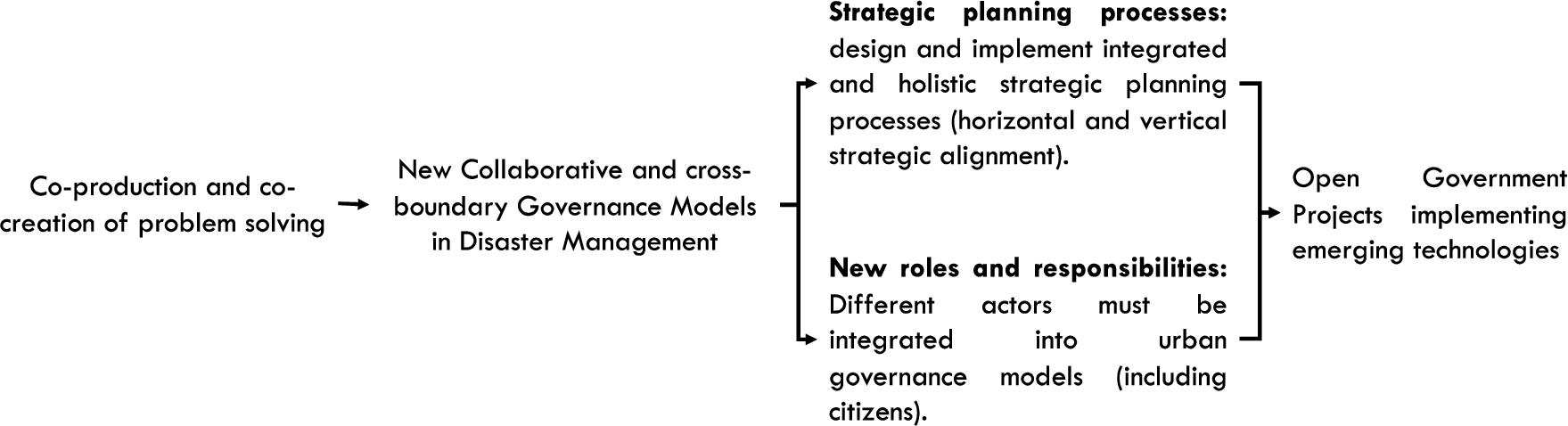
The need of new governance models for improving disaster management.
COVID-19 has acted as a catalyst for change in all industries providing unexpected stimulus for rapid innovation development [62,96]. Under these changes there lies lessons for the future. The main one is that the relevance of ETs implementation in public administrations does not rely on its technological approach (technological determinist view) but on its potential for reforming governance models to more open, collaborative, and participative ones [84,85] with the aim to be more effective in facing health pandemics and other disasters.
At the local government level, public governance mechanisms must implement ETs to take advantage of their potentialities regarding the improvement of information transparency, the immutability of information stored allowing higher level of information trust, the improvement of citizen participation and the higher level of citizen engagement in the co-creation of solutions for managing health pandemics and disasters. Although in an initial stage of ETs implementation, local governments will remain the main responsible body seeking good governance under social challenges, our view is that public governance models should turn into networked crowd-governance models integrating citizens and other stakeholders’ inputs in public decisions in an equal-basis power with the city government. City governments will thus change their role from policy producers to efficient executors of democratic decisions under increasing pressure of transparent and continuous accountability mechanisms.
But this issue is not easy. Public administrations and stakeholders must be educated to work together in the public decision-making process for improving public services. It involves a cultural change on both the stakeholders and on the public administrations. From the stakeholders’ side, they must be active in demanding their collaboration and relationship with public administrations, but they must be also generous with sharing their knowledge in an open arena for improving the quality of life of all residents in the urban areas. Looking for boosting this citizenry cultural change, some of these issues are being dealt with scholarly courses (some of them free of charge) using Massive Open Online Course (MOOC) as a main vehicle to reach as much people as possible (see for example,
From the public administration side, they not only should enhance government transparency, accessibility of stakeholders to public services and information, but also, they should adapt their internal structures and processes to a greater openness to the public and improve their responsiveness to new ideas, demands and needs [82]. This is not always well-understood by public administrations and requires both knowledge of the technology and organizational realities. In this regard, staff training, the creation of innovation platforms and/or networks, and cultural change in public administrations are also necessary.
In the last years, some innovation platforms and networks have been launched to join the work of public administrations and stakeholders in different projects aimed at improving public services (see, for example,
In addition, strategic planning processes have been demonstrated to be efficient when aligned both horizontally and vertically. Indeed, systematic, strategic foresight is the basis for governance and prior research has indicated that robust governance mechanisms supporting strategy alignment can improve organizational performance [7]. Thus, these innovative governance models should allow city governments to both connect and be connected with all their internal departments and other levels of administrations in order to find synergies in the search of common economic and social objectives. Integrating strategic objectives, all administrations find their role in the search and achievement of these common objectives.
In any case, these innovative governance models find their perfect ground on the smart cities framework, where ETs are already implemented and connected with the information flows of data of the city. OG projects can be mechanisms to implement these innovative governance models because the integrate Open Data platforms and good spaces for stakeholders’ participation and collaboration. Therefore, it would be of interest to focus our research on these innovative networked crowd-governance models and OG projects, which has been recently found as a main research gap in the smart city area in the future [53]. Therefore, future research in the public management area should think how integrate ETs in OG projects to implement innovative governance models to efficiently face social challenges and disaster management. These studies should not only be theoretical but also empirical in order to get insights regarding efficiency in city resilience and sustainability, which are main objectives to be achieved according to the sustainable development goals of the United Nations [1].
Footnotes
Acknowledgements
The author wants to thank the reviewers for their excellent work in the revision of the paper. Their suggestions have helped the author notably improve the paper. This work was supported by the Regional Government of Andalusia (Spain), Department of Innovation, Science and Enterprise (Research Projects No. P20_00314 and B-SEJ-556-UGR20) and the Centre of Andalusian Studies (PR137/19).
Conflict of interest
None to report.