




Abstract
PURPOSE:
Sixty percent of children with bilateral cerebral palsy have impaired hand function. The study’s purpose was to examine the benefits of bimanual task practice on the manual ability and hand function of children with bilateral spastic cerebral palsy.
METHODS:
In this pre-post study design, 18 children with bilateral spastic cerebral palsy with an average age of 11.5 (+/-1.9) years, Manual Ability Classification System levels I-III and Bimanual Fine Motor Function levels I-III participated in bimanual task practice of upper extremities. The task practice included clay activities, paper manipulation and activities of daily needs. The children underwent 45-minute training sessions 3 times a week over 6 weeks. The outcome measures were ABILHAND-Kids, Quality of Upper Extremity Skills Test and grip strength.
RESULTS:
Post-training, a mean change of 6.44 logits in ABILHAND-Kids, 11 points on the Quality of Upper Extremity Skills Test, and 3.3 and 3.1 kilograms grip strength in the dominant and nondominant hands respectively were observed with a statistical significance (p < 0.05).
CONCLUSION:
Bimanual task training might be beneficial in improving manual ability, hand function and grip strength in children with bilateral spastic cerebral palsy.
Keywords
Introduction
Cerebral palsy is described as a cluster of disorders of movement and posture causing limited activity that contribute to non-progressive disturbances in the developing fetus or infant’s brain [1]. Children with unilateral spastic cerebral palsy show bilateral upper limb muscle weakness compared to their typically-developing peers, despite encouragement of the use of the less affected upper limb during development and spontaneous daily activities. As a result, they experience limitations in unimanual or bimanual ability [2]. Bilateral spastic cerebral palsy is the most prevalent type of motor disability, primarily involving the lower extremities and with minimal involvement of the upper extremities [1]. A study examining the bimanual hand function in children with unilateral and bilateral spastic cerebral palsy showed similar hand asymmetry in both groups [3]. Children with bilateral spastic cerebral palsy hold their upper body in a stiff posture and increase the tonus of upper extremities to compensate for what the lower body cannot do [4]. Children with bilateral spastic cerebral palsy have visuo-perceptual and postural deficits, which contribute to poor gross motor and fine motor functions like reaching, grasping, releasing and manipulating objects [5]. This allows the development of secondary musculoskeletal adaptations in upper extremities over time. The weakness of handgrip, slowness of movement and poor tracking of objects due to impaired hand-eye coordination might affect their performance of manual skills [6, 7]. Somatosensory deficits can also contribute to poor hand function and awkward dexterity in children with bilateral spastic cerebral palsy [8].
Studies in the past have mainly addressed the benefits of treatment of lower extremities on mobility and daily function in children with bilateral spastic cerebral palsy but failed to focus on hand dysfunction. There are ongoing research developments in upper limb motor recovery in children with bilateral cerebral palsy [9]. Few studies have explored the surgical, pharmacological, and physical and occupational therapy options for upper limb function in children with bilateral cerebral palsy [10]. Occupational therapy with botulinum neurotoxin, Armeo Spring device training, selective dorsal rhizotomy along with occupational therapy and physiotherapy, and Wii virtual reality training have shown level IV evidence for upper limb function in children with bilateral cerebral palsy [10]. A small, randomized trial using intrathecal baclofen along with physiotherapy showed beneficial improvement in upper limb coordination and arm-hand motor control [11]. Most of these published studies had weak to moderate methodological quality and heterogeneity in outcomes [10]. Inspired by constrained therapy, a new technique of hand-arm bimanual intensive training targeting upper extremity motor recovery was evolved [12]. A study on hand-arm bimanual intensive therapy in addition to lower extremities training showed improvements in self-care, manual ability and fine motor control of children with bilateral cerebral palsy [13]. A systematic review by Ouyang et al. [14] supported the benefits of hand-arm bimanual intensive training in improving arm function in children with cerebral palsy. Most of the studies on bimanual training have limited focus on bilateral cerebral palsy.
Bimanual activities are important for children with bilateral cerebral palsy as the majority of daily tasks require the skillful use of both hands. The cornerstone of bimanual hand training is the ability to use both hands equally to accomplish a bimanual task [13, 15]. Intense practice of tasks and shaping skills are the basic principles of bimanual activity training. The theoretical framework of bimanual training is similar to functional therapy. The training should have a goal-directed, task-specific, context-specific focus on functionality instead of normality, encourage the active involvement of the child and caregivers in learning better motor skills, as well as address the activities or participation level of the International Classification of Functioning, Disability and Health for Children and Youth (ICF-CY) [16]. There is a dearth in the literature on how goal-directed bimanual task practice would benefit the manual ability, hand function and grip strength of children with bilateral spastic cerebral palsy; hence, this research was attempted.
Materials and methods
Participants
In this pre-post study design, children diagnosed with cerebral palsy were recruited between January 2018 and April 2019 from the Spastic Society of Karnataka and the Association of People with Disability, India. The study procedure was explained to the school teachers and parents of the children, and written informed assent was obtained. Children meeting the following inclusion criteria were included in the study: children with bilateral spastic cerebral palsy aged 8–15 years of both genders; ability to understand and follow simple verbal instructions; Manual Ability Classification System (MACS) levels of I-III; and Bimanual Fine Motor Function (BMFM) version 2 levels of I-III. Children were excluded from the study if they had a severe intellectual disability that would interfere with their understanding of verbal prompts, visual and hearing impairments, any botulinum toxin injection or surgery of the upper extremities in the past four months, or active seizures and behavioral issues. A pediatrician or clinical psychologist made the clinical diagnosis of the severity of mental retardation and reported it in school records. The institutional research committee of Manipal College of Health Professions, Manipal Higher Education approved this study. This study was prospectively registered in the clinical trial registry of India with a registration number CTRI/2018/02/012251.
Intervention
The children included in the study were given bimanual task practice in a calm, well-ventilated room. Standardized seating without an armrest and backrest was ensured during the testing and intervention. In a given treatment session, a maximum of two children practiced under the supervision of a physical therapist. They initially practiced activities in three sets. The goal-directed hand tasks were fun-filled, cheerful and enjoyable for the children. Innovative ideas of task practice were introduced to keep the children motivated throughout the training session. The first set of activities included clay activities. They were asked to make a simple round object from the clay, flatten the clay with the palm, make a rope by rubbing the palms against each other, make a string out of the clay, manipulate it to form the letters of their names with the string, and shape meaningful objects. The second set of activities were paper manipulation activities such as tearing the paper into two halves and multiple pieces, and simple paper folding into intricate folds. Tearing thicker cardboard was introduced when the children showed changes in their manual skills. Children were trained in simple paper origami using both hands. They were guided to cut varied textures of papers and hardbound cardboards into different shapes and sizes. They began with straight lines followed by zigzag lines and forms such as triangles, rectangles, and circles. The third set of activities was the day-to-day hand skills. Children were asked to separate buttons of different sizes and textures from a box kept in front of a table. They were encouraged to create a necklace or a bracelet out of beads. Finger painting was another activity that was introduced to engage them in the bimanual task practice. Opening and closing a screw jar required a non-dominant hand for stability while the dominant hand opened or closed the jar (Fig. 1).
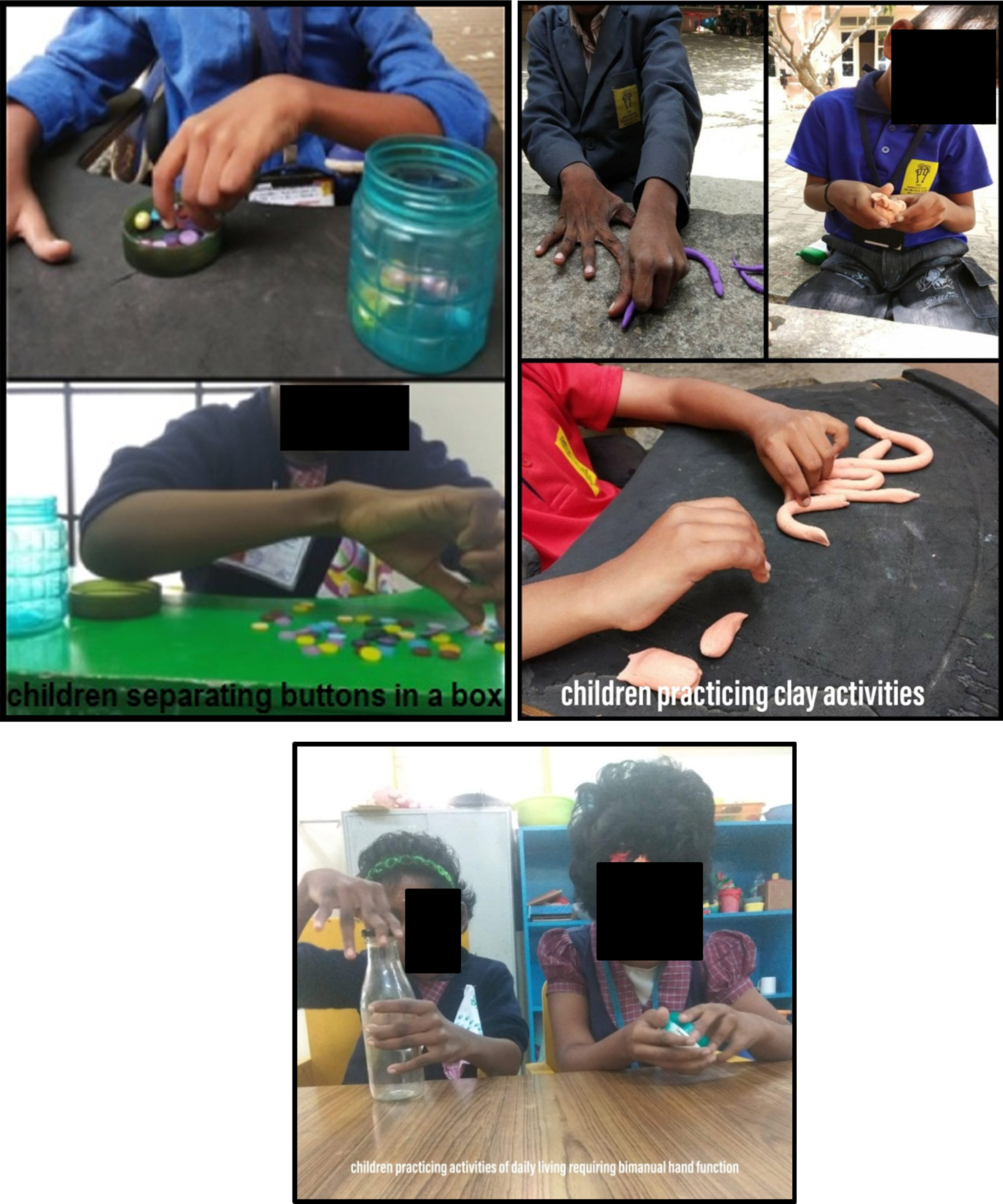
Bimanual task practice. Parental release was obtained to use these photos.
All the children received bimanual goal-directed tasks in a graded manner and progressed after achieving mastery of the simple manual skills. The bimanual skills were initially assisted by the therapists with cues, and then children practiced on their own. Complex bimanual tasks were introduced after the successful planning and execution of simple tasks. The therapist judged when to do so based on the children’s inter-limb coordination and arm-hand movement speed and proficiency. The children were initially given more time to complete the tasks and then later asked to perform them faster. The complexity of bimanual training in these children was determined according to their MACS levels of manual ability and BFMF version 2 fine motor functional performance. The children were asked to replicate the bimanual hand tasks after every two sessions and progressed accordingly. The supervised training sessions lasted for 45 minutes and were given thrice weekly for 6 weeks. Overall, the dosage of the goal-directed skills training was low (i.e., 18 hours, 15 minutes) compared to intensive approaches such as constraint-induced movement therapy and bimanual intensive training (30–40 hours) [17]. A systematic review reported that a threshold dose of 14–25 hours of face-to-face upper limb training along with home practice is necessary for improving individual goals for children with cerebral palsy [18]. The teachers and parents of the children were encouraged to facilitate the use of bimanual tasks in the school and home environments. An exercise log was maintained to track the adherence and compliance of practicing bimanual hand tasks at home. Due to inconsistency in reporting by the parents and/or teachers, the average exercise conducted was not documented.
The ABILHAND-Kids, Quality of Upper Extremity Skills Test (QUEST) and grip strength were the outcomes used in this study. The ABILHAND-Kids, a 21-item questionnaire, measures the manual ability of children with cerebral palsy aged 6–15 years. It measures the child’s ability to use the upper arm for activities of daily living with or without compensatory strategies [19]. It tests the activity domain of ICF-CY and provides an understanding of a child’s manual ability from the parents’ perspective (child’s perceived difficulties of bimanual activities). It also considers the environmental (assisting devices, school education) or personal (motivational, cognitive and emotional status, compensatory behaviors) contextual factors [19]. Each item is scored on an ordinal scale as impossible (0), difficult (1), or easy (2), with a maximum possible score of 42. The measurement error and smallest detectable differences are 0.42 and 0.19 logits in the center of the scale. Test-retest reliability of this scale is R = 0.91 [20].
The QUEST measures the hand function and upper arm patterns of movement in children with cerebral palsy. It consists of 36 items distributed among dissociated movements, grasp, weight-bearing, and protective extension. Each sub-score of the QUEST is reported as a percentage out of 100 points. It tests the upper extremity physiological function domain of the ICF-CY [21]. The standard error of measurement for the total score is 3.2% and 5% on the most involved side in children with cerebral palsy. The reported minimum detectable change for the total score is 7.1% and on the most involved side is 13.8% [22]. The QUEST showed moderate responsiveness, detecting a change in total score with an effect size of 0.72 post-training [23]. It showed excellent internal consistency (Cronbach’s alpha = 0.97) [24], and domains of QUEST demonstrated better construct validity using Rasch analysis [25]. A Trailite digital hand dynamometer was used to measure the strength of the handgrip in kilograms. Handgrip strength is the isometric flexion of fingers applied by an individual under normal conditions. The muscles of the flexor mechanism of the hand and forearm create the gripping force. The test-rest reliability of an electronic hand dynamometer has an intra-class correlation coefficient value of 0.95 [26]. In an unpublished study, grip strength showed a good intra-class correlation coefficient value of 0.96 in children with cerebral palsy.
All the outcome measures were collected before and after 6 weeks of training by an independent assessor who was not involved in the practice regimen. The assessor was an experienced physical therapist working with children with developmental dysfunction. Before the study, to ensure the consistency of data collected, test-retest reliability was evaluated in a group of 36 children with spastic cerebral palsy. The first and second readings of outcome measurements were collected on Monday and Friday of the test week. The intra-class correlation coefficient (r) was 0.93 (0.87–0.96) points for grip strength and 0.89 (0.81–0.95) points for the QUEST with statistical significance (p < 0.001).
Statistical analysis
Data were analyzed using SPSS version 16.0 for Windows. A Shapiro-Wilk test confirmed the normal distribution of the outcome variables. A Wilcoxon signed-rank test, a non-parametric statistic, was used to compare the changes in outcome measures between the pre-training and post-training. The confidence interval was set at 95% with a pre-set α value of 0.05. The relative percentage change in the outcome measures was calculated by dividing the mean difference with the baseline score multiplied by 100. The effect size (d) was computed by d = MD/SD, where MD is the mean difference score and SD is the standard deviation of that particular mean difference. Cohen’s classification of effect size index (d) was small (0.20), medium (0.50) and large (0.80).
Results
A total number of 178 children were screened for study eligibility; 18 children met the inclusion criteria, which included a diagnosis of bilateral spastic cerebral palsy. The mean age of the 18 children was 11.5 (+/-1.19) years. The percentage of boys was 67% (N = 12), and 33% (N = 6) were girls. Of the 18 children with bilateral spastic cerebral palsy, 10 were right-hand dominant (56%) whereas eight were left-hand dominant (44%).
Children (N = 160) were excluded from the study due to the following reasons. The majority (N = 67) had a diagnosis of severe mental retardation and had difficulty in responding to simple verbal instructions. Fifty-two children were categorized as having cerebral palsy with dyskinesia and quadriplegia other than bilateral spastic cerebral palsy. Twenty-five children had visual and/or hearing impairments. Two had active seizures and were on anticonvulsive medications. There were behavioral issues reported in 11 children. All the eligible children (N = 18) completed 6 weeks of bimanual task practice without missing any sessions. The baseline demographic characteristics of the study children are presented in Table 1.
Baseline demographic characteristics of children with bilateral spastic cerebral palsy (N = 18)
Baseline demographic characteristics of children with bilateral spastic cerebral palsy (N = 18)
MACS - Manual Ability Classification System; BMFM - Bimanual Fine Motor Function.
Post-training, there was a statistically significant improvement (p < 0.05) in ABILHAND-Kids scores with a mean (SD) difference of 6.44 (2.06) points and a relative change of 19% improvement from the baseline scores. The QUEST showed a mean (SD) difference of 11.07 (13.89) points (p < 0.05). The sub-score analysis of the QUEST showed statistically significant changes in all components except protective extension. Following the training, grip strength improved by 3.32 (SD 2.28) kilograms in the dominant hand and 3.05 (SD 2.25) kilograms in the non-dominant hand (p < 0.05). The effect size was large for all the outcome variables with bimanual task practice. The change scores of outcome measures between the pre- and post-training levels and the corresponding effect size are shown in Table 2.
Changes in the outcome measures following bimanual task practice (N = 18)*
QUEST - Quality of Upper Extremity Skills Test; Cohen’s effect size (d) is referred to as small = 0.20, medium = 0.50 and large = 0.80; *Analyzed using Wilcoxon signed-rank test and p value < 0.05 was statistically significant. ∧Reduction in the relative change.
To the best of the authors’ knowledge, this study is the first of its kind to examine bimanual task training in children with bilateral spastic cerebral palsy. This study showed beneficial changes in manual ability, quality of arm movements and grip strength following bimanual task practice. The goal-directed hand tasks were fun-filled, cheerful and enjoyable for the children. Innovative ideas of task practice motivated them throughout the training session. They could practice these tasks at home with the help of their parents as well as during downtime at school. This training also allowed the therapist to work with two children at a time. There were no adverse events reported during or immediately after the practice sessions, underscoring the feasibility of bimanual training of upper extremities in children with bilateral spastic cerebral palsy.
The improvement in ABILHAND-Kids scores could be attributed to the practice effect and similarity of bimanual activities of hands. The repeated practice of these tasks in a structured environment might have produced a functional frame of reference for better execution of motor skill performance [27]. It is believed that continual task practice could form a physiological basis for motor learning, allowing the retention of the movements and transferal into daily activities [28]. Some of the activities that were difficult for the kids to perform were broken down into simple actions, and they were practiced step by step. Overall, the relative change of 19% improvement in ABILHAND-Kids scores with bimanual task practice reflects an enhancement of activities of daily living in children with bilateral spastic cerebral palsy. Brandao et al. [29] support this view. They observed that the majority of bimanual tasks in children with cerebral palsy were of functional use in their daily needs.
The QUEST measure showed an overall improvement following bimanual training. The gains in the grasp domain of the QUEST might be related to the graded progression of task practice variability with optimal exercise intensity. Development and modulation of grasp depend on the tactile feedback children with cerebral palsy receive from their hands and fingers [30]. The activities of clay and paper manipulation and finger painting might have modulated the tactile sensory cues for a better grasp for the children in this study. Additionally, repeated practice of structured activities such as sorting out beads and writing with a pen with a thick diameter might have enhanced motor cortex reorganization and thus the practice benefits of improved grasp [31]. Children with bilateral spastic cerebral palsy usually show poor dissociated movements of upper limbs to compensate for postural control deficits [32]. The improvement in the dissociated movement domain of the QUEST could be related to the utility of a different range of shoulder, elbow, and wrist motion while performing the bimanual tasks in a seated position. The improvement in the above-mentioned domains of the QUEST is comparable to the study by Gordon et al. [33] in children with congenital hemiplegia.
In the majority of the bimanual task practice in this study, the children used one hand for manipulating an object and the other hand for stabilizing it. These tasks also demanded the weight-bearing capacity of the arm for postural stability; thus, there was an improvement in the weight-bearing sub-score of the QUEST [34]. The protective extension is a reactive response to rapid displacements of the center of gravity [21, 24]. The bimanual activities were performed when the children were comfortably seated in a stable chair that did not challenge their reactive postural control strategies. Thorley et al. [25] also suggested that these two domains of the QUEST might show little or no change among children with MACS I-III levels.
Grip strength is considered to be an essential factor contributing to bimanual performance in children with cerebral palsy [35]. The grip strength of 3.32 and 3.05 kilograms in dominant and non-dominant hands respectively in this study is comparable with Dekkers et al. [36], who suggested a change of 3.65 kilogram grip strength in children with unilateral cerebral palsy. The bimanual task practice did not use progressive strength training; therefore, no influence on grip strength was expected. However, the children might have learned to scale their muscle force against the resistance they encountered during the different hand tasks. While opening a jar lid, writing on paper, tearing and cutting the newspapers and cardboard, and buttoning, the forearm and hand muscles of the non-dominant hand had to generate sufficient force for stabilizing the object to allow the dominant hand to perform the required manipulative action [37]. Van Meeteren et al. [38] are in line with this opinion; they suggested that grip strength gains could be related to better functional tasks.
Limitations of the current study are that the results cannot be generalized to children with cerebral palsy and should be interpreted with caution. First, the study lacks a control group or comparative intervention. Second, the children were not contacted for long-term follow-up, so the retention effects of improved hand function are unknown. Third, the study participants were school-going children, and the majority of them were level II of the MACS (72%) and the BMFM (67%). Few of the children were independent in writing, and they were already performing some bimanual activities at school. Fourth, the training intensity of the current study was lower than previous studies conducted on congenital hemiplegia. Future studies should explore a dose-specific bimanual task practice in children with bilateral spastic cerebral palsy and significant hand dysfunction. Since this study is a pre-post study design, routine school recreation activities and parents’ engagement in training their children at home are a few potential confounders in addition to bimanual training that might have influenced the study findings.
In conclusion, bimanual task practice might be beneficial in improving the manual ability, quality of movements and grip strength in children with bilateral spastic cerebral palsy. A future randomized controlled trial should confirm this notion.
Footnotes
Acknowledgments
The authors are grateful to the parents, teachers and children who devoted their time to participating in the trial. We appreciate the staff of the Spastic Society of Karnataka and the Association of People with Disability, Bangalore for their timely help. We authors thank Divya Mohan, former faculty of MCHP, MAHE, for her assistance with this work.
Conflict of interest
The authors declare that there is no conflict of interest.
Funding
None.