Abstract
Cerebral palsy (CP) is associated with complex health care needs and, although improved, a continued shortened life expectancy. In order to quantify and understand advances in the diagnosis and management of CP, systematic literature searches of key word groupings in the PubMed database were completed and revealed a recent increased incidence of publications focusing on quality of life, physical activity, exercise, and treatment options. Our bibliometric exploration revealed growing emphasis on function, performance, aging, and health compared to earlier studies when diagnostic features and brain pathology dominated research. Our findings highlight the transition from diagnosis and identification to management of specific conditions and providing guidance for the continuum of needs our patients experience over the course of a lifetime. The field must be prepared to advance our understanding of best practices and implement evidence-based interventions and management options.
Background
Much has changed since Dr. William John Little first described the clinical features of cerebral palsy (CP) in 1860 [1]. CP is estimated to affect 1.5 to more than 4 out of every 1,000 live births. The incidence in Canada and the US for recent years has remained stable [2, 3]. It is the most common motor disability affecting children [4], and likely the most common condition seen by a general Pediatric Rehabilitation Medicine (PRM) physiatrist. Through advances in science and improvements in medical management, the lifespan of people with CP has increased, with the expectation for children with CP to live into adulthood. However, despite these advances, adults with CP tend to die earlier than their peers without CP. Data from the 2012–2016 U.S. Multiple Cause-of-Death Mortality files indicate that those with CP as well as some rare developmental disabilities had the lowest age at death [5]. Some have speculated that this may be due to medical frailty or limited access to specialized care.
Physiatrists have played an important role in the care of those affected by CP and in advancing research in this area. In particular, physiatrists are instrumental in the management of individuals aging with CP, by acknowledging the importance of function on health and often providing the continuity in health care transition planning. Physical Medicine and Rehabilitation residency training programs have included experience in PRM and the care of people with CP since 1967. The American Board of Medical Specialties established certification in the subspecialty of Pediatric Rehabilitation Medicine in 1999, with the first certification examination offered in 2003. Subsequently, the Accreditation Council on Graduate Medical Education (ACGME) established requirements for fellowship training in PRM in 2002 [6]. One of the goals of subspecialty training within a two year time frame was to advance PRM research.
While the number of training programs for the specialty of PRM increased, multiple authors and organizations, including the Institute of Medicine (now National Academy of Medicine), called for recognition of the field of disability and rehabilitation research and increasing productivity and rigor of that research [7, 8, 9, 10, 11]. These calls and an emphasis on evidence based medicine have been integral in expanding research in Physical Medicine and Rehabilitation in general, and as an extension, in the area of CP.
PRM is a growing and evolving subspecialty intimately associated with the management of individuals with CP. We sought to better understand the broad trends in publications about clinical therapy, medication, physical activity, and comorbidities of those affected by CP through a systematized literature search that focused on different time intervals, using selected metrics. This commentary presents an overview of the trends in disability and rehabilitation research about CP using a variety of techniques and metrics that reveal a change in focus over the years. Much of this new information has been incorporated into practice, although there remain regional differences in practice that may be helped through rigorously developed guidelines, which we address. To establish a strong evidence base, we conclude with a call for focused rigorous research and publications related to function and health for people with CP.
Bibliometric techniques
There are a variety of review methodologies for collection and detailed review of published articles. For this commentary, we chose to engage in an overview to provide an historical and comparative perspective. To minimize any preconceptions, we chose to use selected techniques used in larger in-depth reviews. Bibliometrics offered that opportunity since it is a quantitative overview of the development of a field of study by determining size, frequencies, and trends [12]. To further limit bias, a systematic literature search using a single database (PubMed) and focusing on key areas in the field of CP was implemented. We directed our search from the1990s to the present in an effort to include the most timely and relevant information and sub-grouped findings by 5-year intervals. We piloted our approach using broad searches such as “cerebral palsy and rehabilitation” and “cerebral palsy and medical intervention,” again looking for broad trends. After looking through titles and abstracts from these more general searches, we then performed more specific searches using frequently occurring words that we noted in the initial searches, with an emphasis on PRM-related topics. We assessed the returned publications to obtain two pieces of information: the size of and topics in the body of publications. All searches were completed between February 15 and March 15, 2020.
Publication counts for each search performed in the 1990–1995 and 2015–2020 time frames
Publication counts for each search performed in the 1990–1995 and 2015–2020 time frames
Rate of increase in publications by search terms for 1990–1995 and 2015–2020. This figure displays the number of publications returned for each performed search, on a logarithmic scale. When comparing multiple time frames of a single search, an increase of one unit on the y-axis indicates the number of publications doubled. As an example, because the number of publications for “Cerebral Palsy AND medical intervention” doubles from ‘90–’95 to ‘95–’00, the corresponding light blue color increases by 1 unit (a relatively minor increase). Significant increases in a single color indicate the number of publications doubled many times over. However, an increase of one unit on the y-axis for the size of the whole bar does not correspond to a doubling in the total number of publications, since the composite bar for each time frame constitutes all searches being added to one another, not multiplied.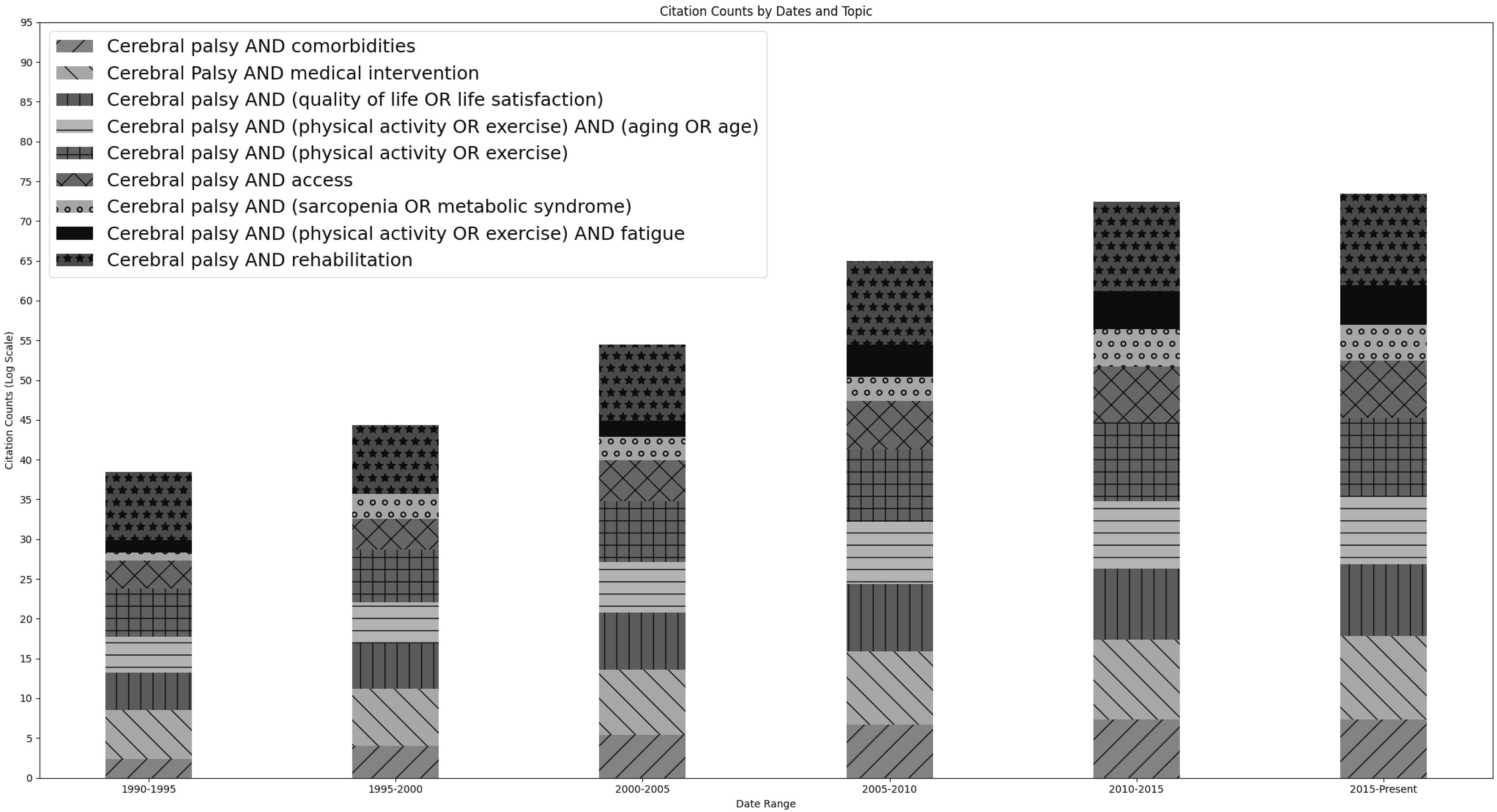
Changes in publication counts loosely mirror increasing or decreasing interest in particular subtopics of the study of CP. Generally, we found that there has been a marked increase in the number of peer reviewed articles published since the 1990–1995 epoch, with the most significant increase over the most recent five year period (see Table 1). We report on the changes noted between the 1990–1995 and 2015–2020 epochs for counts and terms of interest. Five-year epoch specific search results by terms are available from the authors.
Table 1 displays the large increases of percentages in the number of articles focusing on comorbidities, medical interventions, quality of life/life satisfaction, physical activity, exercise, aging, access, and sarcopenia/metabolic syndrome, in particular for individuals with CP. To put these percent increases into context, the PubMed search “cerebral palsy” is added in as well without additional key words as there have been increasing numbers of publications in general. The searches “cerebral palsy and comorbidities,” “cerebral palsy and medical intervention,” and “cerebral palsy and quality of life” have the highest percent increase between the two time periods, pointing to an increasing focus on and development of new interventions for patients with cerebral palsy, and recognition of other chronic conditions that patients with cerebral palsy face and how this affects their life satisfaction. The higher number of returned publications from searches such as “cerebral palsy and physical activity or exercise and aging or age” and “cerebral palsy and physical activity or exercise” show the increasing awareness and focus on how physical activity, exercise, and BMI (body mass index) are important factors to consider for people with CP. Figure 1 presents the same data, but allows for easier visual comparison of the increases in searches on these topics over time. This is shown by the large relative increases in the colored bars corresponding to the searches listed above. Appendix Table A lists the search results by 5 year epochs, 1990–2020.
Term usage in publications
Frequency and context of terms provide another element to identify changes in interest in and focus of research and publications. For this initial overview, article titles provided the basis of terms analysis. A term’s frequency is the number of times it appears in the titles, and the context describes how often terms co-occur in the titles.
Term frequency
Term frequency was easily calculated by processing the titles of publications returned by the ‘cerebral palsy’ query using standard natural language processing (NLP) techniques. NLP refers to the study of processing, analyzing, and understanding human language using computers.
An NLP program counted how frequently each unique term appeared in the resulting collection of text (code available from authors upon request). This process was repeated for the 1990–1995 and the 2015–2020 time frames. Pronouns, punctuation, and words that were determined not to carry clinical significance were removed. The top twenty most frequently occurring words appear in Table 2.
Top 20 most frequently occurring terms in titles for the results of the ‘cerebral palsy’ search, comparing 1990–1995 to 2015–2020
Top 20 most frequently occurring terms in titles for the results of the ‘cerebral palsy’ search, comparing 1990–1995 to 2015–2020
Legend:
In Table 2, some notable key words that are among the top twenty most commonly used in article titles in the 2015–2020 time frame but not the 1990–1995 time frame are “review,” “gait,” “function,” “therapy,” and “adult.” The increased prevalence of the words “therapy,” “gait” and “function” in particular support our view that CP management has expanded to include more PRM diagnoses and treatments. Further, their appearance indicates that the way these patients function and their level of independence is a highly important aspect of their overall care. Similarly, the appearance of the word “adult” points to the increasing importance of treating adults with CP as the life expectancy for these patients has increased. The words “infant,” and “brain” occur higher on the list in the 1990–1995 time period, which may represent an increased focus on the diagnosis and initial management of CP. The 1990–1995 words “syndrome,” and “birth” do not even appear in 2015–2020, again highlighting the focus of earlier literature on diagnosis as opposed to management of CP. Appendix Table B reports the 50 most common terms appearing in article titles.
Quantifying and visualizing term-context is a more challenging problem than identifying term-frequency. One approach commonly taken in NLP is to develop embeddings for each term. A term embedding is a vector (i.e., a coordinate in some space) that is produced for each term in a collection of text such that terms with similar contexts are close together. Representing terms numerically allows for more direct comparisons of terms. We trained a term-embedding model using the techniques of Mikolov et al. [13], again using standard processing techniques on the results for a ‘cerebral palsy’ search for both the 1990–1995 and 2015–2020 epochs. While the resulting model assigns high-dimensional vectors to each term, we can visualize each term in two dimensions via the t-SNE projection algorithm [14], which reduces each vector to two dimensions while preserving the “closeness” of any two terms.
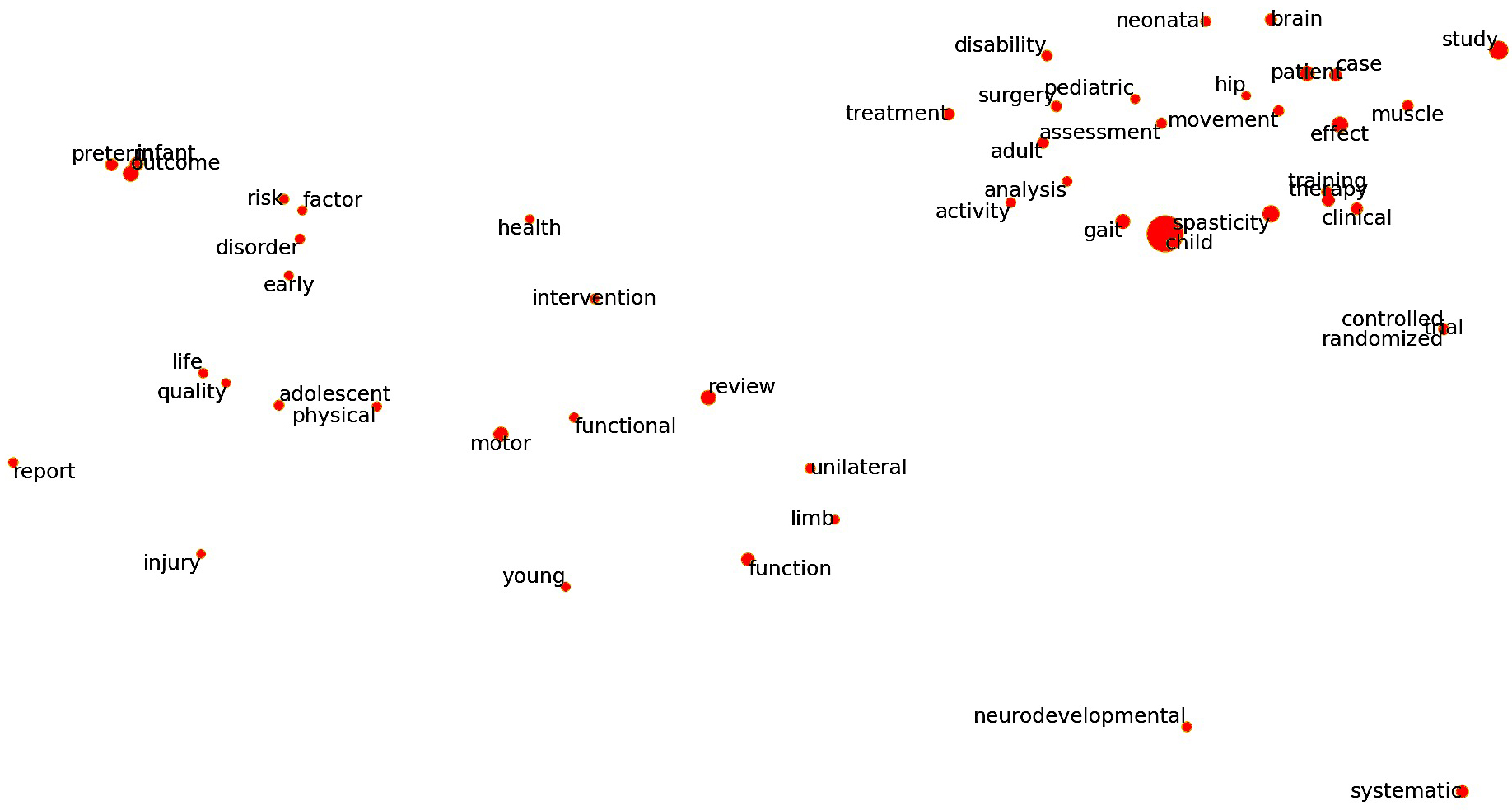
The visualization of the top fifty most frequently occurring terms (1990–1995 and 2015–2020) and the context in which they are presented in article titles is displayed in Fig. 2 (see Appendix for listing of Top 50 terms). We used these embeddings to identify interesting areas for further exploration, using select terms to narrow our search and identify key publications.
Bubble chart of terms used in titles. t-SNE projection of learned term vectors, learned from the titles of the 1990–1995 time frame (A), as compared to those learned from the 2015–2020 time frame (B). The size of each bubble corresponds to the frequency with which each word was used in the titles. Relative positions of words are meaningful (closeness implies similar contexts), yet the exact coordinates have no interpretable meaning.
In Fig. 2A (1990–1995), the word “functional” is closely associated with the words “effect,” “infarction,” and “preterm”, while in Fig. 2B (2015–2020), the word “functional” is associated with “motor” and “intervention.” The difference in word associations suggests a shift in the way function is approached in the two time periods. Perhaps interventions to improve function and motor impairments’ effect on function have become more of a focus in recent literature. As an example, searching for “Cerebral Palsy AND Functional” in 1990–1995 (
In the earlier period, Fig. 2A shows that the word “disability” is in close proximity to a large cluster of terms including the words “analysis”, “supranuclear,” and “progressive” compared to the latter where in Fig. 2B “disability” is associated closely with the words “surgery,” and ”treatment.” This suggests a shift in the literature towards intervention for improvement of function in patients with disability in recent articles and an emphasis on diagnosis and general understanding of CP characteristics and mechanics in the earlier time frame. Representative of the search “Cerebral Palsy and Disability” in 1990–1995 (
The word “therapy” does not appear in the top 50 terms in the former epoch (Fig. 2A), but it is in the latter epoch (Fig. 2B) and is associated closely with “clinical,” “training,” “spasticity,” “effect,” “muscle,” and “child,” likely indicating the increased recognition of the importance of rehabilitative therapies as treatments for people with CP and the importance of initiation of therapies during childhood. The search “Cerebral Palsy and Therapy” in 2015–2020 (
The increasing volume of review articles since the turn of the century (see Table 2) parallels the focus on evidence-based medicine and guideline development. Guidelines and use of evidence-based approaches have been promoted to improve effectiveness and quality of care and to decrease variations in clinical practice [20]. There has been an appeal to improve the rigor and quality of research in order to develop well supported systematic searches/reviews and guidelines [21, 22, 23]. The Cochrane Database of Systematic Reviews [23] is the foremost resource for health-related reviews, however many systematic searches/reviews are published in peer-reviewed journals. Within the Cochrane Database are twelve reviews on topics about CP with recommendations based on those reviews, ranging from 2004 to 2019. Regarding guidelines, a search on the Agency for Healthcare Research and Quality website [24] returned 742 results. However the vast majority matched to “cerebral” not “Cerebral Palsy”. Of those related to CP, most were exploratory and common topics were feeding/nutrition and transitional care issues. Despite the increase in research and publications, evidence remains limited for the majority of interventions typically considered for function and associated or secondary conditions for people with CP. Caution is warranted for recommendations or guidelines that are based solely on expert opinion or rely on multiple levels of evidence equally. High quality guidelines are needed.
Future research
Although there have been significant advances in neonatal care which have improved outcomes and limited the risk of adverse outcomes to very low birth weight infants, CP remains a disability that is common and difficult to manage. Between the time frames covered by our analysis, there has been a marked increase in the number of publications of original research and review articles covering CP and the care of individuals with this condition.
We drew upon the emerging practice of scientometrics to analyze the scientific literature pertaining to CP. Our systematic search of peer reviewed publications listed in PubMed highlighted heightened focus on trends towards assessing functional mobility, improving quality of life, addressing age related changes, and introducing newer medications such as botulinum toxins and intrathecal baclofen into the therapeutic armamentarium.
Research on functional mobility using a standardized scale has enhanced assessments of affected individuals by enabling evaluation of mobility at home and functionality at school and also in the community at large [25]. Similarly, clinical gait analysis has been shown to be a useful tool for examining gait in individuals with CP [26]. Well-defined assessment criteria have facilitated improved communication between physiatrists and orthopedists as well as other members of the health care team. Further clarification of interventions to maintain and improve mobility in individuals with CP is needed.
Review of targetable avenues that improve quality of life in CP patients reveals that sarcopenia is an important contributing factor. Identification of determinants that can address sarcopenia and help clarify prognosis offer an opportunity to greatly improve quality of life in CP. Although sarcopenia commonly affects individuals over 50 years of age, research has highlighted the impact of muscle loss on life expectancy and wellness. Because individuals with CP have smaller muscle mass than their peers, effect on gross motor function are particularly pronounced with aging. Many individuals who were once independent lose important skills to maintain that level independence, which may result in additional health conditions and earlier change in living arrangements. A better understanding of the sarcopenic process may reveal novel approaches to enhance function longer term and improve quality of life for people with CP.
Many medical interventions for treatment of spasticity in CP have come into common use since 1990 including the botulinum toxins and intrathecal baclofen. However, the consequences of long-term treatment with these agents has been suggested to have effects that were not anticipated. Botulinum toxin injections may change the architecture of muscle cells [27] and reduce muscle volume over time [28]. Intrathecal baclofen pumps have been implicated in accelerating progression of scoliosis [29], although may contribute to longer lifespan [30]. Further clarification of these consequences and their impact on function and quality of life are needed.
Call to action
Our review of publications related to CP has provided an overview using selected techniques, metrics, and visualizations. Over the past 30 years, there has been significant increases in both numbers and topics, with a change in focus from diagnosis, brain pathology, and infants to function, performance, aging, and health. This increase in publications supports the report on the status of PRM practice in 2017 [31] that notes greater research engagement among pediatric physiatrists. However, the report also notes minimal funding support for that research and significant geographic variations in practice.
Funding for research in disability science has typically been comparatively low. Pediatric Physiatrists remain a small group, primarily focused on clinical service, and must find ways to contribute to the research enterprise, with or without funding. Multidisciplinary collaborations are essential. However, novel treatment approaches or new insights into underlying or co-existing heath conditions may spark interest at a national level. Although registries are fraught with limitations, data from multiple sites may lead to a better understanding of differences in care or best practices – which again could lead to funding agency interest. Review of the requirements within the two-year fellowship (longer than the time requirement for other ACGME accredited PM&R fellowships) might include more specific guidance for research education and output. The Journal of Pediatric Rehabilitation Medicine has developed a pilot program to mentor PRM fellows in manuscript review, an important part of research promotion, to support this effort. Research is necessary to provide a basis for development of practice guidance, and to keep the subspecialty on a solid foundation. We hope that rigorous research, including standardized outcome measures, longitudinal assessments, and secondary data analysis will lead to high quality evidence-based treatment guidelines.
Footnotes
Acknowledgments
The authors wish to acknowledge and thank Matthew Klawonn, PhD (Air Force Research Laboratory, Information Directorate, 525 Brooks Road, Rome, NY 13441, ) for his support in use of natural language processing techniques and generating the visualizations and their corresponding descriptions.
Conflict of interest
There was no funding to support this work. All authors participated in the development of this manuscript and met the International Committee of Medical Journal Editors (ICJME) () definition of authorship. The authors have no conflicts of interest to report directly related to this publication. Drs. Klawonn and Klamar have no financial disclosures. Dr. Turk’s financial disclosures are Co-Editor-in-Chief, Disability and Health Journal, Elsevier Inc; and Centers for Disease Control and Prevention, National Center for Birth Defects and Developmental Disabilities cooperative agreement #1U19DD001218.
Appendix
Full list of search results by 5 year epochs, 1990–2020
Pubmed search performed
Article number 1990–1995
Article number 1995–2000
Article number 2000–2005
Article number 2005–2010
Article number 2010–2015
Article number 2015–2020
% Change in number of publications from 1990–1995 to 2015–2020
Cerebral palsy AND comorbidities
5
16
43
104
163
156
3020%
Cerebral palsy AND medical intervention
73
148
290
574
1060
1458
1897%
Cerebral palsy AND (quality of life OR life
27
53
140
352
463
534
1878%
satisfaction)
Cerebral palsy AND (physical activity OR
22
34
86
227
368
358
1527%
exercise) AND (aging OR age)
Cerebral palsy AND (physical activity OR
70
103
195
556
970
978
1297%
exercise)
Cerebral palsy AND access
11
14
35
71
125
144
1209%
Cerebral palsy AND (sarcopenia OR metabolic
2
9
8
8
26
23
1050%
syndrome)
Cerebral palsy AND (physical activity OR
3
1
4
17
29
32
967%
exercise) AND fatigue
Cerebral palsy AND rehabilitation
377
413
758
1405
2400
2749
629%
Cerebral palsy AND spasticity AND (repeated
1
2
6
10
16
7
600%
botox injection OR repeated botulinum
toxin injections)
Cerebral palsy AND pain
68
104
197
324
381
458
573%
Cerebral palsy AND muscle wasting
7
7
14
24
27
25
257%
Cerebral palsy
2062
2536
3457
5130
6967
7131
245%
Cerebral palsy AND spasticity
211
269
433
584
646
669
217%
Cerebral palsy AND life expectancy
7
15
19
27
24
16
128%
Top 50 most frequently occurring terms in titles for the results of the ‘cerebral palsy’ search, comparing 1990–1995 to 2015–2020
Pubmed cerebral palsy search 1990–1995 top 50 words in titles
Pubmed cerebral palsy search 2015–2020 top 50 words in titles
Child
Child
Study
Study
Case
Spasticity
Infant
Effect
Spasticity
Outcome
Patient
Review
Treatment
Motor
Outcome
Patient
Syndrome
Gait
Brain
Infant
Surgery
Function
Clinical
Therapy
Birth
Case
Disease
Systematic
Motor
Preterm
Rhizotomy
Clinical
Nerve
Treatment
Hip
Brain
Disorder
Adult
Effect
Training
Disability
Surgery
Perinatal
Muscle
Report
Disability
Posterior
Trial
Selective
Assessment
Management
Movement
Analysis
Unilateral
Progressive
Neonatal
Supranuclear
Adolescent
Developmental
Neurodevelopmental
Neonatal
Activity
Development
Risk
Functional
Disorder
Associated
Report
Assessment
Intervention
Infantile
Analysis
Infarction
Functional
Preterm
Physical
Artery
Life
Change
Pediatric
Mental
Factor
Adult
Young
Following
Hip
Neurodevelopmental
Early
Weight
Health
Early
Randomized
Age
Injury
Care
Quality
Asphyxia
Limb
Due
Controlled
1990–1995.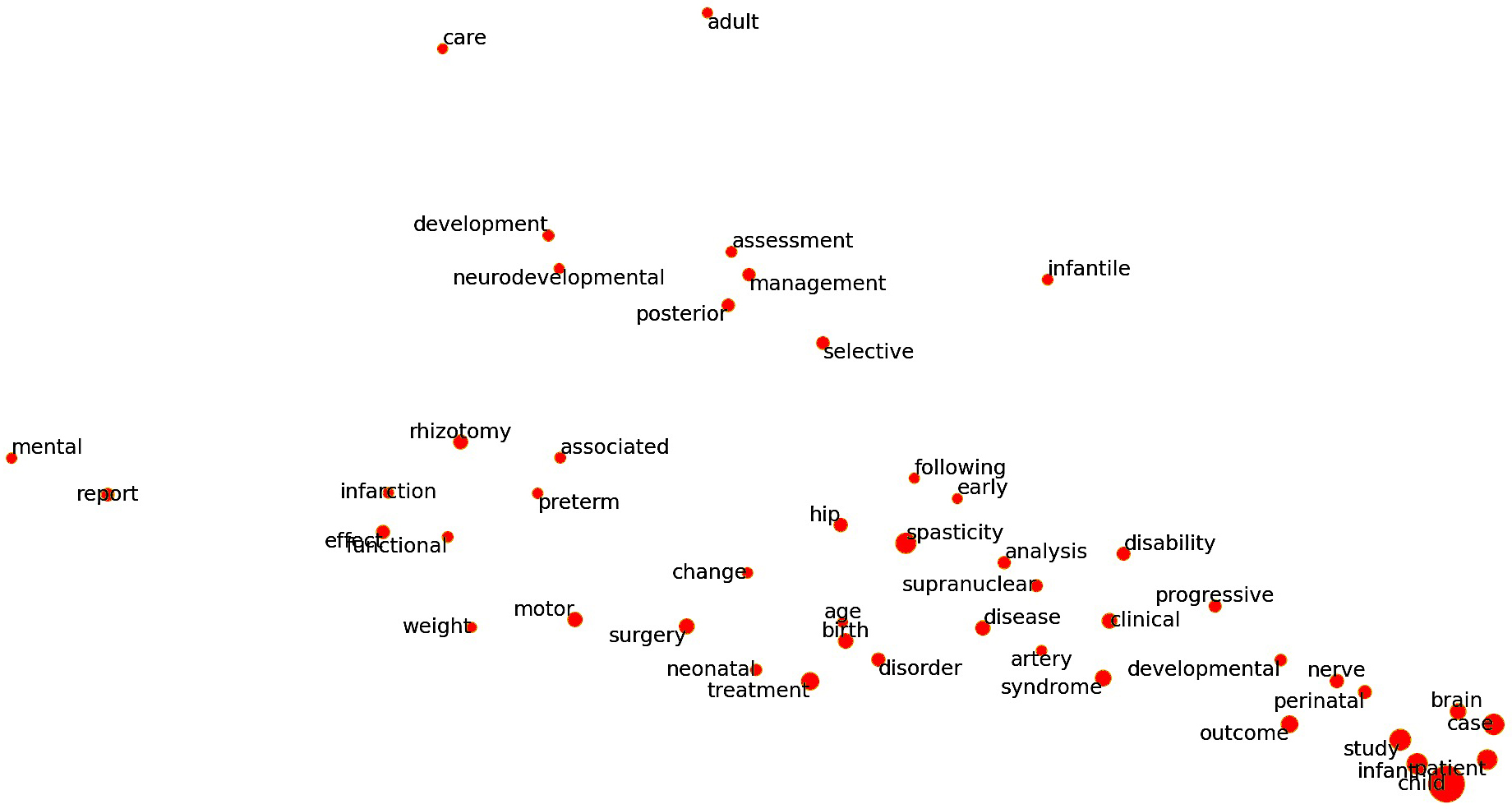
2015–2020.