




Abstract
PURPOSE:
This study evaluated the effects of an instrumented balance board on the balance parameters in children with spastic cerebral palsy by carrying out a pilot single-group pre-post clinical trial.
METHODS:
Five children aged 5 to 15 years with spastic diplegia and a Gross Motor Function Classification System level of I or II were included. All participants attended 20 sessions with an instrumented balance board, 45 minutes per session, 3 times a week for 7 weeks. The main outcome measures included the center of pressure excursion, velocity, and overshoot during quiet standing with open and closed eyes. The assessments were performed in the mediolateral and anteroposterior directions at pre- and one week post-intervention.
RESULTS:
Non-parametric tests showed that the excursion did not change significantly except in the mediolateral direction with eyes closed (p < 0.05). The velocity of the center of pressure improved in both directions and eye conditions (p < 0.05). Also, the maximum velocity decreased with eyes open (mediolateral, anteroposterior, and total) (p < 0.05), while the change was not significant with the eyes closed. The overshoot measurements did not change significantly.
CONCLUSION:
It is recommended to consider balance board training for improving balance parameters in children with cerebral palsy.
Introduction
Cerebral palsy (CP) is a common disability of early childhood associated with cognitive, and motor impairments [1–3]. Spastic diplegia is the most common form of CP. The condition is associated with an impairment of postural control, lack of coordination among voluntary muscles, restriction in balance performance, and finally, low quality of life [4]. Individuals with CP commonly develop scoliosis, hip dislocation, and fixed contractures with increasing age [5]. Children with cerebral palsy have a lower postural balance ability compared with normally developing children [6]. Velocity and center of pressure sway increases in patients with cerebral palsy [6].
A wide variety of therapeutic modalities has been suggested to address balance disorders in subjects with CP [2]. Appropriate physiotherapy programs have the potential to improve gait and increase walking capacity by strengthening the engaged muscles [7–9]. However, there is still no standard for the rehabilitation program for individuals with CP [10, 11]. Medications such as botulinum toxin type A and surgery are commonly administered in children with a lack of favorable response to conservative therapy [12, 13].
To improve walking ability in children with CP, it is necessary to enhance balance control [14]. Research showed that repetitive stance perturbation using a moving platform has the potential of improving stability in CP [4]. In developing children, practice in reactive balance control affects the organization and efficiency of postural responses to balance threats [15]. A trial on six children with GMFCS I/II Spastic Bilateral CP suggested that training with a movable force system (100 perturbations/day, for 5 days) reduced the center of pressure area and time to stabilization [16]. The results suggested that the intervention improved the stability of postural control in children of 7 to 13 years. The benefits of reactive balance control with the movable force system have been verified using surface electromyography [17].
Training of school-age children with CP in reactive balance might recover balance ability [18]. Commonly, they have crouched posture [18]. In addition, they may have inappropriate sequencing, delayed responses, and increased coactivation of agonists/antagonists in ankle muscles [18]. These problems in addition to spasticity put some constraints on the gait. Muscle response characteristics are associated with recovery of postural function in CP [18]. These characteristics include reductions in time of contraction onset, improved muscle response organization, and reduced co-contraction of agonists/antagonists. Successful programs for balance recovery should reduce the total center of pressure path and the time to re-stabilize balance after training [18]. Research indicated that a cost-effective portable balance board provides similar measures of postural sway compared to a force platform in healthy and pathological populations [19]. Twelve weeks of rehabilitation using the gaming balance board decreased the postural sway and improved the performance of the functional balance tests in children with CP [20]. Also, one study showed that the Nintendo Wii Balance Board program reduces the spasticity at the ankle plantar flexors and improves the static standing balance in young people with spastic CP [21].
The evidence regarding the effects of the balance training programs in those with CP is increasing; however, evaluation of the data is still complicated by the lack of uniformity in the studies [4]. Relatively few studies have examined the effects of the balance board on the balance parameters in CP. The exact pattern and magnitude of the effects are uncertain and, therefore, the role of the balance board is not clarified in the clinical guidelines for CP [2, 22]. This trial was conducted to evaluate the effects of the balance board on the balance parameters in children with spastic paraparesis due to CP. It was hypothesized that training with a balance board would affect the movement pattern of the Center of Pressure (COP), and changes in COP distance, velocity, maximum velocity, and overshot with closed and open eyes before and after the intervention in children with CP were compared.
Methods
Design and setting
The study was registered at Iranian Registry of Clinical Trials (IRCT) website http://www.irct.ir/, a WHO Primary Register setup, with the registration number of IRCT20140306016865N3. A single-group pre-post trial was conducted for eight months beginning in September 2019. The study was conducted in the Department of Physical Medicine and Rehabilitation at the Baqiyatallah Hospital. The department is a well-equipped setting with a high patient turnover. Also, the hospital is a large referral and subspecialty center affiliated with Baqiyatallah University of Medical Sciences, Tehran, Iran.
Ethical considerations
The trial was carried out in accordance with the Declaration of Helsinki. Ethics approval was obtained from the Institutional Review Board of Baqiyatallah University of Medical Sciences with the reference number IR. BMSU.REC.1396.481. All parents signed written consent, and they received verbal and written explanations of the nature and purpose of the study. In addition, they were told that they were free to withdraw their children at any stage of the study.
Eligibility
Children with a diagnosis of spastic CP were included if they were between 5 and 15 years of age. They were required to have bilateral spastic CP based on the Modified Ashworth Scale of 1+ or 2 [23, 24]. A classification of Gross Motor Function Classification System [GMFCS] level I or II was also required for participation [25]. Those with the ability to attend a standard physiotherapy program for 20 sessions were included. The exclusion criteria were multilevel surgery within the last year, botulinum toxin injections within the last 6 months, intelligent quotient less than 70, visual acuity of less than 3/10 (Snellen chart), dystonia, and having ataxia because of conditions other than CP such as neuropathies.
Recruitment
Participants were recruited from the waiting list of the hospital for physical therapy management of CP. Children with an established diagnosis of CP were enrolled consecutively. At first, the parents were invited to attend an interview session. The study phases and rationale were explained to them during the interview. If they declined to participate, another individual was selected, and the parents received the same instructions. This continued until the needed sample had been recruited. Documents from previous clinical diagnoses or treatments were reviewed, and physical examinations were carried out. Physical examinations were performed with special attention being given to muscle strength and tone. Reflexes and sensory function were also evaluated, and deformities and muscle contracture at each of the major joints were noted. In addition, any deformity at the spine or the long bones was investigated. Also, the presence of fixed hand or foot deformities was assessed. Balance, equilibrium, and standing and walking postures were assessed and gait analysis was performed. If a recent knee radiograph was not available, a pelvic X-ray was taken to determine if there was any subluxation or dislocation in the hip joint to confirm having the ability to perform exercises. The eligibility of children was confirmed by a consensus committee of the authors. None of the recruited participants needed to be excluded. The recruitment process lasted several hours for each individual. The treatment began immediately for the children whose parents gave written consent.
Protocols and interventions
All the participants attended 20 sessions of the therapeutic program 45 minutes per session, 3 times a week for 7 weeks. During the trial period, the usual physiotherapy program was continued as carried out before the study began using the same physiotherapist. The therapist had been previously trained in the use of the software and instruments, and they were asked to perform the intervention for all the children using gaming software at each session.
For a static balance rehabilitation system, an instrument (Mizan, Pazhoohandegan Pegah Parseh Co., Tehran, Iran) was used that was comprised of a fixed board with several load cells to measure the Center of Pressure (COP). It also had interactive software with enhanced graphical user interface (Fig. 1). The system provided tests and training for balance rehabilitation. For a dynamic balance rehabilitation system, an instrument tilt board (Subar, Pazhoohandegan Pegah Parseh Co., Tehran, Iran) was used with the sensors in its core to measure the angles of the tilt board in two directions, mediolateral (ML) and anteroposterior (AP). The board provided 20 degrees of tilting in each direction. The instrument had an enhanced graphical user interface with the ability to archive data which made it possible to perform the tests and train for balance rehabilitation. Also, it had audio and visual feedback to motivate and guide individuals throughout the treatment.
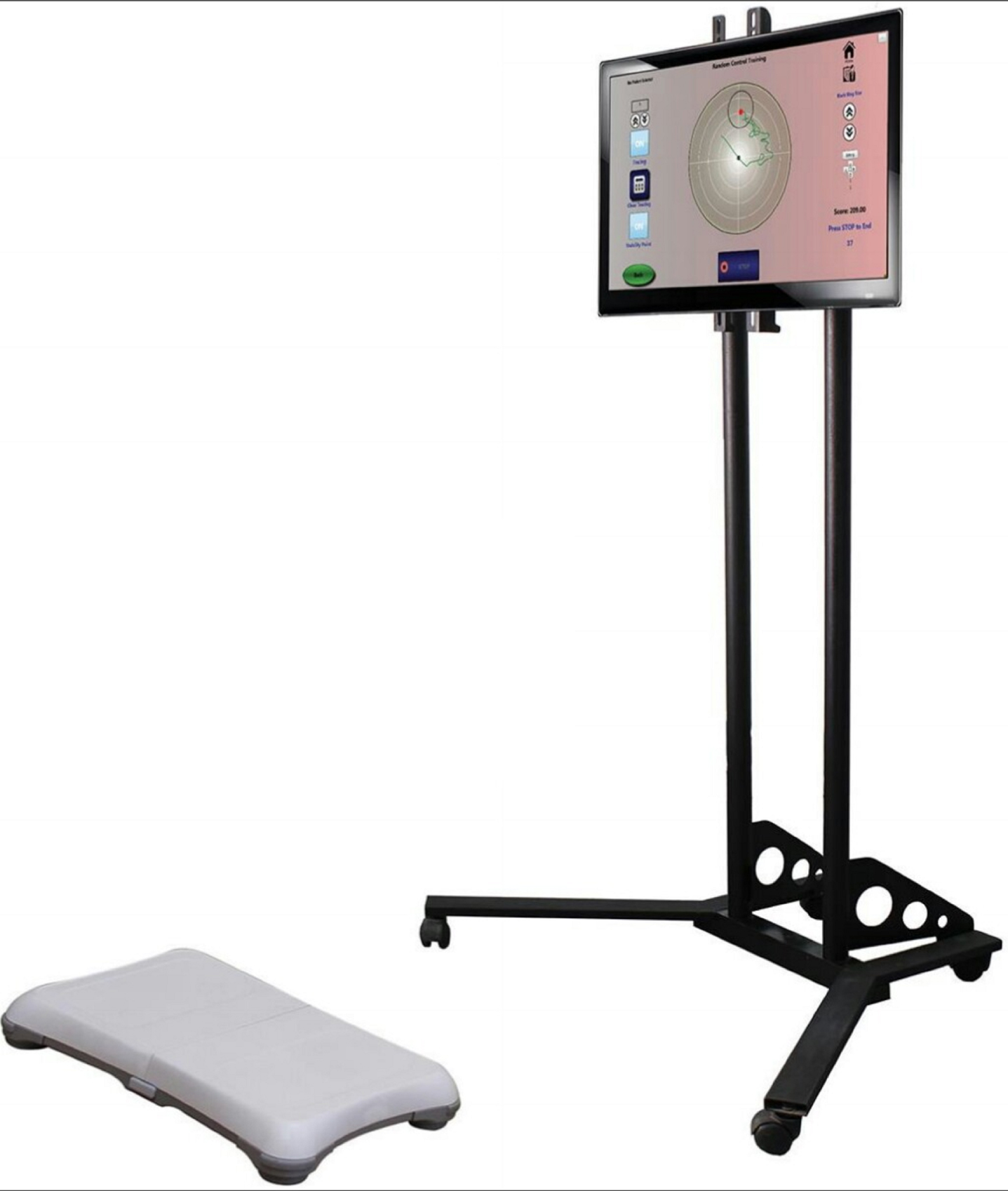
Mizan static balance rehabilitation system.
To assess the balance quantitatively, children attended the gait analysis laboratory at a research center for neuro-rehabilitation immediately before and one week after the treatment. Quiet standing tests with closed and then open eyes were performed over a force plate (Kistler, Switzerland) to measure the body sway and COP movement at 1000 Hz. A minimum of two minutes of rest was allowed between every two tests. In total, for 30 seconds at each condition, 30000 data points were collected indicating the X and Y position of the COP during quiet standing. Then, the COP excursion
Then, the COP features were summarized using medians (interquartile) and were compared before and after the intervention using Wilcoxon signed-rank test. Results are presented as median (interquartile range) for continuous variables. The ranks of the data were compared using the Wilcoxon signed-rank test for paired data [26]. The level of significance was set at a two-tailed α= 0.05. All data analyses were performed with IBM SPSS Statistics for Windows version 22 (IBM Corp., Armonk, NY, USA).
Results
Five children were included in this study. The mean age was 10 and the minimum and maximum were 5 and 15 years. Two girls and 3 boys were included in the sample. Muscle tone was rated as 1+ in two participants and 2 in the remaining, based on the Modified Ashworth Scale. Three children were at a level I and two were at level II of the GMFCS [25]. All the participants attended the 20 therapy sessions. Table 1 shows the results of the assessments at the baseline and one week after the end of the intervention. The non-parametric analyses showed that except for the distance of COP excursion displacement at the mediolateral direction with eyes closed, other components of the distance did not change significantly. However, the velocity of COP excursion displacement improved significantly in all of its components with both closed and open eyes. Also, the maximum velocity decreased with eyes open (mediolateral, anteroposterior, and total), while the results did not show significant changes with the eyes closed. The overshoot measurements did not differ significantly after the training with respect to the baseline. Table 1 shows that all the outcome measures improved after the intervention; however, the small sample size increased the likelihood of type II errors. Therefore, the non-significant results could be attributed to the small sample size.
Median (interquartile range) of the assessments before and after the intervention
Median (interquartile range) of the assessments before and after the intervention
*Significant at the 0.05 level; COP: Center of Pressure.
The absolute median (interquartile range) change of distance, velocity, and maximum velocity caused by the intervention were calculated. The change in the distance [22, 106.1 (21,492.2, 25,412.0) vs. 22,778.6 (19,545.2, 24,892.8) mm, p = 0.625] and velocity [429.8 (401.6, 442.1) vs. 455.6 (390.9, 507.1) mm/s, p = 0.999] were not significant in both closed and open eyes, respectively. However, for the maximum velocity [1,539.3 (1,267.3, 2,645.8) vs. 1,407.0 (752.8, 1,556.8) mm/s, p = 0.999], the improvement was more prominent (but not significant) when the eyes were closed.
This study was conducted to evaluate the effects of 20 training sessions with the balance board on the balance parameters in participants with CP. It was hypothesized that balance board training would affect excursion, velocity, and overshoot of displacement in COP in CP. It was found that balance board training does not change the excursion significantly except for the mediolateral direction with eyes closed. However, the results showed that the intervention improves the velocity of the displacement significantly and that the benefit can be recognized with the participant’s eyes open and closed. Also, the data suggested that the maximum velocity improves with the eyes closed.
Overall, the results are consistent with some of the findings reported in the literature regarding the effects of balance boards. A study indicated that children with CP have a significantly greater peak-to-peak center of mass and COP displacement in the mediolateral and lower peak-to-peak center of mass and COP displacement in the anteroposterior direction [14]. The current study suggested that the balance board decreases the displacement of COP excursion mostly in the mediolateral direction. This may confirm that children benefit from balance board training in correcting their balance. In addition, the results showed that the change in the excursion was significant with eyes closed. This might be due to the fact that the displacement relies mostly on proprioception and that the balance board also has a favorable effect on proprioception of the lower limb [27]. Patients with closed eyes are still able to use proprioceptive information in the absence of visual environmental data. However, more basic studies are needed to evaluate this statement.
Tarakci et al. reported favorable outcomes in applying video games and balance training in children with CP. In a controlled trial, 30 ambulatory children aged 5–18 years with mild CP were randomized to either conventional balance training or Nintendo Wii-Fit balance-based video games training [28]. Both groups received 24 sessions of neuro-developmental treatment as well. Throughout that study, balance scores and independence levels in activities of daily living changed significantly in both groups. However, the improvement in all balance tests and total Wee Functional Independence Measure scores were significantly more in the Wii-based game group compared with those of the conventional balance training group. They concluded that the Wii-fit balance-based video games are better at improving both static and performance-related balance parameters in children with mild CP. The system in the current study also had audio and visual feedback to augment the training process.
A study was conducted to evaluate the effects of a Nintendo Wii balance board program on ankle spasticity and static standing balance in young people with spastic CP [21]. Ten children and adolescents aged 6 to 17 years with spastic CP participated in the Nintendo Wii balance board. For 6 weeks, the participants completed a total of 18 sessions, each lasting for 25 minutes. Ankle spasticity was evaluated with the Modified Ashworth Scale, and static standing balance was assessed using COP posturographic measures. The outcomes were measured before and after the end of the intervention. The results showed that the spasticity decreased significantly in the plantar flexor muscles of the ankle. Also, significant reductions in the COP sway area, COP mediolateral velocity, and COP anterior-posterior velocity were observed. The results of the current study showed that the velocity of the COP displacement improved with open and closed eyes. This may also be indicative of the effects of visual and proprioceptive information for activating the feedback mechanism.
A large number of variables were assessed. Children and parents showed a high level of compliance with training. However, at least two issues need to be pointed out in this study. First, the sample was not large enough to allow performing parametric statistical tests. The nature of the research makes it difficult to include a large number of children in therapy sessions and to carry out a wide variety of assessments on them. This problem can also be recognized in Gatica-Rojas’ study [21] with N = 10, and in Shumway-Cook’s study [16] with N = 6. The small sample size decreased the power of the statistical tests and prevented recognition of possible therapeutic effects by increasing type II error. Nevertheless, within the data in this study, there are clinically informative trends and recognizable patterns of change. Second, there was no independent control group to compare the results more efficiently.
Twenty training sessions were prescribed for the patients in this study. The number of sessions was based on clinical experience. A large study with the dose-response design is needed to determine the optimum number of training sessions. Besides, further research with factorial design and larger sample sizes is required to investigate the effects of balance board combined with other therapeutic modalities for the treatment of musculoskeletal problems in CP. Also, a longer intervention period might make the therapeutic effects more observable. Although, performing a more prolonged longitudinal study makes it hard for children and parents to participate without dropping out.
Conclusion
The balance board training may affect balance parameters in children with spastic CP. In particular, balance improvement can lead to smoother movement of the center of pressure. This experience showed that balance board can be setup easily in caregiving centers. Therefore, the technique might play an important role as the main or adjuvant to other therapeutic modalities for CP. Balance board training should be prescribed for at least 20 sessions to see improvement in balance parameters in children with CP and a GMFCS level of I or II.
Highlights
Balance board training affects balance parameters in children with spastic CP and a GMFCS level of I or II.
Balance board training improves the velocity of the displacement with the eyes open and closed.
Balance board training improves the maximum velocity of COP with the eyes closed.
Author contributions
MB supervised assessments of participants and data recording and helped with literature review and statistical analyses. MA contributed to the concept, developed the study protocol, and helped with the interpretation of the results. MZ helped with designing the study and literature review. MTH conceptualized and supervised the study and contributed to the interpretation of the results. All the authors participated in drafting and its final approval.
Conflict of interest
The authors have no conflict of interest to report.
Ethical considerations
Institutional Review Board of Baqiyatallah University of Medical Sciences, reference number: IR.BMSU.REC.1396.481.
Iranian Registry of Clinical Trials (IRCT) http://www.irct.ir/ reference number: IRCT20140306016865N3.
Funding
This research did not receive any specific grant from funding agencies in the public, commercial, or not-for-profit sectors.