




Abstract
PURPOSE:
To modify the Performance-Oriented Mobility Assessment-Gait (POMA-G) subtest and validate this modified POMA-G (mPOMA-G) in children with hypophosphatasia (HPP), a rare metabolic disorder that can manifest with musculoskeletal symptoms that impair mobility and ambulation.
METHODS:
Based on feedback from an expert panel, the POMA-G was modified by removing gait initiation/path assessments and expanding the rating scale for step length/continuity to capture aspects of observational gait analysis relevant to children with HPP. Three trained physical therapists used the mPOMA-G for video-based assessments of gait in 14 children with childhood HPP who participated in a clinical study of asfotase alfa or in a natural history study. Intraclass correlation coefficients (ICCs) were calculated to determine interrater and intrarater agreement. Concurrent validity was evaluated by correlations with other validated assessment tools.
RESULTS:
Across 192 observations from available videos, interrater and intrarater agreement of
mPOMA-G scores was significant (ICCs: 0.76 for both;
CONCLUSION:
The mPOMA-G is a reliable and valid measure for detecting clinically significant impairments in children with HPP.
Keywords
Introduction
Hypophosphatasia (HPP) is a rare inherited systemic metabolic disorder caused by low tissue-nonspecific alkaline phosphatase activity [1, 2, 3]. Signs and symptoms of HPP can manifest in utero through adulthood and can vary widely [1, 3]. In children, common manifestations include radiographic evidence of abnormal mineralization in provisional zones of the long bones, knocked/bowed knees, muscle weakness, musculoskeletal pain, fractures, poor growth, and premature tooth loss with roots intact [1, 4, 5]. Musculoskeletal aspects of HPP can impair mobility and ambulation, which may have implications for activities of daily living, community participation, and quality of life.
The Performance-Oriented Mobility Assessment (POMA) is validated for evaluating gait and balance in elderly and community-dwelling adults [6]. The POMA gait subtest (POMA-G) contains components that can be applied directly or indirectly to measure gait impairments (e.g., trunk sway, walking stance, step continuity) in patients with HPP [6]. Although the POMA-G has also been used to differentiate gait characteristics in deaf versus hearing children aged 7–17 years [7], it has not been validated for use in other pediatric conditions or in typically developing children. Further, some studies suggest that a ceiling effect exists with the POMA-G, limiting sensitivity to change in interventional studies [8, 9].
With the approval of asfotase alfa, an enzyme-replacement therapy for HPP [10, 11, 12], validated tools are needed for effective assessment and treatment of children with HPP. In the current study, the POMA-G tool was modified, and the modified version was validated for assessment of gait impairment in children with HPP.
Evaluation of the POMA-G and development of the mPOMA-G
An expert panel of physicians, physical therapists, and statisticians evaluated the suitability of the POMA-G for assessing gait impairment in children with HPP using observational, noninstrumented video footage. Most components of the POMA-G were relevant and could be reliably used. However, several modifications to the POMA-G were recommended by the expert panel to adapt it for use in children with HPP while preserving its clinimetric properties, resulting in the modified POMA-G (mPOMA-G) (Table 1). Modifications included: (1) removing the rating of initiation of gait, because children with HPP typically do not have difficulty initiating gait; (2) expanding the assessment of step length and step continuity from a 2- to 3-point scale to provide greater sensitivity and precision to detect change; (3) removing the rating of path, because children, whether or not they have HPP, may lack focused, purposeful gait or may follow a divergent path, and because single-view video footage may not permit reliable assessment of path deviations; (4) adding new items within observations for step length and height; (5) clarifying descriptions of specific items to increase sensitivity and consistency among raters; and (6) creating a scoring key that provides detailed instructions on item rating and includes illustrations (Fig. 1) of step continuity and hip/knee flexion during swing for reference during rating [13, 14]. The lowest score is 0 for each of the items, and the highest score is 1 or, for some observations, 2 (Table 1).
The mPOMA-G Scale (modified POMA-G
)
The mPOMA-G Scale (modified POMA-G
Example of step continuity and hip/knee flexion during swing for reference during
rating. 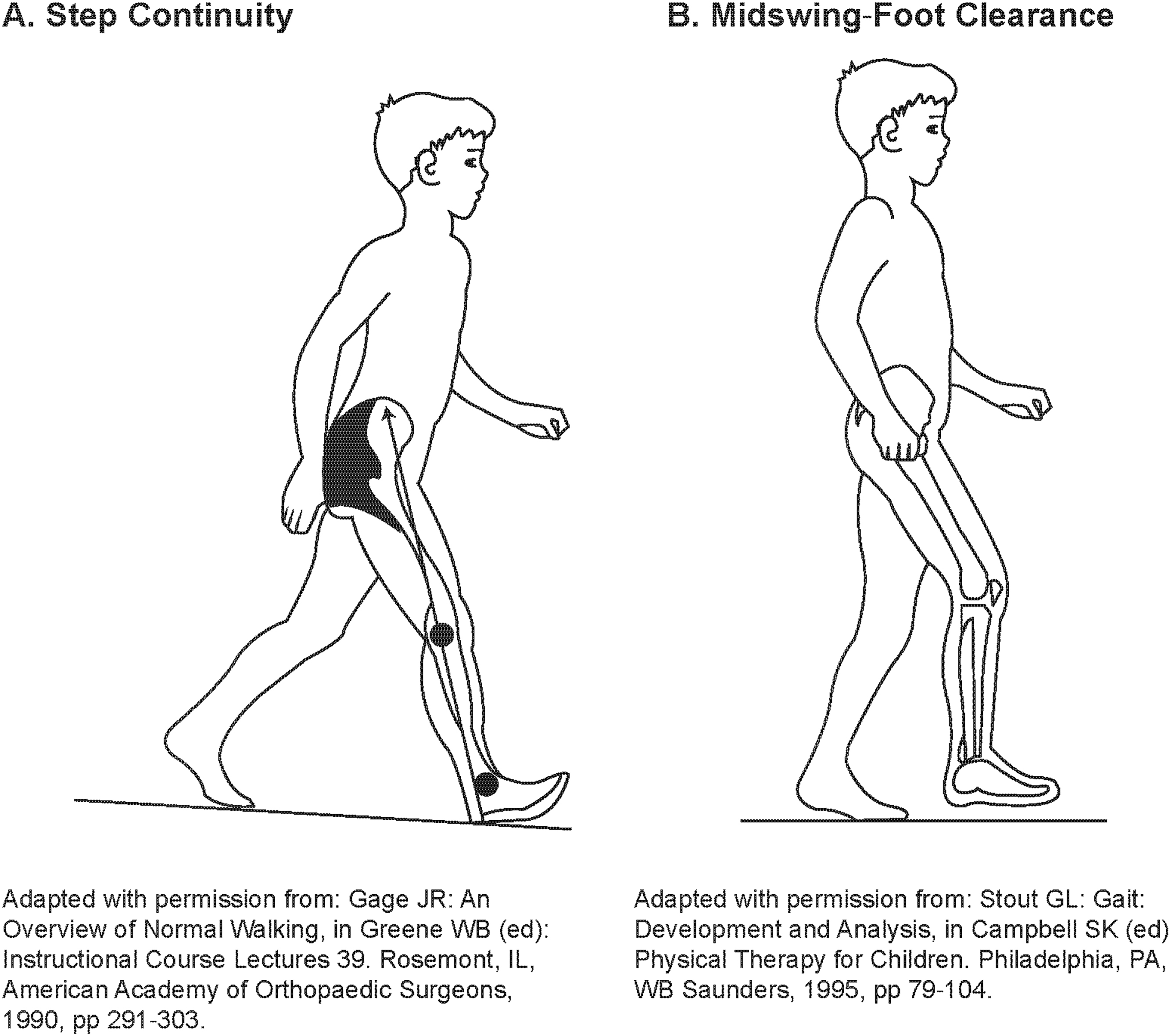
The study was conducted in accordance with the International Conference on
Harmonisation Guideline for Good Clinical Practice after review and approval by the
Washington University in St. Louis Institutional Review Board. Three physical therapists
with experience evaluating patients with HPP used the mPOMA-G to score videos of 14 children
with HPP while walking. Patients (age range: 5–15 years) were enrolled in an open-label
asfotase alfa clinical study (NCT00952484) with extension (NCT01203826) or a natural history
study (NCT02235493). Videos of children in the treated group (
All raters were trained on the scoring key and applied it to sample videos of
normal and atypical gait patterns, including those exhibited by patients with HPP not in the
study sample. Three median scores (one from each of the 3 raters) for each item were
determined for each available time point and were summed to generate a 0–12 overall score (0
All analyses were conducted using SAS software (Cary, NC). Interrater and
intrarater agreement for scores was determined by calculating intraclass correlation
coefficients (ICCs). For interrater ICC, a 2-way random-effects analysis of variance model
was used, with terms for subject-visit, rater, and interaction between subject-visit and
rater. For intrarater ICC, a 2-way random-effects analysis of variance model was used, with
terms for subject-visit-rater, review (original or retest), and interaction between
subject-visit-rater and review. The null hypothesis (ICC
In total, 192 observations were completed by the 3 raters (17 observations per
rater from videos of treated patients at historical pre-treatment time points and the
natural history group at baseline and last assessment; 47 observations per rater from videos
of treated patients at baseline and post-baseline time points). Both interrater and
intrarater ICC was 0.76 (
For concurrent validation of mPOMA-G scores to other outcome measures assessing
functional impairments, linear regressions were conducted and their corresponding Pearson
correlation coefficients (
Linear regression and Pearson correlation analyses of mPOMA-G with (A) CHAQ
Disability Index; (B) PODCI Transfer and Basic Mobility Subscale, Normative Score from
Parents; (C) PODCI Sports and Physical Function Subscale, Normative Score from
Parents; and (D) 6MWT, Distance Walked in Children with Infantile and Childhood HPP.
The n represents number of observations. Filled triangles indicate overlapping
observations. 6MWT 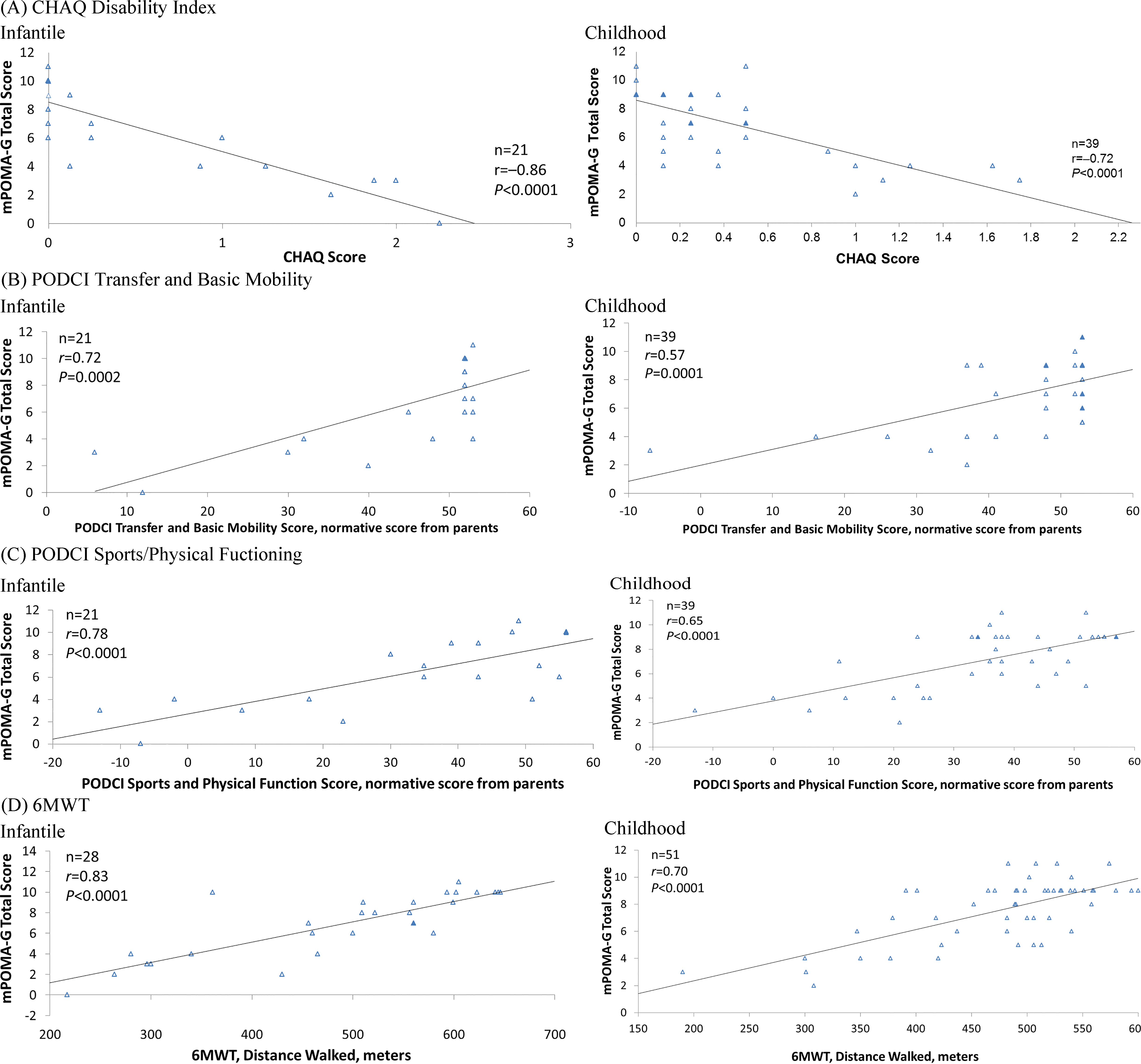
This analysis demonstrates that the mPOMA-G is a reliable and valid tool for
detecting clinically significant impairments and changes in gait from videos of children
with HPP. ICC calculations indicated good interrater and intrarater agreement. The mPOMA-G
showed strong concurrent validity with other validated measures of disability, activities of
daily living, and physical function, which is important given that children’s usual daily
activities and their performance in age-appropriate settings may be evaluated more
effectively using
Current healthcare resource constraints limit availability of gait assessment laboratories and use of detailed gait assessment tools. mPOMA-G items were reliably evaluated in observational, noninstrumented video footage from clinical visits and from a single-view perspective of children with HPP performing the 6MWT. Video capture does not require the use of special equipment, advanced technical expertise, or a studio. Furthermore, in contrast to real-time subjective observations, the resulting video footage provides an objective record that can be replayed repeatedly and analyzed precisely.
To understand the impact of recent advances in the medical management of HPP on patients’ quality of life, healthcare providers need tools that accurately and thoroughly assess mobility. The mPOMA-G is a reliable and valid clinical tool that can be easily administered in the clinical setting to assess gait impairment of patients with HPP.
Footnotes
Acknowledgments
This study was sponsored by Alexion Pharmaceuticals, Inc. Editorial support was provided by Bina J. Patel, PharmD, CMPP, of Peloton Advantage, LLC, and was funded by Alexion Pharmaceuticals, Inc.
Conflict of interest
DP was a consultant for Alexion Pharmaceuticals, Inc., at the time of the study and had received funding and travel support from Alexion for consulting and participating on advisory boards. DG, TP, EM, and ALR have no conflict of interest to report. MV and KPF are employees of and may own stock/ options in Alexion Pharmaceuticals, Inc., which sponsored the study. KLM received speaker/consulting fees, research grants, and travel support from Alexion Pharmaceuticals, Inc.