




Abstract
BACKGROUND:
The synthetic antioxidants are used routinely in foods especially those containing oils and fats to protect them against oxidation. Among the synthetic types, the most frequently used are butylated hydroxyl anisole (BHA), butylated hydroxyl toluene (BHT), propyl gallate (PG) and tert-butyl hydroquinone (TBHQ). These compounds have been reported to be dangerous for human health. Thus the search for effective, natural compounds with antioxidant activity has been intensified in recent years to replace the synthetic products.
OBJECTIVE:
The aim of the present study is to investigate the phytochemical composition, quantify the total phenolic and flavonoid contents and to study the in vitro antioxidant potential of berries ethanolic extract of P. lentiscus.
METHODS:
P. lentiscus berries were subjected to different chemical tests for the detection of phytoconstituents of the Algerian variety. The total phenolic and flavonoid contents were also determined using standard methods. Moreover, the antioxidant activity was assessed by using 2,2-diphenyl-1-picrylhydrazyl (DPPH·) assay, 2,2’-azino-bis-(3-ethylbenzthiazoline-6-sulphonic acid) (ABTS·+) assay and reducing power activity assay. Here, (BHT) was used as standard antioxidant.
RESULTS:
Phytochemical screening revealed that the berries contained phenolic compounds, flavonoids, anthocyanins, leucoanthocyanins, phlobotannins, tanins, saponins, terpenoids, proteins and mucilage while alkaloids, quinones and carotenoids are absents. The P. lentiscus berries extract was found to contain a high amount of total phenols, flavonoids. The berries ethanolic extract of P. lentiscus possess strong scavenging activity against DPPH·, (ABTS·+) free radical scavenging activity and reducing power. The antioxidant proprieties may be attributed to the presence of high phenolic and flavonoid compounds.
CONCLUSION:
P. lentiscus is a potential source of natural antioxidants and other phytoconstituents, which justifies its uses in folk medicines.
Introduction
Plants are a large source of new bioactive molecules with therapeutic potentials [1–5]. Many studies carried out have shown that the medicinal properties of plants come from the presence of bioactive agents in their extracts [6–9]. The most important elements are alkaloids, flavonoids, vitamins, tannins, essential oils, organic acids, resins, fat oils, saponins and polysaccharides [10, 11]. Reports indicate that there is an inverse relationship between the dietary intake of antioxidant-rich foods and the incidence of human disease [12, 13]. However, synthetic antioxidants, such as (BHT) and (BHA), have been widely used as antioxidants in the food industry and may be responsible for liver damage and carcinogenesis [14, 15]. For this reason, interest in the use of natural antioxidants has increased. Epidemiological studies have indicated the relationship between the plant antioxidants and reduction of chronic diseases [16–18]. Therefore, the development and utilization of more effective and non-toxic antioxidants from natural products are recommended, not only for the food and drug storage, but also for the nutritional and clinical applications. A great deal of effort has focused on using available experimental techniques to identify natural antioxidants from medicinal plants [19]. The Mediterranean region is relatively rich with plants (between 15,000 and 20,000 species) [20]. Algeria, a North African country with a large variety of soils (littoral, steppe, mountains and desert) and climates, possesses a rich flora (more than 3,000 species and 1,000 genders) [21], it has an immense biodiversity. Pistacia lentiscus L. is an aromatic evergreen shrub belonging to the Anacardiaceae family, largely distributed in the Mediterranean basin [22]. Aerial parts of P. lentiscus have traditionally been used in the treatment of hypertension, coughs, sore throats, eczema, stomach aches, kidney stones and jaundice. They possess stimulant and diuretic properties [23]. The fruits, galls, resin and leaves of P. lentiscus have a long tradition in folk medicine dating from the times of the ancient Greeks [24]. Several studies focused on the phytochemical composition of the resin, the leaves and the galls essential oil of P. lentiscus [24–28] and also on its antioxidant activity [29, 30], but in contrast, fewer studies are related to the composition and antioxidant activity of the berries of P. lentiscus [31–33].
The aim of this study was to investigate the P. lentiscus berries growing in Algeria for its phytochemical composition, DPPH radical scavenging activity, ABTS activity and reducing power activity to explore their potential pharmaceutical and functional food uses.
Materials and methods
Plant materiel
The berries of P. lentiscus were collected in October 2014 from Bouira region in Algeria. The plant material identification was carried out according to the new flora of Algeria [34]. The P. lentiscus berries were dried at room temperature. After drying, the aerial part was ground with a coffee grinder to obtain a fine powder and stored in paper bags at 4°C until their use.
Preparation of the extract
Ethanolic extract was prepared from 20 g of the dried and powdered plant with 200 ml of absolute ethanol (Ethanol 95%) in a Soxhlet apparatus for 6 hours. Then, the solvent was evaporated using a rotary evaporator at 65°C. Finally, the residue was lyophilized, weighed and kept in the dark at +4°C until further analysis.
Phytochemical screening
Phytochemical analysis of the berries of P. lentiscus was carried out using the standard protocols for the presence of phenolic content, flavonoids, alkaloids, saponins, antocyanins, leucanthocyanins, phlobatannins, tannins, terpenoids, quinones, proteins, carotenoids and mucilage. Detection of these phytochemicals was based on visual observation following color change or formation of a precipitate after the addition of specific reagents.
Total phenolic content
Total phenolic constituents of plant extracts were performed employing the literature methods involving Folin-Ciocalteu reagent and gallic acid as standard [35]. 0.25 ml of each sample (three replicates) was mixed with 1.25 ml 1/10 dilution of Folin-Ciocalteau’s reagent. After 3 minutes, 1 ml of Na2CO3 (7.5%, w/v) were added and incubated for 30 min.
The absorbance of all samples was measured at 765 nm. The total phenolic content was expressed in mg of gallic acid equivalents (mg GAE)/g of dried extract by using the regression equation that was obtained from the calibration curve of the gallic acid standard. All determinations were performed 3 times.
Total flavonoids contents
Total flavonoid content of each extract was determined by aluminium trichloride (AlCl3) method as described by Lamaison et al. [36]. 1 ml aliquot of each extract dissolved in ethanol was added to 1 ml of solution of AlCl3 (2% w/v). The mixture was vigorously shaken, and after 1 h of incubation, absorbance was taken at 420 nm. Quercetin was used as the standard for the calibration curve. The flavonoid content was expressed as mg of quercetin equivalent (QE) per gram dry weight of P. lentiscus berries extract.
Antioxidant activity
In this study, the antioxidant potential of the ethanolic extract of P. lentiscus berries was measured by different chemical assays: DPPH radical scavenging activity, ABTS test and reduction power activity. We compared the antioxidant capacity of the extract with BHT as reference.
DPPH assay
The antiradical activity of ethanolic extract was determined using the stable 2,2-diphenyl-1-picrylhydrazyl radical (DPPH·) [37]. 25 μL samples of various concentrations of ethanolic extract were added to 975 μL of ethanolic solution containing DPPH radicals (60 μM) while butylatedhydroxytoluene (BHT) acted as a positive control, the absorbance of DPPH· radical solution without sample was measured as blank. All test tubes were incubated in a dark place at room temperature for 30 minutes. Then the absorbance was measured at 517 nm. All determinations were carried out in triplicates. The disappearance of DPPH· was recorded and the percent inhibition of the DPPH· radical by sample is calculated as follows:
Where Ab is the absorbance of blank and As is the absorbance of positive control or sample. Extract concentration providing 50% inhibition (IC50) was calculated from the graph plotting inhibition percentage against extract concentration.
ABTS·+free radical scavenging activity
The ABTS method is based on the reduction of the green ABTS radical cation (7.00 mM) that was obtained by its oxidation with equal volume of potassium persulfate (2.45 mM) [38], for 12–16 h at 4°C in the dark. ABTS·+ solution was diluted with ethanol to absorbance of (1.00±0.02) at 734 nm. Then, 25 μL of the extract dilutions was mixed with 1 mL ABTS+ solution, the absorbance of reaction mixture was measured after 7 min at 734 nm. Tests were carried out in triplicate. ABTS·+ solution was used as blank sample, and BHT was used as positive control. As for the DPPH assay, ABTS scavenging ability was expressed as IC50 (mg/l). The values of IC50 were determined as reported above. The inhibition percentage of ABTS radical was calculated using the following formula:
Where A0 is the absorbance of the control, and A1 is the absorbance of the sample.
Reducing power
The reducing power was determined according to the method of Oyaizu [39]. 0.125 ml of ethanolic extract and BHT at different concentrations were mixed with 2.5 ml of sodium phosphate buffer (0.2 M, pH = 6.6), and 2.5 ml of potassium ferricyanide (1%). The mixture was incubated at 50°C for 20 min. Then, 2.5 ml of 10% trichloroacetic acid was added to the mixture which was centrifuged for 10 min at 1500 rpm. The upper layer (2.5 ml) was mixed with 2.5 ml of distilled water and 0.5 ml of 0.1% ferric chloride. The absorbance was measured at 700 nm. Blank absorbance was read by replacing sample by ethanol. BHT was used as a positive control. The reducing power increases with the increase of absorbance. All determinations were carried out in triplicates. A higher absorbance indicates a higher reducing power. IC50 value (mg/l) is the effective concentration giving an absorbance of 0.5 for reducing power and was obtained from linear regression analysis.
Statistical analysis
Statistical comparisons were made with one way ANOVA followed by Tukey multiple comparison test. The level of significance was set at P < 0.05. Statistical calculation was performed using SPSS 20.0 software. All the data were analyzed and expressed as mean±standard deviation of three separate determinations (n = 3).
Results
In the present study, the DPPH radical scavenging activity, ABTS radical scavenging activity and reducing power of P. lentiscus berries extract were investigated. The antioxidant activities of P. lentisus extract were also compared with that of reference synthetic antioxidant. In addition, the phytochemical analysis, phenolic compound and flavonoids content of ethanolic extract were carried out.
Phytochemical screening
Phytochemical screening was performed using standard protocols which showed the presence of phenolic compounds, flavonoids, antocyanins, leucanthocyanins, phlobotannins, tannins, saponins, terpenoids, proteins and mucilage with absence of alkaloids, quinones and carotenoids (Table 1).
Phytochemical screening of P. lentiscus berries
Phytochemical screening of P. lentiscus berries
(+): Present, (–): Absent.
Phenolic compounds are the largest group of phytochemicals and have been touted as accounting for most of the antioxidant activity of plants or plant products [40]. Several reports have shown a close relationship between total phenolic content and high antioxidant activity [41]. Total phenolic contents obtained were 955.28±0.125 mg GAE/g of the berries extract and total flavonoid contents obtained were 13.40±0.35 mg QE/g of the berries extract for the P. lentiscus (Table 2).
The content of total phenolics, flavonoids in P. lentiscus berries ethanolic extract
The content of total phenolics, flavonoids in P. lentiscus berries ethanolic extract
Data are expressed as mean±standard deviation of three different experiments.mg GAE/g: mg of gallic acid equivalent per g of lyophilized extract; mg QE/g: mg of quercetin equivalent per g of lyophilized extract.
Plants rich in secondary metabolites, including phenolics, flavonoids and carotenoids, have antioxidant activity due to their redox properties and chemical structures [42], the DPPH radical scavenging method was used to evaluate the antioxidant capacity of the berries extract, because the use of DPPH radical provides an easy, rapid and convenient method to evaluate the antioxidants and radical scavengers [43]. In the present study, P. lentiscus berries extract showed a strong effect in inhibiting DPPH, reaching up to 90.059±0.65% at concentration of 100 mg/l. Figure 1 shows the dose response curve of DPPH radical scavenging activity of P. lentiscus compared with standard BHT. The concentration of the extract to scavenge 50% of the DPPH radical is called IC50 and lower IC50 values indicates higher antiradical activity. The IC50 value of P. lentiscus berries extract was 8.60±0.07 mg/l while the IC50 value of standard antioxidant BHT was 28.24±0.20 mg/l (Table 3).
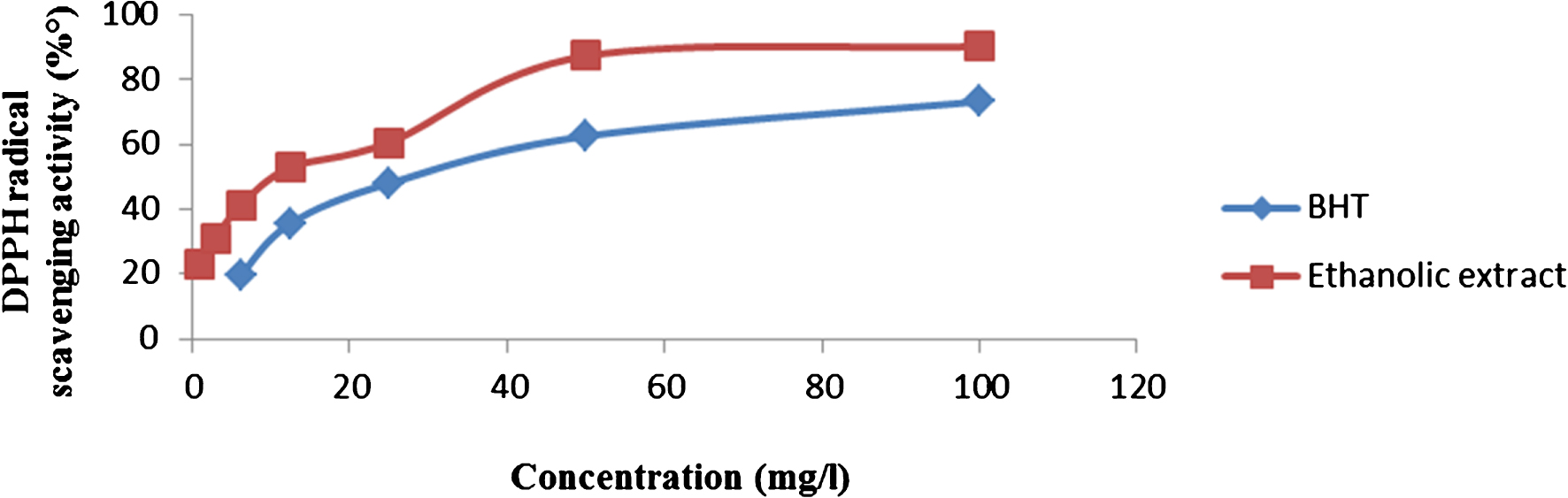
Free radical scavenging capacities of BHT and P. lentiscus berries ethanolic extract measured in DPPH assay.
Antioxidant activity expressed in IC50 (mg/l) of ethanol extract of of P. lentiscus berries and BHT
Values in the same column followed by the same letter are not significantly different by the Tukey’s multiple range test (p < 0.05). Data are the mean of three replicates.
The ABTS assay is based on the inhibition of the absorbance of radical cation, ABTS+, which has a characteristic wavelength at 734 nm, by antioxidants. Similar to DPPH, the decolorization of ABTS radical reflects the capacity of an antioxidant species to donate electron or hydrogen atoms to inactivate this radical cation [44]. ABTS results were in good agreement with DPPH method that the scavenging activity of the ethanolic extract was increased with the increasing concentration. The extract scavenged the ABTS radical in a dose dependent manner at concentration of 1–100 mg/l (Fig. 2). Furthermore, the results obtained in this study indicated that the berries ethanolic extract of P. lentiscus exhibited a high ABTS radical-scavenging activity and its percentage inhibition reached 91.45±0.14% at a concentration of 100 mg/l, which appeared lower than of synthetic antioxidants BHT (99.56±0.056%) for the same concentration, these findings were confirmed by calculating the IC50 values for the P. lentiscus berries extract (8.65±0.051 mg/l), which was found to be lower that of standard BHT (IC 50 = 5.81±0.01 mg/l).
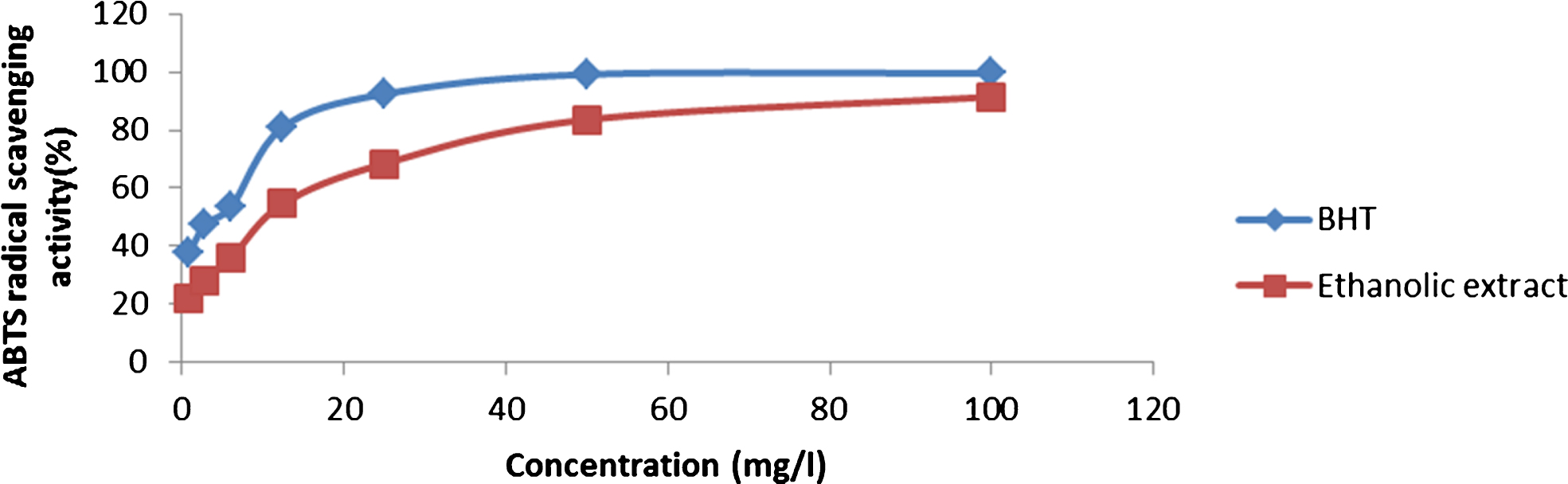
Free radical-scavenging capacities of BHT and P. lentiscus berries ethanolic extract measured in ABTS assay.
Reducing power experiment is a good reflector of antioxidant activity of the plant. The plant having high reducing power generally reported to carry high antioxidant potential too. In this experiment, Ferric ions are reduced to ferrous ions with the color of the reaction mixture changes from yellow to bluish green. In reducing power assay, the dose-dependent curve of the plant extract at different concentrations (1–100 mg/l) was compared with that of BHT (Fig. 3). Ethanolic extract showed higher reducing power than that of the BHT. Reducing power potential of extract increase with the dose, however, extract exhibits height reducing power than that of BHT. The absorbance of the plant extract was varied from 0.39±0.008 (1 mg/l) to 0.87±0.001 (100 mg/l), whereas BHT was varied from 0.01±0.001 (1 mg/l) to 0.78±006 (100 mg/l). The IC50 value of the plant extract was 12.21±0.036 mg/l and that of BHT was 64.14±0.14 mg/l (Table 2).
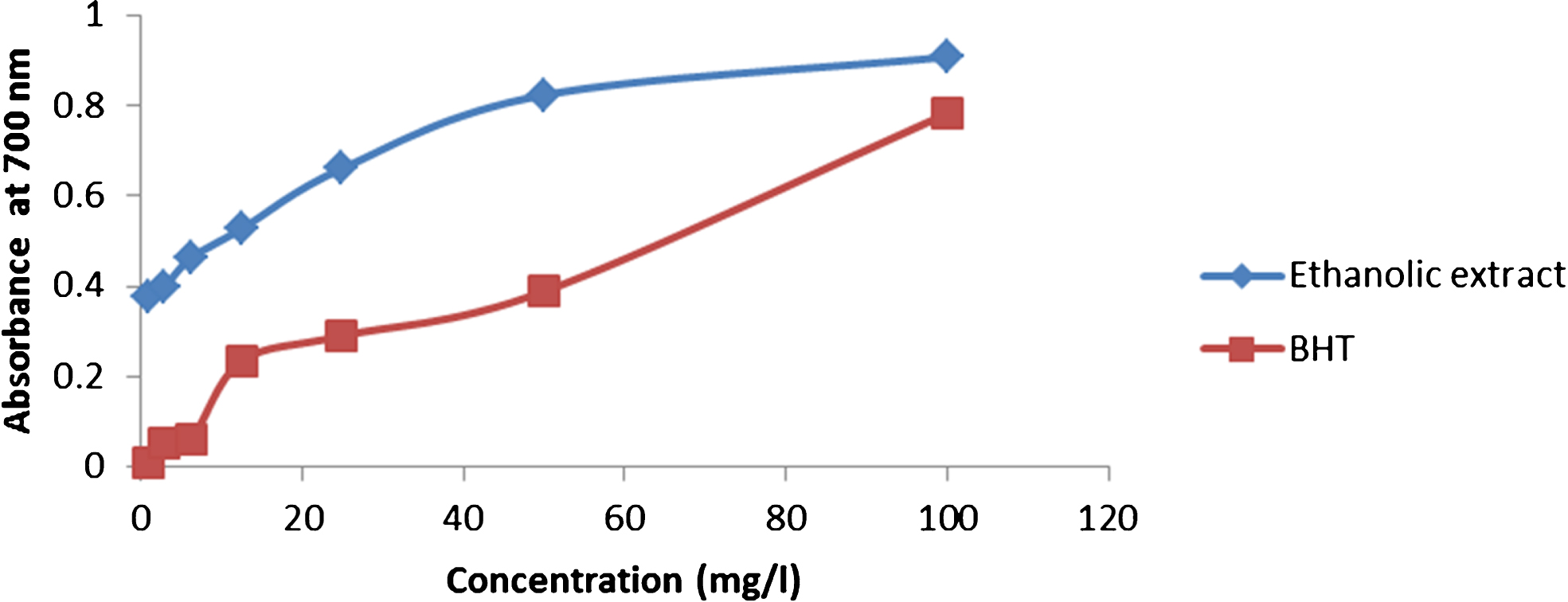
Reduction power of berries ethanolic extract of P. lentiscus compared with that of BHT.
The phytochemical screening was performed to identify the classes of chemical compounds present in the berries of P. lentiscus. Preliminary results have shown that P. lentiscus contains the majority of secondary metabolites, confirming the findings of Arab et al. [45]. We can say that almost all of bioactive molecules are present which proves their wealth and potentiality biological activities; they are responsible for the major activities including antioxidant activity; thus supporting the medicinal uses of this plant. Phenolic compounds have been detected in different parts of it [46], demonstrating that digallic acid (39) from fruits of P. lentiscushas anti-mutagenic properties. 1,2,3,4,6-Pentagalloyl glucose (45) and gallic acid from fruits of P. lentiscus were introduced as antioxidant and anti-mutagenic compounds [22]. Flavonoids were also isolated from aerial parts of P. lentiscus, quercetin-3-glucoside (56) was reported as the most abundant one [47]. Natural antioxidants like phenols, flavonoids and tannins possess potent antioxidant [48, 49]. Zitotni et al. [33] reported that phytochemical analysis showed that the major constituents of the extracts of P. lentiscus fruit were flavonoids, tannins, and anthocyanins, another authors found the anthocyanins, the flavonoids and triterpenes respectively in this plant [50, 51]. Similarly, the review of phytochemical screening realized by Hamad et al. [52] revealed the presence of unsaturated sterols and/or triterpenes, carbohydrates, flavonoids and tannins in P. lentiscus. Anthocyanins have been reported from some Pistacia species [53–55]. Cyanidin-3-O-glucoside and delphinidin-3-O-glucoside (63) have been detected in P. lentiscus berries and leaves [27, 50].
Plant phenols represent one of the major groups of compounds acting as primary antioxidants or free radical terminators. Thus, it was reasonable to determine their total amount in the selected plant extracts [56]. The results of these phytochemicals obtained in the present study, especially those of flavonoids and phenolic content, was shown to be higher than that found in some studies, the phenolic contents in berries were of 103.342±2.317 mg GAE/g and 414.9±3.0 mg GAE/g, respectively found by Zitouni et al. [33] and Boutsari et al. [57]. Another recent study by Arab et al. [45] reported an abundance of phenolic compounds in fruits of P. lentiscus (61.34%). In comparison with others authors, Zitouni et al. [33] found that the flavonoid content was 4.696±0.329 (mg CE/g DM) in berries of P. lentiscus. Author work reported that the total phenolic and flavonoid content in fruits extract of P. lentiscuswere (205.79±6.51 mg CatE/gE and 6.28±1.04 mg RutE/gE), respectively [32]. The results of this study shown the higher total phenolic compounds content of P. lentiscus berries than cranberry berries from Canada [58]. The Total phenolic compound values of methanolic extracts of three berry fruits (blueberry, blackberry, and strawberry) growing in Nanjing, China, were found to be 9.44, 5.58, and 2.72 mg gallic acid/g DW, respectively [59]. These differences in total phenolic contents could be due to genotypic and environmental variations (climate, location, temperature, fertility and diseases) within species, plant part tested, harvesting time and extraction procedure [60]. The presence of phenolic compounds account for the majority of antioxidant activity in plants. Flavonoids, including flavones, flavanols and condensed tannins, are plant secondary metabolites, the antioxidant activity of which depends on the presence of free OH groups, especially 3-OH. Plant flavonoids have antioxidant activity in vitro and also act as antioxidants in vivo. The presence of phenolic compounds account for the majority of antioxidant activity in plants, in which the antioxidant properties are mainly because of their redox potential, which allow them to act as reducing agents, hydrogen donators, metal chelators and singlet oxygen quenchers [63]. Flavonoids exhibit a variety of biological activities both in vitro and in vivo [64]. The flavonoids content reported in our study for P. lentiscus berries were higher than that reported in previous studies for other berries (cranberry) [58, 65]. The Total flavonoids content values of blueberry, blackberry and strawberry were found to be 24.38, 3.99 and 1.16 mg catechin/g DW, respectively [59]. The type and variety of berries plants may account for differences in the results obtained as well as possible variations in the extraction conditions and type used, Geographic origin of plants, genotypes considered, environmental conditions (soil, climate) and maturity stage at harvest of plants berries. It is reported in literature that flavonoids show considerable antioxidant action on human health and fitness and act either through scavenging or chelating processes [66].
Several methods are available to measure the antioxidant activity of food and biological systems [67]. Due to the presence of different bioactive components with antioxidative potential in the berries extracts of P. lentiscus, three complementary methods (DPPH, ABTS radical scavenging activity and reducing power) have been used to investigate sample extract antioxidant activity. The improved ABTS method has been widely used to evaluate the total antioxidant capacities of both aqueous and lipophilic systems in vitro, while the DPPH method has been used for evaluating the scavenging activities of antioxidants in lipophilic systems [68]. The DPPH is a stable free radical, which has been widely used as a tool for estimating free radical scavenging activities of antioxidants [48]. Our results suggested that different concentration have different activities and maximum activity was observed at 100 mg/l concentration. The observed antioxidant of extracts may be due to the neutralization of free radicals (DPPH), either transfer of hydrogen atom or by transfer of an electron [69]. This significant scavenging ability in the above berries extract could be attributed to the presence of active phytoconstituents in them and their high content of phenols and flavonoids. Phytochemical studies indicated the presence of copious amounts of flavonoids, tannins and phenolics in the extracts of P. lentiscus, which could be responsible for the observed activity [51]. Zitouni et al. [33] reported that Tannins roots and fruits of P. lentiscus exhibited also high activity with EC50 of 0.090±0.011 mg/ml and 0.099±0.019 mg/ml. Belyagoubi-Benhammou et al. [70] reported that the results from various free radical scavenging systems revealed that the fruits of P. atlantica plant had significant antioxidant activity and free radical scavenging activity and the EC50 values of the DPPH radical scavenging activity of the ethyl acetate fraction found to be (14.64 mg Antioxidant/g DPPH) and (49.21 mg/g) for the butanolic extract. Flavonoids and phenolic acids are the most important groups of secondary metabolites and bioactive compounds in plants [27]. Some researchers have investigated the relationship between antioxidant activity and polyphenol content [71–74]. Polyphenol compounds are reported to be a good source of natural antioxidants [75]. The rich flavonoid plants could be a good antioxidant source that would help increase the overall antioxidant capacity of an organism and guard it against lipid peroxidation [76].
The presence of specific chemical compounds in the extract of P. lentiscus may inhibit the potassium persulfate activity and hence reduced the production of ABTS. Several other authors noted that there is a correlation between total phenolic content and ABTS scavenging activity of the plants extracts [77–78]. Previous studies [53, 80], showed that greater antioxidant potential of several Pistacia species extract could be related to the nature of phenolic compounds and their hydrogen ability. Cherbal et al. [81] reported that a strong correlation exists between the total phenolic content and the antioxidant properties of P. lentiscus extract, indicating that the phenol compounds play an important role in the beneficial effects of these medicinal plant. Plants containing flavonoids have been reported to possess strong antioxidant activities [82]. Higher total phenol and flavonoid contents lead to better radical scavenging activity [83]. Phenolic compounds and flavonoids have been reported to be associated with antioxidant action in biological systems, mainly due to their red-ox properties, which can play an important role in absorbing and neutralizing free radicals, quenching singlet and triplet oxygen, or decomposing peroxides [84].
The reducing capacity of a compound may serve as a significant indicator of its potential antioxidant activity. It was found that in general, the reducing power of the berries ethanolic extract was higher than that of the standard BHT, giving an indication in the potential higher antioxidant activity of the extract. Earlier study revealed the antioxidant activity of reduction power of P. atlantica fruit extract with an IC50 of 0.13±0.001 mg/ml [70]. Also in another recent study conducted by Zitouni et al. [33] reported that the IC50 of P. lentiscus fruit metnanolic extract was 0.666±0.035 mg/ml. Our results are in agreement with those of Atmani et al. [51], Djidel et al. [85] and Atmani et al. [86], which showed that P. lentiscus exhibited a great reducing power. Benhammou et al. [87] noted that the both extracts of P. lentiscus and P. atlantica leaves were characterized by a high reduction power. Reducing power may be due to the presence of polyphenols, which can donate electrons and scavenge free radicals by converting them into more stable products and can terminate the radical chain reaction [88]. The reducing power of the extract is an indicator of its antioxidant properties [89].
Conclusion
The phytochemical tests performed on the berries of P. lentiscus shows the presence of phenolic compounds, flavonoids, anthocyanins, leucoanthocyanins, phlobotannins, tanins, saponins, terpenoids, proteins and mucilage while alkaloids, quinones and carotenoids are absents. The present study revealed that the P. lentiscus berries extract was found to contain a high amount of total phenols, flavonoids. In the present study, we concluded that the ethanolic extract of P. lentiscus is a potential source of natural antioxidants to react against free radicals such as DPPH, ABTS and reduction power. This activity of the extract may be due to the total polyphenolic contents present in it. The phytochemical profile results showed that the plant extract has molecules with high potential for the development of new drugs with application in the treatment and prevention of various diseases. On the whole, it is interesting to note that the studied plants have, in fact, properties that may suggest applications in pharmaceutical industry and food. Our results also suggest that inclusion of antioxidant rich extract of P. lentiscus as a dietary supplementary has beneficial effects for human health. The data of the current work appear useful for further research aiming to chemically identify the specific compounds responsible for the antioxidant activities of P. lentiscus, further works are necessary to explore this medicinal plant in terms of isolation of this compound. In vivo antioxidant activity, anti-inflammatory activity and anticancer activity studies are also necessary.
Conflict of interest
None to report.