




Abstract
We present a new, simple knockout format for sports tournaments, that we call “Choose Your Opponent”, where the teams that have performed best during a preliminary group stage can choose their opponents during the subsequent knockout stage. The main benefit of this format is that it essentially solves a recently identified incentive compatibility problem when more than one teams from a group advance to the knockout stage, by effectively canceling the risk of tanking. This new design also makes the group stage more exciting, by giving teams a strong incentive to perform at their best level, and more fair, by limiting the risk of collusion and making sure that the best group winners are fairly rewarded in the knockout round. The choosing procedure would add a new, exciting strategic component to the competition. Advancing teams would choose their opponent during new, much anticipated TV shows which would attract a lot of media attention. We illustrate how this new format would work for the round of 16 of the UEFA Champions League, the most popular soccer club competition in the world.
Introduction
Many sports tournaments consist of a group stage played as a round-robin, followed by a single-elimination knockout stage. Often, the best k teams1 in each group advance to the knockout stage, and the knockout stage follows a predetermined bracket route that depends only on group labels (e.g., A, B, C, etc.) and group ranks (group winner, group runner-up, etc.). Usually, for the teams that advance, a better group rank means facing an opponent with a worse group rank during the first round of the knockout stage. Since group rank is supposed to reflect team abilities, the bracket gives, on paper, an incentive to advance with the best group rank. Probably the most famous example of a competition using such a format is the FIFA World Cup (soccer). The knockout bracket of the 2018 FIFA World Cup is shown in Figure 1; the 8 groups are labeled A to H; C1 denotes the winner of Group C, F2 denotes the runner-up of Group F, etc. Some variations exist; for instance, when the number of groups is not a power of 2, the best k teams in each group advance to the knockout stage, as well as the best of the teams ranked k + 1 in their group (compared across groups), so as to populate a bracket with 2 N teams. For example, the 1986, 1990, 1994 FIFA World Cups, as well as the UEFA Euros since 2016, use a format with n = 6 groups of 4, where the best k = 2 teams in each group advance to the round of 16 (2 N = 16), together with the best 2 N - kn = 4 third-placed teams; see (Guyon, 2016) for details.

Bracket of the knockout stage of the 2018 FIFA World Cup.
Compared to a pure round-robin tournament involving all teams, this hybrid format made of a group stage followed by a knockout stage has more outcome uncertainty, but it has much less matches, so it can fit in a given calendar frame. It also has a much smaller proportion of noncompetitive matches. Compared to a pure knockout tournament, this hybrid format has less outcome uncertainty, and it gives all teams a minimum number of matches (at least two) and a chance to advance even if they lose their first game.
Those traditional designs suffer from well-known and well-documented flaws. Fairness issues include the risk of collusion, the risk of tanking/shirking, the possible absence of win incentive in the last group games, and group winners being poorly rewarded in the knockout stage despite a great performance in the group stage. Those flaws are discussed in detail in Section 2.
In this article, in order to eliminate these flaws, we suggest a new knockout format. In this new format, that we call “Choose Your Opponent”, the teams that have performed best during the group stage can choose their opponent during the subsequent knockout stage. The main benefit of this format is that it makes the group stage more exciting, by giving teams a strong incentive to perform at their best level. It also makes the group stage more fair, by limiting the risk of collusion, effectively canceling the risk of tanking, and making sure that the best group winners are fairly rewarded for their group stage performance and do not meet strong opponents in the first knockout round.
In particular, one of the remarkable benefits of this design is that it practically solves the problem identified by Vong (2017), who has shown that in the classical design of hybrid tournaments, i.e., when bracket routes are predetermined based on group labels and group ranks, in order to exclude the risk of tanking, it is both necessary and sufficient to allow only the top-ranked team in each group to advance. That is crucially important because regulations that allow only one qualifier from each group may not be desirable, as they tend to produce many stakeless games. Though the “Choose Your Opponent” design cannot fully cancel the risk of tanking, it makes tanking irrelevant in practice, since in all realistic situations tanking can only decrease a team’s probability of achieving its goal, whether it be winning the tournament or reaching a particular round.
Moreover, advancing teams would pick their opponent during new, much anticipated TV shows which would attract a lot of media attention; the picking strategies of the teams would certainly be highly debated by the media and among fans.
The “Choose Your Opponent” knockout format appears to have been used in the Austrian ice hockey league since the 2012–2013 postseason “Playoff Pick” (Austrian ice hockey league website; Matisz, 2020). The top three teams in the league can choose their opponent from the playoff spots 5 to 8. For instance, in 2016–17, the first-placed Vienna Capitals chose the fifth-placed HC TWK Innsbruck and the second-placed EC Red Bull Salzburg picked the seventh-placed Graz 99ers (Wikipedia, 2016–17 Austrian Hockey League season). In 2017–18, Vienna Capitals also finished in first place and again picked HC TWK Innsbruck, this time six-placed (Wikipedia, 2017–18 Austrian Hockey League season). In 2019–20, they finished in third place and preferred the fifth-placed EC Graz 99ers to the seventh-placed Black Wings Linz (Wikipedia, 2019–20 Austrian Hockey League season).
The “Choose Your Opponent” design has also been used in the Southern Professional Hockey League in the U.S. under the name “Challenge Round” in 2017–18 and 2018–19 (Southern Professional Hockey League website). 2 The English rugby league applied it under the name “Club Call” in 2009–14 for semifinals only (Wikipedia, Super League play-offs). The format has also recently been used in bridge (Canadian Bridge Federation; The United States Bridge Federation), chess (Chess.com website), sailing (2015 World Match Racing Tour), and in the multiplayer online battle arena video game Dota 2 (The International Dota 2 Championships).
However, it seems that it has never been used in the most popular sports tournaments. It could be used in many major tournaments, including: Soccer: FIFA World Cup, UEFA European Championship, Copa America, African Cup of Nations, UEFA Champions League, UEFA Europa League, playoffs of European qualifiers to the FIFA World Cup, etc. Football (NFL), basketball, baseball, ice hockey: playoffs of the regular domestic season. Handball, basketball, volleyball: World Cup, continental championships, European club competitions. Rugby: World Cup, European club competitions, playoffs of the regular domestic season. Tennis: ATP Finals. Cricket: the ICC Cricket World Cup.
In this article we will illustrate how this new format would work for the round of 16 of the UEFA Champions League, the most popular soccer club competition in the world.
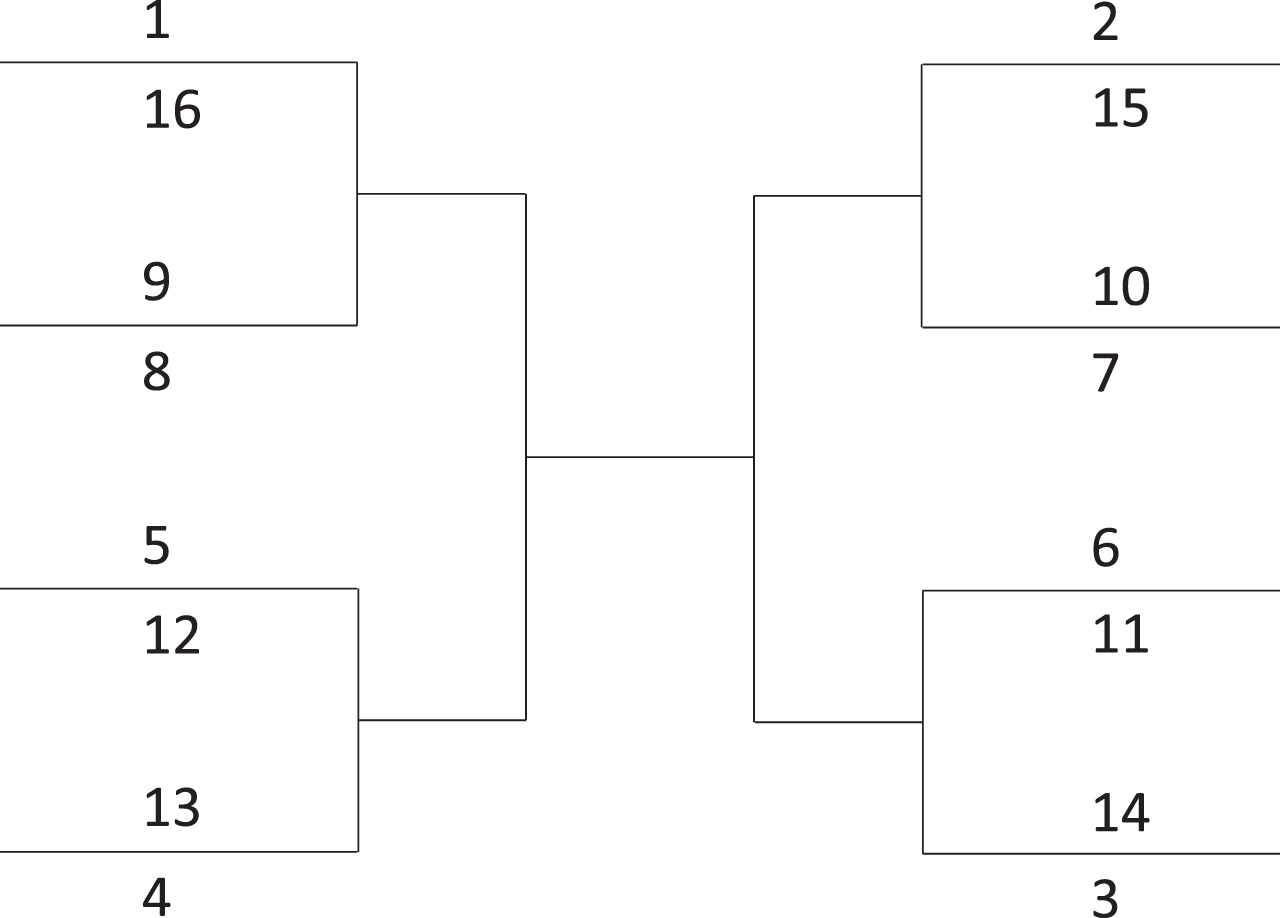
Ideal bracket, when teams have been ranked from 1 (the best group winner) to 2 N after the group stage is over. Here N = 4.
There exists a vast literature on knockout tournament design. Several theoretical studies have attempted to find a best seeding and formalize different goals of seeding. Hwang (1982) defines a bracket to be monotone if the probability of winning the tournament increases with team skill. He shows that the canonical knockout bracket (see Figure 2) is not necessarily monotone and suggests an adaptive reseeding method that he proves to be monotone. Schwenk (2000) suggests three axioms for fair seeding (delayed confrontation, sincerity rewarded, favoritism minimized). He proves that the canonical knockout bracket fails to satisfy the second axiom and suggests a variant that satisfies all three seeding axioms, in which subgroups of teams are randomly shuffled. Vu and Shoham (2011) introduce two alternative criteria for fairness (envy-freeness and order preservation) and investigate several impossibility results. Groh et al. (2012) aim to find optimal seedings in elimination tournaments for three different criteria: (1) maximization of total tournament effort; (2) maximization of the probability of a final among the two top ranked teams; (3) maximization of the win probability for the top player. They also identify the seedings ensuring that higher-ranked players have a higher winning probability. Pauly (2014) develops a mathematical model of strategic manipulation in complex sports competition formats. Karpov (2016, 2018) develops an axiomatic theory of knockout tournaments, gives axiomatic justification for various seedings methods, suggests two new seeding methods (equal gap seeding and increasing competitive intensity seeding), and provides many useful references. Dagaev and Suzdaltsev (2018) study optimal ways to seed a knockout tournament in order to maximize the overall spectator interest in it, assuming that neutral spectators tend to prefer to watch close and intense matches and matches that involve strong teams. As it has already been mentioned, Vong (2017) has shown that in the classical design of hybrid tournaments, in order to exclude the risk of tanking, it is necessary and sufficient that only the top-ranked team in each group advances. Arlegi and Dimitrov (2020) study the impact of two basic principles of fairness on the structure of elimination-type competitions: that stronger players should have a larger chance of winning than weaker players, and that equally strong players should have the same chances of being the final winner. They find that a new competition structure that they call antler plays a referential role in the design of fair knockout brackets.
Our new format is radically different from the ones studied in those papers, as in our approach teams are not placed in a bracket using a predefined mechanism. Rather, the teams that have performed best so far during the tournament decide against who they will play in the next knockout round, while the teams that are chosen have no say. This new feature practically solves the win incentive issues raised in the abovementioned papers.
Numerous statistical and simulation studies aim at comparing tournament designs. Glickman (2008) assumes only partial information about competitors’ relative rankings and develops Bayesian locally-optimal design of adaptive knockout tournaments to maximize the probability that the best team advances to the next round. Recently, Glickman and Hennessy (2016) have extended this approach in order to identify the overall best team in fixed knockout tournament brackets. Other utility functions are also considered. Scarf, Yusof, and Bilbao (2009) propose tournament metrics that can be used to measure the success of a sporting tournament, and describe how these metrics may be evaluated for a particular tournament design. This allows them to compare competing designs, such as round-robin, pure knockout and hybrids of these designs. They use the UEFA Champions League (soccer) to illustrate their methodology, while Scarf and Yusof (2011) use the FIFA World Cup Finals (soccer). Csató (2021a) compares four hybrid designs for the World Men’s Handball Championships. Other relevant literature includes Adler et al. (2017), Annis and Wu (2006), Appleton (1995), Baumann, Matheson, and Howe (2010), Csató (2021b), Dagaev and Rudyak (2019), Edwards (1998), Goossens, Beliën, and Spieksma (2012), Lasek and Gagolewski (2018), Marchand (2002), McGarry and Schutz (1997), and Ross and Ghamami (2008). Fair draws of round-robin groups are investigated in (Cea et al., 2020; Guyon, 2014a, 2015a; Laliena and López, 2019). Another recent line of research is concerned with fixing a knockout tournament (Aziz et al., 2014; Stanton and Vassilevska Williams, 2011; Vassilevska Williams, 2010; Vu, Altman, and Shoham, 2009).
In a sense, the “Choose Your Opponent” policy is a “reversed” draft allocation mechanism as the former prefers the best teams and the latter prefers the worst teams. Draft allocation has a very large literature, see, e.g., Banchio and Munro (2021), Fornwagner (2019), Kazachkov and Vardi (2020), Lenten (2016), Lenten, Smith, and Boys (2018), Price et al. (2010), and Taylor and Trogdon (2002).
Note that academic research has already led to changing tournament designs in soccer. Let us mention three examples: Inspired by Guyon (2014a, 2015a), the draw for the 2018 FIFA World Cup—unlike the previous editions of this championship—has determined all pots by positions in the FIFA World Ranking in order to increase balancedness across the groups while still satisfying geographic constraints; UEFA has followed the proposal of Guyon (2016) to reduce the biases in the design of the knockout bracket of the 2020 UEFA European Championship; Durán et al. (2017) have constructed an alternative schedule for the FIFA World Cup South American Qualifiers, which overcomes the main drawbacks of the previous policy and has unanimously been approved by all CONMEBOL (South American Football Confederation) members to be used in the qualifier for the 2018 FIFA World Cup; see also (Alarcón et al., 2017).
The remainder of this article is structured as follows. Section 2 discusses the main flaws of the traditional hybrid designs. In Section 3, we describe the “Choose Your Opponent” knockout format and investigate its main benefits and drawbacks. Section 4 investigates how this new format would work for the round of 16 of the UEFA Champions League. Finally, Section 5 concludes.
The hybrid tournament design, though it is widely used, has serious fairness issues: One of the most famous examples of collusion in sports is the “disgrace of Gijón” (see, e.g., (Kendall and Lenten, 2017)). It refers to the match between West Germany and Austria who refused to attack each other during 80 minutes, satisfied by the 1-0 Germany win that let both teams advance to the second round of the 1982 FIFA World Cup at the expense of Algeria, who had played their last group game the day before. To prevent this to happen again, FIFA, soccer’s world governing body, decided that all teams in a given group would play their last group match at the same time. However, playing the last two group games at the exact same time does not fully prevent collusion. Denmark-France (0-0 on June 26, 2018 during the 2018 FIFA World Cup) is a recent example of tacit collusion in this context: both teams knew that a draw would let them both advance to the knockout stage whatever the result of the other game in the group, Australia-Peru. They did little effort to attack each other, which resulted in a boring game and the only goalless match of the 2018 World Cup. The crowd made its displeasure known, as well as football fans around the world on social media (The Sun, 2018). Denmark’s manager Åge Hareide said after the game: “We just needed one point, we were up against one of the best teams in the world at counterattacks, so we would have been stupid to open up a lot of space. We stood back and got the result we needed, it was a 0-0 and we’re very pleased with that” (The Guardian, 2018). The last 10 minutes of the 2018 World Cup match between Japan and Poland is another example of tacit collusion. Poland, already eliminated, was leading 1-0 and happy to leave the tournament on a win. When Senegal, which was playing at the same time against Colombia, conceded a goal at the 74th minute, Japan was perfectly even with Senegal in the group ranking on points, goal difference, and goals scored. The next tie-breaker was fair-play. With two yellow cards less than Senegal during the group stage, Japan would advance at the expense of Senegal. Even though Senegal could still score, Japan was happy with a 0-1 loss. Japan and Poland then suddenly stopped to attack each other, in scenes reminiscent of the disgrace of Gijón (BBC, 2018). Another recent example of tacit collusion in soccer was the last minutes of the Peru-Colombia World Cup qualifying game (1-1) in October 2017. The current score saw both sides progress in World Cup qualifying. With results elsewhere going in their favor, Colombia knew a draw would see them finish in fourth place and qualify automatically, while Peru would advance to a playoff against New Zealand after finishing fifth. Both teams then stopped to attack each other. The Independent (2017) reported that, following allegations of match-fixing, Radamel Falcao, the Colombian striker and captain, admitted that he discussed playing for a draw with his opponents, as could be seen on TV. Denmark-Sweden at UEFA Euro 2004 is another example of a tacit collusion situation (Kendall and Lenten, 2017): a 2-2 tie would qualify both teams at the expense of Italy, whatever the result of the game between Italy and Bulgaria. The game indeed ended as a 2-2 draw, raising complaints from the Italian team and fans, even though Sweden and Denmark seemed to attack each other without restraint and try to win the game. The pre-2017 examples above are studied in Kendall and Lenten (2017) where the authors also provide other examples of tacit collusion in sports, and more generally examples where the rules of sports have led to unforeseen and/or unwanted consequences. Guyon (2020d) examines the risk of collusion in groups of 3, a format that FIFA considers using for the 48 team group stage of the 2026 World Cup. He explains how to build the match schedule so as to minimize the risk of collusion, and also quantifies how the risk of collusion depends on competitive balance and the point system. He also describes alternate formats for a 48 team World Cup that would eliminate or strongly decrease the risk of collusion. Stronka (2020) attempts to quantify the probability of match-fixing in groups of four teams under various match schedules and pair matching procedures. Schedules to reduce match-fixing opportunities have been recently studied in (Chater et al. 2021). Tanking famously happened in the badminton tournament of the 2012 Olympics in London. On August 1, 2012, four teams were ejected from the competition for “not using one’s best efforts to win a match” and “conducting oneself in a manner that is clearly abusive or detrimental to the sport” following round-robin matches the previous evening, during which the teams were accused of trying to lose in order to manipulate the knockout bracket.
3
The decision was highly debated. Indeed it can be argued that the bad design of the tournament could be blamed more than the teams: while the teams have not been performing their best effort to win the game at hand, they have been in fact doing their best to win the tournament (Badminton at the 2012 Summer Olympics). Moreover, it is a common practice in every competitive sport to save forces in earlier matches in order to perform better in later stages of a tournament. The badminton tournament of the 2012 Olympics is discussed in (Kendall and Lenten, 2017, Section 3.3.1). It is also used as a motivating example by Pauly (2014). The game between England and Belgium at the 2018 FIFA World Cup is another good illustration of the risk of tanking. England and Belgium were playing against each other in the last round of the group stage, and the winner could face a more difficult path to the final (Brazil in quarterfinals and France in semifinals) than the loser (England lost against Belgium and faced Sweden and Croatia instead). In the case of France-Denmark, it was not clear either whether winning the group was much of an advantage: the group winner could possibly face twice World Cup winners Argentina, while the runner-up would very likely face Croatia (and all this indeed happened). Tanking also famously happened during the soccer game Thailand vs Indonesia at the 1998 AFF championship (Kendall and Lenten, 2017, Section 3.9.2), in which Indonesian defender Mursyid Effendi deliberately scored an own goal during injury time to secure a 2-3 loss that would allow Indonesia to play against Singapore in semifinals rather than against Vietnam, the hosts of the tournament. Csató (2020e) investigates an interesting example of tanking in soccer, where in a given match the two teams must not win in order to advance to the next stage, due to a bad tournament design. Other studies on incentive incompatibility or lack of strategy-proofness, i.e., the possibility that a team is strictly better off with a weaker performance, include (Csató, 2018, 2019, 2020b; Dagaev and Sonin, 2018; Vong, 2017); see also the references therein. Teams may also just need a draw in their last group game to secure the first place, and prefer securing a draw rather than taking risks and trying to win the game by playing attacking soccer. This usually results in more defensive, less attractive play. Note that teams might have at least some financial incentives to win as many matches as possible in the group stage. This is the case for instance in UEFA club competitions, where the revenue distribution system incentivizes win even for teams that have no sporting win incentive, see for instance (Total Sportal website; UEFA website, 2019/20 UEFA club competitions revenue distribution system). Note that at UEFA European Championships, since 2016, some group winners face third-placed teams while other play runners-up, depending only on their group label (see a full study of the corresponding so-called “group advantage” in (Guyon, 2016)).
The “Choose Your Opponent” knockout design
Description of the format
In classical hybrid tournament designs, the teams that advance to the knockout round either follow a predetermined bracket route entirely decided by their group label and group rank, as illustrated for example in Figure 1; or follow the predetermined “ideal” bracket entirely decided by their rank during the regular season, like during the NBA playoffs (see Figure 2 for an illustration of the 16-team “ideal” bracket); or are automatically reseeded in the “ideal” bracket, like during the NFL Conference Championships, where the strongest remaining teams face the weakest remaining teams; or are randomly drawn against opponents, like during the draws of the knockout rounds of the UEFA Champions League and the UEFA Europa League.
Instead, in the “Choose Your Opponent” knockout format, the teams that have performed best during the preliminary group stage can choose their opponent during the subsequent knockout stage.
First, the 2 N teams that qualified for the knockout stage would be ranked from 1 to 2 N , based on their group stage results. For instance, the n group winners would be ranked from 1 to n, compared across groups based on sporting criteria which depend on the sport in consideration. For example, in soccer, the criteria could be in order: number of points; goal difference; number of goals scored; fair-play score (based on the number of yellow and red cards received), etc. Then the n runners-up would be ranked from n + 1 to 2n, compared across groups based on the same criteria, and so on. We call the resulting ranking the “global ranking 1–2 N ”. For instance, UEFA uses this mechanism for its Nations League to build a global ranking of the 55 member associations from the rankings of the different groups of the different leagues; this overall ranking was used in the draw of the groups of the Euro 2020 qualifiers (Wikipedia, UEFA Euro 2020 qualifying). UEFA also used the suggested global ranking mechanism in the seeding of the Euro 2020 (Wikipedia, UEFA Euro 2020 qualifying).
At this point, one natural knockout format would consist of placing teams in the “ideal” bracket shown in Figure 2 in the case where N = 4 (see (Guyon, 2016) and the references therein). The ideal bracket is a perfectly balanced bracket, where the ranks (from 1 to 2 N ) of the two opponents sum to 2 N + 1 in each of the 2N-1 matches of the first knockout round, and then, assuming the best ranked team always advances to the next round, sum to 2N-k+1 + 1 in the kth knockout round. It ensures that teams 1 to 8 cannot meet before the quarterfinals, in which case the quarterfinals are 1-8, 2-7, 3-6, and 4-5; that teams 1, 2, 3, and 4 cannot meet before the semifinals, in which case the semifinals are 1-4 and 2-3; and that teams 1 and 2 cannot meet before the final. This bracket is not only perfectly balanced, it is also free of any group advantage (see (Guyon, 2016)) and, compared to brackets built only on group labels and group ranks (like the one in Figure 1), it also increases win incentive during the group stage, as the more a team wins during the group stage, the weaker their opponents in the knockout stage will be, at least on paper, and the higher the probability is that it goes far in the tournament. Guyon (2016) has suggested two ways of modifying the “ideal” bracket to make sure that two teams from the same group cannot meet again before the semifinals.
However, it often happens that teams perceived as strong get quite poor results in the group stage and advance to the knockout round with a poor global ranking, maybe due to bad luck, or a bad seeding (see Section 4.4), or because their physical training aims at peak performance during the knockout round and players have suffered too much fatigue during the group stage. In such a case, a team advancing into the “ideal” knockout bracket with a good rank may end up facing an opponent that it perceives as stronger than other, better ranked opponents, and may feel unfairly rewarded for its good performance in the group stage. For example, if UEFA had adopted the “ideal” bracket for the UEFA Euro 2016, Germany would have been ranked 2nd after the group stage and therefore would have had to face Portugal, ranked 15th, a team generally considered as a soccer powerhouse (and, as a matter of fact, the future winner of the competition), in the round of 16. Germany may have preferred to play, say, against Ireland, Slovakia, Iceland, or Hungary, teams that finished the group stage with a better rank than Portugal but are considered weaker by many specialists (see (Guyon, 2016)). There exist numerous examples of teams unfairly rewarded for winning their group and having to face strong opponents in the first knockout round: Brazil having to face Argentina in the round of 16 of the 1990 FIFA World Cup; Arsenal and Napoli having to face Bayern Munich and Real Madrid in the round of 16 of the 2016–17 UEFA Champions League; Tottenham and Paris Saint-Germain, the best two group winners in the 2017–18 group stage of the UEFA Champions League, having to face Juventus and Real Madrid in the round of 16, etc.
The “Choose Your Opponent” knockout format precisely aims to avoid these situations by allowing the teams that have performed best during the group stage to choose their opponent during the final knockout stage among the pool of opponents that are still available. Team 1 in the global rankings chooses their opponent among Teams {2, …, 2
N
}. Team 2, if not already picked, chooses their opponent among the remaining teams. Team 3, if not already picked, chooses their opponent among the remaining teams. And so on, until all matchups are formed. Team 1 would choose their opponent among Teams {2N-1 + 1, …, 2
N
} (the weaker half of the advancing teams). Team 2 would choose their opponent among the remaining teams in the weaker half of the advancing teams. Team 3 would choose their opponent among the remaining teams in the weaker half of the advancing teams. And so on, until all matchups are formed.
For subsequent rounds, the same choice procedure would be applied:
For example, with the restricted choice implementation, Germany would not have been allowed to pick Hungary (ranked 6th out of 16) in the round of 16 of the UEFA Euro 2016; Hungary would have been protected by their good performance during the group stage. Other restrictions can easily be accomodated. For instance, in the UEFA Champions League, teams from the same country or group cannot play against each other during the round of 16 (see Section 4).
4
. Also, if the tournament organizer wants to avoid repeated matchups year after year, it may add the constraint that, if possible, a team cannot pick a team that it has selected in the previous edition (or p previous editions) of the tournament. The tournament organizer may also add a constraint to prevent two teams qualifying from the same city to play at home on the same day, as this may overload the infrastructure.
Many variations of the “Choose Your Opponent” policy can be considered. A team may be awarded by the opportunity to choose not only its next opponent but also, for instance: Whether they play the first leg of the next knockout round at home or away, when applicable. Several papers analyze whether playing the second leg at home means a significant advantage or not (Amez et al., 2020; Eugster et al., 2011; Geenens and Cuddihy, 2018; Page and Page, 2007). The opponents of other teams or a set of possible opponents for other teams. Other features of its knockout bracket. For example, the team ranked first might choose its opponent not only in the Round of 16 but in the quarterfinals, too, if it wins all of its group matches.
This procedure is a good way of rewarding the highest-ranked teams while ensuring group balance. It would actually ensure superior group balance compared to drawing seeded teams into groups, as the higher-ranked seeded teams would probably choose the weaker groups, while the lower-ranked seeded teams would end up in stronger groups.
Benefits and drawbacks
The main benefits of the “Choose Your Opponent” knockout format are the following: in which a minimum number of rest days, say r, is guaranteed to all teams between two games; in which match days and knockout rounds are spread over several days to maximize TV exposure and the value of media rights; that must be played over a short period of time. Leaving r match-free days between the end of the group stage and the first round of the knockout stage, and between consecutive rounds of the knockout stage, is the obvious, simplest way of ensuring that all teams benefit from r rest days between two matches. By proper scheduling, it might be enough to schedule less than r match-free days. The minimum number of rest days can also be decreased by imposing additional constraints during the “Choose Your Opponent” procedure, but at the expense of fairness. For instance, a team having played its last group game early may only be allowed to pick an opponent having also played its last group game early. For example, in the case of the FIFA World Cup, group winners from the first half of the groups—those playing early—may only pick their opponents among runners-up from the same half. Another scheduling drawback could be the advantage enjoyed by the teams that play the last group matches. In contrast to the teams from the groups that play early, they know which result will be sufficient to achieve a certain position in the global ranking. Since group labeling is arbitrary, this could be judged unfair—but can be handled to a certain degree by, for example, placing the titleholder automatically in a group that is finished the latest time. Theoretically, all groups can be finished simultaneously, but this would decrease the value of media rights. Note that the picking teams could also be allowed to choose the city/stadium where they will play their next game. This is illustrated in (Guyon, 2019a) in the case of the UEFA Euro 2020, where the rule could have been used to maximize the number of home games during the knockout stage.
The main drawbacks are the following:
The FIFA World Cup is a typical example of such tournaments. Indeed, consider a tournament with the three above characteristics. At the end of the group stage or at the end of a knockout round, a team who played its last game several days ago may pick a team who just finished playing. This implies that more match-free days may be needed between the end of the group stage and the first round of the knockout stage, and between consecutive rounds of the knockout stage, and could lengthen the tournament. Note, however, that adopting “Choose Your Opponent” is not problematic for tournaments that leave a lot of time between the end of the group stage and the first knockout round, and between consecutive knockout rounds, like the UEFA Champions League or the UEFA Europa League.
A poor seeding may be the result of following a poor ranking, see for instance (Guyon, 2014b; Lasek et al. 2013; McHale and Davies, 2007) about pre-2018 FIFA rankings. A poor seeding may also be the result of not following a good ranking; Section 4.4 deals with an issue with the seeding of the group stage of the UEFA Champions League. And a poor seeding may be also the result of how (legitimate) draw constraints are handled. For instance, Guyon (2014a, 2015a) explains that until 2014, due to how FIFA enforced the geographic constraints that it puts on the draw, the group stage of the FIFA World Cup was poorly seeded and produced unbalanced groups. One of his solutions (Suggestion #1 in (Guyon, 2014)) was adopted by FIFA for the 2018 World Cup.
The fact that the “Choose Your Opponent” design requires the groups to be very well balanced can be seen both as a drawback and as a benefit. Indeed, it can be considered a drawback as tournament organizers sometimes fail to correctly seed the teams, as the above examples show. However, for many symmetric tournament designs, group balance should be a priority of all tournament organizers, and tournament designs that make group balance very important can be seen as a great way to ensure that the teams are correctly seeded. Note, however, that asymmetric designs with voluntarily unbalanced groups do also exist; they have been studied by Csató (2020a), who has shown potential benefits of those formats.
In the next section, we illustrate the “Choose Your Opponent” format by showing how it would work for the round of 16 of the UEFA Champions League.
Application to the round of 16 of the UEFA Champions League
After describing the flaws of the current draw system of the round of 16 of the UEFA Champions League in Section 4.1, we explain how the “Choose Your Opponent” policy would work in practice in Section 4.2. In Section4.3_example we give a detailed example using the results of the group stage of the 2017-18 season of the Champions League; we consider both the full choice and restricted choice implementations. Finally, Section 4.4 discusses the importance of correctly seeding the group stage.
Global rankings 1–16 at the end of the group stage of the 2017–18 UEFA Champions League. GD stands for “Goal Difference” and GF for “Goals For”. UEFA uses head-to-head results as the first tie-breakers
Global rankings 1–16 at the end of the group stage of the 2017–18 UEFA Champions League. GD stands for “Goal Difference” and GF for “Goals For”. UEFA uses head-to-head results as the first tie-breakers
The “Choose Your Opponent” format could for instance be used in the UEFA Champions League in order to better reward group winners and make the group stage more attractive. In the current format, the group stage is made of 8 groups of 4 teams, with the best two teams in each group advancing to the round of 16. Every year in December, the draw of the round of 16 is a much anticipated event, which attracts a lot of media attention. In order to reward group winners for their group stage performance, they can only be drawn against runners-up. (Two other constraints apply: teams from the same group or from the same country cannot be drawn against each other. This yields interesting draw probability calculations, see (Guyon, 2017a, 2017b, 2018, 2019b, 2019c, 2020b, 2020c; Kloessner and Becker, 2013). The draw procedure has also been analyzed in (Boczoń, 2018).)
However, it often happens that some of the very best European clubs, considered to be consistently in the top 8 clubs over the past years, actually finish second in their group. In the recent years, this was the case of Real Madrid (2016–17, 2017–18, 2019–20), Bayern Munich (2016–17, 2017–18), Juventus Turin (2015–16, 2017–18), Atlético Madrid (2018–19, 2019–20), Manchester City (2016–17), and Paris Saint-Germain (2015–16, 2016–17). When group winners are drawn against one of those teams, they can feel bitter about the way they are rewarded for winning their group.
The flawed seeding system used by UEFA for the group stage since 2015 made those cases more likely (see Section 4.4). In the 5 years preceding the change, runners-up advanced to the quarterfinals 7 times out of 40 (17.5%), whereas in the 5 years following the change the proportion more than doubled, reaching 15 times out of 40 (37.5%).
The “Choose Your Opponent” format for the round of 16 of the UEFA Champions League
The “Choose Your Opponent” format would solve this problem, and could easily be adapted to take the country and group constraints into account: UEFA would allow the group winners to choose their opponent, but group winners could not pick an opponent from the same country or the same group. The best group winner (based on the global ranking 1–16) would first pick their opponent, then the second best group winner would pick theirs, etc. It would make sense to protect the group winners by enforcing the restricted choice implementation, where group winners cannot be picked by other group winners. By contrast, the full choice implementation would allow group winners to choose other group winners as their opponents.
Exactly as is done today for the draw of the round of 16 of the UEFA Champions League, to make sure that a team’s choice is acceptable, i.e., does not lead to a dead end, a computer program would provide the list of admissible opponents ahead of each team pick. A team’s choice leads to a dead end if it makes it impossible that the above rules (no match between teams from the same country or from the same group) be met for all the remaining games. The backtracking algorithm is a nice recursive procedure that does just that; see (Guyon, 2014a) for an example.
Note that UEFA uses head-to-head results as the first tie-breaker. This is impossible to apply across groups. Consequently, it might happen that a runner-up has better performance measures in the global ranking compared to the winner of its group, which would be quite strange. That is a further argument for not using head-to-head results as a tie-breaking rule and preferring global goal difference within the group. Note that goal difference is more attractive from a theoretical point of view (Berker, 2014).
Round of 16 draw of the 2017–18 UEFA Champions League
Round of 16 draw of the 2017–18 UEFA Champions League
Let us take the 2017–18 season of the UEFA Champions League as an example. The results of the group stage are reported in Table 1, and the outcome of the draw of the round of 16 in Table 2. Tottenham and Paris Saint-Germain were the two best group winners that year, but in the round of 16 they were respectively drawn against Juventus and Real Madrid, two clubs which, despite being 1st and 5th in the UEFA club coefficient ranking at the time, finished second in their group. Despite collecting 13 points in Group H, Real Madrid finished behind Tottenham which performed exceptionally well that year (16 points); Juventus finished second in Group D behind another soccer powerhouse, Barcelona (3rd in the UEFA club coefficient ranking at the time). Both Tottenham and Paris Saint-Germain must have felt bitter and poorly and unfairly rewarded for their excellent group stage performance.
Elo ratings of the 16 teams participating in the round of 16 of the 2017–18 UEFA Champions League as of December 11, 2017, day of the draw
Elo ratings of the 16 teams participating in the round of 16 of the 2017–18 UEFA Champions League as of December 11, 2017, day of the draw
Let us look at how the “Choose Your Opponent” design would have possibly worked. We first consider the restricted choice version. Here, we assume that teams pick their opponent based on the prevailing Elo ratings at the time, see Table 3. Elo ratings, introduced for chess by Arpad Elo in the 1960s, are a reliable measure of team skills. For European soccer clubs, they are maintained by the website First, Tottenham (Team 1) would choose their round of 16 opponent among runners-up. The available teams for Tottenham are: Bayern Munich, Basel, Shakhtar Donetsk, Juventus, Porto, and Sevilla. Tottenham cannot choose Real Madrid, as both teams were in the same group. They cannot play against Chelsea either, due to the country constraint. For instance, Tottenham picks Basel (the runner-up with the lowest Elo rating at the time, see Table 3). Then it is Team 2’s turn (Paris Saint-Germain) to choose their opponent among the remaining runners-up. The available teams for Paris Saint-Germain are: Real Madrid, Shakhtar Donetsk, Chelsea, Juventus, Porto, and Sevilla. Paris Saint-Germain cannot choose Bayern Munich, as both teams were in the same group. For instance, Paris Saint-Germain picks Shakhtar Donetsk. The following team to choose their opponent is Manchester City. The available opponents are: Bayern Munich, Real Madrid, Juventus, Porto, and Sevilla. Manchester City cannot choose Chelsea, another English team. For instance, they pick Porto. Then it is Team 4’s turn (Manchester United). The available teams are: Bayern Munich, Real Madrid, Juventus, and Sevilla. Manchester United cannot choose Chelsea either, because of the country constraint. For instance, they pick Sevilla. Then it is Barcelona’s turn (Team 5). They can only pick Bayern Munich or Chelsea. They cannot play against Real Madrid, another Spanish team, nor against Juventus, which was in the same group as Barcelona. For instance, Barcelona chooses Chelsea. Then Beşiktaş (Team 6) can choose among: Bayern Munich, Real Madrid, and Juventus. For instance, they pick Juventus. Next, Team 7 (Liverpool) must choose between Bayern Munich and Real Madrid. For instance, they pick Bayern Munich. Finally, the last round of 16 matchup is Roma–Real Madrid.
Possible round of 16 of the 2017–18 UEFA Champions League under the “Choose Your Opponent” design with restricted choice
Possible round of 16 of the 2017–18 UEFA Champions League under the “Choose Your Opponent” design with restricted choice
The resulting round of 16 table is shown in Table 4 In this example, the backtracking algorithm does not detect any future dead end. However, if Beşiktaş (Team 6) chose Real Madrid instead of Juventus, then Liverpool (Team 7) would have had no choice: they would have had to play against Juventus. Indeed, the backtracking algorithm would not allow Liverpool to choose Bayern Munich, as in this case the last match-up would be Roma–Juventus, which is prohibited by the country constraint.
As for the full choice implementation, it may have worked this way: First, Tottenham (Team 1) would choose their round of 16 opponent among all other qualified teams (group winners or runners-up). The available teams for Tottenham are: Paris Saint-Germain, Barcelona, Beşiktaş, Roma, Bayern Munich, Basel, Shakhtar Donetsk, Juventus, Porto, and Sevilla. Tottenham cannot choose Real Madrid, as both teams were in the same group. They cannot play against the 4 other qualified English teams either (Manchester City, Manchester United, Liverpool, Chelsea). For instance, Tottenham picks Basel. Then it is Team 2’s turn (Paris Saint-Germain) to choose their opponent among the remaining teams. The available teams for Paris Saint-Germain are: Manchester City, Manchester United, Barcelona, Beşiktaş, Liverpool, Roma, Real Madrid, Shakhtar Donetsk, Chelsea, Juventus, Porto, and Sevilla. Paris Saint-Germain cannot choose Bayern Munich, as both teams were in the same group. For instance, Paris Saint-Germain picks Shakhtar Donetsk.
7
The following team to choose their opponent is Manchester City. The available opponents are: Barcelona, Beşiktaş, Roma, Bayern Munich, Real Madrid, Juventus, Porto, and Sevilla. Manchester City cannot choose the other English teams. For instance, they pick Porto. Then it is Team 4’s turn (Manchester United). The available teams are: Barcelona, Beşiktaş, Roma, Bayern Munich, Real Madrid, Juventus, and Sevilla. Manchester United cannot choose the other English teams. For instance, they pick Beşiktaş, a group winner, whereas in the restricted choice version they had picked Sevilla. Then it is Barcelona’s turn (Team 5). They can pick among: Roma, Bayern Munich and Chelsea. They cannot play against the other Spanish teams (Real Madrid and Sevilla), nor against Juventus, who was in the same group as Barcelona. For instance, Barcelona chooses Roma. Since Beşiktaş (Team 6) has already been picked, it is directly Team 7’s turn (Liverpool). They can only choose between Bayern Munich, Real Madrid, and Sevilla, since they cannot play against Chelsea. For instance, they pick Sevilla. Roma (Team 8) has already been chosen, therefore it is Team 9’s turn (Bayern Munich). They can play against Real Madrid, Chelsea, and Juventus. For instance, they pick Chelsea. Finally, the last round of 16 matchup is Real Madrid–Juventus.
The corresponding round of 16 table is shown in Table 5. Note that in this case runners-up could face each other in the round of 16.
Comparison
In the full choice version, powerful clubs that failed to win their group would probably not be picked by group winners, and as a result they would have to face each other in the round of 16 (in our example, Bayern Munich–Chelsea and Real Madrid–Juventus). Therefore in the full choice version it would be extremely important for soccer powerhouses to win their group; otherwise they would likely eliminate each other in the round of 16, and also possibly in the following rounds. This is because the full choice version gives more options to the group winners, who are given the possibility to avoid a strong runner-up and prefer picking a group winner that they believe they have more chances to eliminate. This is for instance the choice made by Manchester United and Barcelona in our example, who avoid Sevilla and Chelsea and prefer Beşiktaş and Roma, respectively.
Therefore, by giving more choice options to the group winners, the full choice implementation maximizes win incentive in the group stage, and might seem preferable in this regard.
Champions League under the “Choose Your Opponent” design with full choice
Champions League under the “Choose Your Opponent” design with full choice
The above example highlights the importance of correctly seeding the group stage and illustrates one of the important flaws of the current seeding system of the UEFA Champions League. UEFA modified the seeding system of the group stage in 2015–16. Before the 2015–16 season, the 32 teams participating in the group stage would be placed in 4 pots of 8 teams, with Pot 1 being made of the 8 best teams (based on the UEFA club coefficient, which measures performance in European club competitions in the last 5 years), Pot 2 the following 8, etc. Since each group of 4 is made of one team drawn from each pot, this procedure guaranteed that groups were well balanced, and two top 8 teams could not face each other in the group stage. Since the 2015–16 season, in order to reward domestic champions, Pot 1 is made of the domestic champions of the 8 highest ranked domestic leagues (even if they have a low UEFA coefficient, i.e., a poor performance in European club competitions in the last 5 years), while Pots 2 to 4 are still built based on decreasing UEFA club coefficient. 8 This means that two top 8 teams (based on the UEFA coefficient) can now face each other in the group stage, and in this case it is likely that one top 8 club will finish second in their group. The group winner facing that team in the round of 16 (under the current draw system) will feel unfairly rewarded for winning its group.
For example, in 2017–18, despite being ranked 3rd and 5th in the UEFA club coefficient ranking, Barcelona (Pot 2) and Juventus (Pot 1) were placed in the same group. As a consequence it was very likely that during the draw of the round of 16 one of the runners-up would be from the top 5 of the UEFA club coefficient ranking, either Barcelona or Juventus, and one group winner would have to face a very strong opponent in the round of 16. Juventus finished second in the group behind Barcelona, and Tottenham, despite being the best group winner with 16 points, had to face a strong Juventus in the round of 16—and were eliminated.
As noted in Remark 3.2, it would also be very important that groups be well balanced in the “Choose Your Opponent” design. For instance, under the current seeding rules of the UEFA Champions League, there is usually at least one Pot 1 team (the champions of the domestic leagues ranked 6th or beyond) with a UEFA club coefficient or Elo rating much lower than those of the other Pot 1 teams (both numbers measure team skills based on performances in the past few years). For instance, in 2017–18, Spartak Moscow (Russia) was seeded in Pot 1, as the champions of the 6th highest ranked domestic league, despite the fact that their UEFA club coefficient was only 18.6, much lower than those of the other Pot 1 teams (the average of the 7 other club coefficients in Pot 1 was 120), and as a matter of fact the third lowest UEFA club coefficient of the 32 clubs that qualified for the group stage. No Russian team had a club coefficient larger than 87.1 at the time. As a result, under “Choose Your Opponent”, the winner of the group of Spartak Moscow would have been awarded an undue advantage: since it faced a weak Pot 1 opponent due to the poor seeding, it could have more easily been ranked as one of the best group winners and thus been one of the first teams to choose their round of 16 opponent. This again underlines the importance of adopting seeding rules that fairly reflect team abilities.
Guyon (2015b) suggested a better way of seeding the UEFA Champions League group stage that would reward the European leagues whose teams performed best in Europe in the past years, and for each country would also reward the teams that performed best in their domestic league the previous year. Corona et al. (2019) have simulated the UEFA Champions League under the pre-2015 and post-2015 seeding regimes. Dagaev and Rudyak (2019) have also obtained numerical estimates for competitiveness changes in the UEFA tournaments caused by the 2015–16 seeding reform. Note that Engist et al. (2021) find no evidence that seeding itself contributes positively to a team’s success in the UEFA Champions League.
Conclusion
In this article, we have introduced and investigated a new, exciting, and simple design for hybrid tournaments, in which the teams that have performed best during a preliminary group stage can choose their opponent in the subsequent knockout rounds. The main benefit of this format is that it significantly increases win incentive during the group stage, by rewarding the best group winners with first picks, thus making the group stage more exciting. It also increases fairness, by deterring teams from colluding or tanking during the last game of the group stage, and by making sure that the best group winners are fairly rewarded for their group stage performance and do not meet a strong opponent in the first round of the knockout stage. The “Choose Your Opponent” format would also lend itself to new, much anticipated TV shows during which advancing teams would pick their opponent. These events are likely to attract a lot of media attention, and the picking strategies of the teams would probably be highly debated by the media and among fans. This format would bring an interesting strategic component to the tournament.
We have illustrated how this new format would work for the round of 16 of the UEFA Champions League, the most popular soccer club competition in the world; the “Choose Your Opponent” easily adapts to the constraints that UEFA currently puts on the draw. In (Guyon, 2019a), we have also studied how the “Choose Your Opponent” format could have naturally been adapted in order to maximize the number of home games during the knockout round of the UEFA Euro 2020, which for the first time will be hosted by 12 countries.
This new knockout format could create logistics issues for tournaments that are played in distant cities over a short period of time, such as the FIFA World Cup, but it looks particularly well suited to competitions where knockout draws/picks can be organized well ahead of the knockout matches, like the UEFA Champions League or the UEFA Europa League; or to competitions that are organized in one city or in close cities. We encourage sports governing bodies and leagues around the world to consider it as a way to build fairer, more exciting tournaments.
Footnotes
Acknowledgments
We are very grateful to László Csató, Dries Goossens, and Frits Spieksma for their interesting comments on the preprint (Guyon, 2019a), and to two anonymous referees for their very helpful comments on a first version of this article. We would also like to thank Nicholas Hall for pointing out to us (very unrealistic but mathematically possible) situations in which teams may still be tempted to tank under the “Choose Your Opponent” knockout design.
Note that between 2010 and 2013 the Finnish ice hockey league made a surprising use of “Choose Your Opponent”, allowing the lowest-ranked teams at some point during the 14-team regular season to pick their opponent among the best-ranked teams for an additional two games in the regular season (International Hockey Wiki website; Wikipedia, 2010–11 SM-liiga season). The 14th-placed team at the time was the first picking team, followed by the 13th-placed team, etc. The restricted choice version was used: the picking teams could only choose opponents ranked between the first and seventh place.
It seems that the teams wanted to avoid one half of the bracket (Badminton at the 2012 Summer Olympics).
Currently, Ukrainian and Russian teams are not allowed to play against each other either.
For knockout rounds played over two legs, one at home and one away, a team advancing thanks to the away goals rule may also be awarded less points than one advancing after scoring strictly more goals than its opponent over the two legs.
The 2022 FIFA World Cup in Qatar is an exception, as all stadiums used for the tournament will be close to each other.
Beşiktaş had a lower Elo rating than Shakhtar Donetsk at the time, but Paris Saint-Germain would maybe have considered that it is more difficult to get a good result when they play the first leg in Turkey, due to the famous “hot” ambiance in Turkish stadiums, rather than in Ukraine. Paris Saint-Germain may also have considered that if they chose Beşiktaş, many Beşiktaş fans would have attended the second leg in Paris, as there are many football fans of Turkish descent living in the Paris area. For similar reasons, Manchester City (Team 3) may have also preferred to choose Porto.
To be precise, in both seeding systems, the Champions League title holder is seeded in Pot 1, as an exception. Since the 2018–19 season, the Europa League title holder is also seeded in Pot 1. For instance, when none of the two title holders have won one of the 6 highest ranked domestic leagues, only the domestic champions of the 6 highest ranked domestic leagues are seeded in Pot 1, along with the two title holders. A good summary of the UEFA Champions League seeding policy is (Csató, 2020d), which also identifies an issue of incentive incompatibility in the current rule. The Champions League titleholder was automatically allocated into Pot 1, independently of its UEFA club coeffcient even before the 2015–16 season (UEFA website, Regulations of the UEFA Champions League 2012–15 Cycle, 2014/15 Season). This advantage enjoyed by the title holder dates back to at least the 1997–98 season (Wikipedia, 1997–98 UEFA Champions League group stage).