




Abstract
Background:
Early 2014, Kaiser Permanente decided to adopt an innovative model for network-based allied healthcare for persons with Parkinson’s disease (PD), based on the principles of the Dutch ParkinsonNet.
Objective:
We present the interventions that were performed to implement this method at Kaiser Permanente and we show the first outcomes based on these interventions.
Methods:
In this study, 57 physical therapists, 18 speech therapists and 20 occupational therapists, as well as 13 medical centers across the state of California were included. Nine interventions were performed more or less simultaneously, including training and education of healthcare providers and patients, a train the trainer curriculum, organizing IT, streamlining referral processes and building networks.
Results:
At the start, less than 30% of the patients within the Southern California Region received specialized allied health treatment (consisting of, i.e., gait training, voice training or guidance in activities of daily life). After one year, almost 55% of patients received specialized allied health treatment. In the second year, this number increased to just under 67%, suggesting a sustained concentration of care (the second core component of networked care). This can be seen as a first indicator for successful implementation of the ParkinsonNet network at Kaiser Permanente.
Conclusions:
The importance of these findings lies in the fact that a healthcare innovation that proved effective in one country can be transferred successfully to another country and to another healthcare system.
INTRODUCTION
In early 2014, Kaiser Permanente decided to adopt an innovative model for network-based allied healthcare for persons with Parkinson’s disease (PD), based on the principles of the Dutch ParkinsonNet. ParkinsonNet is grounded upon three pillars: patient empowerment (through education); professional empowerment (through dedicated training programs); and team empowerment (by organizing care in regional multidisciplinary networks) [1–3]. Improved levels of professional expertise and skills training are achieved through professional training based on evidence-based guidelines [4–6], in particular for allied health professionals (e.g., care professionals trained to provide services in healthcare other than a physician or a registered nurse, such as physical therapists, occupational therapists, speech and language therapists and nutritionists). After completing the professional expertise and skills training, providers are identified as PD experts and become part of the regional ParkinsonNet. Another key component is concentration of care among these expert professionals, because seeing a large number of patients helps to gain cumulatively more experience and to deliver optimal quality of care [7]. Furthermore, the experts work together to facilitate an optimal treatment plan for PD patients. Patients themselves become more knowledgeable through coaching and education programs, which are designed by teams of expert professionals. Taken together, this multifaceted approach has been shown to significantly improve the quality of care in the Netherlands, reduce disease complications among patients with PD and save costs [1, 8]. The cost savings were modest but significant, achieved through greater efficiency of care, a reduction of disease complications (e.g., fewer hospital admissions for fractures), and emphasis on patient self-management (which reduces the dependency on medical care). The overall cost savings in the Netherlands equal around 5% of the annual expenditure on chronic Parkinson care. Implementation of the Dutch ParkinsonNet model in California was therefore expected to contribute to the triple-aim: better care, better health and lower costs [9].
However, translating a healthcare innovation into another (cultural) setting may require structural adaptations to the innovation and a variety of implementation strategies [10–12]. Here, we will present our experience with the first phase of the implementation of PD network care in California, specifically focusing on the achieved concentration of care among expert allied health professionals, who were trained as part of the Dutch network approach and their training programs.
METHODS
The ParkinsonNet model was specifically developed to improve care for patients with PD in the Netherlands. Because of differences between countries in, for example, organization of care, the model could not be “copy pasted” into the Kaiser Permanente system. Although the basic principles of an integrated care model are universal, some adaptations to the model had to be made to match the specific situation in California. First, the Dutch network is a community-based network with regions centered around large hospitals. Most trained professionals work within the community and treat patients in their own (private) practice. Within Kaiser Permanente, on the other hand, the networks had to be hospital-based, because hardly any care is provided within the community. Because of this, patients need to travel to the clinic to receive PD care, which might impose a barrier for some patients to be seen by an expert provider. Second, all professionals within the Californian network are employed by Kaiser Permanente. Therefore, system changes to make the network more efficient and effective can be done through hierarchical decisions, instead of consensus among professionals as used the Dutch ParkinsonNet. This was expected to increase the pace of implementation of this new model in daily clinical practice.
Interventions
In building an allied healthcare network within Kaiser Permanente, nine interventions were performed more or less simultaneously (Table 1). This included training 57 physical therapists, 18 speech therapists and 20 occupational therapists in medical centers across Southern California. These therapists were trained over the course of three days based on an evidence-based treatment guideline (e.g., the European Physiotherapy Guideline for Parkinson’s Disease (2010)) in order to increase their level of knowledge and expertise.
Interventions for implementing networked care for allied health professionals, as originally developed for the Dutch ParkinsonNet
At the same time, a project team was installed to build the area networks. The project team was responsible for organizing the training, facilitating collaboration, sharing knowledge, and implementing supporting IT systems. The project team consisted of one consultant from the Netherlands who guided the implementation, a project lead, and a trainer from each of the three professional disciplines. These trainers received a train-the-trainer curriculum in order to become the local area experts, to further enhance local implementation and to ascertain a sustained functioning of the network. Even though the ParkinsonNet network is primarily an allied health network, neurologists were also involved by informing them about the importance of non-medical treatments, streamlining the referral process and facilitating easy and efficient communication and collaboration between the different professionals. Supporting IT systems included: (1) a website for patients with reliable and relevant information about PD; (2) a ‘healthcare finder’, where patients as well as referring physicians can find the expert professionals, and (3) an online community platform for healthcare providers, patients and family members. The platform is used for questions (patients) and answers (expert professionals) and to share knowledge and information.
Data collection
The objective here was to report on the concentration of care among the expert professionals as a first indicator of the success of implementation of ParkinsonNet (using ICD9 and ICD10 PD diagnosis codes). For all identified PD patients, the electronic medical health records were extracted from Health Connect – the electronic health system that Kaiser Permanente is using – to collect several variables including visit type, provider type and name, contact date, diagnosis date and specialty/department name.
Subsequently, we calculated the number of patients that were treated at least once by an expert professional. The data were collected starting from January 2015 and have since then been updated monthly (last check included in this paper May 2018).
RESULTS
Approximately 14,000 PD patients were treated by Kaiser Permanente in 2015. The overall average age of these patients was 72.19 with 40.3% female and 59.7% male. In 2015, the specialized allied health network within Kaiser Permanente has reached full coverage in the state of California, meaning that all medical centers employ at least one expert professional in each of the three trained disciplines: physical therapy, occupational therapy and speech language therapy. Before the start of the network, only 29% of the PD patients in the Southern California Region received specialized allied health treatment. During the first year of implementation, almost 55% of the PD patients was treated by an expert physical- occupational or speech and language therapy provider within Kaiser Permanente’s Southern California Region. In the second year, this number increased to just under 67%, which led to a total increase of 38%. See Fig. 1.
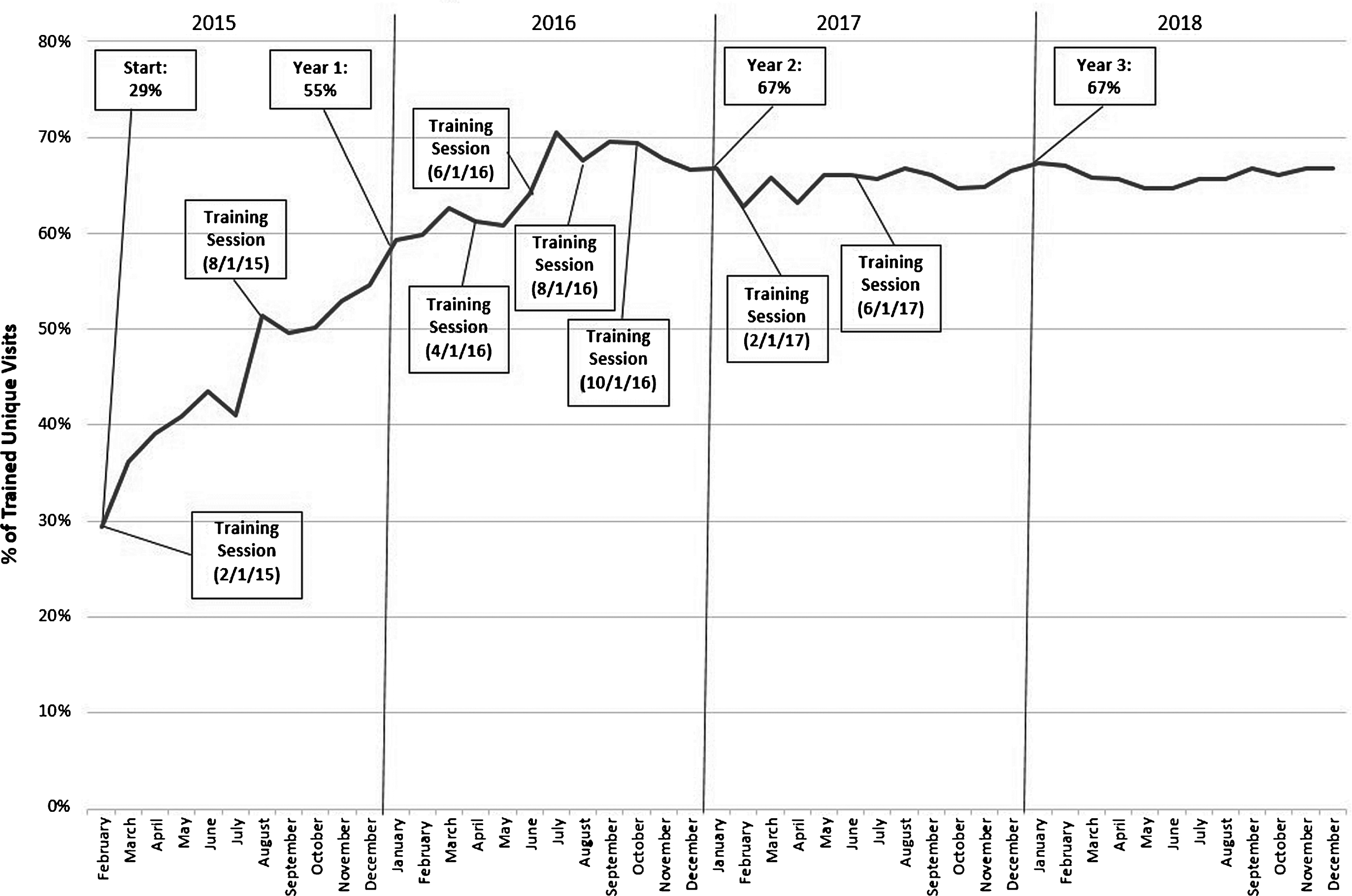
Percentage of unique visits to a ParkinsonNet professional.
DISCUSSION
Concentration of care is only an initial—but important—indicator of a successful implementation of specialized networked care within the Kaiser Permanente system. Two years after the first training program was launched, around 67% of the PD patients were treated by an expert allied health professional. Interestingly, it took almost 10 years to achieve the same level of concentration of care within the Dutch ParkinsonNet. This more rapid process is likely due to the fact that all providers in California belonged to one healthcare organization that internally promoted the concept. In the present analysis, we did not examine health benefits to patients, as we expect that it will take more time to see effects on, e.g., hip fractures or quality of life. Indeed, freshly trained networks in the Netherlands were not associated with health benefits for patients [13], whereas more mature networks – where professionals have accumulated expertise by treating a large number of patients – did translate into tangible benefits to patients [1, 8]. Several studies have shown that a network approach for PD patients leads to better quality of care, fewer disease complications and marked cost savings in the Netherlands [8, 14]. As the Kaiser Permanente network continues to grow and mature, future analyses will have to focus on evaluating outcomes such as hospital admission, hip-fracture rates and healthcare costs.
Kaiser Permanente integrated components of the Dutch ParkinsonNet program into their existing care model for PD patients. Through professional training of providers, patient education, the creation of networks and specifically designed care plans, the concentration of allied healthcare increased. After these initial results, ParkinsonNet is now also being implemented in Northern California. Top-down promotion of the concept by a single healthcare system will help facilitate a rapid introduction. Other determinants that may help with the sustained introduction of network care from one country to another country include the sharing of key knowledge (train-the-trainer concept), a controlled start in pilot regions before scaling, involving patients involved from the outset, and making modifications to adjust the approach to the existing services within the Kaiser Permanente system. Meanwhile, other disease populations are now beginning to benefit from the lessons learned from the networked care approach, as new networks are now being built for patients with other chronic conditions who are likely to benefit from the generic components of professional training, patient education and interdisciplinary collaboration.
Strength and limitations of this study
For this study, only a limited data set was available for analysis. The outcomes of this study are only one first indicator of the success of implementation of networked care within Kaiser Permanente. Long term results will be shown after a longer implementation period. This study shows the potential of replicating a method that was developed in another country and in another health care system. The method in this study is based on a substantial amount of scientific research and evidence and on prior implementation trajectories.
CONFLICT OF INTEREST
We declare the following interests: LR, CN, TS, SC and JC were employed at Kaiser Permanente at the time of the study. Dr. De Vries reports a research grant of the Netherlands Organization for Health Research and Development. Dr. Munneke is managing director of ParkinsonNet. BRB currently serves as associate editor for the Journal of Parkinson’s Disease, serves on the editorial board of Practical Neurology, has received honorariums from serving on the scientific advisory board for Zambon, Abbvie, Biogen, and UCB, has received fees for speaking at conferences from AbbVie, Zambon, and Bial, and has received research support from the Netherlands Organisation for Scientific Research, the Michael J Fox Foundation, UCB, Abbvie, the Stichting Parkinson Fonds, the Hersenstichting Nederland, the Parkinson’s Foundation, Verily Life Sciences, Horizon 2020, the Topsector Life Sciences and Health, and the Parkinson Vereniging.
Data sharing statement
The data used for this study are the sole property of Kaiser Permanente and cannot be shared.
Footnotes
ACKNOWLEDGMENTS
Prof. Bastiaan R. Bloem was supported by a research grant of the National Parkinson Foundation and The Netherlands Organization for Health, Research and Development. Dr. N.M. de Vries was supported by a research grant of The Netherlands Organisation for Health, Research and Development. The authors thank Rodney Cooley, Helene Martel, Elizabeth Suden, Jann Dorman, Heidi Bremner, Chris DiStasio, Nancy Adachi, and Martin Yuson for their contribution to the implementation of ParkinsonNet at Kaiser Permanente.
This research received no specific grant from any funding agency in the public, commercial or not-for-profit sectors.